The UK’s official statistics body released its retail sales figures for August on Friday and the overall number was up, with clothing being one of the most buoyant categories.
Photo: Pixabay
Retail sales volumes are estimated to have risen by 0.5% in August 2025, following an increase of 0.5% in July (revised down from a 0.6% rise in the last bulletin). Clothing stores, butchers and bakers, and non-store retailing grew in August, which some retailers attributed to the good weather. Textile, clothing and shoe stores actually rose 1.3% for the month.
But volumes are estimated to have fallen by 0.1% in the three months to August 2025 when compared with the three months to May 2025. Although increases in non-store retailing and clothing stores (the former up 2.9% and the latter up 2.2%) helped to partly offset drops in other sectors.
August marked the third consecutive period of monthly growth, but volumes didn’t quite return to their recent March 2025 peak and are still below the last month before the pandemic hit the UK (February 2020).
The amount spent online rose by 2% when comparing the three months to August 2025 with the three months to May 2025, and by 3.4% year on year.
In addition to those figures, there were some interesting stats released Friday by Shopify with its MD EMEA, Deann Evans, saying its data showed back-to-school shopping “remained a key driver, with the sales of school uniforms up by 55.2% compared to July”.
But the data also showed that “consumers are already looking ahead to the festive season, with sales of advent calendars up 36.3%, wreaths up 32.7%, and fireworks and firecrackers up 15.4% in August. This could be an early indication that households are spreading out festive spending and avoiding a last-minute rush”.
Analysts were generally upbeat but also cautious with Oliver Vernon-Harcourt, head of retail at Deloitte, saying: “Retail sales in August were bolstered by continued warm weather as consumers enjoyed the final month of summer. Encouragingly, spending on discretionary items including clothing also rose. While the summer months have been positive for retail sales, all eyes are now on the Golden Quarter – the most important few months of the year for retailers. The change of the seasons in September should no doubt encourage consumers to purchase items for their winter wardrobes, but many businesses will be hoping that rain doesn’t deter shoppers from the high street.”
Meanwhile Jacqueline Windsor, Head of Retail at PwC, said: “Overall, August caps off a better-than-expected summer, particularly for non-food retailers, with sales of seasonal lines boosted by the hottest summer temperatures on record. However, overall sales volumes remain below pre-pandemic levels, so the high street is far from being out of the woods. After some respite from the cost-of-living crisis last year, over four in five consumers now tell us they are concerned about inflation”.
And that’s a concern that can’t be ignored as consumer confidence was down two points in September to -19, according to GfK’s long-running monthly measurement that was also released on Friday.
All measures were down in comparison to last month’s announcement.
Neil Bellamy, GfK’s Consumer Insights Director, said: “There’s an autumnal chill in the air this month, with all five measures of consumer confidence down and the Overall Index Score for September slipping. The August seventh decrease in interest rates does not appear to have provided any obvious boost to the financial mood of consumers or drawn attention away from day-to-day cost issues. Both personal finance measures – past and future – are lower, while our major purchases measure has dropped three points to -16.
“Even more striking is an eight-point fall in saving intentions. Looking at the economy, sentiment is sliding sharply: in June 2024 our forward-looking measure stood at -11, but just 15 months later it has slumped to -32. Perceptions of the past year remain weak too, down three from last month to -45. With tax rises expected in the November budget, the risk is that confidence inevitably falls, just like the autumn leaves.”
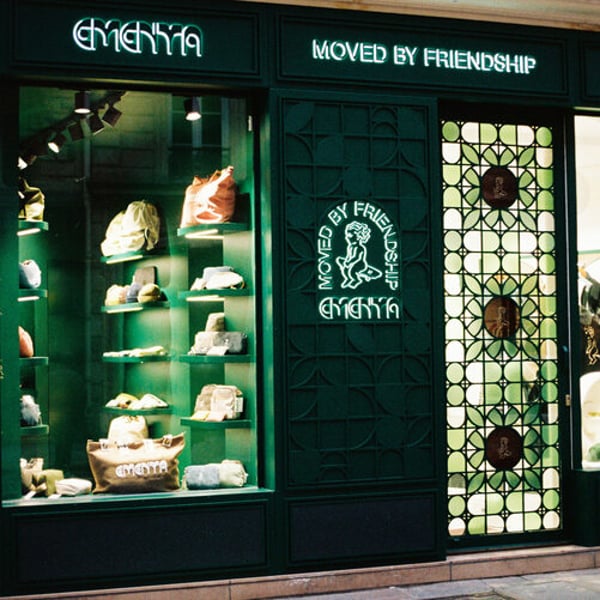
Just a stone’s throw from the bustle of Paris’ Les Halles, Ementa’s new boutique at 11, rue Montmartre gleams in green. The brand, ‘driven by friendship,’ has been revealing itself there, beyond its stained-glass doorway, since its official opening on December 6. It marks a new milestone for founders Emídio Silva, Nikita Gorev, and Raphael Castilho, whose adventure began amid Portugal’s markets.
Ementa opened its first boutique outside Portugal in Paris – Ementa
Born directly from the skateboarding world, Ementa launched in 2007. The three friends, then students at Academia da Amadora near Lisbon, shared the dream of creating their own label, inspired by the sponsor pieces from their sporting circle. They knew little about running a business, but that didn’t stop them. They took out a loan and financed production of their first thousand T-shirts.
A retail turning point beginning in 2021
By 2021, time had passed, but Ementa remained active. That year, an opportunity arose to open its first boutique at LX Factory in the Portuguese capital. The shop was fitted out almost entirely in the DIY spirit cherished by its founders. Around six months later, Ementa opened a second brick-and-mortar shop on Rua da Boavista, near Cais do Sodré, again in Lisbon.
The majority of its production is based in Portugal – Ementa
The third shop opened in 2023: Ementa’s flagship in Chiado, a lively district in southern Lisbon. ‘This project represented a far greater challenge than the previous ones,” the brand notes. “In 2024, we opened a boutique dedicated to collaborations with artists and exclusive collections, located right next to our first boutique at LX Factory,” it continues. The time then seemed ripe for Ementa to venture beyond the capital. On August 10, 2024, it inaugurated its fifth boutique, on Rua Sá da Bandeira in Porto- a ‘major challenge’ for the brand.
A mid-range positioning
This retail journey culminates today with the Paris opening. The brand also works with 27 stockists in total, including seven in France, one in Italy, two in Germany, and two in the Netherlands, with the remainder in Portugal. Its products are therefore available in several European countries. “Our aim is to be represented by avant-garde stockists with a sophisticated image and clear objectives,” says the brand.
Ementa draws inspiration from the world of skateboarding – Ementa
Drawing on its skateboarding heritage, the Portuguese brand’s offer spans a wide range of ready-to-wear pieces, including jackets, jumpers, screen-printed sweatshirts and T-shirts, cropped polo shirts, corduroy trousers, jeans, and accessories. As a lifestyle brand, Ementa also offers plenty of scarves, socks, sunglasses, caps, a few pieces of jewellery, and bags. Its prices sit below those of brands such as Palace Skateboards and Drôle de Monsieur, even though the majority of its production takes place in northern Portugal.
Ementa now aims to maintain a rhythm of a drop every fortnight, to bridge the gap between its autumn-winter and spring-summer collections. The brand hopes to continue its retail adventure with new openings, strengthening its existing boutiques, and international expansion.
This article is an automatic translation. Click here to read the original article.
As the European Union prepares to impose a €3 levy on small non-EU parcels valued at under €150, the French Senate wants to increase the proposed national charge from €2 to €5. E-commerce organisation Fevad says this would be a mistake that could cost France half a billion euros and is urging lawmakers to change course.
Shutterstock
The Fédération française de la vente en ligne, which backs the French flat-rate tax proposal, is campaigning for the national levy to remain aligned with those of its neighbours. Several countries, including Belgium, the Netherlands, and Italy, are preparing their own €2 taxes on small non-EU parcels. In Fevad’s view, France would be shooting itself in the foot by falling out of step with neighbouring markets.
“To circumvent the new €5 French tax, non-EU platforms such as Shein and Temu will have little difficulty routing their small parcels destined for the French market via neighbouring countries where they already have logistics infrastructure, notably Belgium,” the federation says.
Fevad also points out that a €5 tax would cost France more than €500 million in lost revenue, due to parcels being redirected to port and airport hubs in neighbouring countries rather than in France.
A temporary European tax
This stance comes just days after the EU adopted a €3 EU-wide levy on non-EU parcels under €150. The measure will come into force on 1 July, but it will be temporary.
This flat-rate tax, irrespective of the parcel’s value, will apply pending the introduction of standard parcel taxation, which will then follow the usual tariff rules for personal consumer goods.
“While this is a step in the right direction towards levelling the playing field between EU-based and non-EU-based businesses, companies will also need clear operational arrangements to ensure legal certainty and to adapt their compliance models and internal IT systems in time,” says Luca Cassetti, secretary general of the European confederation Ecommerce Europe, of which Fevad is a founding member.
This article is an automatic translation. Click here to read the original article.
UK fast-growing bridal and occasionwear brand Six Stories is on a major recruitment drive in order to support its “next phase of scale” backed by a “significant investment in senior talent”.
Six Stories
After three consecutive years of “exceptional commercial performance and continued demand across its core categories”, the hiring drive includes newly-created roles such as head of Trade, head of Brand, Social Media manager, CRM manager and Paid Media manager.
Founder Lucy Menghini said the decision “reflects both the momentum behind the brand and the strategic foundations required for the business to accelerate further.”
She added: “Over the past three years our growth has exceeded every expectation, and it’s now essential that we build a senior team that can support the scale we’re heading into.”
She noted that its lofty 2026 strategy is about “elevating every part of the business, strengthening our brand, deepening our customer relationships, expanding internationally and continuing to lead in occasionwear.
“To do that, we need experts in place who can help us evolve while staying true to what makes Six Stories special. Investing in the right people ensures we’re building a lifestyle brand with longevity, ambition and real creative impact.”
The brand’s expansion follows a period of “rapid and sustained momentum”, recording 110% annual sales growth over each of the last three years. Meanwhile, the brand’s signature occasionwear has seen sales jump 250% in the past two years, while the bridesmaid category also grew 120% in the same period.
The compamy says it sold eight dresses a second during Black Friday.
And with 25% of sales already coming from the US, “international expansion will be a major focus for 2026”.
The retailer said demand for bridesmaid dresses and occasionwear in the US has “skyrocketed”, with sales up 391% year-on-year, prompting Six Stories to plan a series of “brand activations, partnerships, and targeted campaigns across key markets to leverage this strong customer base”.
Menghini added: “As we grow, our vision extends beyond individual collections. We want to continue leading in the bridal space and set a new vision for the women of 2026, creating a lifestyle destination that celebrates them. I believe 2026 will be our most transformative year yet.”
That will come as the brand unveils new collections, explores collaborations “with leading creatives, talent and household brands”, while broadening into new product categories and investing in initiatives that “personalise the customer journey, strengthening its reach and impact internationally”.