Well there’s a surprise. All the doom and gloom news reports on Tuesday were shown to be wrong on Wednesday as UK annual consumer price inflation (CPI) for September didn’t come in at the predicted 4% but stayed at 3.8%, the same as in July and August.
Archivfoto
Economists (and the Bank of England) had been sure the figure would rise and deliver bad news for the Chancellor weeks ahead of her Autumn Budget statement.
That said, UK inflation will be the highest among the Group of Seven economies in 2025 and 2026, the International Monetary Fund said last week, which means progress on cutting interest rates is likely to stay slow.
There was good news on ‘core’ CPI (excluding energy, food, alcohol and tobacco) as it rose by 3.5% for September 2025, down from 3.6% for August.
Inflation isn’t expected by the Bank of England to hit the target 2% rate until Q2 2027.
In the latest month, transport was the biggest upwards driver and while clothing and footwear sales rose (and rose more than they had done the month before), they were well below the headline rate of inflation. August’s inflation rise in clothing and footwear had been 0.2% and for September it was 0.5%.
What did analysts think? Pieter Reynders, partner at McKinsey & Company, said: “Inflation continues its zig zag path, holding steady but significantly above the 2% target. Core inflation however was slightly below last month’s figure, which is a small but welcome step in the right direction.
“While consumer confidence is fragile, it is not absent. Our latest research finds that 71% of consumers plan to spend the same or more than last year on their 2024 holiday shopping, signalling that spending intentions are holding firm despite ongoing pressures.”
Expect Christmas shoppers to be “cautious but positive” this year when it comes to spending. But there’s also one big difference: AI’s getting more and more involved in the decision-making process, a new report shows.
Shutterstock
It appears British consumers are approaching this Christmas with “quiet confidence but clear spending limits” as 56% plan to spend roughly the same as last year, 18% expect to spend more, and the same number expect to spend less, according to Accenture data.
It all adds up to a “slowly stabilising retail environment… after several years of inflation-driven adjustment, households have found a new spending equilibrium when considering planning for Christmas this year”.
Accenture says consumers “are not slashing budgets but managing them more deliberately”. The most common strategies include reducing spend on presents (77%), buying from budget supermarkets (43%), saving earlier (34%), and skipping premium delivery (26%).
And the AI element? Around one in three (31%) consumers have used or would consider using AI tools such as ChatGPT or Gemini to plan Christmas shopping this year.
Their top uses are practical: gift ideas (25%), price comparison (24%) and budget management (18%).
But the research also indicates that while uptake isn’t widespread, “people could be open to using AI to help them in the future”. This means 46% would try an AI gift assistant integrated into retailer websites; 31% said they would be open to using an AI agent to do the full shopping experience, from sourcing a product to making the purchase.
But this uptake of AI is tempered by concern: 62% are unlikely to use AI this year, citing privacy (48%) and loss of personal touch (47%) as key reasons – suggesting we’re still at a nascent phase of adoption of the new technology.
Matt Jeffers, retail strategy lead, Accenture UK & Ireland: “After several years of managing a high cost of living, our data suggests that this year we’re seeing some signs of cautious consumer confidence returning, but people are still hovering above the brakes, and fine-tuning their spending to make Christmas work on their terms. For retailers, it means the opportunity is less about chasing volume, and more about demonstrating genuine value and empathy in how they engage and serve customers.”
On the AI front, Jeffers added: “This year shoppers are still in a test-and-learn phase, but our data shows that many shoppers are beginning to embrace AI to support their Christmas planning. This comes as platforms are beginning to embed third-party shopping tools into their chats, helping consumers make purchasing decisions directly from an AI chat.
“Retailers therefore need to ensure their business is built on modern and agile tech and data stacks, in order to capitalise on this trend as it grows for Christmas next year and beyond. This means being ready to seamlessly connect with LLMs as they prepare to become another way people shop. Trust and personalisation will still be king, and robust data protections should be baked into every layer.”
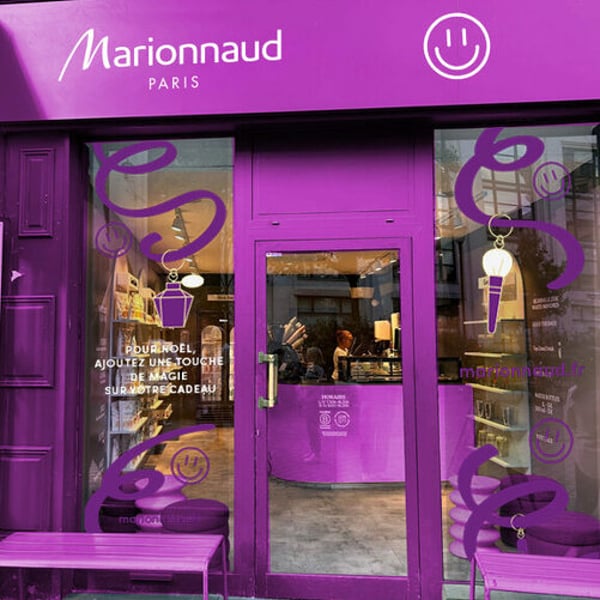
“We need moments like these to get to know our female customers,” says Marionnaud. With this in mind, the perfume and fragrance business is taking up residence in two Good News cafés in Paris until December 10.
Rue Montmartre shopfront – AI-generated photo by Marionnaud – DR
Marionnaud is unveiling two pop-ups “conceived as convivial interludes, designed to strengthen its physical presence, drive footfall, and partner with a French player sharing the same values of proximity and optimism,” notes the French beauty specialist. The temporary spaces will be located at 94 Rue Montmartre, in the second arrondissement, and at 7 Boulevard de la Madeleine, in the first arrondissement.
Founded in 1984, Marionnaud now operates 385 stores in France. Under the leadership of Kulvinder Birring, the retailer is pursuing a strategy focused on modernising its network and strengthening customer relations. The brand’s turnover amounted to €573 million in 2023, the latest figure available, although the company does not officially disclose its financial performance. These pop-ups are part of this momentum, sitting somewhere between commercial experimentation and on-the-ground engagement.
According to Clémence Courquin, head of marketing, this collaboration is part of a 360° campaign combining social media activations with a physical rollout. “Today, we’re seeing the power of beauty-and-coffee alliances,” she emphasises. The two brands, both French, are bringing their worlds together and cross-pollinating their audiences to reach a broader customer base while nurturing their brand DNA.
In practical terms, Marionnaud and Good News are pooling their databases to increase the number of touchpoints, attract new customers, and raise their visibility. The initiative also includes the distribution of oversized gifts, designed to create surprise and spark engagement.
In short, it is a partnership conceived as a lever for commercial momentum, with each brand putting its expertise at the service of the other to maximise impact throughout the duration of the initiative.
This article is an automatic translation. Click here to read the original article.
French sporting goods retailer Decathlon is continuing its expansion across Latin America. The business has opened its first store in El Salvador, a large-format location at the Multiplaza shopping centre in the country’s capital San Salvador.
Decathlon
‘This country, known for its rich culture, its Pacific coastline ideal for surfing, and its growing passion for outdoor sports, represents a strategic and vibrant market for our mission,” said the business in a release. Decathlon also stated that it aims to “bring people together through sport to make wellbeing accessible for all.”
Decathlon’s expansion into Latin American markets has marked a milestone, boosting access to sports equipment across a range of disciplines. The business currently has a presence in Mexico, Colombia, Chile, Brazil, Panama, Costa Rica, and now El Salvador.
Latin America has become a highly attractive market for European and other international brands, with new market entries up by more than 30% over the past three years.
This article is an automatic translation. Click here to read the original article.