Connect with us

Business

U.S. GDP growth is being kept alive by AI spending ‘with no guaranteed return’: Deutsche Bank

Published

on


We will get a new estimate of Q3 U.S. GDP growth today. The consensus among analysts is for a rise of 3.2% year-on-year. That’s pretty decent growth. No wonder then, that the S&P 500 ticked up another 0.88% yesterday, to come within half a percentage point of its all-time high, and futures this morning are marginally up too. Traders seem to be pretty happy about where the U.S. economy is going.

But some analysts are starting to worry about how much of that growth is concentrated in AI.

A recent note from Pantheon Macroeconomics said that private fixed investment—a measure of how much companies are spending—”is rising only due to AI-related spending.” Analyst Oliver Allen published a chart this morning showing that all other private fixed investment is actually in decline:

“Capex intentions remain depressed, suggesting investment outside of AI-linked sectors remains weak,” he told clients in a note seen by Fortune.

Deutsche Bank said much the same thing in a recent note discussing whether AI was a bubble. “Investment in AI-related sectors is critical to GDP growth [and the] U.S. would be close to recession this year if it weren’t for tech-related spending, as other spending has flatlined post-Covid,” analysts Adrian Cox and Stefan Abrudan wrote.
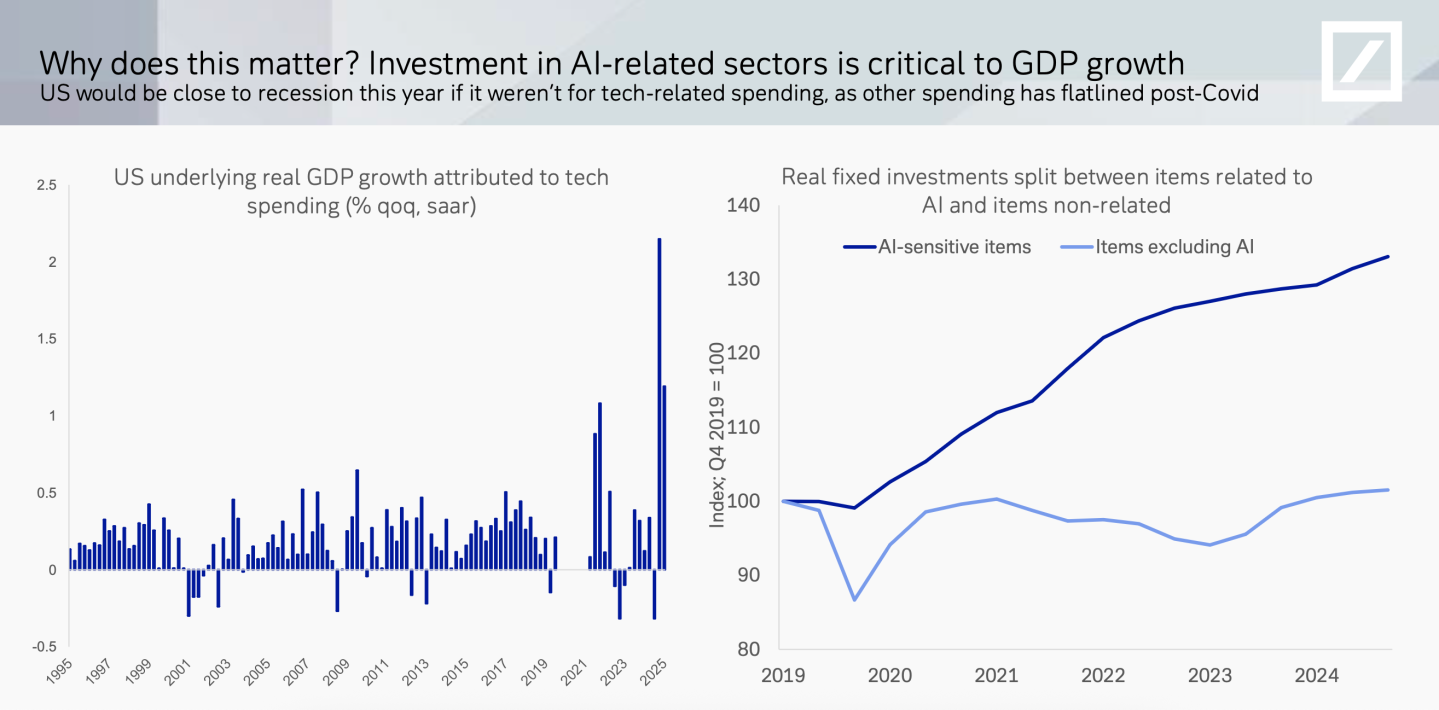
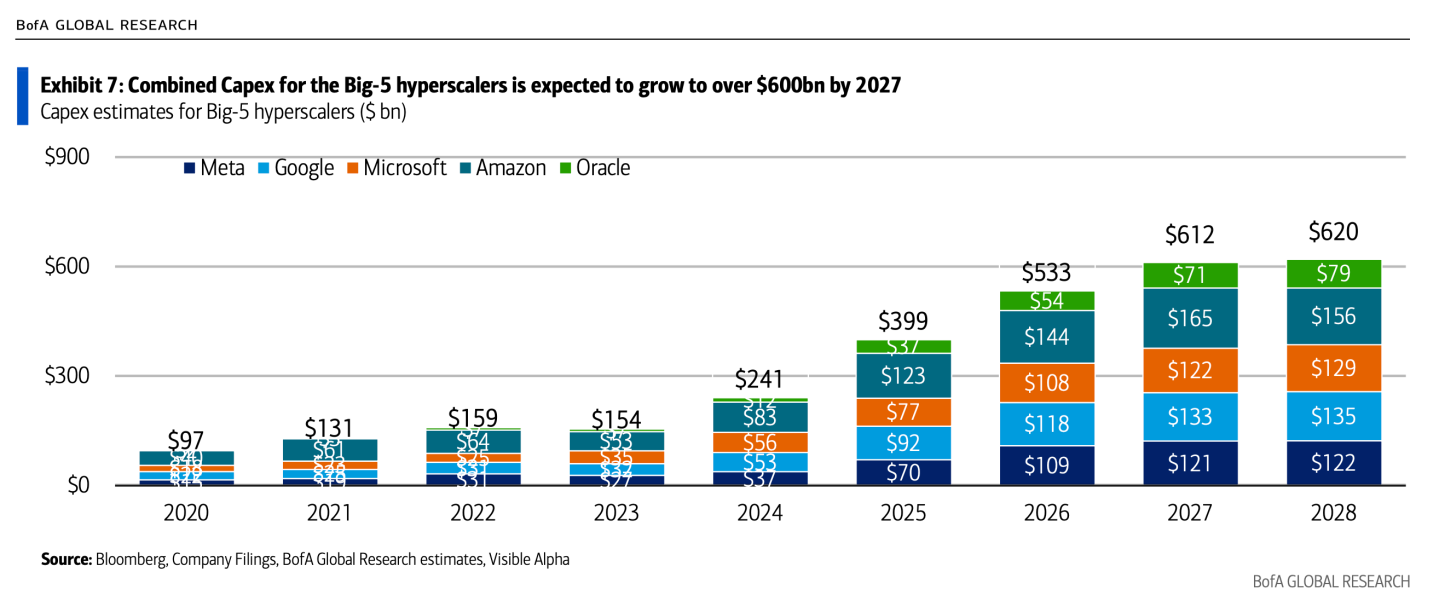
The scale of capital expenditure (capex) investment going into AI is gargantuan. Bank of America’s Justin Post and Nitin Bansal estimate that AI capex from just five “hyperscalers” (Alphabet, Meta, Microsoft, Amazon, and Oracle) will total $399 billion this year and rise to over $600 billion in the years to come.
Increasingly, that AI capex will likely be funded by debt. The big tech companies have such healthy cashflow and robust balance sheets that it’s easy for most of them to add debt without harming their bottom lines, BofA says.

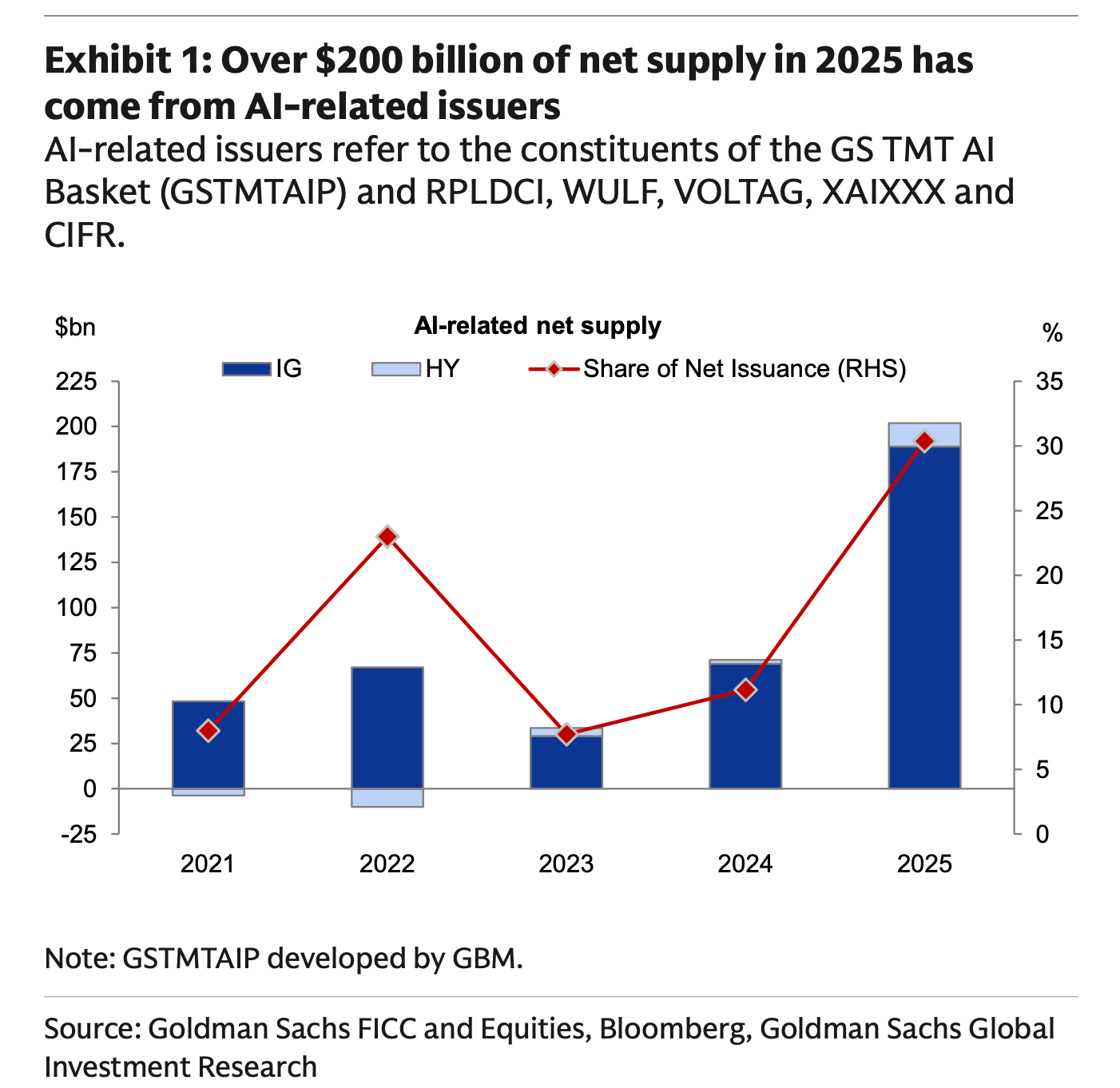
That debt is already breaking records. “Net supply [of new debt] from AI-related issuers in the USD credit market has crossed $200 billion in 2025, more than doubling last year’s total,” Spencer Rogers and his colleagues at Goldman Sachs told clients recently. “30% of USD credit net supply this year is AI-related.” He expects that number to go higher next year.
BofA says the companies are chasing $1 trillion in incremental revenues over the next five years. About $500 billion of that from cloud services; $400 billion in extra digital advertising spending; and $200 billion from AI subscriptions from both consumers and businesses. 

“Historically (2021-24), each dollar of capex helped generate an average of $0.90 incremental revenue and $0.42 of incremental EBITDA in the following year,” they wrote.

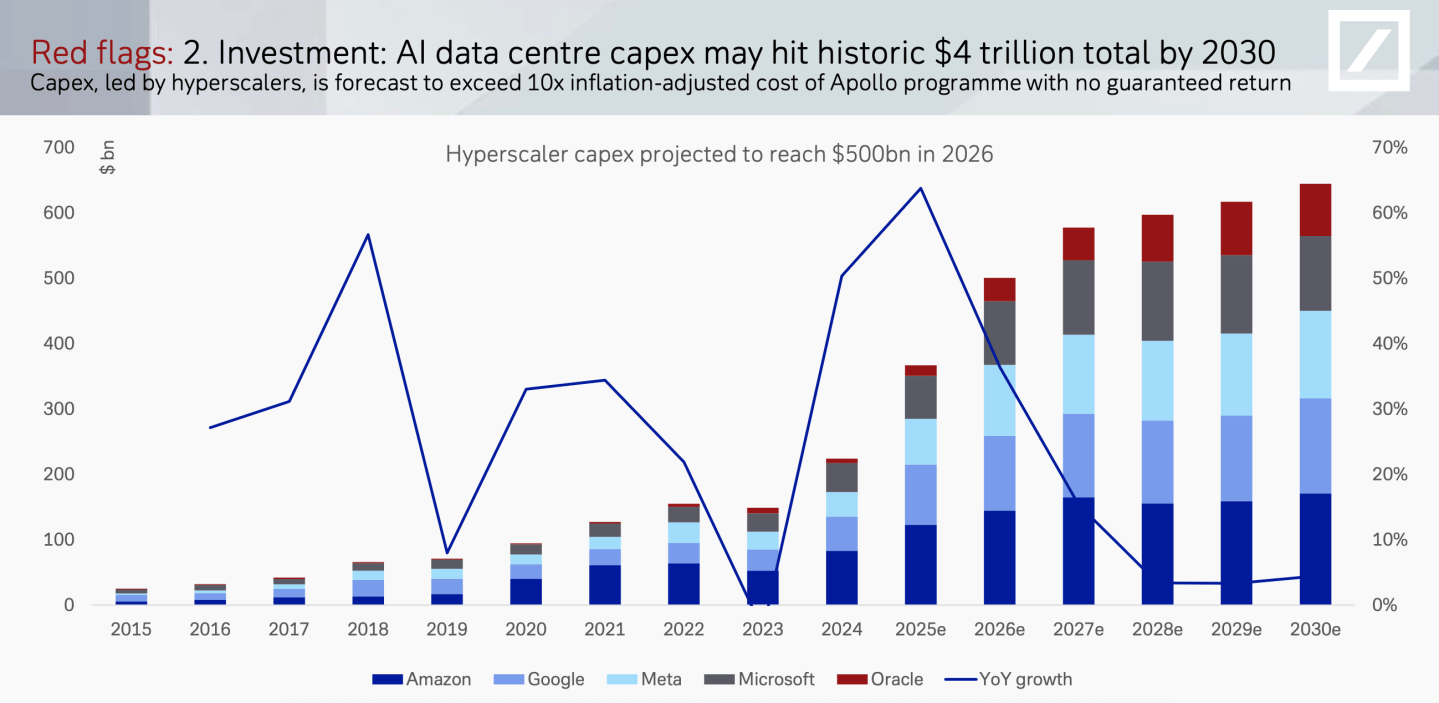
Let’s hope they are right. Because according to Deutsche Bank, hyperscalers will spend a cumulative $4 trillion on AI data centers through 2030—more than the U.S. government’s moon-landing program in the 1960s: “10x [the] inflation-adjusted cost of Apollo programme with no guaranteed return.”
Here’s a snapshot of the markets ahead of the opening bell in New York this morning:

  • S&P 500 futures are up marginally this morning. The last session closed up 0.64%. 
  • STOXX Europe 600 was up 0.18% in early trading. 
  • The U.K.’s FTSE 100 was flat in early trading. 
  • Japan’s Nikkei 225 was flat. 
  • China’s CSI 300 was up 0.2%. 
  • The South Korea KOSPI was up 0.28%. 
  • India’s NIFTY 50 was flat. 
  • Bitcoin sunk to $87K.
Join us at the Fortune Workplace Innovation Summit May 19–20, 2026, in Atlanta. The next era of workplace innovation is here—and the old playbook is being rewritten. At this exclusive, high-energy event, the world’s most innovative leaders will convene to explore how AI, humanity, and strategy converge to redefine, again, the future of work. Register now.


Source link

Continue Reading

Business

Trump and CBS News’ chief both tried to stop a critical ’60 Minutes’ segment from airing. Somehow it leaked online anyway

Published

on


news segment about the Trump administration’s immigration policy that was abruptly pulled from “60 Minutes” was mistakenly aired on a TV app after the last minute decision not to air it touched off a public debate about journalistic independence.

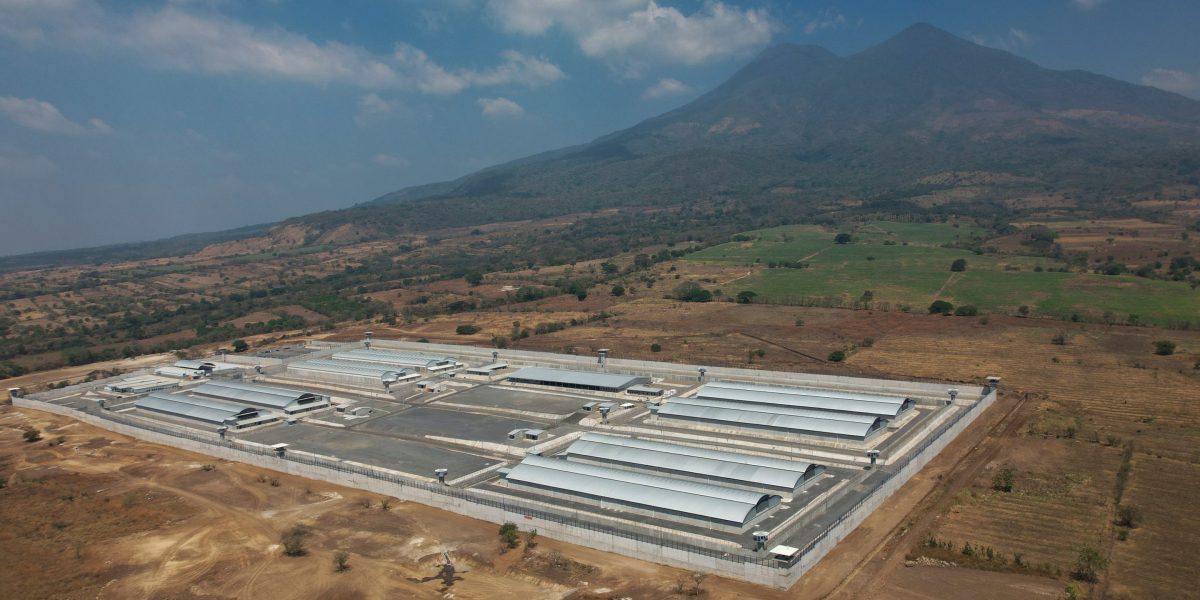
The segment featured interviews with migrants who were sent to a notorious El Salvador prison called the Terrorism Confinement Center, or CECOT, under President Donald Trump’s aggressive crackdown on immigration.

The story was pulled from Global Television Network, one of Canada’s largest networks, but still ran on the network’s app. Global Television Network swiftly corrected the error, but copies of it continued to float around the internet and pop up before being taken down.

“Paramount’s content protection team is in the process of routine take down orders for the unaired and unauthorized segment,” a CBS spokesperson said Tuesday via email.

A representative of Global Television Network did not immediately respond to a request for comment.

In the story, two men who were deported reported torture, beatings and abuse. One Venezuelan said he was punished with sexual abuse and solitary confinement.

Another was a college student who said guards beat him and knocked out his tooth upon arrival.

“When you get there, you already know you’re in hell. You don’t need anyone to tell you,” he said.

The segment featured numerous experts who called into question the legal basis for deporting migrants so hastily amid pending judicial decisions. Reporters for the show also corroborated findings by Human Rights Watch suggesting that only eight of the deported men had been sentenced for violent or potentially violent crimes, using available ICE data.

The decision to pull a story critical of the Trump administration was met with widespread accusations that CBS leadership was shielding the president from unfavorable coverage.

The journalist who reported the story, Sharyn Alfonsi, said in an email sent to fellow “60 Minutes” correspondents that the story was factually correct and had been cleared by CBS lawyers and its standards division.

CBS News chief Bari Weiss said Monday that the story did not “advance the ball” and pointed out that the Trump administration had refused to comment for the story. Weiss said she wanted a greater effort made to get its point of view and said she looked forward to airing Alfonsi’s piece “when it’s ready.”

The dispute put one of journalism’s most respected brands — and a frequent target of Trump — back in the spotlight and amplified questions about whether Weiss’ appointment is a signal that CBS News is headed in a more Trump-friendly direction.


Source link

Continue Reading

Business

Americans may be angry about affordability, but gas prices are the cheapest they’ve been all year in most states

Published

on


This holiday season, many U.S. drivers are getting the gift of lower gas prices.

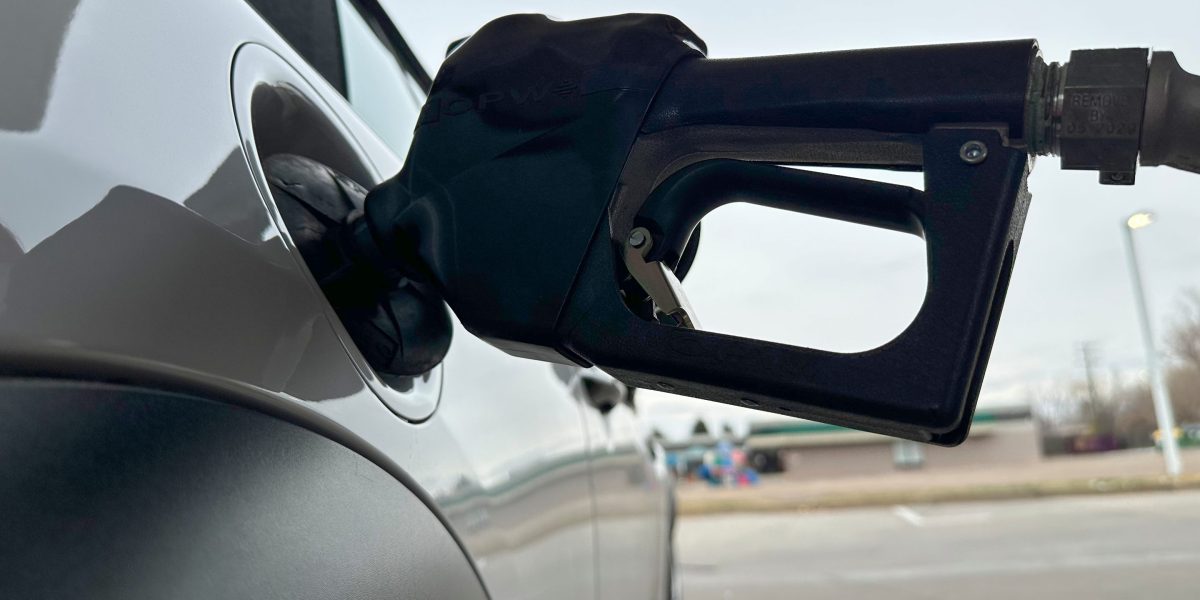
According to data from motor club AAA, December has been the cheapest month for prices at the pump this year. The national average for unleaded gasoline has stayed below the $3 mark since Dec. 2, falling to its lowest level of about $2.85 a gallon on Monday.

That figure has inched up slightly since, sitting at closer to $2.86 a gallon Tuesday — but overall, consumers hitting the road ahead of the Christmas holiday will likely continue to see mild prices.

As always, some states have cheaper averages than others, due to factors ranging from nearby refinery supply to local fuel requirements. Hawaii had the highest average of about $4.44 a gallon on Tuesday, per AAA — followed by $4.30 in California and $3.92 in Washington. Meanwhile, Oklahoma had the lowest average at about $2.30 per gallon, followed by nearly $2.42 in both Arkansas and Iowa.

Still, nationwide, unleaded gasoline is down more than 18 cents than it was at this time last year, and 21 cents from a month ago. So far, AAA says that prices seen this month mark the cheapest December for gas prices since 2020, when the COVID-19 pandemic roiled the economy.

The travel organization notes that this month’s cheaper prices arrive as supply remains strong. Crude oil, the main ingredient in gasoline, has also been at a relatively mild level — with West Texas Intermediate remaining below the $60 per barrel mark for most of December.

Relief at the pump is welcome for consumers who have been feeling higher prices in other parts of their budgets — as worries about the costs of goods ranging from groceries to holiday gifts rise amid ongoing inflation and U.S. President Donald Trump’s tariffs on foreign imports.

Government data actually showed that consumer prices cooled in November, rising at just 2.7% from a year earlier. But year-over-year inflation still remains well above the Federal Reserve’s 2% target — and economists quickly warned that last month’s numbers were suspect because of delays and possible distortions from the 43-day federal shutdown.

Most Americans have continued to express anger and frustration about the high cost of living — as well as an uncertain job market. On Tuesday, the Conference Board said that its consumer confidence index fell in December to its lowest level since April.


Source link

Continue Reading

Business

Pennsylvania nursing home rocked by deadly explosion on Christmas Eve

Published

on


A thunderous explosion Tuesday at a nursing home just outside Philadelphia killed at least two people, collapsed part of the building, sent fire shooting out and left people trapped inside, authorities said.

Pennsylvania Gov. Josh Shapiro said in a later news conference that emergency responders braved the flames, a heavy odor of gas and a second explosion to evacuate residents and employees.

Fire officials said they were in “rescue mode” five hours later, with responders still digging by hand and using search dogs, earth-moving equipment and sonar to locate potential victims.

The explosion happened at Bristol Health & Rehab Center in Bristol Township, just as a utility crew had been on site looking for a gas leak.

Shapiro said a finding that a gas leak caused the explosion was preliminary.

A plume of smoke rose from the nursing home as emergency responders from across the region rushed there.

Authorities did not identify those who died and did not immediately know the total number of people injured.

The town’s fire chief, Kevin Dippolito, said at the Tuesday evening news conference that five people were still unaccounted for, but he cautioned that some may have left the scene with family members.

Shapiro asked his fellow Pennsylvanians to take a moment to pray “for this community, for those who are still missing, for those who are injured, and for those families who are about to celebrate Christmas with an empty chair at their table.”

Dippolito described a chaotic rescue where firefighters found people stuck in stairwells and elevator shafts and pulled residents out of the fiery building through windows and doors. Two people were rescued from a collapsed section of building, he said.

Firefighters handed off patients to waiting police officers outside, including one “who literally threw two people over his shoulders,” Dippolito said. “It was nothing short of extraordinary.” A second explosion erupted during the rescue, he said.

Bucks County emergency management officials said they first received a report of an explosion at approximately 2:15 p.m.

Willie Tye, who lives about a block away, said he was sitting at home watching a basketball game on TV when he heard a “loud ka-boom.”

“I thought an airplane or something came and fell on my house,” Tye said.

He got up to go look and saw “fire everywhere” and people escaping the building. “Just got to keep praying for them,” Tye said.

The local gas utility, PECO, said while its crews were responding to reports of a gas odor at the nursing home, an explosion happened.

“PECO crews shut off natural gas and electric service to the facility to ensure the safety of first responders and local residents. It is not known at this time if PECO’s equipment, or natural gas, was involved in this incident,” the utility said in a statement.

One worker sustained non-life-threatening injuries, the utility said.

Investigators from the Pennsylvania Public Utility Commission’s went to the scene. Finding that the explosion was caused by a gas leak won’t be confirmed until the agency can examine the scene, a utility commission spokesperson said.

Musuline Watson, who said she was a certified nursing assistant at the facility, told WPVI-TV/ABC 6 that, over the weekend, she and others there smelled gas, but “there was no heat in the room, so we didn’t take it to be anything.”

The 174-bed nursing home is about 20 miles (32 kilometers) northeast of Philadelphia. It is newly affiliated with Saber Healthcare Group and had been known until recently as Silver Lake Healthcare Center.

In a statement, Saber called the explosion “devastating.” It said facility personnel had promptly reported a gas smell to PECO before the explosion and that it was working with authorities to ensure the safety and well-being of staff, residents and the community.

The latest state inspection report for the facility was in October, and the Pennsylvania Department of Health found that it was not in compliance with several state regulations.

The inspection report said the facility failed to provide an accurate set of floor plans and properly maintain several stairways.

It said the facility failed to maintain portable fire extinguishers on one of the three levels and failed to provide the required “smoke barrier partitions,” which are designed to contain smoke on two floors.

According to Medicare.gov, the facility underwent a standard fire safety inspection in September 2024, during which no citations were issued. Medicare’s overall rating of the facility is listed as “much below average,” with poor ratings for health inspections in particular.

___

Levy and Scolforo reported from Harrisburg, Pennsylvania. Associated Press reporters Holly Ramer in Concord, N.H., Michael Casey in Boston and Hannah Schoenbaum in Salt Lake City contributed.


Source link

Continue Reading

Trending

Copyright © Miami Select.