Connect with us

Business

U.S.-China chip war: How Trump’s Nvidia-AMD deal has redefined Washington’s export control policy

Published

on


Under both the first Trump and Biden administrations, Washington argued that it needed to limit China’s technological development by barring more and more sensitive products from being exported to its strategic rival. Now, Trump’s decision to allow Nvidia and AMD to sell their advanced AI chips to China in exchange for a 15% cut of their revenue turns the export control regime into something like a bargaining chip.

The Trump administration is already positioning the deal as a playbook for other products and industries. “Now that we have the model and the beta test, why not expand it?” U.S. Treasury Secretary Scott Bessent said on Bloomberg TV on Wednesday. 

Trump’s move reflects Washington’s uneasy position in its tech rivalry with Beijing. The lead the U.S. holds over China in AI and semiconductors is shrinking, with experts estimating a lead of just one to two years at most. Meanwhile, U.S. companies complain of being shut out of the world’s second-largest economy. And now China is adopting the U.S.’s tactic of export controls, using its wealth of rare earth metals—key materials used in an array of electronic goods—to put pressure on Washington and its allies.

Analysts that spoke to Fortune view Trump’s Nvidia deal as a one-off measure stemming from the president’s trade negotiations with China.

Ray Wang, a semiconductor researcher at the Futurum Group, points out that the Trump administration first signaled that it would issue export licenses for Nvidia’s H20 processor—an AI chip designed to comply with U.S. rules—in late July, as part of its trade war truce with Beijing. Wang suggests that the government’s 15% cut, agreed upon over the weekend, is an add-on, an “opportunity to raise government revenue,” in accordance with Trump’s broader goals.

But the damage to the export control regime may have already been done, says Jennifer Lind, an associate professor at Dartmouth University and international relations expert. “This deal suggests that under the Trump administration, what gets banned or permitted is not being driven by careful calculations about the effect on Chinese military power—but rather on political whim and personalist politics,” Lind explains. “This is ruinous for a functioning export control regime.”

How have export controls changed?

On Monday, Trump confirmed media reports that Nvidia and AMD had agreed to give 15% of their China sales to the U.S. government in exchange for export licenses. The chips in question are Nvidia’s H20 and AMD’s MI308, two AI processors designed for the Chinese market and tailored to comply with earlier U.S. export controls. 

In that same press conference, Trump suggested he might even let Nvidia sell a watered-down version of its leading Blackwell processor to China. 

Export controls have changed wildly in the past few months. In April, Nvidia revealed that the U.S. had blocked it from selling the H20 to China, and that it was taking a $5.5 billion charge on the unsold inventory. 

As Washington and Beijing escalated their trade war, the export controls ramped up. By late May, the U.S. had expanded controls to block the sale of chip design software and airplane parts, among other products and chemicals, to China. 

Then, almost as quickly as they were imposed, these export controls disappeared. As part of its trade negotiations with China, the U.S. agreed to scale back controls on chip design software and airplane parts. 

Officials argue that these agreements are needed to get China to loosen its own controls on rare earth magnets, which threaten several U.S. industries like automobiles and defense. 

Some lawmakers worried about the growing tech dominance of China fear that Trump’s deal sets a bad precedent. John Moolenar, a Republican who chairs the House Select Committee on China, argued that “we should not set a precedent that incentivizes the government to grant licenses to sell China technology that will enhance its AI capabilities.” 

His Democratic counterpart, Raja Krishnamoorthi, suggested that “by putting a price on our security concerns, we signal to China and our allies that American national security principles are negotiable for the right fee.”

Backlash to the deal might prevent further erosion of the export regime, says Chris Miller, author of Chip War: The Fight for the World’s Most Critical Technology. “We’re going to see some pushback against the H20 decision in the U.S. from Congress, the media, and the bureaucracy, which will likely also discourage a further weakening of controls,” Miller says. 

Did the chip controls work?

The Biden administration framed export controls as a national security measure, designed to maintain and expand the U.S.’s technological edge versus China. 

The Trump administration has used similar reasoning in the past. But now he seems to be treating the chip controls as tools for economic dealmaking, raising questions as to what might come next. 

“There’s no real leadership on this issue with the White House now, as there was in the Biden era,” Paul Triolo, a partner at the DGA-Albright Stonebridge Group, said at the Fortune Brainstorm AI Singapore conference in mid-July, after the first announcement that Trump would allow the H20 to be sold in China again. “We’re in a little bit of a weird moment.”

It’s unclear, however, how effective the export controls have been at throttling tech development in China. The country’s tech sector, in spite of the export controls, seems to have developed satisfactory processors and powerful AI models. Huawei, the Chinese tech giant, is working with chipmaking giant SMIC to make its own AI processors. Huawei’s Ascend chips still lag Nvidia’s most advanced products, yet compare favorably to Nvidia’s chips sold in China. 

This momentum puts the U.S. in a difficult position. It could double down on controls in the hope of restraining Chinese innovation in the short-term—even if, in the long run, China’s domestic industry becomes self-sufficient. Or it can relax its curbs, retaining market access and hope that China never invests in domestic alternatives. 

U.S. officials, it seems, now believe it’s better for Nvidia to keep selling to China. “You want to sell the Chinese enough that their developers get addicted to the American technology stack,” U.S. Commerce Secretary Howard Lutnick said on CNBC in mid-July, soon after reports emerged that Nvidia would be allowed to sell the H20 in China again. (Lutnick also dismissed the H20 as Nvidia’s “fourth-best” chip.)

“What we don’t want is for Huawei to have a digital Belt and Road,” Bessent said Wednesday, referring to China’s strategy to build infrastructure in emerging markets around the world. “We do not want the standard to become Chinese.”

China pushes back

Chinese pressure likely played a role in getting Trump to let Nvidia and AMD chips back into China. 

While China had slowly started to limit exports of rare earths in recent years, Beijing stopped exports entirely as part of its retaliatory measures to Trump’s tariffs earlier this year. Officials demanded that Chinese exporters apply for licenses before they sell to any overseas clients. The suspension froze industries in both the U.S. and Europe.

China is the source of around 90% of the world’s rare earths, thanks to a years-long project to invest in domestic processing. Governments are starting to invest in non-Chinese sources, but it may take years for such projects to come to fruition.

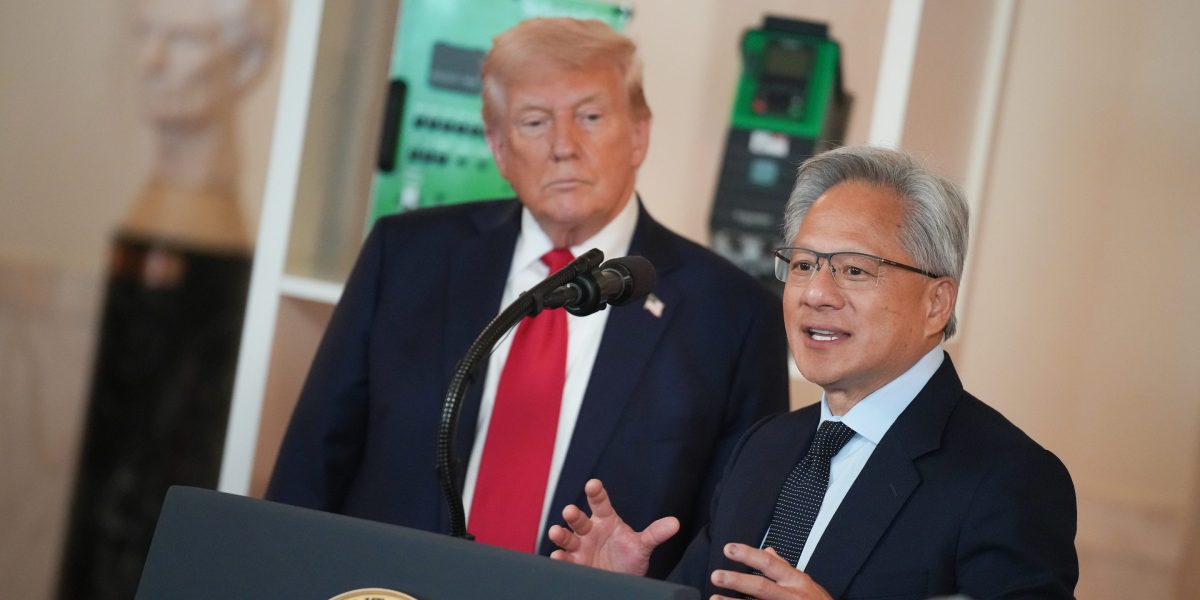
After winning over Washington, Nvidia and CEO Jensen Huang may now need to win over Beijing. Chinese officials have warned companies working in government-related areas against using Nvidia’s chips, Bloomberg reported on Tuesday. 

Chinese state media have also gone after the H20. “When a type of chip is neither environmentally friendly, nor advanced, nor safe, as consumers, we certainly have the option not to buy it,” a CCTV-affiliated WeChat posted on Sunday.

And after Michael Kratsios, one of the U.S.’s leads on AI policy, suggested that Nvidia chips could contain “location-tracking” to combat chip smuggling, Chinese regulators summoned Nvidia executives to a meeting to explain whether H20 chips contained security risks. 

The furor was enough to push Nvidia to forcefully state that “Nvidia GPUs do not and should not have kill switches and backdoors.”

Wang, the researcher at the Futurum Group, points out that China’s private sector—big tech companies like Alibaba and Tencent and smaller startups like Moonshot—will consume the vast majority of Nvidia’s chips.

“They really need those chips to train and develop their AI,” Wang says. “I don’t believe the guidelines from the government will stop this behavior.”


Source link

Continue Reading

Business

‘Everybody wants the economy of tomorrow, but paying the bills today is absolutely critical’: Democratic governors huddle on affordability

Published

on


Democratic governors met this weekend in Arizona, looking to parlay last month’s big victories for the party in New Jersey and Virginia into campaigns for next year’s midterms, when a majority of governor’s seats will be up for election.

Those elections helped Democrats zero in on what they see as a strategy to help grow their ranks in office and recover from big losses in 2024, when voters put Donald Trump back in the White House and gave Republicans majorities in both houses of Congress.

The plan is to focus intently on making life more affordable, a message they hope will work even in some conservative-leaning states.

“We have to be laser focused on people’s everyday concerns and how hard life is right now for the American people,” said Kentucky Gov. Andy Beshear, the new chairman of the Democratic Governors Association and a possible candidate for president in 2028. “Everybody wants the economy of tomorrow, but paying the bills today is absolutely critical.”

He and other governors said Democrats can use the affordability message as a cudgel against Trump without making him the central focus of their campaigns.

“Yes, we can judge a president, and we should judge this president,” Beshear said. “But we never judge those voters.”

Democrats hone in on costs

The meeting of Democratic governors comes as blue states have been under fire from the Trump administration, which is exercising power in novel ways against the president’s perceived enemies.

Trump has deployed the National Guard in California, Oregon and Illinois over the objections of their Democratic governors. His administration has demanded detailed voter data and threatened to cut off food assistance for states that don’t provide information to support his immigration crackdown.

Heading into a primary season in which factions will battle over the future of the party, Democratic governors largely sang from the same sheet over the weekend. A dozen candidates and sitting governors all said they plan to talk extensively about the costs of housing, child care, utilities and groceries during Trump’s second term.

But the unified focus on affordability papers over real divisions in the party’s ranks over how aggressively to confront Trump, who won all of the presidential battleground states last year, and how to deal with the rising costs that are squeezing Americans.

On the same day Democratic moderates with national security credentials, Mikie Sherrill in New Jersey and Abigail Spanberger in Virginia, won their governor’s races, Democratic socialist Zohran Mamdani won election as New York mayor. All ran on promises to tackle affordability, but they offered very different visions for how to deliver.

The affordability strategy isn’t without risk. Economic conditions could change, making concerns about prices less salient or urgent.

And Democrats could be setting themselves up for disappointment down the road if they win in 2026 but are unable to bring down costs to voters’ satisfaction, allowing Republicans to capitalize on the same buyer’s remorse Democrats are now seeking to stoke.

For Democratic incumbents seeking reelection, they can’t rest on fighting the Trump administration, said two-term Democratic Gov. Michelle Lujan Grisham of New Mexico. They need to show results.

“Deliver for me. But don’t forget to fight this,” said Lujan Grisham, who is barred by term limits from seeking reelection. “They do want both, and finding ways to cross-cut those and marry that I think is going to be a winning set of messages.”

Affordability also becomes a focal point for Trump

After the New Jersey and Virginia elections last month, the White House began shifting its message to focus more on affordability. Trump, who has not done much domestic travel during his second term, is scheduled to visit Pennsylvania on Tuesday to highlight his efforts to reduce inflation.

The president has talked more about affordability recently, and he reduced tariffs on beef and other commodities that consumers say cost too much. But Trump also has said the economy is better and consumer prices lower than reported by the media.

“The word affordability is a Democrat scam,” he said during a Cabinet meeting last week.

He continues to blame his Democratic predecessor, former President Joe Biden, for the increase nationwide in inflation rates that occurred this year after his return to the White House. Overall, inflation is tracking at 3% annually, up from 2.3% in April when Trump rolled out a sweeping set of import taxes.

Treasury Secretary Scott Bessent on Sunday said the administration will be intent on reducing inflation, after tackling immigration and pushing to have interest rates cut.

“I expect inflation to roll down strongly next year,” he said on CBS’s “Face the Nation.”

Democratic governors and candidates were largely aligned in the conclusion that many voters in 2024 didn’t feel as if their party was focused on their concerns or shared their anger at a system they believe is failing average Americans.

“I think if there was any failure in the presidential election, it’s we forgot what real people care about,” said Oregon Gov. Tina Kotek, who is expected to seek a second term next year.

“We’ve got to listen to people,” said Keisha Lance Bottoms, the former mayor of Atlanta who is running for Georgia governor.

Democrats believe some red states could be in play

Once Spanberger takes office in January, Democrats will control 24 governor’s offices, a significant improvement from the low point of just 16 following the 2016 election but still slightly behind the Republicans’ 26 seats.

Thirty-six states will hold elections for governor next year.

Among the hardest-fought contests will be in swing states that flipped between supporting Biden in 2020 and Trump in 2024. Those include Arizona, where Democratic Gov. Katie Hobbs is seeking a second term, and Nevada, where Republican Gov. Joe Lombardo is up for reelection. Wisconsin, Michigan and Georgia all have open seats that are widely expected to attract a large field of candidates and big spending.

The retirement of Democratic Gov. Laura Kelly in Kansas, an overwhelmingly Republican state in presidential contests, gives the GOP the upper hand there. But Democrats are talking about expanding the field by competing in states such as Iowa or Ohio, where the party used to be competitive but has struggled in the Trump era.

Gina Hinojosa, a Texas lawmaker running for governor in the nation’s second-most populous state, is making the case to Democratic donors that investing in Texas will be crucial to her party’s hopes of winning power in Washington before the 2030 census. Her state is projected to pick up at least four House seats and Electoral College votes at the expense of blue states such as California and Illinois.

“If we don’t flip before the end of the decade, there won’t be Democratic control of Congress or the White House,” Hinojosa said. “Because the math doesn’t work.”


Source link

Continue Reading

Business

Nonprofits are solving 21st century problems—they need 21st century tech

Published

on


AI is accelerating progress in almost every sector. But in the social sector, it’s exposing a gap. 

Despite playing a crucial role as the first line of defense for vulnerable communities, nonprofits are at risk of being left behind in the age of AI. Society is asking nonprofits to solve 21st-century problems with 20th-century tech. At the same time, they are up against sociopolitical headwinds, loss of funding, and existential battles. 

We cannot expect nonprofits to invest in technological innovation unless we come together across sectors to provide them the resources. The engineers and the activists, the policymakers and the philanthropists. If AI is to be a force for good, we need to fund the tech, fund the future, and fund together.

An emerging, creative class of entrepreneurs — AI-powered nonprofits — represent one of the most promising fronts in social impact. While for-profit companies are building AI that’s fundamentally changing daily life and the global economy, AI-powered nonprofits are using the same tech to solve humanity’s most urgent challenges. They’re banding together to transform education. To advance economic empowerment. To change health outcomes. They are demonstrating resilience in ways the private sector alone cannot. 

Take CareerVillage. Since 2011, CareerVillage has been on a mission to democratize access to career information and support those who need it most. Rather than shying away from hard questions about how AI will impact the labor market, CareerVillage is leaning in. Their AI-powered “Coach” platform helps job seekers navigate the changing labor market by offering mock interviews, resume support, career navigation, and more. Coach has already delivered personalized guidance to 50,000 learners, the majority of which have been youth from low-income households, students of color, and women.

But that’s just one example. New data from Fast Forward’s 2025 AI for Humanity Report, created with support from Google.org, finds that AI-powered nonprofits like CareerVillage are leading an early-stage transformation of AI in the nonprofit sector. We found that nonprofits are building AI solutions at every size and every stage. 40% of AI-powered nonprofits surveyed have been using AI for a year or less. And nearly a third (30%) have budgets of $500K or less.

It isn’t a surprise that the smallest, nimblest nonprofits are leading the way. Nonprofits have always looked for ways to do more with less. In this way, AI-powered nonprofits are similar to traditional nonprofits — they care about impact and efficiency. But AI-powered nonprofits are organized differently, and they have a different set of needs. 

For one, AI-powered nonprofits need tech expertise in their C-suite and on their staff. Tech and data aren’t extraneous. They’re core program costs. It costs money to build the technology responsibly, and it takes time for impact to follow. This puts a lot of AI-powered nonprofits in a catch-22: needing capital to prove impact, but needing proven impact to unlock capital.

To that end, AI-powered nonprofits need support at every stage of the impact cycle: from research and development, to sustaining mid-stage growth — the point where many nonprofits otherwise stall — to scaling proven models.

Importantly, 84% of AI-powered nonprofit respondents said funding would most help them further develop and scale AI. This insight matters because the data shows a clear relationship between resources and reach. At the smallest budgets, AI-powered nonprofits are serving thousands, a median of just under 2,000 lives. By the time budgets cross $1 million, median reach jumps to half a million people. And at more than $5 million, AI-powered nonprofits are reaching millions of people — a median impact of 7 million lives.

To unlock their full potential, they need the support of coalitions, shared infrastructure, and cross-sector collaboration with technologists, policymakers, and funders. 

There is no better example of this than Karya. The smartphone-based platform employs workers in rural India to complete AI data tasks to train large language models, like translation for less-commonly spoken languages. Karya seized an opportunity to flip the script on the AI economy — improving global technologies while enabling income and upskilling opportunities for over 100,000 workers. 

Karya also licenses its technology to local governments and peer organizations. Using Karya’s Platform-as-a-Service model, Digital Green sourced speech data directly from farmers in Kenya to fine-tune an agricultural AI model. The localized model outperformed leading models on domain-specific tasks, proving that community-generated data can drive smarter, more relevant AI. Karya provided the technology, Digital Green led on-the-ground operations, and philanthropic funding helped bridge the two. 

Partnership, even within the nonprofit sector, acts as a force multiplier. AI can unlock positive benefits for humanity, but we all play a role in making sure that happens.

Every once in a while, history presents us with moments that demand a fundamental shift in approach. This is one of those moments. 

It starts with giving nonprofits a seat at the table.

The opinions expressed in Fortune.com commentary pieces are solely the views of their authors and do not necessarily reflect the opinions and beliefs of Fortune.


Source link

Continue Reading

Business

Citadel’s shot at Andreessen Horowitz points to coming battle over DeFi and U.S. stock trading

Published

on


A quiet fight between two of the most powerful names in finance burst into the open last week. In a letter to the Securities and Exchange Commission, Citadel Securities complained that crypto interests are poised to damage the U.S. stock market and harm consumer protections with a pell-mell rush into decentralized finance (DeFi). The firm didn’t directly say who it regards as responsible for this state of affairs—but it’s enough to guess from the footnotes, which refer to the venture giant Andreessen Horowitz more than 10 times.

The source of the dispute is the fast-growing world of tokenized equities, which let users trade shares of popular companies but in a blockchain wrapper. The likes of Robinhood, Kraken, and even BlackRock are all dabbling in this technology, whose advantages include easy 24/7 trading and instant settlement. Holding stock on a blockchain also reduces middlemen, and expands opportunities to deploy equity-based collateral.

So what’s not to like? According to Citadel, the problem is DeFi platforms like Uniswap. Right now, traders use them to swap billions of dollars of crypto every day—and soon large volumes of tokenized Nvidia or Apple stock could be sloshing around these platforms, too. And if the SEC grants certain exemptions that Andreessen and its DeFi allies are seeking, Uniswap and others will get to operate as de facto brokerages—without taking on the legal responsibilities that go with that. These include displaying the price of every trade or ensuring customers get the best price. Citadel also warns of “fragmenting liquidity” as stock investing gets split between two parallel systems.

In response to the letter, the founder of Uniswap (one of Andreessen’s blue-ribbon portfolio companies) took to X to accuse Citadel of slandering DeFi in order to protect its lucrative role as the “king of shady tradfi market makers.” Other prominent names in crypto piled on as well, accusing the firm of trying to smother innovation.

At first glance, it appears both sides have a point. If tokenized stock trading breaks into the mainstream, it would threaten Citadel’s business model of paying firms like Robinhood for their orders and using that volume to make trading profits. So the company’s letter to the SEC is clearly based in self-interest. That said, Citadel’s concerns about liquidity are not unreasonable—if the pool of U.S. stocks is divided into two separate pools, doesn’t that make trading more expensive for everyone? Likewise, it’s fair to ask if the SEC would be wise to grant exemptions on investor protection rules that have historically served the public very well.

In reading the letter, it’s remarkable to read its claims that the likes of automated AMMs, block builders, validators and layer 2 blockchains are basically brokerages—less for the argument itself, than that Citadel and the SEC are discussing this stuff at all. It wasn’t long ago when only a handful of crypto diehards knew what these terms even meant. Now, they have become mainstream enough to be part of a non-crypto firm’s correspondence with the SEC, and there is no doubt they’re here to stay.

As for which side is going to prevail, it’s worth noting the fight pits two of the most powerful firms in the country against each other. On one side, there is Citadel, which is owned by Ken Griffin, one of the richest and most combative people in the country. On the other is Andreessen, an influential VC firm that doubles as a PR firm and lobbying agency with immense clout in Washington, DC. For now, it feels Griffin may be able to slow down the spread of tokenized equities but, as with any superior technology, he will be unable to stop it.

Jeff John Roberts
jeff.roberts@fortune.com
@jeffjohnroberts

DECENTRALIZED NEWS

Binance’s new look: The world’s biggest cryptocurrency exchange announced Yi He as co-CEO, confirming her status as the most powerful woman in crypto, while also establishing a de facto corporate headquarters for the first time via major licenses in Abu Dhabi. (Fortune)

Alt-coin winter: The recent downturn has battered alts with the sector shedding $200 billion since market peak. Memecoins have been hit particularly hard, due in part to the sheer number of them, but also because they are competing with a growing number of other speculative opportunities like prediction markets. (Bloomberg)

If at first you don’t succeed: Coinbase plans to relaunch in India early next year. It first opened shop in 2022, but was forced to retreat a year later in the face of hostile regulators who blocked its access to the country’s national payments network. (TechCrunch)

Mining mischief: The Malaysian government is using drones and a cross-agency task force to go after thousands of illegal Bitcoin mining operations that hop from place to place, and have stolen over $1 billion of electricity. (Bloomberg)

Saylor selling? The fraught world of DATs got dicier as Strategy said it might sell Bitcoin as a last resort. The move comes as Strategy’s share price fell below mNAV as the firm faces looming dividend obligations—but there is also a case that Saylor’s corporate strategy wizardry means the firm will be just fine. (Fortune)

MAIN CHARACTER OF THE WEEK

Changpeng Zhao, cofounder of Binance.

Samsul Said—Bloomberg/Getty Images

CZ wins the main character title this week as his debate with goldbug Peter Schiff helped drive a flood of social media attention around the Binance founder who looks very much back in the crypto game.

MEME O’ THE MOMENT

Franklin the Turtle loves UDSC and USDT.

@haonan

After the U.S. Treasury Secretary Bessent co-opted beloved children’s character Franklin the Turtle to pitch T-bills, it didn’t take long for CT to expand the meme to stablecoins. 

Fortune Brainstorm AI returns to San Francisco Dec. 8–9 to convene the smartest people we know—technologists, entrepreneurs, Fortune Global 500 executives, investors, policymakers, and the brilliant minds in between—to explore and interrogate the most pressing questions about AI at another pivotal moment. Register here.


Source link

Continue Reading

Trending

Copyright © Miami Select.