Connect with us

Business

U.S.-China chip war: How Trump’s Nvidia-AMD deal has redefined Washington’s export control policy

Published

on


Under both the first Trump and Biden administrations, Washington argued that it needed to limit China’s technological development by barring more and more sensitive products from being exported to its strategic rival. Now, Trump’s decision to allow Nvidia and AMD to sell their advanced AI chips to China in exchange for a 15% cut of their revenue turns the export control regime into something like a bargaining chip.

The Trump administration is already positioning the deal as a playbook for other products and industries. “Now that we have the model and the beta test, why not expand it?” U.S. Treasury Secretary Scott Bessent said on Bloomberg TV on Wednesday. 

Trump’s move reflects Washington’s uneasy position in its tech rivalry with Beijing. The lead the U.S. holds over China in AI and semiconductors is shrinking, with experts estimating a lead of just one to two years at most. Meanwhile, U.S. companies complain of being shut out of the world’s second-largest economy. And now China is adopting the U.S.’s tactic of export controls, using its wealth of rare earth metals—key materials used in an array of electronic goods—to put pressure on Washington and its allies.

Analysts that spoke to Fortune view Trump’s Nvidia deal as a one-off measure stemming from the president’s trade negotiations with China.

Ray Wang, a semiconductor researcher at the Futurum Group, points out that the Trump administration first signaled that it would issue export licenses for Nvidia’s H20 processor—an AI chip designed to comply with U.S. rules—in late July, as part of its trade war truce with Beijing. Wang suggests that the government’s 15% cut, agreed upon over the weekend, is an add-on, an “opportunity to raise government revenue,” in accordance with Trump’s broader goals.

But the damage to the export control regime may have already been done, says Jennifer Lind, an associate professor at Dartmouth University and international relations expert. “This deal suggests that under the Trump administration, what gets banned or permitted is not being driven by careful calculations about the effect on Chinese military power—but rather on political whim and personalist politics,” Lind explains. “This is ruinous for a functioning export control regime.”

How have export controls changed?

On Monday, Trump confirmed media reports that Nvidia and AMD had agreed to give 15% of their China sales to the U.S. government in exchange for export licenses. The chips in question are Nvidia’s H20 and AMD’s MI308, two AI processors designed for the Chinese market and tailored to comply with earlier U.S. export controls. 

In that same press conference, Trump suggested he might even let Nvidia sell a watered-down version of its leading Blackwell processor to China. 

Export controls have changed wildly in the past few months. In April, Nvidia revealed that the U.S. had blocked it from selling the H20 to China, and that it was taking a $5.5 billion charge on the unsold inventory. 

As Washington and Beijing escalated their trade war, the export controls ramped up. By late May, the U.S. had expanded controls to block the sale of chip design software and airplane parts, among other products and chemicals, to China. 

Then, almost as quickly as they were imposed, these export controls disappeared. As part of its trade negotiations with China, the U.S. agreed to scale back controls on chip design software and airplane parts. 

Officials argue that these agreements are needed to get China to loosen its own controls on rare earth magnets, which threaten several U.S. industries like automobiles and defense. 

Some lawmakers worried about the growing tech dominance of China fear that Trump’s deal sets a bad precedent. John Moolenar, a Republican who chairs the House Select Committee on China, argued that “we should not set a precedent that incentivizes the government to grant licenses to sell China technology that will enhance its AI capabilities.” 

His Democratic counterpart, Raja Krishnamoorthi, suggested that “by putting a price on our security concerns, we signal to China and our allies that American national security principles are negotiable for the right fee.”

Backlash to the deal might prevent further erosion of the export regime, says Chris Miller, author of Chip War: The Fight for the World’s Most Critical Technology. “We’re going to see some pushback against the H20 decision in the U.S. from Congress, the media, and the bureaucracy, which will likely also discourage a further weakening of controls,” Miller says. 

Did the chip controls work?

The Biden administration framed export controls as a national security measure, designed to maintain and expand the U.S.’s technological edge versus China. 

The Trump administration has used similar reasoning in the past. But now he seems to be treating the chip controls as tools for economic dealmaking, raising questions as to what might come next. 

“There’s no real leadership on this issue with the White House now, as there was in the Biden era,” Paul Triolo, a partner at the DGA-Albright Stonebridge Group, said at the Fortune Brainstorm AI Singapore conference in mid-July, after the first announcement that Trump would allow the H20 to be sold in China again. “We’re in a little bit of a weird moment.”

It’s unclear, however, how effective the export controls have been at throttling tech development in China. The country’s tech sector, in spite of the export controls, seems to have developed satisfactory processors and powerful AI models. Huawei, the Chinese tech giant, is working with chipmaking giant SMIC to make its own AI processors. Huawei’s Ascend chips still lag Nvidia’s most advanced products, yet compare favorably to Nvidia’s chips sold in China. 

This momentum puts the U.S. in a difficult position. It could double down on controls in the hope of restraining Chinese innovation in the short-term—even if, in the long run, China’s domestic industry becomes self-sufficient. Or it can relax its curbs, retaining market access and hope that China never invests in domestic alternatives. 

U.S. officials, it seems, now believe it’s better for Nvidia to keep selling to China. “You want to sell the Chinese enough that their developers get addicted to the American technology stack,” U.S. Commerce Secretary Howard Lutnick said on CNBC in mid-July, soon after reports emerged that Nvidia would be allowed to sell the H20 in China again. (Lutnick also dismissed the H20 as Nvidia’s “fourth-best” chip.)

“What we don’t want is for Huawei to have a digital Belt and Road,” Bessent said Wednesday, referring to China’s strategy to build infrastructure in emerging markets around the world. “We do not want the standard to become Chinese.”

China pushes back

Chinese pressure likely played a role in getting Trump to let Nvidia and AMD chips back into China. 

While China had slowly started to limit exports of rare earths in recent years, Beijing stopped exports entirely as part of its retaliatory measures to Trump’s tariffs earlier this year. Officials demanded that Chinese exporters apply for licenses before they sell to any overseas clients. The suspension froze industries in both the U.S. and Europe.

China is the source of around 90% of the world’s rare earths, thanks to a years-long project to invest in domestic processing. Governments are starting to invest in non-Chinese sources, but it may take years for such projects to come to fruition.

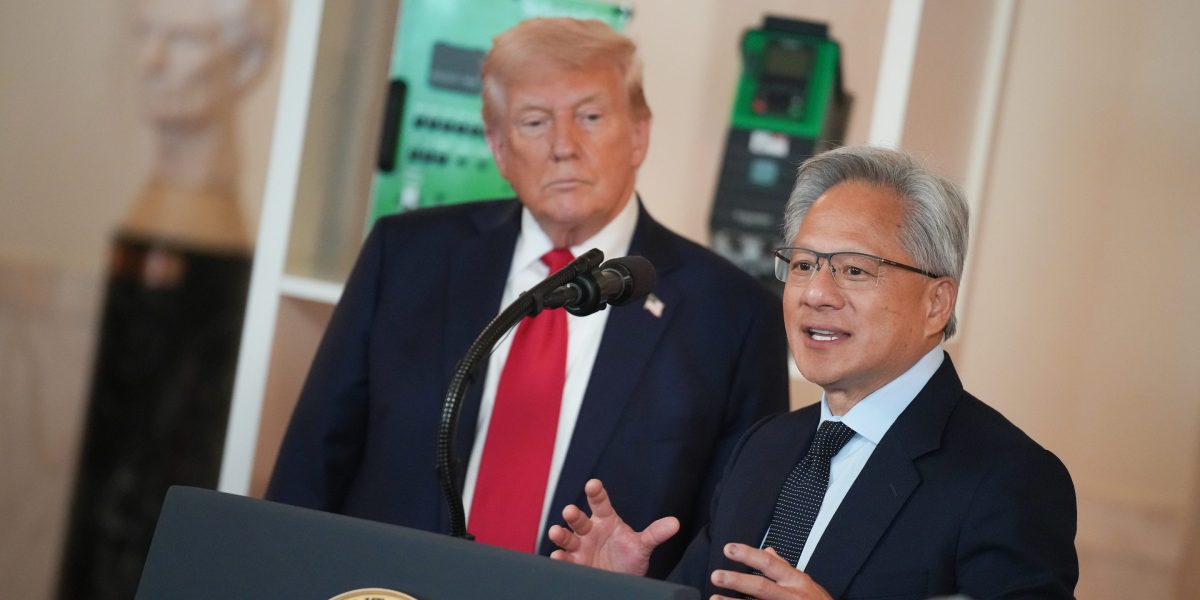
After winning over Washington, Nvidia and CEO Jensen Huang may now need to win over Beijing. Chinese officials have warned companies working in government-related areas against using Nvidia’s chips, Bloomberg reported on Tuesday. 

Chinese state media have also gone after the H20. “When a type of chip is neither environmentally friendly, nor advanced, nor safe, as consumers, we certainly have the option not to buy it,” a CCTV-affiliated WeChat posted on Sunday.

And after Michael Kratsios, one of the U.S.’s leads on AI policy, suggested that Nvidia chips could contain “location-tracking” to combat chip smuggling, Chinese regulators summoned Nvidia executives to a meeting to explain whether H20 chips contained security risks. 

The furor was enough to push Nvidia to forcefully state that “Nvidia GPUs do not and should not have kill switches and backdoors.”

Wang, the researcher at the Futurum Group, points out that China’s private sector—big tech companies like Alibaba and Tencent and smaller startups like Moonshot—will consume the vast majority of Nvidia’s chips.

“They really need those chips to train and develop their AI,” Wang says. “I don’t believe the guidelines from the government will stop this behavior.”


Source link

Continue Reading

Business

If you want your employees back in the office, try feeding them, says Gensler executive

Published

on


What do both employees and employers really want in a workplace of the future? It’s a topic that came up last week in my conversations with CEOs, designers, and thought leaders at Fortune’s Brainstorm Design conference in Macau.

If you ask Ray Yuen, office managing director at the design and architecture firm Gensler, the answer is food. A recent Gensler survey asked employees to rank the office spaces that were most important to them. The top three? The office food hall, cafe, or lounge. 

“It’s really about food and wellness,” Yuen said onstage. “They didn’t even mention anything about work. Everybody just picked the stuff that we really want as human beings.”

It’s worth listening to these human desires as companies try to bring people back into the office, Yuen said. He described a project he worked on recently for a large company’s new Tokyo headquarters, where 50% of the company’s employees were working remotely and he was tasked with finding a way to bring them back. One of the biggest successes was a lo-fi vinyl listening bar, where no tech or talking was allowed, he said. 

Flexibility is also key. In the past, Yuen said he used to heavily design about 80% of a company’s headquarters with built in furniture and modules like cubicles, and leave about 20% as “flexible space.” Now, the balance is more 50/50, so companies can transform their office spaces easily when needs arise, such as an office happy hour, he says.

“We’re no longer just designing workplaces. We’re actually designing experiences. Because [employees may] think, ‘Well, if I can work anywhere, why do I want to go to work? I can do it at home,’” Yuen said. “You’ve really got to make the campus or the workplace be more than work, and that’s the fun part of it.”

Kristin Stoller
Editorial Director, Fortune Live Media
kristin.stoller@fortune.com

Around the Table

A round-up of the most important HR headlines.

Employers used to frown on social media posting during work hours, but now employees at companies including Starbucks and Delta are being asked to post on-the-job social media content. Wall Street Journal

The U.S. Equal Employment Opportunity Commission, or EEOC, is reportedly blocking or stalling claims brought by transgender workers. Bloomberg

As automated systems come under fire for potentially allowing discriminating hiring practices, many states are expanding bans on discrimination to AI. Washington Post

Watercooler

Everything you need to know from Fortune.

Meeting shakeup. Instagram’s CEO is calling employees back to the office five days a week, but is canceling all unnecessary recurring meetings —Marco Quiroz-Gutierrez

Earnings report. In the U.K., Gen Z college graduates are earning 30% less than Millennials did at the same stage of life. —Preston Fore

Trade troubles. As Gen Zers opt for trade schools and blue-collar jobs, there is one sector they are hesitant to get involved in: manufacturing. —Emma Burleigh 


Source link

Continue Reading

Business

McKinsey’s CFO: Why finance chiefs shouldn’t hit pause on AI right now

Published

on


Good morning. For CFOs, using the words “uncertainty” and “unprecedented” has become second nature this year.

“There’s a bit of fatigue from uncertainty right now,” Yuval Atsmon, CFO of McKinsey, told me when we met in Washington, D.C., to discuss how finance chiefs navigated 2025 and the impact of AI. He often hears some executives joke, “Can we just have something that has a precedent?”

Following President Donald Trump’s so-called Liberation Day, Atsmon said significant uncertainty emerged around the new administration’s economic and geopolitical agenda. “If I look at the peak of uncertainty, what I was focused on as a CFO was: What are the things that I should be doing that would be helpful in any scenario?” Atsmon said. “The worst thing is inaction,” he added. Acting on what you can control builds resilience, he said.

Key questions included: How can you improve liquidity and operational efficiency? What costs can be delayed or eliminated? Which investments are essential, and which can be stopped?

While uncertainty often drives defensive moves, Atsmon noted the importance of reviewing long-standing strategies and seizing competitive opportunities. “I wouldn’t recommend anyone stop making AI investments at this moment,” he said, adding that some actions are still driven by inertia, not strategy.

“The other thing that I think is different in 2025 than it was over the last 100 years is that so much of resource allocation now happens through the technology function of the company,” Atsmon said.

Yet there’s still uncertainty about AI’s readiness to impact the bottom line. McKinsey already uses AI to handle up to 30% of its tasks—such as faster research and better summarization—but “you can’t really do a full strategic analysis yet,” he said. Timelines vary widely by company.

Atsmon pointed to new McKinsey research estimating profound changes in how work is done by 2030. People will need to reorganize how they create value or take on different activities. For CFOs, curiosity about technology is useful, but the core responsibility is enabling the organization to respond at the right pace—neither moving so fast that it creates financial strain nor so slowly that competitiveness erodes, he said.

For most organizations, he believes AI efforts should be “80% on productivity for growth and 20% on productivity for efficiency.” The biggest opportunity, he said, lies not in reducing headcount but in unlocking better uses of time.

Ultimately, leveraging AI requires a willingness to reimagine how work gets done. It is a cross-functional C-suite effort. “More than ever,” Atsmon said, “managing uncertainty—economic, geopolitical, and technological—comes down to planning for the best, but also preparing for the worst.”

SherylEstrada
sheryl.estrada@fortune.com

Leaderboard

Jennifer DiRico was appointed EVP and CFO of PTC (Nasdaq: PTC), effective Jan. 1. DiRico succeeds Kristian Talvitie, who will continue to serve as CFO through Dec. 31. DiRico’s experience ranges from large-scale enterprise software organizations to high-growth technology companies. She currently serves as CFO of Commvault, a cyber resilience company. Before Commvault, DiRico spent several years at Toast in finance and operations leadership roles.

David Hastings was appointed CFO of Trevi Therapeutics, Inc. (Nasdaq: TRVI), a clinical-stage biopharmaceutical company, effective Jan. 6. Hastings brings over 25 years of financial leadership experience. Most recently, he was CFO at Arbutus from June 2018 until March 2025. Previously, he was SVP and CFO of Unilife from 2015 until 2017.  Prior to that, Hastings spent the majority of his career as CFO and EVP at Incyte. 

Big Deal

“Global Economic Outlook Q1 2026: AI Tailwinds Boost Otherwise Weak Growth” is an economic research report published by S&P Global Ratings. Some key takeaways from the report include that global growth is holding up better than expected into 2026, helped by AI-driven investment and exports, even as underlying demand stays relatively soft. Also, forecasts have been revised up in many countries, but policy uncertainty, labor markets, bond yields, and the risk that AI underdelivers on earnings all remain key threats to the outlook.

Going deeper

KPMG’s latest “M&A trends in financial services” report is a review of M&A in Q3 for each of the banking, capital markets, and insurance sectors, with the latest data and top deals, as well as an outlook for M&A.

“Momentum from the prior quarter, driven by regulatory rollback and private equity interest, persisted in the third quarter of 2025,” according to the report. “However, inflation, credit quality concerns, trade policy uncertainty, and geopolitical tensions posed significant challenges, requiring adept navigation.”

Overheard

“In the days after the acquisition was completed, I was asked during a media interview if good luck was a factor in bringing together these two tech industry stalwarts. Replace good luck with good timing, and the answer is a resounding, ‘Yes!'”

Amit Walia, the CEO of Informatica, a Salesforce company, writes in a Fortune opinion piecetitled, “Why the timing was right for Salesforce’s $8 billion acquisition of Informatica—and for the opportunities ahead.”


Source link

Continue Reading

Business

Fortune Brainstorm AI San Francisco starts today, with Databricks, OpenAI, Cursor, and more on deck

Published

on


It’s been a crazy few weeks in AI.

Granted, it feels like it’s always been a crazy few weeks in AI. But this cycle has been especially notable: Reports that Sam Altman has declared a “code red” around improving ChatGPT have made waves, while Databricks is reportedly in talks to raise at a jaw-dropping $134 billion valuation. Anthropic is reportedly looking at a real-life IPO, and everyone’s always watching for news from perhaps the biggest ascent of the year: Cursor, the AI coding juggernaut that’s now valued at more than $29 billion. 

And today, Brainstorm AI starts, and so many of these key players will be with us live in San Francisco, including Databricks CEO Ali Ghodsi, OpenAI COO Brad Lightcap, Cursor CEO Michael Truell, San Francisco Mayor Daniel Lurie, Google Cloud CEO Thomas Kurian, and Rivian CEO RJ Scaringe, plus some starpower from Joseph Gordon-Levitt and Natasha Lyonne. 

If you’re attending the conference, come find me! I’ll realistically be the one running around in a bright pantsuit. And if you can’t make it, we’ll be livestreaming the show, too – tune in here.

See you soon,

See you tomorrow,

Allie Garfinkle
X:
@agarfinks
Email:alexandra.garfinkle@fortune.com
Submit a deal for the Term Sheet newsletter here.

Joey Abrams curated the deals section of today’s newsletter.Subscribe here.

Venture Deals

Antithesis, a Tysons Corner, Va.-based platform designed to validate that software works before it launches, raised $105 million in Series A funding. JaneStreet led the round and was joined by AmplifyVenturePartners, SparkCapital, and others.

ParadigmHealth, a Columbus, Ohio-based clinical research platform, raised $78 million in Series B funding. ARCHVenturePartners led the round and was joined by DFJGrowth and existing investors.

Oxzo, a Santiago, Chile-based provider of oxygenation services for aquaculture, raised $25 million in funding from S2GInvestments.

Quanta, a San Francisco-based accounting platform, raised $15 million in Series A funding. Accel led the round and was joined by OperatorCollective, NavalRavikant, DesignerFund, and others.

LizzyAI, a New York City-based AI-powered talent interviewing company, raised $5 million in seed funding. NEA led the round and was joined by Speedinvest and ZeroPrimeVentures

PvX, a Singapore-based provider of user-acquisition financing for gaming companies, raised $4.7 million in a seed extension from Z Venture Capital, DrivebyDraftKings, and existing investors.

Corma, a Paris, France-based developer of a copilot for AI teams, raised €3.5 million ($4.1 million) in seed funding. XTXVentures led the round and was joined by TuesdayCapital, KimaVentures, 50Partners, OlympeCapital, and angel investors.

Private Equity

NITEOProducts, a portfolio company of HighlanderPartners, acquired Folexport, a Tualatin, Ore.-based manufacturer of carpet, fabric, and hard surface cleaning products. Financial terms were not disclosed.


Source link

Continue Reading

Trending

Copyright © Miami Select.