Connect with us

Business

Two Trump-appointed economists—and longtime friends—are clashing over Trump’s jobs data

Published

on


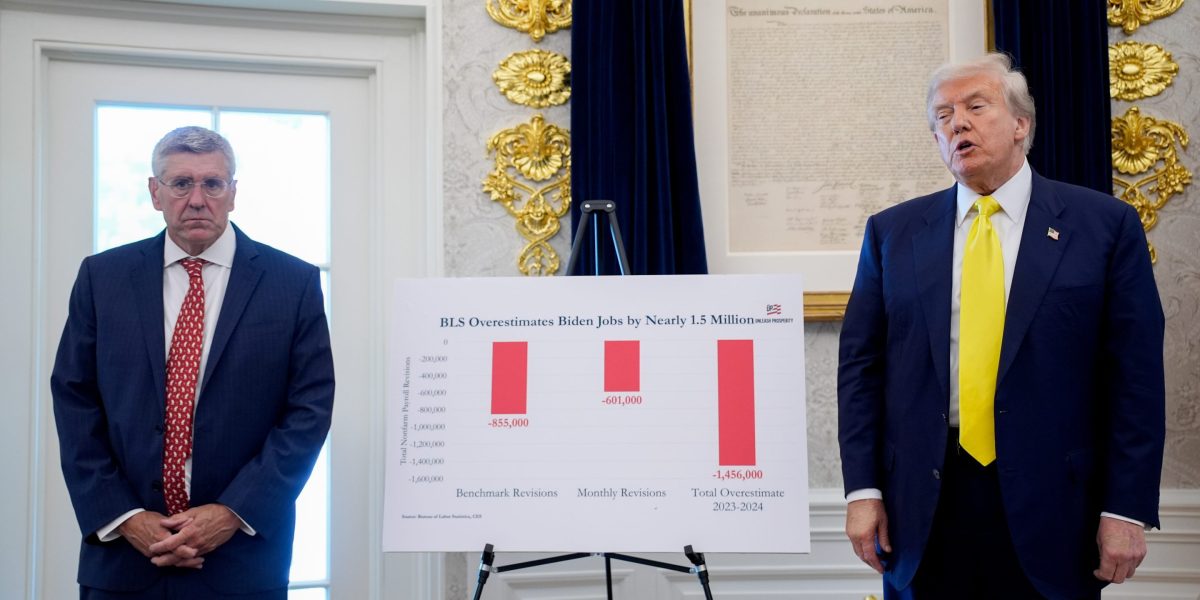
Former Bureau of Labor Statistics (BLS) Commissioner William Beacha Trump nominee—said every number on the jobs chart President Donald Trump touted in the Oval Office on Thursday was wrong.

Still bitter over last week’s “rigged” jobs report, which showed weaker-than-expected job growth, Trump convened an impromptu press conference Thursday evening to showcase graphs with what he called “all-new numbers.”

Stephen Moore, a Heritage Foundation economist, said during the press conference that the numbers justified Trump’s firing of former BLS Chief Erika McEntarfer. He estimated that over the last two years of President Joe Biden’s administration, the BLS overestimated job creation by 1.5 million jobs. 

In an interview with Fortune, Moore said he disagreed with the president that the numbers were rigged on purpose. He never met McEntarfer, he explained, but said it was “suspicious” that the jobs numbers published right before the election were eventually revised. 

That suspicion formed the basis for the chart Moore brought to the Oval Office, which showed three bars: the benchmark revisions, the monthly revisions, and the total estimated jobs growth from 2024. 

Beach—who Moore said he’s known for 30 years and calls a “good friend” —called those numbers “the strangest thing in the world.” 

“He should have known better than to do that,” Beach said. 

Beach found problems across the board.

The first bar—labeled as an August jobs revision—used a preliminary estimate that was later revised downward in February, meaning the number on the chart didn’t match the official final figure, Beach said. 

Moore countered that Beach misunderstood his method. He said the team was comparing the initial “headline” jobs numbers released each month to the final revised and benchmarked numbers, and summing those differences, rather than simply pulling the final August correction.

Beach also argued the benchmark revision figure on the chart was incorrect and didn’t align with BLS’s published data. The last bar, labeled “total revisions,” was mathematically flawed, he said, because it added benchmark revisions to monthly revisions, even though the benchmark already incorporates those monthly changes—“like counting the same apple twice and pretending you had two.” 

Moore rejected the idea that this was double-counting, saying he was capturing separate steps in the revision process.

Additionally, during the press conference, Moore said the income figures came from unpublished Census Bureau data; Beach says that makes them unverifiable. Moore told Fortune his team developed an algorithm to estimate those income numbers in advance with what he claims is 97% accuracy, and plans to publish a report explaining the method.

Perhaps the largest disagreement between the two longtime friends is philosophical. While Moore claimed he didn’t believe the numbers are rigged, he also said the positive revisions for Biden “raised eyebrows,” and emboldened the president to argue the BLS was corrupted. 

Beach couldn’t fathom this conspiracy. When he led the BLS from 2019 to 2023, he personally saw the decentralized nature of the process and the “hardheaded” loyalty of the statistics that pored over hundreds of pieces of data. Each person in the BLS role has such a particular job, that it was hard to imagine how they could conspire to push the jobs data in one direction or another.

“I mean, there’s a person at BLS who specializes in drinking-places data,” Beach laughed. 

Trump’s suspicions are more than just puzzling, Beach said. They were also “highly dangerous.” Markets rely so heavily on trust in the jobs report data, he said, that the damage from Trump’s words and actions has likely already happened. 

Drawing on his experience in the private sector, he explained that uncertainty in some metrics forces business leaders to widen their “margin of error” when making investments, which can kill deals. If companies doubt the accuracy of federal statistics, he warned, they’ll eventually turn to alternative measures.

Rather than blaming the messenger, or sowing unnecessary doubt, Beach emphasized that many issues with the statistical data could be solved by modernization. 

“I served two years as the chief statistician of the United States, as well as the BLS Commissioner,” Beach said. “So I know how the system is weakened, and it’s been weakened over time by lack of attention by Congress and lack of modernization. So there are many things to be done.” 

He hoped Moore would be able to find an opportunity to explain his statistical discrepancies better. Moore has always had a different way of constructing numbers, something that Beach said he has benefited from. 

“But sometimes, he doesn’t really get engaged with a topic at the time it’s important for him to make that engagement,” Beach said. “And I think this, this is a case in point.” 

Introducing the 2025 Fortune Global 500, the definitive ranking of the biggest companies in the world. Explore this year’s list.


Source link

Continue Reading

Business

Epstein grand jury documents from Florida can be released by DOJ, judge rules

Published

on


A federal judge on Friday gave the Justice Department permission to release transcripts of a grand jury investigation into Jeffrey Epstein’s abuse of underage girls in Florida — a case that ultimately ended without any federal charges being filed against the millionaire sex offender.

U.S. District Judge Rodney Smith said a recently passed federal law ordering the release of records related to Epstein overrode the usual rules about grand jury secrecy.

The law signed in November by President Donald Trump compels the Justice Department, FBI and federal prosecutors to release later this month the vast troves of material they have amassed during investigations into Epstein that date back at least two decades.

Friday’s court ruling dealt with the earliest known federal inquiry.

In 2005, police in Palm Beach, Florida, where Epstein had a mansion, began interviewing teenage girls who told of being hired to give the financier sexualized massages. The FBI later joined the investigation.

Federal prosecutors in Florida prepared an indictment in 2007, but Epstein’s lawyers attacked the credibility of his accusers publicly while secretly negotiating a plea bargain that would let him avoid serious jail time.

In 2008, Epstein pleaded guilty to relatively minor state charges of soliciting prostitution from someone under age 18. He served most of his 18-month sentence in a work release program that let him spend his days in his office.

The U.S. attorney in Miami at the time, Alex Acosta, agreed not to prosecute Epstein on federal charges — a decision that outraged Epstein’s accusers. After the Miami Herald reexamined the unusual plea bargain in a series of stories in 2018, public outrage over Epstein’s light sentence led to Acosta’s resignation as Trump’s labor secretary.

A Justice Department report in 2020 found that Acosta exercised “poor judgment” in handling the investigation, but it also said he did not engage in professional misconduct.

A different federal prosecutor, in New York, brought a sex trafficking indictment against Epstein in 2019, mirroring some of the same allegations involving underage girls that had been the subject of the aborted investigation. Epstein killed himself while awaiting trial. His longtime confidant and ex-girlfriend, Ghislaine Maxwell, was then tried on similar charges, convicted and sentenced in 2022 to 20 years in prison.

Transcripts of the grand jury proceedings from the aborted federal case in Florida could shed more light on federal prosecutors’ decision not to go forward with it. Records related to state grand jury proceedings have already been made public.

When the documents will be released is unknown. The Justice Department asked the court to unseal them so they could be released with other records required to be disclosed under the Epstein Files Transparency Act. The Justice Department hasn’t set a timetable for when it plans to start releasing information, but the law set a deadline of Dec. 19.

The law also allows the Justice Department to withhold files that it says could jeopardize an active federal investigation. Files can also be withheld if they’re found to be classified or if they pertain to national defense or foreign policy.

One of the federal prosecutors on the Florida case did not answer a phone call Friday and the other declined to answer questions.

A judge had previously declined to release the grand jury records, citing the usual rules about grand jury secrecy, but Smith said the new federal law allowed public disclosure.

The Justice Department has separate requests pending for the release of grand jury records related to the sex trafficking cases against Epstein and Maxwell in New York. The judges in those matters have said they plan to rule expeditiously.

___

Sisak reported from New York.


Source link

Continue Reading

Business

Miss Universe co-owner gets bank accounts frozen as part of probe into drugs, fuel and arms trafficking

Published

on


Mexico’s anti-money laundering office has frozen the bank accounts of the Mexican co-owner of Miss Universe as part of an investigation into drugs, fuel and arms trafficking, an official said Friday.

The country’s Financial Intelligence Unit, which oversees the fight against money laundering, froze Mexican businessman Raúl Rocha Cantú’s bank accounts in Mexico, a federal official told The Associated Press on condition of anonymity because he was not authorized to comment on the investigation.

The action against Rocha Cantú adds to mounting controversies for the Miss Universe organization. Last week, a court in Thailand issued an arrest warrant for the Thai co-owner of the Miss Universe Organization in connection with a fraud case and this year’s competition — won by Miss Mexico Fatima Bosch — faced allegations of rigging.

The Miss Universe organization did not immediately respond to an email from The Associated Press seeking comment about the allegations against Rocha Cantú.

Mexico’s federal prosecutors said last week that Rocha Cantú has been under investigation since November 2024 for alleged organized crime activity, including drug and arms trafficking, as well as fuel theft. Last month, a federal judge issued 13 arrest warrants for some of those involved in the case, including the Mexican businessman, whose company Legacy Holding Group USA owns 50% of the Miss Universe shares.

The organization’s other 50% belongs to JKN Global Group Public Co. Ltd., a company owned by Jakkaphong “Anne” Jakrajutatip.

A Thai court last week issued an arrest warrant for Jakrajutatip who was released on bail in 2023 on the fraud case. She failed to appear as required in a Bangkok court on Nov. 25. Since she did not notify the court about her absence, she was deemed to be a flight risk, according to a statement from the Bangkok South District Court.

The court rescheduled her hearing for Dec. 26.

Rocha Cantú was also a part owner of the Casino Royale in the northern Mexican city of Monterrey, when it was attacked in 2011 by a group of gunmen who entered it, doused gasoline and set it on fire, killing 52 people.

Baltazar Saucedo Estrada, who was charged with planning the attack, was sentenced in July to 135 years in prison.


Source link

Continue Reading

Business

Elon Musk’s X fined $140 million by EU for breaching digital regulations

Published

on


European Union regulators on Friday fined X, Elon Musk’s social media platform, 120 million euros ($140 million) for breaches of the bloc’s digital regulations, in a move that risks rekindling tensions with Washington over free speech.

The European Commission issued its decision following an investigation it opened two years ago into X under the 27-nation bloc’s Digital Services Act, also known as the DSA.

It’s the first time that the EU has issued a so-called non-compliance decision since rolling out the DSA. The sweeping rulebook requires platforms to take more responsibility for protecting European users and cleaning up harmful or illegal content and products on their sites, under threat of hefty fines.

The Commission, the bloc’s executive arm, said it was punishing X because of three different breaches of the DSA’s transparency requirements. The decision could rile President Donald Trump, whose administration has lashed out at digital regulations, complained that Brussels was targeting U.S. tech companies and vowed to retaliate.

U.S. Secretary of State Marco Rubio posted on his X account that the Commission’s fine was akin to an attack on the American people. Musk later agreed with Rubio’s sentiment.

“The European Commission’s $140 million fine isn’t just an attack on @X, it’s an attack on all American tech platforms and the American people by foreign governments,” Rubio wrote. “The days of censoring Americans online are over.”

Vice President JD Vance, posting on X ahead of the decision, accused the Commission of seeking to fine X “for not engaging in censorship.”

“The EU should be supporting free speech not attacking American companies over garbage,” he wrote.

Officials denied the rules were intended to muzzle Big Tech companies. The Commission is “not targeting anyone, not targeting any company, not targeting any jurisdictions based on their color or their country of origin,” spokesman Thomas Regnier told a regular briefing in Brussels. “Absolutely not. This is based on a process, democratic process.”

X did not respond immediately to an email request for comment.

EU regulators had already outlined their accusations in mid-2024 when they released preliminary findings of their investigation into X.

Regulators said X’s blue checkmarks broke the rules because on “deceptive design practices” and could expose users to scams and manipulation.

Before Musk acquired X, when it was previously known as Twitter, the checkmarks mirrored verification badges common on social media and were largely reserved for celebrities, politicians and other influential accounts, such as Beyonce, Pope Francis, writer Neil Gaiman and rapper Lil Nas X.

After he bought it in 2022, the site started issuing the badges to anyone who wanted to pay $8 per month.

That means X does not meaningfully verify who’s behind the account, “making it difficult for users to judge the authenticity of accounts and content they engage with,” the Commission said in its announcement.

X also fell short of the transparency requirements for its ad database, regulators said.

Platforms in the EU are required to provide a database of all the digital advertisements they have carried, with details such as who paid for them and the intended audience, to help researches detect scams, fake ads and coordinated influence campaigns. But X’s database, the Commission said, is undermined by design features and access barriers such as “excessive delays in processing.”

Regulators also said X also puts up “unnecessary barriers” for researchers trying to access public data, which stymies research into systemic risks that European users face.

“Deceiving users with blue checkmarks, obscuring information on ads and shutting out researchers have no place online in the EU. The DSA protects users,” Henna Virkkunen, the EU’s executive vice-president for tech sovereignty, security and democracy, said in a prepared statement.

The Commission also wrapped up a separate DSA case Friday involving TikTok’s ad database after the video-sharing platform promised to make changes to ensure full transparency.

___

AP Writer Lorne Cook in Brussels contributed to this report.


Source link

Continue Reading

Trending

Copyright © Miami Select.