Connect with us

Business

Twelve people killed in Bondi Beach Hanukkah terror attack

Published

on


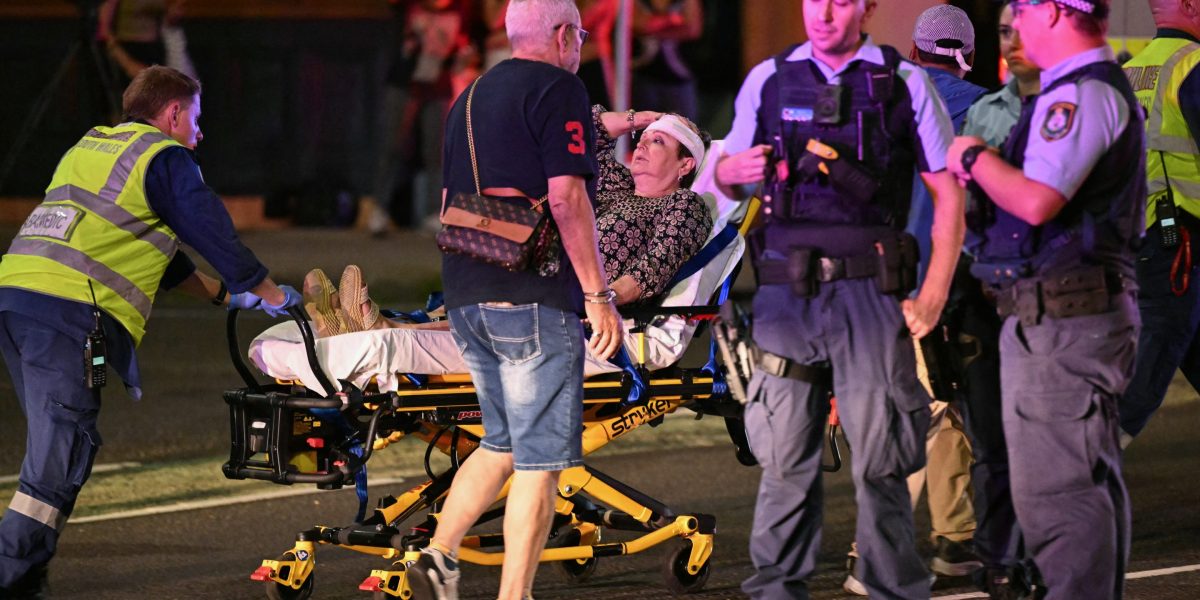
Twelve people have been killed in Australia’s worst terrorist attack, as gunmen opened fire on Jewish people who had gathered to celebrate the first day of Hanukkah at Sydney’s iconic Bondi Beach on Sunday evening. 

The shooting was a “targeted attack” on the Jewish community, Australian Prime Minister Anthony Albanese said at a late-night press conference. He described the incident as an “act of evil anti-Semitism, terrorism that has struck the heart of our nation,” and flagged an uncompromising crackdown on anti-Semitism. 

“We will eradicate it,” he said. 

Australia’s Jewish population was estimated to be 116,967 in 2021, one of the world’s 10 largest. Bondi, in Sydney’s eastern suburbs, is among key Jewish communities in the nation. 

One of the gunmen is dead and a second is in a critical condition in the hospital, New South Wales Police Commissioner Mal Lanyon told reporters at a media conference, where he designated the incident as a terrorist attack. At least 29 people, including two police officers, were injured and taken to hospitals across Sydney, he added. 

The incident is Australia’s deadliest mass-shooting since a lone gunman killed 35 people at Port Arthur in Tasmania on April 28, 1996.  

“There are nights that tear at our nation’s soul,” Albanese said. “In this moment of darkness, we must be each other’s light.”

The gunmen opened fire just after 6:45 p.m. local time as more than 1,000 people attended the Chanukah by the Sea event on a warm summer evening. 

One of the victims said he only arrived in Australia in recent days from Israel, where he had lived for 13 years, to help the Jewish community in Sydney cope with anti-Semitic incidents. Speaking with Channel Nine television, his face bloodied and head swathed in bandages, he said the community would pull even closer together in the wake of the shootings.

The Australian Broadcasting Corp. showed footage of two black-clad gunmen firing on people from a footbridge near the beach. In another unconfirmed clip, a bystander is shown tackling and disarming one of the gunmen — actions that New South Wales Premier Chris Minns described as genuinely heroic, saying the intervention likely saved many lives. 

An improvised explosive device was found in a car linked to the dead offender, Police Commissioner Lanyon said. Police are also investigating whether there was a third offender, he said. 

Mike Burgess, director-general of the Australian Security Intelligence Organisation, said the national terror level rating remains at “probable” despite Sunday’s incident.

Israeli Foreign Affairs Minister Gideon Sa’ar said the shootings “are the results of the anti-Semitic rampage in the streets of Australia over the past two years,” adding that “the Australian government, which received countless warning signs, must come to its senses!” 

Speaking at an event recognizing the extraordinary achievements of immigrants to Israel at the President’s Residence in Jerusalem, Israeli President Isaac Herzog said the shooting was a “cruel attack on Jews who went to light the first candle of Chanukah on Bondi Beach.”

Several synagogues in Australia, along with Jewish businesses and homeowners, have been targeted following the outbreak of the conflict in Gaza triggered by Hamas’s Oct. 7, 2023, attack on Israel. 

In October last year, two masked men torched Lewis’ Continental Kitchen in Bondi after dousing it with accelerant. The following month, assailants sprayed anti-Israel graffiti and set a vehicle alight in Woollahra — a suburb with a large Jewish community — damaging more than 10 cars and several buildings.

Last December, offenders broke into the Adass Israel Synagogue in Ripponlea, Victoria, and spread accelerant in what police described as a probable terrorist attack. Days later, another graffiti-and-arson attack targeted a street in Woollahra that perpetrators selected because it was considered a Jewish area.

Around the same time, about 20 members of a neo-Nazi group gathered outside a Melbourne government building with a banner reading “Jews hate freedom.”

This year, Albanese said Australia uncovered intelligence that Iran’s Islamic Revolutionary Guard Corps directed at least two of last year’s arson attacks — including the Bondi restaurant and Melbourne synagogue incidents — prompting Canberra to expel Iran’s ambassador, its first such move since World War II.

Gun Crimes

The Bondi attack has refocused attention on gaps in Australia’s gun-control framework, a system often cited internationally as a model. However, it’s still marked by uneven implementation.

A January report from the Australia Institute found that all states and territories fell short on core benchmarks for effective oversight, including transparent data reporting and limits on how many firearms an individual can legally own.

The Australia Institute report also showed how concentrated gun ownership has become: the average license holder owns more than four firearms, and two residents in suburban Sydney hold upward of 300 each.

Using scorecards to rank jurisdictions on measures such as ownership caps and data availability, the Institute assessed New South Wales — home to Sydney — as the strongest performer on transparency, even as broader national shortcomings persist.


Source link

Continue Reading

Business

Fed chair race: Warsh overtakes Hassett as favorite to be nominated by Trump

Published

on


Wall Street’s top parlor game took a sudden turn on Monday, when the prediction market Kalshi showed Kevin Warsh is now the frontrunner to be nominated as the next Federal Reserve chairman, overtaking Kevin Hassett.

Warsh, a former Fed governor, now has a 47% probability, up from 39% on Sunday and just 11% on Dec. 3. Hassett, director of the National Economic Council, has fallen to 41%, down from 51% on Sunday and 81% on Dec. 3.

A report from CNBC saying Hassett’s candidacy was running into pushback from people close to President Donald Trump seemed to put Warsh on top. The resistance stems from concerns Hassett is too close to Trump.

That followed Trump’s comment late Friday, when he told The Wall Street Journal Warsh was at the top of his list, though he added “the two Kevins are great.”

According to the Journal, Trump met Warsh on Wednesday at the White House and pressed him on whether he could be trusted to back rate cuts. 

The report surprised Wall Street, which had overwhelming odds on Hassett as the favorite, lifting Warsh’s odds from the cellar.

But even prior to the Journal story, there have been rumblings in the finance world Hassett wasn’t their preferred choice to be Fed chair.

At a private conference for asset managers on Thursday, JPMorgan Chase CEO Jamie Dimon signaled support for Warsh and predicted Hassett was likelier to support Trump on more rate cuts, sources told the Financial Times.

And in a separate report earlier this month, the FT said bond investors shared their concerns about Hassett with the Treasury Department in November, saying they’re worried he would cut rates aggressively in order to please Trump.

Trump has said he will nominate a Fed chair in early 2026, with Jerome Powell’s term due to expire in May. 

For his part, Hassett appeared to put some distance between himself and Trump during an appearance on CBS’ Face the Nation on Sunday.

When asked if Trump’s voice would have equal weighting to the voting members on the rate-setting Federal Open Market Committee, Hassett replied, “no, he would have no weight.”

“His opinion matters if it’s good, if it’s based on data,” he explained. “And then if you go to the committee and you say, ‘well the president made this argument, and that’s a really sound argument, I think. What do you think?’ If they reject it, then they’ll vote in a different way.”


Source link

Continue Reading

Business

What happens to old AI chips? They’re still put to good use and don’t depreciate that fast

Published

on


New AI chips seem to hit the market at a quicker pace as tech companies scramble to gain supremacy in the global arms race for computational power.

But that begs the question: What happens to all those older-generation chips?

The AI stock boom has lost a lot of momentum in recent weeks due, in part, to worries that so-called hyperscalers aren’t correctly accounting for the depreciation in the hoard of chips they’ve purchased to power chatbots.

Michael Burry—the investor of Big Short fame who famously predicted the 2008 housing collapse—sounded the alarm last month when he warned AI-era profits are built on “one of the most common frauds in the modern era,” namely stretching the depreciation schedule. He estimated Big Tech will understate depreciation by $176 billion between 2026 and 2028.

But according to a note last week from Alpine Macro, chip depreciation fears are overstated for three reasons.

First, analysts pointed out software advances that accompany next-generation chips can also level up older-generation processors. For example, software can improve the performance of Nvidia’s five-year-old A100 chip by two to three times compared to its initial version.

Second, Alpine said the need for older chips remains strong amid rising demand for inference, meaning when a chatbot responds to queries. In fact, inference demand will significantly outpace demand for AI training in the coming years.

“For inference, the latest hardware helps but is often not essential, so chip quantity can substitute for cutting-edge quality,” analysts wrote, adding Google is still running seven- to eight-year-old TPUs at full utilization.

Third, China continues to demonstrate “insatiable” demand for AI chips as its supply “lags the U.S. by several generations in quality and severalfold in quantity.” And even though Beijing has banned some U.S. chips, the black market will continue to serve China’s shortfalls.

Meanwhile, not all chips used in AI belong to hyperscalers. Even graphics processors contained in everyday gaming consoles could work.

A note last week from Yardeni Research pointed to “distributed AI,” which draws on unused chips in homes, crypto-mining servers, offices, universities, and data centers to act as global virtual networks.

While distributed AI can be slower than a cluster of chips housed in the same data center, its network architecture can be more resilient if a computer or a group of them fails, Yardeni added.

“Though we are unable to ascertain how many GPUs were being linked in this manner, Distributed AI is certainly an interesting area worth watching, particularly given that billions are being spent to build new, large data centers,” the note said.


Source link

Continue Reading

Business

‘I had to take 60 meetings’: Jeff Bezos says ‘the hardest thing I’ve ever done’ was raising the first million dollars of seed capital for Amazon

Published

on


Today, Amazon’s market cap is hovering around $2.38 trillion, and founder Jeff Bezos is one of the world’s richest men, worth $236.1 billion. But three decades ago, in 1995, getting the first million dollars in seed capital for Amazon was more grueling than any challenge that would follow. One year ago, at New York’s Dealbook Summit, Bezos told Andrew Ross Sorkin those early fundraising efforts were an absolute slog, with dozens of meetings with angel investors—the vast majority of which were “hard-earned no’s.”

“I had to take 60 meetings,” Bezos said, in reference to the effort required to convince angel investors to sink tens of thousands of dollars into his company. “It was the hardest thing I’ve ever done, basically.”

The structure was straightforward: Bezos said he offered 20% of Amazon for a $5 million valuation. He eventually got around 20 investors to each invest around $50,000. But out of those 60 meetings he took around that time, 40 investors said no—and those 40 “no’s” were particularly soul-crushing because before getting an answer, each back-and-forth required “multiple meetings” and substantial effort.

Bezos said he had a hard time convincing investors selling books over the internet was a good idea. “The first question was what’s the internet? Everybody wanted to know what the internet was,” Bezos recalled. Few investors had heard of the World Wide Web, let alone grasped its commercial potential.

That said, Bezos admitted brutal honesty with his potential investors may have played a role in getting so many rejections.

“I would always tell people I thought there was a 70% chance they would lose their investment,” he said. “In retrospect, I think that might have been a little naive. But I think it was true. In fact, if anything, I think I was giving myself better odds than the real odds.”

Bezos said getting those investors on board in the mid-90s was absolutely critical. “The whole enterprise could have been extinguished then,” he said.

You can watch Bezos’ full interview with Andrew Ross Sorkin below. He starts talking about this interview gauntlet for seed capital around the 33-minute mark.

This story was originally featured on Fortune.com


Source link

Continue Reading

Trending

Copyright © Miami Select.