Connect with us

Politics

t’s a year of rapid change, except when it comes to Donald Trump’s approval numbers, AP-NORC polling finds
Published

on


Eric Hildenbrand has noticed prices continue to rise this year, even with President Donald Trump in the White House. He doesn’t blame Trump, his choice for president in 2024, but says Gov. Gavin Newsom and other Democrats who control his home state, California, are at fault.

“You can’t compare California with the rest of the country,” said Hildenbrand, who is 76 and lives in San Diego. “I don’t know what’s going on in the rest of the country. It seems like prices are dropping. Things are getting better, but I don’t necessarily see it here.”

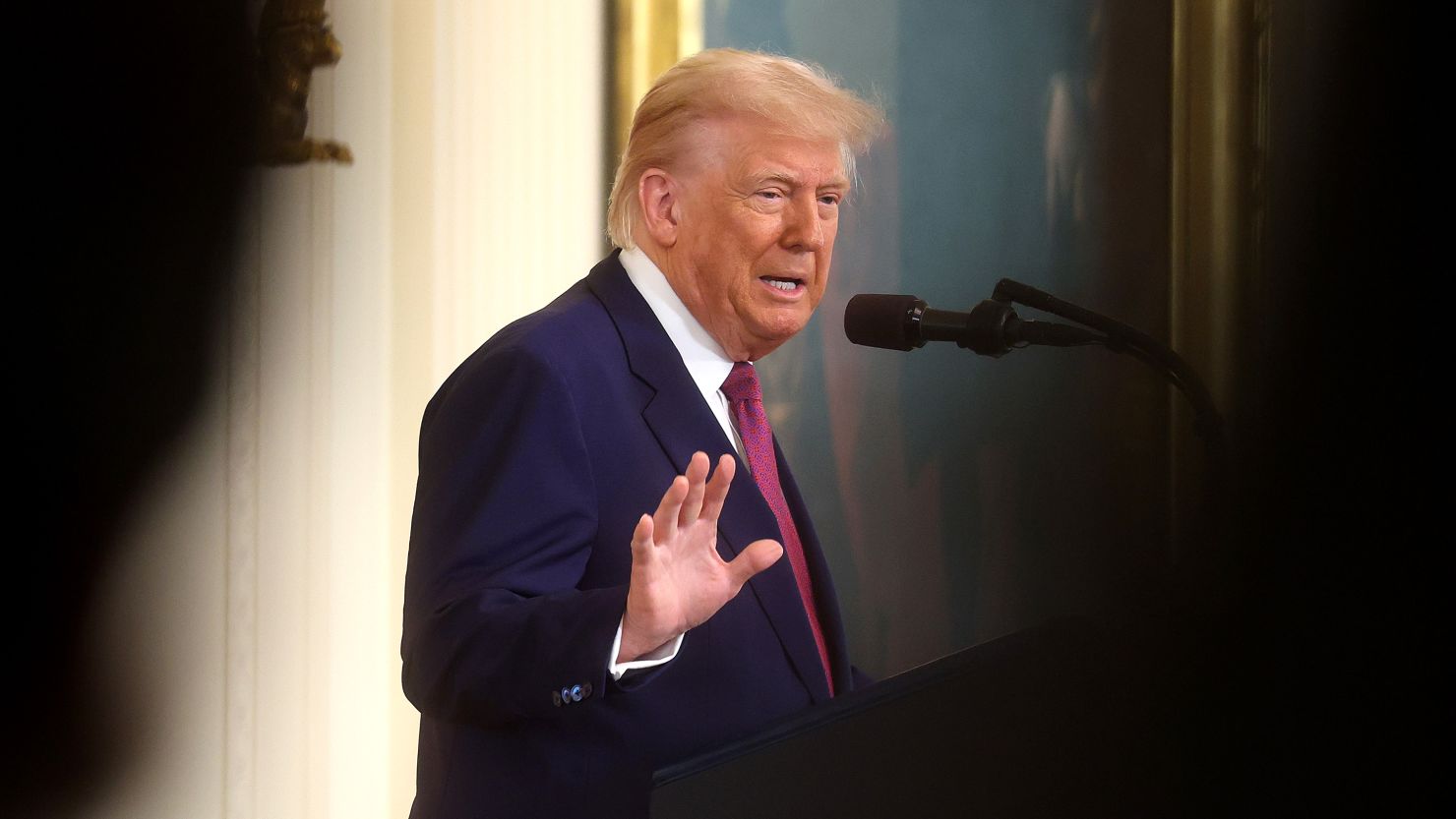
Voters like Hildenbrand, whose support of the Republican president is unwavering, help explain Trump’s polling numbers and how they have differed from other presidents’ polling trajectory in significant ways. An Associated Press-NORC Center for Public Affairs Research poll conducted in March found that 42% of U.S. adults approved of Trump’s job performance. That is a lower rating than those of other recent presidents at the beginning of their second terms, including Democrat Barack Obama and Republican George W. Bush.

The most recent AP-NORC poll, from July, puts Trump at 40% approval. While that is not a meaningful change from March, there is some evidence that Trump’s support may be softening, at least on the margins. The July poll showed a slight decrease in approval of his handling of immigration since earlier in the year. Some other pollsters, such as Gallup, show a downward slide in overall approval since slightly earlier in his term, in January.

But even those shifts are within a relatively narrow range, which is typical for Trump. The new AP-NORC polling tracker shows that Trump’s favorability rating has remained largely steady since the end of his first term, with between 33% and 43% of U.S. adults saying they viewed him favorably across more than five years.

Those long-term trends underscore that Trump has many steadfast opponents. But loyal supporters also help explain why views of the president are hard to change even as he pursues policies that most Americans do not support, using an approach that many find abrasive.

Trump has not had a traditional honeymoon period in his second term. He did not in his first, either.

An AP-NORC poll conducted in March 2017, two months into his first term, showed that 42% of Americans “somewhat” or “strongly” approved of his performance. That is largely where his approval rating stayed over the course of the next four years.

The recent slippage on immigration is particularly significant because that issue was a major strength for Trump in the 2024 election. Earlier in his second term, it was also one of the few areas where he was outperforming his overall approval. In March, about half of U.S. adults approved of his handling of immigration. But the July AP-NORC poll found his approval on immigration at 43%, in line with his overall approval rating.

Other recent polls show growing discontent with Trump’s approach on immigration. A CNN/SSRS poll found that 55% of U.S. adults say the president has gone too far when it comes to deporting immigrants who are living in the United States illegally, an increase of 10 percentage points since February.

“I understand wanting to get rid of illegal immigrants, but the way that’s being done is very aggressive,” said Donovan Baldwin, 18, of Asheboro, North Carolina, who did not vote in the 2024 election. “And that’s why people are protesting because it comes off as aggression. It’s not right.”

Ratings of Trump’s handling of the economy, which were more positive during his first term, have been persistently negative in his second term. The July poll found that few Americans think Trump’s policies have benefited them so far.

Even if he is not a fan of everything Trump has done so far, Brian Nichols, 58, of Albuquerque, New Mexico, is giving him the benefit of the doubt.

Nichols, who voted for Trump in 2024, likes what he is seeing from the president overall, though he has his concerns both on style and substance, particularly Trump’s social media presence and his on-again, off-again tariffs. Nichols also does not like the push to eliminate federal agencies such as the Education Department.

Despite his occasional disagreements with Trump, though, Nichols said he wants to give the president space to do his job, and he trusts the House and Senate, now run by Republicans, to act as a safeguard.

“We put him into office for a reason, and we should be trusting that he’s doing the job for the best of America,” Nichols said.

Trump has spent the past six months pushing far-reaching and often unpopular policies. Earlier this year, Americans were bracing themselves for higher prices as a result of his approach to tariffs. The July poll found that most people think Trump’s tax and spending bill will benefit the wealthy, while few think it will pay dividends for the middle class or people like them.

Discomfort with individual policies may not translate into wholesale changes in views of Trump, though. Those have largely been constant through years of turmoil, with his favorability rating staying within a 10-percentage point range through the COVID-19 pandemic, a felony conviction and attempted assassination.

To some of his supporters, the benefits of his presidency far outweigh the costs.

Kim Schultz, 62, of Springhill, Florida said she is thrilled with just about everything Trump is doing as president, particularly his aggressive moves to deport anyone living in the country illegally.

Even if Trump’s tariffs eventually take effect and push prices up, she said she will not be alarmed.

“I’ve always had the opinion that if the tariffs are going to cost me a little bit more here and there, I don’t have a problem with that,” she said.

Across the country, Hildenbrand dislikes Trump’s personality and his penchant for insults, including those directed at foreign leaders. But he thinks Trump is making things happen.

“More or less, to me, he’s showing that he’s on the right track,” he said. “I’m not in favor of Trump’s personality, but I am in favor of what he’s getting done.”

___

Republished with permission of The Associated Press.


Post Views: 0


Source link

Continue Reading

Politics

Ben Gibson reappointed General Counsel of Republican National Lawyers Association

Published

on


Gibson was one of Florida’s electors in the presidential election for 2024 in the Electoral Collage.

The General Counsel of the Republican National Lawyers Association (RLNA) is a Florida lawyer who’s getting another crack at the position.

Ben Gibson was reappointed this month to the General Counsel’s job of the RLNA. Gibson was lauded by the Republican Party of Florida for the top legal position in the organization that represents the conservative-leaning legal eagles.

Even Power, Under Chairman of the Republican Party of Florida, said in a news release, Gibson has already been instrumental in building effective legal teams across the U.S. and provided victories for the party regarding Florida’s election laws.

“Ben Gibson is one of the best Republican lawyers in the nation. He has delivered big wins for Florida and the Republican Party. We are proud of his reappointment to the RNLA and proud that Florida continues to lead the nation in election integrity,” Power said.

The RNLA is a networking organization for lawyers who are Republican and the group’s main objectives include advancing professionalism for practicing lawyers and law students. The group provides networking and legal education for political, government and legislative law. It also advocates for open and fair elections while advancing Republican philosophy. Gibson is also on the Board of Governors for the Executive Committee for the RNLA and is the Chapter Chair of the group.

Beyond his RNLA activities, Gibson is the Managing Partner for the law firm Shutts & Bowen in the Tallassee office. Gibson primarily practices political law and has represented statewide political candidates, Republican Party committees, political committees and nonprofit organizations in litigation, compliance and administrative proceedings on the state and national level.

Gibson was one of Florida’s electors in the presidential election for 2024 and cast his ballot for President Donald Trump and Vice President JD Vance in the Electoral College. Gibson’s also been the Chief Legal Counsel for the Republican Party of Florida for the past four election cycles.


Source link

Continue Reading

Politics

Another blue wave? Meet the Democrat trying to make it happen and the Republican trying to stop her

Published

on


Even though Republican Brian Jack is only a first-term congressman, he has become a regular in the Oval Office these days. As the top recruiter for his party’s House campaign team, the Georgia native is often reviewing polling and biographies of potential candidates with President Donald Trump.

Lauren Underwood, an Illinois congresswoman who does similar work for Democrats, has no such West Wing invitation. She is at the other end of Pennsylvania Avenue working the phones to identify and counsel candidates she hopes can erase Republicans’ slim House majority in November’s midterm elections.

Although they have little in common, both lawmakers were forged by the lessons of 2018, when Democrats flipped dozens of Republican-held seats to turn the rest of Trump’s first term into a political crucible. Underwood won her race that year, and Jack became responsible for dealing with the fallout when he became White House political director a few months later.

Underwood wants a repeat in 2026, and Jack is trying to stand in her way.

For Republicans, that means going all-in on Trump and his “Make American Great Again” agenda, gambling that durable enthusiasm from his base will overcome broader dissatisfaction with his leadership.

“You’re seeing a lot of people very inspired by President Trump,” Jack said about his party’s House candidates. “They’re excited to serve in this body alongside him and the White House. That’s been a tool and a motivating factor for so many people who want to run.”

Underwood said she is looking for candidates with community involvement and public service beyond Washington politics. A registered nurse, she was a health care advocate before she ran in 2018, joining a cadre of Democratic newcomers that included military veterans, educators, activists and business owners.

“It’s about having ordinary Americans step up” in a way that “draws a sharp contrast with the actions of these MAGA extremists,” she said.

It’s routine for a president’s party to lose ground in Congress during the first midterms after winning the White House. Trump, however, is in the rare position to test that historical trend with a second, nonconsecutive presidency.

Neither party has released its list of favored candidates in targeted seats. But Jack said Oval Office discussions with Trump focus on who can align with the White House in a way that can win.

Jack highlighted former Maine Gov. Paul LePage as an example. LePage is running in a GOP-leaning district where Democrats face the challenge of replacing Rep. Jared Golden, another member of the party’s 2018 class who recently announced he would not seek reelection.

Trump’s involvement contrasts with 2017, when he was not as tied to House leadership, including then-Speaker Paul Ryan, a Wisconsin Republican, on details of the midterm campaign as he is now. Jack, who got his start with Trump by managing delegate outreach before the 2016 convention, was White House deputy political director during that span. He was promoted to political director after the 2018 losses.

Jack continued advising the president, especially on his endorsements, between Trump’s 2021 departure for the White House and Jack’s own congressional campaign in 2024. He described Trump as intimately involved in recruitment decisions and open to advice on his endorsements since those 2018 defeats.

Trump loyalty will not always be easy to measure, especially in first-time candidates.

But Jack said Republicans have quality options. He pointed to Albuquerque, New Mexico, where Republicans could have a competitive primary that includes Jose Orozco, a former Drug Enforcement Administration contractor, and Greg Cunningham, a former Marine and police officer.

“They both have very inspirational stories,” Jack said.

Orozco has asked voters to “give President Trump an ally in Congress.” Cunningham did not focus on Trump in his campaign launch.

Underwood said Democrats are replicating a district-by-district approach of 2018. Recruiting in the Trump era, she said, is more often about talking with prospective candidates who raised their hands to run than about coaxing them into politics.

The notable numbers of women and combat veterans in her first-term class, Underwood said, was not a top-down strategy but the result of candidates who saw Trump and Republicans as threats to functional government and democracy.

Underwood, who at age 32 became the youngest Black woman ever to serve in Congress after her 2018 election, recalled that Republicans’ efforts to repeal the Affordable Care Act spurred her to run because of her training as a nurse. She shares those experiences with recruits, sharpening how they can connect their ideas and background to the job of a congressperson.

Underwood said she also regularly fields questions about serving in an era of political violence and about the day-to-day balance of being a candidate or congressperson, especially from recruits who have children.

National security is again a draw for Democrats. Former Marine JoAnna Mendoza is running in a largely rural southern Arizona seat and former Rep. Elaine Luria, another Underwood classmate and former naval officer, is running again in Virginia after losing her seat in 2022. Luria was among the lead House investigators of the Jan. 6, 2021, Capitol riot.

Underwood said there are clear parallels to 2018, when successful congressional candidates included Mikie Sherrill, a former Navy helicopter pilot who is now New Jersey governor-elect; Jason Crow, a former Army Ranger who is one of her recruiting co-chairs; and Virginia Gov.-elect Abigail Spanberger, a former CIA case officer.

Democrats also noted the need to find candidates who reflect a district’s cultural sensibilities, meaning a candidate who can withstand Republican accusations that national Democrats are out of touch with many voters.

For instance, in a South Texas district, the top potential Democratic challenger is Tejano music star Bobby Pulido. The five-time Latin Grammy nominee has criticized progressive Rep. Alexandria Ocasio-Cortez of New York for using the term “Latinx” rather than “Latino” or “Latina.”

Mid-decade gerrymandering, mostly in Republican-led states at Trump’s behest, leaves the state of the 435 House districts in flux. Even with the changes, Democrats identify more than three dozen Republican-held seats they believe will be competitive. Republicans counter with about two dozen Democratic-held seats they think can flip.

In the Southwest, Democrats are targeting all three Republican seats in Arizona. The GOP is aiming at three Democratic seats in Nevada. From the Midwest across to the Philadelphia suburbs, Democrats want to flip two Iowa seats, two in Wisconsin three in Michigan, three in Ohio and four in Pennsylvania. Republicans are targeting four Democratic seats in New York.

Nearly all Democratic targets were within a 15-percentage point margin in 2024, many of them much closer than that. Democratic candidates in 2025 special elections typically managed double-digit gains compared with Trump’s margins in 2024, including a recent special House election in Tennessee, when Democrats came within 9 points in a district Trump won by 22 points.

“It’s the same kind of shifts that we saw in 2017 before the 2018 wins,” said Meredith Kelly, a top official at the Democratic Congressional Campaign Committee during Trump’s first presidency. “So, it becomes a mix of that national environment and finding the right candidates who fit a district and can take advantage.”

___

Republished with permission of The Associated Press.


Source link

Continue Reading

Politics

Governor’s office announces new judicial appointments

Published

on


The picks will decide cases around the state.

Four legal professionals will be able to celebrate either promotions to higher judgeships or, in two cases, becoming a judge for a first time, as Gov. Ron DeSantis announced appointments on Friday.

Johnathan Lott, of Fort Lauderdale, will serve as Judge on the Fourth District Court of Appeal.

Lott has been a Circuit Court Judge for the Seventeenth Judicial Circuit Court since 2024. He has also been an Assistant United States Attorney for the Southern District of Florida.

Green Cove Springs’ Kristina Mobley will move from her position as a County Court Judge for Clay County to a Judge for the entire 4th Circuit, where she was a Judicial Staff Attorney prior to becoming a judge. Legislation passed this year expanded judgeships throughout the state, allowing Mobley to move up.

Jarred Patterson will move from being the Chief Assistant State Attorney for Gulf County to become a Judge in the 14th Circuit, another beneficiary of the legislation expanding the judiciary. He also has been the Chief Assistant State Attorney for the Second Judicial Circuit.

Pascale Achille will move from being an Assistant State Attorney in the 17th Circuit to a judgeship, meanwhile, but not through legislation. She will replace Judge Gary Farmer, who resigned his position amid questions over his unorthodox comportment on the bench.


Source link

Continue Reading

Trending

Copyright © Miami Select.