Connect with us

Business

Trump’s social security chief says ‘everything’ is on the table

Published

on


Like many developed nations, the U.S. is wrangling with a complex question: How to pay for the care and support of an aging population. Many of the answers to that question won’t be popular, but governments are aware of the need to address the issue before crisis hits.

In America, that timeline is set to seven years. The Committee for a Responsible Federal Budget estimates that Social Security’s retirement trust funds will be insolvent by the end of 2032.

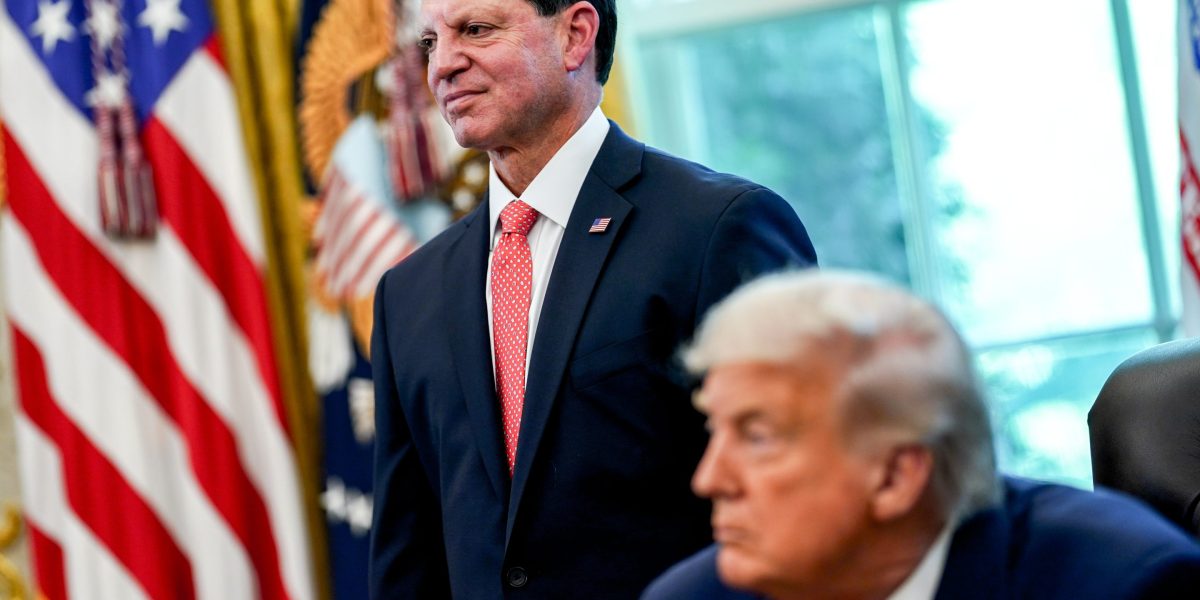
As such Trump’s Social Security Administration Commissioner, Frank Bisignano, needs to workout the landscape for the next generation of retirees.

When asked if plans to redress the issue may include raising the retirement age, Bisignano told Fox Business yesterday: “I think everything’s being considered, will be considered.” 

He added: “Remember, most people told you and I Social Security wasn’t going to be around, and it’s going to be around. And so the generations that are coming in will probably have a different set of rules than we had.” 

The number of people wrangling with the new reality of retirement is staggering. The Congressional Budget Office (CBO) estimates the Social Security area population (the relevant demographic for estimating payroll taxes and benefits as individuals reach retirement age) will increase from 342 million people in 2024 to 383 million people by 2054.

And this equilibrium of individuals supported by state benefits versus workers to pay into the system to support them is not a use which the CBO believes will be rebalanced anytime soon. In its estimation due to low fertility rates, all population growth from 2040 onwards will be as a result of immigration.

Bisignano added that raising the retirement age—currently set at 65—isn’t the only option on the table, saying there is “a whole host of items out there than can be hugely beneficial to get to the answer.”

Another consideration is the earnings cap at which benefits are phased out. While Bisignano said this figure—currently $175,000—will continue to go up, he added: “It’s another thing to put in the equation to think about.”

The Social Security chief added his team isn’t pushing the panic button yet, saying: “It’s really about solving it. Eight years is a long time away.”

The White House did not respond to Fortune’s request for comment on when, or if, the Social Security eligibility age might increase.

Retirement rates keeping employment steady

An unexpected upside to America’s aging population is that a shrinking workforce is, in the short-term, helping keep the nation’s unemployment rate in check.

Despite adding a meagre 22,000 jobs last month—and seeing significant downwards revision to labor market data—the U.S. has maintained an employment rate of around 4.3% over the past few months.

While the margins which could tip the rate up or down are minimal, one factor helping maintain the equilibrium is the increased amount of people who are retiring and as such, are not searching for roles.

As David Doyle, Macquarie’s head of economics, told Fortune a couple of weeks ago: “There’s been a surge in retirements this year. The first baby boomers that were born in 1946, they’re now turning 80, and you cascade down from that—I believe the last baby boomer year was 1964—so even the youngest baby boomers are into their sixties now.

“You now have this huge generation that is gonna be [a] drag on labor force growth.”

Of course, that drag is also helping keep unemployment rates down for the time being because the supply of labor does not outweigh even the most meagre of demand.

Fortune Global Forum returns Oct. 26–27, 2025 in Riyadh. CEOs and global leaders will gather for a dynamic, invitation-only event shaping the future of business. Apply for an invitation.


Source link

Continue Reading

Business

Google cofounder Sergey Brin said he was ‘spiraling’ before returning to work on Gemini

Published

on


Google cofounder Sergey Brin thought retiring from Google in 2019 would mean quietly studying physics for days on end in cafés. 

But when COVID hit soon after, he realized he may have made a mistake.

“That didn’t work because there were no more cafés,” he told students at Stanford University’s School of Engineering centennial celebration last week, Business Insider reported.

The transition from president of Google parent company Alphabet to a 40-something retiree ended up not being as smooth as he imagined, and soon after he said he was “spiraling” and “kind of not being sharp” as he stepped away from busy corporate life.

Therefore, when Google began allowing small numbers of employees back into the office, Brin tagged along and put his efforts into what would become Google’s AI model, Gemini. Despite being the world’s fourth-richest man with a net worth of $247 billion, retirement wasn’t for him, he said.

“To be able to have that technical creative outlet, I think that’s very rewarding,” Brin said. “If I’d stayed retired, I think that would’ve been a big mistake.”

By 2023, Brin was back to work in a big way, visiting the company’s office three to four times a week, the Wall Street Journalreported, working with researchers and holding weekly discussions with Google employees about new AI research. He also reportedly had a hand in some personnel decisions, like hiring. 

Skip forward to 2025 and Brin’s plans for a peaceful retirement of quiet study are out the window. In February, he made waves for an internal memo in which, despite Google’s three-day in-office policy, he recommended Google employees go into the company’s Mountain View, Calif. offices at least every weekday, and that 60 hours a week was the “sweet spot” of productivity.

Brin’s newfound efforts at work may have been necessary as OpenAI’s release of ChatGPT in 2022 caught the tech giant off guard, after it had led the field of AI research with DeepMind and Google Brain for years.

To be sure, Google for its part has been rising in the AI race. Analysts raved last month about Gemini 3, the company’s latest update to its LLM, and Google’s stock is up about 8% since its release. Meanwhile, OpenAI earlier this month declared a “code red,” its highest alert level, to improve ChatGPT. 

Brin added in the talk at Stanford that Google has an advantage in the AI arms race precisely because of the foundation it laid over years through its neural network research, its custom AI chips, and its data center infrastructure.

“Very few have that scale,” he said.


Source link

Continue Reading

Business

Gen Z grads are now being given ‘resilience’ training at PwC U.K. to toughen up for the job

Published

on


Gen Z is often branded a “lazy” generation of workers with no ambition to climb the corporate ladder. But PwC U.K. says the real challenge isn’t motivation—it’s resilience. These young professionals are eager to succeed in their own way, but the pandemic may have left them with gaps in essential skills. So the “Big Four” consulting firm is taking matters into its own hands with “resilience” training for fresh-faced hires. 

“Quite often we are struck that the graduates [who] join us—who are meeting all the cognitive tests we’ve set—they don’t always have the resilience,” Phillippa O’Connor, chief people officer at PwC U.K., recently toldThe Sunday Times. “They don’t always have the human skills that we want to deploy onto the client work we pass them towards.”

“We’ve really doubled down, particularly [with] this year’s graduates,” O’Connor continued. “We’re doing a whole load of separate training in their first six months with us, really about resilience, really about some of those communication skills.”

The executive described resilience as the ability to handle day-to-day work dynamics—especially pressure, criticism, or sticky situations. That skill, she said, is particularly crucial in a deal-making environment, where managing challenges is a “core” part of the job.

According to O’Connor, many younger workers simply didn’t get the chance to build that muscle during the pandemic, when lockdowns disrupted education and early workplace experiences that would normally help develop it.

But by offering this special training, PwC is ensuring the talent that fills its 1,300 open U.K. graduate jobs this year—which received around 47,000 applications—are well-equipped to succeed. 

Fortune reached out to PwC for comment. 

Companies are offering Gen Z special training 

PwC’s “resilience” training is just one example of how employers have been stepping up to ensure Gen Z is primed to succeed in the workforce. 

In 2023, fellow “Big Four” consulting giant KPMGsupplied extra instruction to its Gen Z hires. The business provided training for its graduate talent, out of concern they were struggling to adapt to professional life—particualry when it came to “soft skills,” how to give presentations, work in a team, and manage projects. 

The chief people officer of $1.5 billion data protection start-up Cohesity, Rebecca Adams, has also pushed for inter-generational cohesiveness. 

Earlier this year the executive led the charge to skill bosses in managing the young professionals, citing that Gen Z responds to feedback differently: “They want to know why, how—they want constant feedback.” On the flipside, she described having to teach “basic things” to young staffers that would mind-boggle their Gen X counterparts. 

“How do I manage my calendar? You actually have to accept the meeting request,” Adams explained toFortune in September. “You can’t just walk out of the meeting that you’re in because you have another one while it’s still going on.”

Charitable organizations are also stepping up to solve Gen Z’s professional pitfalls. Radical Hope is a nonprofit helping equip college students with essential skills including communication, interpersonal dexterity, and emotional intelligence. It began as a pilot program at New York University back in 2020, after experts noted “elevated anxiety, stress, and depression” among students within the previous years—and has spread to 75 college campuses so far.  

Liz Feld, the CEO of Radical Hope, hopes the Gen Z trainees will become adept in the skills “we all got growing up at the kitchen table.” Even the little things, like small talk, can be a challenge for the young hopefuls striving to one day succeed in the workplace. 

“They won’t ask someone, ‘Do you want to go to the dining hall and grab dinner, you want to go grab a beer, you want to go for a walk, you want to get a coffee?’” Feld told Fortune, adding that if someone says “no,” their confidence is crushed. “They internalize the whole thing. The face-to-face rejection is what they’re afraid of.”


Source link

Continue Reading

Business

Meetings are not work, says Southwest Airlines CEO—he’s blocking his calendar every afternoon, Wednesday to Friday

Published

on


Business leaders are raising the alarm: meetings have taken over, and real work is being left behind. And Southwest Airlines CEO Bob Jordan is the latest to speak out on the phenomenon—arguing that many leaders mistake constant meetings for leadership.

“When you first start, it’s easy to confuse busyness and going to meetings with leadership,” Jordan said last week on a panel of CEOs at The New York Times DealBook Summit. “…Because what we all find, I’m sure, is there’s no time to ‘work’ and you confuse going to meetings with the work.”

Over the years, Jordan’s solution has been increasingly straightforward: protect his time. For 2026, his goal is to keep his calendar completely clear every Wednesday, Thursday, and Friday afternoon—blocking anyone from booking meetings during those hours.

While he acknowledges that approach might sound “crazy” to some executives, he said CEOs are hired to do work only they can do—and that rarely happens when they are trapped in back-to-back meetings. 

“It’s so that you can work on things you need to work on. You can think about what’s important right now. You can call people you need to talk to,” Jordan added.

The approach may be paying off. Despite a rocky year for the airline industry, Southwest posted a surprise profit in its most recent quarterly earnings report. Year-to-date, its stock price is up about 23%.

Fortune reached out to Southwest Airlines for further comment.

Meetings have become the bane of existence for employees and employers alike

Jordan isn’t alone in his frustration. Meetings have become a shared pain point for both workers and executives.

During the pandemic, meetings took on an almost emotional-support role—an attempted substitute for in-person interaction amid lockdowns. With no need to wait for a free conference room, calendars quickly filled up.

But now, nearly 80% of people say they’re drowning in so many meetings and calls that they barely have time to get any real work done, according to a 2024 Atlassian study which surveyed 5,000 workers across four continents. About 72% of the time, meetings are deemed ineffective.

That backlash has prompted a growing number of executives to aggressively prune—or outright eliminate—meetings from corporate schedules, sometimes carving out entirely meeting-free days. Still, some experts warn that getting rid of meetings altogether is a strategy that could risk removing any sense of belonging with the organization and backfire in the long term.

“Meetings don’t need to be banished completely; it’s just the ineffective, time-wasting ones that do,” Ben Thompson, CEO and cofounder of Employment Hero, previously told Fortune.

How Nvidia and JPMorgan Chase tackle meeting overload

Other CEOs have adopted their own unconventional approaches.

Nvidia’s CEO Jensen Huang, for instance, does not have one-on-one meetings with his more than 50 direct reports. Doing so, he has said, would not only overwhelm his schedule but also slow the broader team’s capacity to address challenges, work effectively, and maintain transparency.

“Our company was designed for agility—for information to flow as quickly as possible. For people to be empowered by what they are able to do, not what they know,” Huang said at Stanford University last year.

At JPMorgan Chase, CEO Jamie Dimon has taken a more blunt approach. In his annual letter to shareholders released last spring, he urged employees to rethink whether meetings are worth having at all.

“Here’s another example of what slows us down: meetings. Kill meetings,” he wrote. “But when they do happen, they have to start on time and end on time – and someone’s got to lead them. There should also be a purpose to every meeting and always a follow-up list.”

Efficiency has become an even higher priority as JPMorgan has pushed employees back into the office five days a week. Meetings, Dimon has emphasized, should command full attention.

“None of this nodding off, none of this reading my mail,” Dimon echoed at Fortune’s Most Powerful Women Summit in October. “If you have an iPad in front of me and it looks like you’re reading your email or getting notifications, I tell you to close the damn thing. It’s disrespectful.”


Source link

Continue Reading

Trending

Copyright © Miami Select.