Connect with us

Business

Trump’s shock $100k gambit ‘inserts total chaos in existing H-1B process with basically a day’s noti

Published

on


President Donald Trump’slatest plan to overhaul the American immigration system has left some immigrant workers confused, forcing the White House on Saturday to scramble to clarify that a new $100,000 fee on visas for skilled tech workers only applies to new applicants and not to current visa holders.

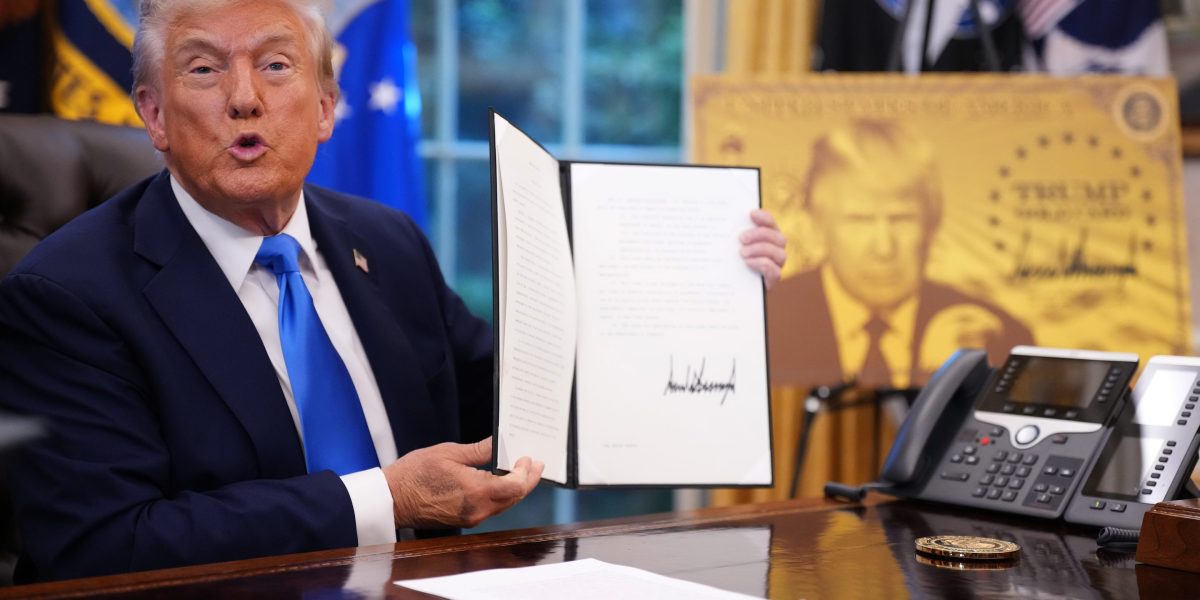
The president on Friday, with Commerce Secretary Howard Lutnick by his side, signed a proclamation that will require the new fee for what are known as H-1B visas — meant for high-skilled jobs that tech companies find hard to fill.

“Those who already hold H-1B visas and are currently outside of the country right now will NOT be charged $100,000 to re-enter,” White House press secretary Karoline Leavitt said in a posting on X. “This applies only to new visas, not renewals, and not current visa holders.”

The fee takes effect at 12:01 a.m. ET Sunday. It is scheduled to expire after a year. But it could be extended if the government determines that is in the interest of the United States to keep it.

The White House in a social media post also sought to make clear the new rule “does not impact the ability of any current visa holder to travel to/from the U.S.”

But immigration attorneys said that the White House move threatened to upend the lives of many skilled workers and has far-reaching impact on American business.

Kathleen Campbell Walker, an immigration attorney with Dickinson Wright based in El Paso, Texas, said in a posting on LinkedIn that the White House move “inserts total chaos in existing H-1B process with basically a day’s notice.”

Lutnick on Friday told reporters that the fee would be an annual cost for companies.

But a White House official said Saturday that it’s a “one-time fee.” Asked if Lutnick’s comments sowed confusion, the official, who was not authorized to comment publicly about the matter and spoke on the condition of anonymity, said the new fee “currently does not apply to renewals but that policy is under discussion.”

Meanwhile, India’s government expressed concern Saturday that the Trump administration move would dramatically raise the fee for visas that bring tech workers from there and other countries to the United States.

Trump also rolled out a $1 million “gold card” visa for wealthy individuals. The moves face near-certain legal challenges amid widespread criticism he is sidestepping Congress.

To be certain, if the moves survive legal muster, they will deliver staggering price increases. The visa fee for skilled workers would jump from $215.

India’s Ministry of External Affairs said Saturday that Trump’s plan “was being studied by all concerned, including by Indian industry.″ The ministry warned that ”this measure is likely to have humanitarian consequences by way of the disruption caused for families. Government hopes that these disruptions can be addressed suitably by the U.S. authorities.″

More than 70% of H-1B visa holders are from India.

Critics say the H-1B visas undercut American workers

H-1B visas, which require at least a bachelor’s degree, are meant for high-skilled jobs that tech companies find difficult to fill. Critics say the program undercuts American workers, luring people from overseas who are often willing to work for as little as $60,000 annually. That is well below the $100,000-plus salaries typically paid to U.S. technology workers.

Trump on Friday insisted that the tech industry would not oppose the move. Lutnick, meanwhile, claimed “all big companies” are on board.

Representatives for the biggest tech companies, including Amazon, Apple, Google and Meta, did not immediately respond to messages for comment. Microsoft declined to comment.

“We’re concerned about the impact on employees, their families and American employers,” the U.S. Chamber of Commerce said. “We’re working with the Administration and our members to understand the full implications and the best path forward.”

Lutnick said the change will likely result in far fewer H-1B visas than the 85,000 annual cap allows because “it’s just not economic anymore.”

“If you’re going to train people, you’re going to train Americans,” Lutnick said on a conference call with reporters. “If you have a very sophisticated engineer and you want to bring them in … then you can pay $100,000 a year for your H-1B visa.”

Trump also announced he will start selling a “gold card” visa with a path to U.S. citizenship for $1 million after vetting. For companies, it will cost $2 million to sponsor an employee.

Trump offers ‘Platinum Card’

The “Trump Platinum Card” will be available for $5 million and allows foreigners to spend up to 270 days in the U.S. without being subject to U.S. taxes on non-U.S. income. Trump announced a $5 million gold card in February to replace an existing investor visa — this is now the platinum card.

Lutnick said the gold and platinum cards would replace employment-based visas that offer paths to citizenship, including for professors, scientists, artists and athletes.

Critics of H-1Bs visas who say they are used to replace American workers applauded the move. U.S. Tech Workers, an advocacy group, called it “the next best thing” to abolishing the visas altogether.

Doug Rand, a senior official at U.S. Citizenship and Immigration Services during the Biden administration, said the proposed fee increase was “ludicrously lawless.”

“This isn’t real policy — it’s fan service for immigration restrictionists,” Rand said. “Trump gets his headlines, and inflicts a jolt of panic, and doesn’t care whether this survives first contact with the courts.”

Lutnick said the H-1B fees and gold card could be introduced by the president but the platinum card needs congressional approval.

Visas doled out by lottery

Historically, H-1B visas have been doled out through lottery. This year, Amazon was by far the top recipient of H-1B visas with more than 10,000 awarded, followed by Tata Consultancy, Microsoft, Apple and Google. Geographically, California has the highest number of H-1B workers.

Critics say H-1B spots often go to entry-level jobs, rather than senior positions with unique skill requirements. And while the program isn’t supposed to undercut U.S. wages or displace U.S. workers, critics say companies can pay less by classifying jobs at the lowest skill levels, even if the specific workers hired have more experience.

As a result, many U.S. companies find it cheaper to contract out help desks, programming and other basic tasks to consulting companies such as Wipro, Infosys, HCL Technologies and Tata in India and IBM and Cognizant in the U.S. These consulting companies hire foreign workers, often from India, and contract them out to U.S. employers looking to save money.

___

Ortutay reported from Oakland, Calif. Associated Press writers Adriana Gomez Licon in Ft. Lauderdale, Florida, Elliot Spagat in San Diego and Paul Wiseman in Washington contributed to this report.


Source link

Continue Reading

Business

Morgan Stanley strategist Michael Wilson says lackluster job numbers could actually be good news

Published

on


Ahead of the highly anticipated November jobs data to be released this week, even lackluster numbers may be greeted with relief by Wall Street.

A moderately cooling labor market could increase the likelihood of more rate cuts by the Federal Reserve—a tantalizing prospect for many investors eying future earnings growth—fueling bullish behaviors in the stock market, according to Morgan Stanley analysts.

“We are now firmly back in a good is bad/bad is good regime,” Michael Wilson, chief U.S. equity strategist and chief investment officer for Morgan Stanley, wrote in a note to investors on Monday.

Fed Chair Jerome Powell’s divisivecut last week, the Fed’s third cut in as many meetings, was based on consistent data showing a softening job market, including unemployment rising three months in a row through September, and the private sector shedding 32,000 jobs last month, per ADP’s November report

According to Powell, the quarter-point cut was defensive and a way to prevent the labor market from tumbling, adding that while inflation sits at about 2.8%, which is higher than the Fed’s preferred 2%, he said he expects inflation to peak early next year, barring no additional tariffs.

He added that monthly jobs data may have been overcounted by about 60,000 as a result of data collection errors, and that payroll gains may actually be stagnant or even negative.

“I think a world where job creation is negative…we need to watch that very carefully,” Powell said at the press conference directly following the announcement of the rate cut. 

Wilson suggested that Powell’s emphasis on the jobs data, as well as his de-emphasis on tariff-caused inflation, makes the labor market a crucial factor in monetary policy going into 2026. 

As a result of the government shutdown, the Labor Department’s job market report will be released on Tuesday, which will contain data from both October and November, and is expected to show a modest 50,000 payroll gain in November, with the unemployment rate ticking up from 4.4% to about 4.5%, consistent with the trend of a labor market that is slowing, but not suddenly bottoming out. 

‘Rolling recovery’ versus plain bad news

The Morgan Stanley strategist has previously argued that weak payroll numbers are actually a sign of a “rolling recovery,” with the economy in the early stages of an upswing slowly making its way through each sector. It follows three years of a “rolling recession” that Wilson said had kept the economy weaker than what employment and GDP figures suggested.

In Wilson’s eyes, because jobs data is a lagging metric, the trough of the labor cycle was actually back in the spring, coinciding with mass DOGE firings and “Liberation Day” tariffs. For a more accurate representation of the health of the economy, Wilson argued to look instead at the markets. The S&P 500, for example, is up nearly 13% over the last six months.

However, with Powell basing his policy decisions on data such as jobs, Wilson noted, the Fed could still see more room to cut, even as Morgan Stanley sees a labor market that is not in jeopardy.

“In real time, the data has not been weak enough to justify cutting more,” Wilson told CNBC last week prior to the Fed meeting. “But when they actually look at the revisions now…it’s very clear that we had a significant labor cycle, and we’ve come out of it, which is very good.”

But just as economists weren’t in consensus for the FOMC’s most recent rate cut, the possibility of more meager jobs numbers is not universally favored.

Claudia Sahm, chief economist at New Century Advisors and a former Fed economist, agreed the job data is a lagging economic indicator, but warned it could indicate a recession is underway, not that we’re already in the clear. What was particularly concerning to her was that lagging labor data could bear worse job news, as layoffs have yet to surge following shrinking job openings. 

She told Fortune ahead of the Fed’s decision last week that additional rate cuts would not be welcome news, but rather a sign the Fed had acted too late in trying to correct a battered labor market.

“If the Powell Fed ends up doing a lot more cuts, then we probably don’t have a good economy,” she said. “Be careful what you wish for.”


Source link

Continue Reading

Business

Actor Joseph Gordon-Levitt wonders why AI companies don’t have to ‘follow any laws’

Published

on


In a sharp critique of the current artificial intelligence landscape, actor-turned-filmmaker-turned- (increasingly) AI activist Joseph Gordon-Levitt challenged the tech industry’s resistance to regulation, posing a provocative rhetorical question to illustrate the dangers of unchecked development: “Are you in favor of erotic content for eight-year-olds?”

Speaking at the Fortune Brainstorm AI conference this week with editorial director Andrew Nusca, Gordon-Levitt used “The Artist and the Algorithm” session to pose another, deeper question: “Why should the companies building this technology not have to follow any laws? It doesn’t make any sense.”

In a broad-ranging conversation covering specific failures in self-regulation, including instances in which “AI companions” on major platforms reportedly verged into inappropriate territory for children, Gordon-Levitt argued relying on internal company policies rather than external law is insufficient, noting such features were approved by corporate ethicists.

Gordon-Levitt’s criticisms were aimed, in part, at Meta, following the actor’s appearance in a New York Times Opinion video series airing similar claims. Meta spokesperson Andy Stone pushed back hard on X.com at the time, noting Gordon-Levitt’s wife was formerly on the board of Meta rival OpenAI.

Gordon-Levitt argued without government “guardrails,” ethical dilemmas become competitive disadvantages. He explained that if a company attempts to “prioritize the public good” and take the “high road,” they risk being “beat by a competitor who’s taking the low road.” Consequently, he said he believes business incentives alone will inevitably drive companies toward “dark outcomes” unless there is an interplay between the private sector and public law.

‘Synthetic intimacy’ and children

Beyond the lack of regulation, Gordon-Levitt expressed deep concern regarding the psychological impact of AI on children. He compared the algorithms used in AI toys to “slot machines,” saying they use psychological techniques designed to be addictive.

Drawing on conversations with NYU psychologist Jonathan Haidt, Gordon-Levitt warned against “synthetic intimacy.” He argued that while human interaction helps develop neural pathways in young brains, AI chatbots provide a “fake” interaction designed to serve ads rather than foster development.

“To me it’s pretty obvious that you’re going down a very bad path if you’re subjecting them to this synthetic intimacy that these companies are selling,” he said.

Haidt, whose New York Times bestseller The Anxious Generation came recommended from Gordon-Levitt onstage, recently appeared at a Dartmouth-United Nations Development Program symposium on mental health among young people and used the metaphor of tree roots for neurons. Explaining tree-root growth is structured by environments, he brought up a picture of a tree growing around a Civil War–era tombstone. With Gen Z and technology, specifically the smartphone, he said: “Their brains have been growing around their phones very much in the way that this tree grew around this tombstone.” He also discussed the physical manifestations of this adaptation, with children “growing hunched around their phone,” as screen addiction is literally “warping eyeballs,” leading to a global rise in myopia shortsightedness.

The ‘arms race’ narrative

When addressing why regulations have been slow to materialize, Gordon-Levitt pointed to a powerful narrative employed by tech companies: the geopolitical race against China. He described this framing as “storytelling” and “handwaving” designed to bypass safety checks,. Companies often compare the development of AI to the Manhattan Project, arguing slowing down for safety means losing a war for dominance. In fact, The Trump administration’s “Genesis Mission” to encourage AI innovation was unveiled with similar fanfare just weeks ago, in late November.

However, this stance met with pushback from the audience. Stephen Messer of Collectiv[i] argued Gordon-Levitt’s arguments were falling apart quickly in a “room full of AI people.” Privacy previously decimated the U.S. facial recognition industry, he said as an example, allowing China to take a dominant lead within just six months. Gordon-Levitt acknowledged the complexity, admitting “anti-regulation arguments often cherrypick” bad laws to argue against all laws. He maintained that while the U.S. shouldn’t cede ground, “we have to find a good middle ground” rather than having no rules at all.

Gordon-Levitt also criticized the economic model of generative AI, accusing companies of building models on “stolen content and data” while claiming “fair use” to avoid paying creators. He warned a system in which “100% of the economic upside” goes to tech companies and “0%” goes to the humans who created the training data is unsustainable.

Despite his criticisms, Gordon-Levitt clarified he is not a tech pessimist. He said he would absolutely use AI tools if they were “set up ethically” and creators were compensated. However, he concluded without establishing the principle that a person’s digital work belongs to them, the industry is heading down a “pretty dystopian road.”


Source link

Continue Reading

Business

Fed chair race: Warsh overtakes Hassett as favorite to be nominated by Trump

Published

on


Wall Street’s top parlor game took a sudden turn on Monday, when the prediction market Kalshi showed Kevin Warsh is now the frontrunner to be nominated as the next Federal Reserve chairman, overtaking Kevin Hassett.

Warsh, a former Fed governor, now has a 47% probability, up from 39% on Sunday and just 11% on Dec. 3. Hassett, director of the National Economic Council, has fallen to 41%, down from 51% on Sunday and 81% on Dec. 3.

A report from CNBC saying Hassett’s candidacy was running into pushback from people close to President Donald Trump seemed to put Warsh on top. The resistance stems from concerns Hassett is too close to Trump.

That followed Trump’s comment late Friday, when he told The Wall Street Journal Warsh was at the top of his list, though he added “the two Kevins are great.”

According to the Journal, Trump met Warsh on Wednesday at the White House and pressed him on whether he could be trusted to back rate cuts. 

The report surprised Wall Street, which had overwhelming odds on Hassett as the favorite, lifting Warsh’s odds from the cellar.

But even prior to the Journal story, there have been rumblings in the finance world Hassett wasn’t their preferred choice to be Fed chair.

At a private conference for asset managers on Thursday, JPMorgan Chase CEO Jamie Dimon signaled support for Warsh and predicted Hassett was likelier to support Trump on more rate cuts, sources told the Financial Times.

And in a separate report earlier this month, the FT said bond investors shared their concerns about Hassett with the Treasury Department in November, saying they’re worried he would cut rates aggressively in order to please Trump.

Trump has said he will nominate a Fed chair in early 2026, with Jerome Powell’s term due to expire in May. 

For his part, Hassett appeared to put some distance between himself and Trump during an appearance on CBS’ Face the Nation on Sunday.

When asked if Trump’s voice would have equal weighting to the voting members on the rate-setting Federal Open Market Committee, Hassett replied, “no, he would have no weight.”

“His opinion matters if it’s good, if it’s based on data,” he explained. “And then if you go to the committee and you say, ‘well the president made this argument, and that’s a really sound argument, I think. What do you think?’ If they reject it, then they’ll vote in a different way.”


Source link

Continue Reading

Trending

Copyright © Miami Select.