
Business
Trump’s pressure on Apple to make All-American phones ignores the last tech giant that tried and failed
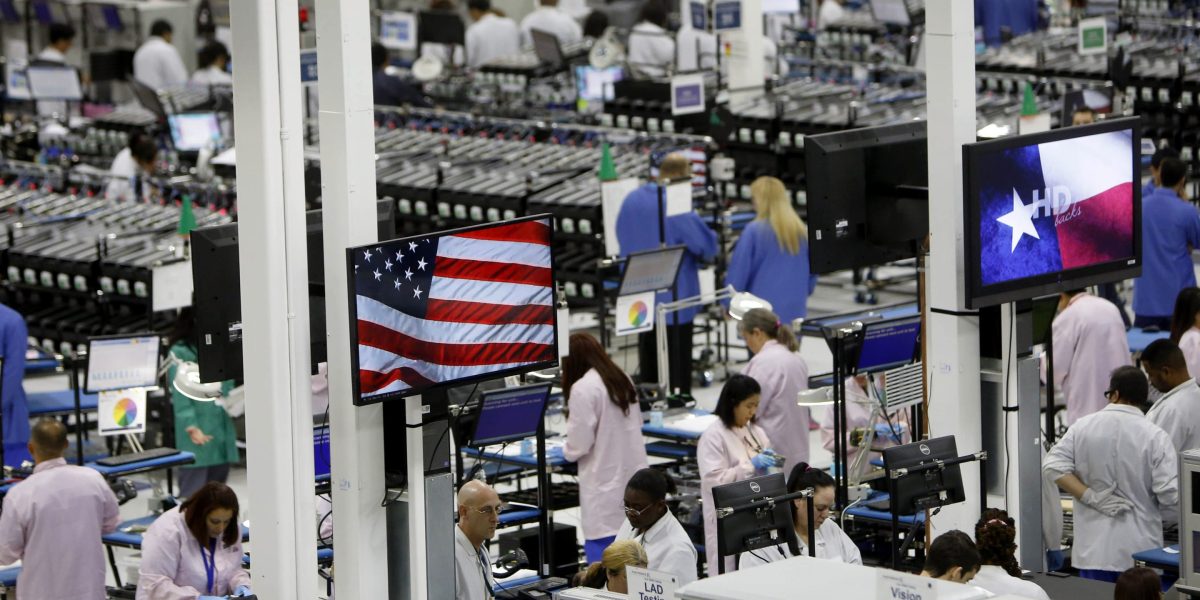
The executives were well aware of the difficulties they would face in manufacturing a smartphone in the U.S. As with any great tech industry moonshot, the challenge was part of the appeal—and they embraced it.
“Conventional wisdom said it wasn’t possible,” the company crowed defiantly in a blog post announcing the new America-made smartphone. “Experts said that costs are too high in the US; that the US has lost its manufacturing capability; and that the US labor force is too inflexible.”
Soon, tens of thousands of shiny, new touchscreen phones began rolling off the assembly line at a plant in Fort Worth, Texas every day, and what seemed like a risky endeavor began to look like it could be a milestone—a bold bet on American manufacturing at a time when smartphone giant Apple relied on factories in China, home to cheap labor and legions of suppliers eager to produce electronic components.
That was 2013. And the company behind the bet was Google, which had acquired legacy phone maker Motorola Mobility and was leveraging its modern tech prowess and vast resources to make the Moto X smartphone a success.
Just a year later, it was all over. Google sold the Motorola phone business and pulled the plug on the U.S. manufacturing effort. It was the last time a major company tried to produce a U.S. made smartphone.
The story of Google’s short-lived on-shorting experiment has been largely forgotten, a footnote in the internet search giant’s nearly three-decade history of business initiatives and projects. But Google’s experience, particularly where it succeeded, where it discovered unexpected benefits, and where it stumbled, are newly relevant amid President Trump’s campaign to pressure Apple, and other tech companies, to build their gadgets on U.S. soil.
In just the past few weeks, the President has demanded that Apple reshore a big part of its iPhone production from Asia or face tariffs of at least 25%.
Mike Fuentes/Bloomberg via Getty Images
The Google Motorola case study provides critical lessons about U.S. smartphone manufacturing that are still applicable today, as well as numerous intriguing what ifs. Was the project doomed by the economic realities of globalization, the competitive landscape in the smartphone business, or were Google’s shifting corporate priorities ultimately to blame? Could more time, or more effective marketing, have made a difference?
To piece together the history, Fortune spoke with five former Motorola employees who were directly involved in the company’s U.S. assembly push, as well as numerous industry experts and analysts. “We felt scrappy and felt we could carve out a niche for ourselves,” recalled Steve Mills, who was Motorola Mobility’s chief information officer at the time and who is now chief operating officer at Foresite Cybersecurity.
Many of the former Google insiders described starting the effort with high hopes but quickly realized that some of the assumptions they went in with were flawed and that, for all the focus on manufacturing, sales simply weren’t strong enough to meet the company’s ambitious goals laid out by leadership.
Looking for an edge
The phone at the center of the plan, the Moto X, stood out from the pack not just because of where it would be produced. Motorola would offer consumers who purchased the phone directly on its website the option to customize the device, with dozens of colors and materials, eventually including bamboo and walnut backs, as well as special touches like personalized engraving.
The company hoped that offering customized phones would give it an edge over rivals Apple and Samsung, which sold only standardized lineups. And the customization was well-suited to the on-shoring plan: By making phones in the U.S., Motorola would be able to deliver them to domestic customers within four days, instead of making them wait, while also saving on shipping costs.
In its marketing, Motorola played up the device’s pedigree as a patriotic alternative to the foreign-produced competition. The plant’s opening celebration was such a big deal that then-Texas Gov. Rick Perry and billionaire Shark Tank investor Mark Cuban showed up.

Mike Fuentes/Bloomberg via Getty Images
The factory in Fort Worth, about an hour’s drive from Dallas, was operated by Flextronics, a contract manufacturer now known as Flex. To save on costs, workers at the plant handled only final assembly, using components that were imported from Asia.
The cost of labor was of course higher than in China – workers were paid an hourly wage that was about three times more than in China, company executives said at the time. But it was an acceptable trade-off, given the other advantages. Dennis Woodside, who was then the CEO of Motorola Mobility, said in an interview at the time that the customized phones were being sold at a profit.
In addition to the customized models, Motorola sold standardized versions of the Moto X to wireless carriers – an arrangement that helped ensure a base level of demand and production at the factory.
Apple vs. Trump
While Apple does not produce customized versions of its iPhone, the company would likely face many of the same complications, plus new ones, if it quickly shifted iPhone manufacturing to the U.S. as Trump has called for. Higher labor costs are still a reality. And domestic suppliers are limited, with most based in China.
As a result, Apple would have to raise iPhone prices astronomically—at least initially—to make a profit, experts said. Instead of $1,000, U.S.-made phones would have to retail for as much as $3,500, Wedbush Securities analyst Dan Ives estimated in a recent research note, concluding that Apple ever producing the devices domestically is a “fairy tale.”
Over the past six months, to reduce its exposure to Trump’s tariffs, Apple has accelerated a years-long shift in its sourcing of iPhones. Rather than China, its main manufacturing hub and initially the target of Trump’s highest import taxes, the company now ships most of its U.S.-bound phones from India, where tariffs are lower.

MANDEL NGAN/AFP via Getty Images
How the trade war will ultimately play out is still in flux. Trump has delayed some of his import taxes and is still negotiating others.
But his comments in May on conservative social network Truth Social show he opposes Apple’s current workaround. In his message, he insisted Apple’s iPhones ‘must be built in the United States, not India, or anyplace else.”
Apple CEO Tim Cook has described Asia as better for manufacturing than the U.S. The reason has nothing to do with the difference in wages, he insisted in an interview at a Fortune conference in 2017. China stopped being a low-cost labor destination years ago, according to Cook. Rather, the country’s advantage is the far greater availability of skilled workers, such as the tooling engineers who create designs and molds for components, and who he praised for their precision.
“In the U.S., you could have a meeting of tooling engineers and I’m not sure we could fill the room,” Cook said on stage. “In China you could fill multiple football fields.”
In an effort to appease Trump, Apple this year promised to spend $500 billion in the U.S. over the next four years. Some of that money, the company said, will go to producing servers in Houston for its data centers. But Apple hasn’t mentioned anything about bringing iPhone manufacturing back home to the U.S.
Imported workers and equipment
When it came to the Moto X, Flextronics, from the outset, anticipated a shortage of skilled engineers in the U.S. To get around the problem, it drafted engineering talent from its factories across the globe, including from Hungary, Israel, Malaysia, Brazil, and China, and splurged on moving them to Fort Worth just to get the operation running as quickly as possible.
“We had to bring in a very cultural cast of characters,” said Mark Randall, who led Motorola’s supply chain and operations.
Rank and file assembly line workers, along with supervisors and managers, were easier to recruit locally because of the area’s status as a telecom manufacturing corridor, he added. Of the nearly 3,800 staffing the facility at its peak, most didn’t require intensive training.
Production at the plant, equivalent in size to nearly eight football fields, started in the summer of 2013. The operation was in a former Nokia phone factory, in an industrial park designated as a foreign trade zone and with its own airport for cargo. The location meant that Motorola would pay lower tariffs on certain components it imported from Asia. The savings would only kick in, however, if the company decided to export some of the phones it produced there to other countries.
Randall, who is now a supply chain consultant and startup board member, described Texas as a friendly home for manufacturing. In just one example of the warm welcome, the state gave Motorola a tax break for worker training, he said.

Mike Fuentes/Bloomberg via Getty Images
Setting up the Moto X plant required installing a massive amount of equipment, including conveyor belts and other machinery. Some, like certain testing machines, were shipped from China. Workers wearing smocks and gloves to protect the electronics from dirt and lint stood at blue tables set in neat rows while they went through the many steps required to finish a phone. Computer screens glowed above each station.
Fitting plastic parts, like the phone’s back cover, tended to be done by hand. Robotics was used for adding components like touch screens and for testing certain parts during assembly to make sure they worked properly.
As production ramped up, process engineers, who sometimes patrolled the assembly line with stopwatches, looked for bottlenecks and rejiggered the assembly line. Like with any plant, the effort to squeeze out more efficiency was a constant focus.
As the first Motorola phone designed under Google, Moto X generated considerable buzz. The Android device, which was priced at $579 for the unlocked entry version, had a rounded backside and pioneering voice control feature. Users merely had to say “Okay, Google now” to activate the feature, to set up reminders and get driving directions
“It was a cool sexy phone,” said Mills, the CIO. “I got it for my kids.”
The mobile network carriers were also excited by the Moto X, though at least partly for self-serving reasons, according to Randall, the supply chain guru. If the device sold well, it would provide the carriers more leverage over Apple in negotiating the wholesale prices they paid for future iPhones.
But ultimately, critics gave the Moto X mixed reviews. While they praised the ability to customize the device and its overall design, they dinged it for having underwhelming storage in the basic model (16GB) and inferior screen quality compared to the competition.
Made in America “wasn’t resonating“
As the Fort Worth plant revved up, workers quickly started pumping out up to 100,000 phones weekly. Initially, the plant’s staff was overwhelmed, forcing Motorola to briefly backtrack on its promise to deliver phones to customers within four days. But over time, the volume dipped considerably. In the first quarter of 2014, Motorola sold 900,000 Moto X handsets worldwide compared to Apple selling 26 million of its new iPhone 5s during the same period, according to Strategy Analytics.
Five months after Moto X debuted, Motorola slashed its price to $399. After nine months, the factory was down to 700 workers, or less than one-fifth of what it had earlier.
Within the first few weeks, Randall said it was clear to leadership that the Moto X was underperforming. The team had to ramp down production.
While not a complete failure in terms of sales, the phone wasn’t a huge success either. Employees said they expected future models to do better, after improving the phone’s design. Many blamed a limited marketing budget compared to the big money that Samsung and Apple spent on print ads and TV commercials. Because Moto X was a brand new model, they argued it needed a splashier ad campaign to get the word out or a more convincing message.
One of the company’s big assumptions about the phone had turned out to be wrong. After betting big on U.S. assembly, and waving the red, white, and blue in its marketing, the company realized that most consumers didn’t care where the phone was made.
“One of the learnings was that assembled in America wasn’t resonating,” said Mark Rose, a senior director of product management with Motorola at the time who now coaches product managers as a consultant.
Apple wouldn’t necessarily face the same challenges as Motorola, if it opened a U.S. smartphone plant. Their vast difference in size could make a big difference.
Because of sluggish demand, Motorola struggled to achieve the cost savings from making Moto X in huge numbers. Apple, on the other hand, with annual U.S. iPhone sales in the tens of millions, could more easily cash in on the economies of scale.
For Motorola, the challenge it faced was compounded by its decision to let shoppers customize their phones when ordering them online. Fully assembling those devices ahead of time, which would have helped make the plant run more smoothly, was impossible. It also led to higher return rates, an expensive problem for any company, because customers were more likely to be disappointed with the color scheme they chose. Apple, with its standardized lineup, doesn’t have the same worries.
Thanks to its successful track record, Apple also has significant control and leverage over its suppliers to negotiate lower prices for its iPhone components. Motorola, with its back-in-the-pack position and the uncertainty about whether its new Moto X phone would be a hit, had little sway in comparison.
Meanwhile, Motorola, along with most other Android phone makers, operate in an environment of intense competition that translates into low profit margins. Any extra costs, such as is the case with U.S. manufacturing from higher wages, can be financially painful. Apple’s iPhone, however, is a premium product that sells at a high margin. As a result, the company could more easily absorb the additional expense of producing it in the U.S.
12 years later…
Ultimately, Google’s changing priorities played a major role in its decision in January 2014 to sell Motorola to China-based Lenovo for $2.9 billion. A few months later, with the sale of the phone maker still pending, Google announced it would shut down its Moto X assembly line in Fort Worth and shift production entirely to China and Brazil, where production costs were lower. Instead of trying to compete with Apple, Motorola, under Lenovo, would focus on making cheaper phones aimed at customers in developing countries. “What we found was that the North American market was exceptionally tough,” Motorola president Rick Osterloh told the Wall Street Journal after announcing that the Fort Worth plant would close.
Selling would eliminate another problem for Google: Griping by phone makers that used Android software in their devices. They complained that Google, after buying Motorola, competed directly against them. Google had to take the rebellion seriously. If those partners bailed on Android, it would be a huge blow to Google because it would make it more difficult for handset users to access its services.
Another factor in the sale was Google’s rationale for acquiring Motorola in the first place. In addition to buying a phone business, Google had gotten Motorola’s huge patent portfolio that it hoped would help it fend off a growing number of lawsuits over Android. Apple, Microsoft, and other competitors had targeted Google and its phone making partners with claims that the operating system infringed on their intellectual property. In selling Motorola to Lenovo, Google kept most of the patents, tacitly acknowledging that they were more valuable to it than a handset business with disappointing sales.
In the end, Motorola’s failed U.S. adventure had little to do with where the Moto X was assembled, by all accounts. The phone simply didn’t sell well enough to justify a U.S. assembly line.
“If it had sold better off the jump, the whole story would have been different,” said Gabe Madway, who worked in Motorola’s public relations at the time and is now at online investment management service Wealthsimple.

artphone. Photographer:
Randall, meanwhile, put it even more bluntly, saying the phone’s failure “had very much zero” to do with U.S. manufacturing and everything to do with the iPhone being a better device with bigger brand recognition than the Moto X.
Of course, a lot has changed in 12 years that could make or break a new U.S. manufacturing push by a company like Apple. Factory automation, for example, has greatly improved, opening the door to more cost savings in any U.S. smartphone factory now compared to before.
But some things haven’t changed. Adding thousands of workers on short notice to speed up production of a device getting more sales than anticipated would be next to impossible to do in the U.S. In China, it’s routine.
“If there was a ramp that went super well, the ability to flex that workforce is insane” Randall said about China. “The ability to scale down that work workforce is insane.”
Also, there are relatively few U.S.-based suppliers that could produce enough electronic components for millions of phones. And expanding the pool would likely take years. Meanwhile, importing parts, the obvious alternative, may be prohibitively expensive if Trump’s “Liberation Day” tariffs, proposed in April, fully kick in. It doesn’t help that the president frequently changes his mind about the levies, making it difficult for companies to plan ahead for big investments like phone assembly plants.
Mills, the former Motorola CIO, said Trump giving phone makers like Apple some wiggle room would make it easier for them to set up U.S. manufacturing. Instead of producing their phones entirely in the U.S, they could avoid tariffs by doing merely final assembly domestically, like Motorola tried.
“A big thing comes down to what Trump means by Made in America,” said Mills.
Another idea is for Apple to set up a small operation domestically to produce a “prestige or limited edition” iPhone, said Ross Rubin, an analyst with Reticle Research. It could charge a premium for the device, say $2,000, he said, and let Trump declare victory, letting Apple avoid the much more expensive alternative to onshoring a huge chunk of its iPhone production.
What is clear is this: Motorola’s Made in America experiment lasted just over a year, and in more than a decade since, no other major smartphone maker has dared to try something similar again.