Connect with us

Business

Trump’s Intel deal has already given the government a $1.9 billion gain on paper

Published

on


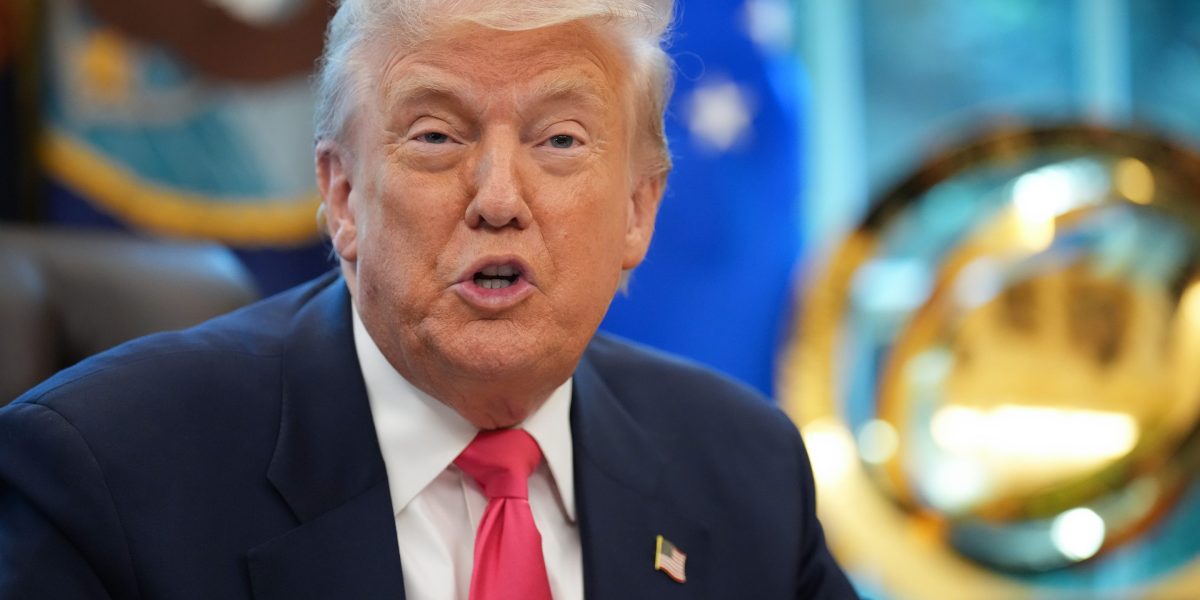
President Donald Trump on Friday announced the U.S. government has secured a 10% stake in struggling Silicon Valley pioneer Intel in a deal that was completed just a couple weeks after he was depicting the company’s CEO as a conflicted leader unfit for the job.

“The United States of America now fully owns and controls 10% of INTEL, a Great American Company that has an even more incredible future,” Trump wrote in a post.

The U.S. government is getting the stake through the conversion of $11.1 billion in previously issued funds and pledges. All told, the government is getting 433.3 million shares of non-voting stock priced at $20.47 apiece — a discount from Friday’s closing price at $24.80. That spread means the U.S. government already has a gain of $1.9 billion, on paper.

The remarkable turn of events makes the U.S. government one of Intel’s largest shareholders at a time that the Santa Clara, California, company is in the process of jettisoning more than 20,000 workers as part of its latest attempt to bounce back from years of missteps taken under a variety of CEOs.

Intel’s current CEO, Lip-Bu Tan, has only been on the job for slightly more than five months, an d earlier this month, it looked like he might be on shaky ground already after some lawmakers raised national security concerns about his past investments in Chinese companies while he was a venture capitalist. Trump latched on to those concerns in an August 7 post demanding that Tan resign.

But Trump backed off after the Malaysian-born Tan professed his allegiance to the U.S. in a public letter to Intel employees and went to the White House to meet with the president, leading to a deal that now has the U.S. government betting that the company is on the comeback trail after losing more than $22 billion since the end of 2023. Trump hailed Tan as “highly respected” CEO in his Friday post.

In a statement, Tan applauded Trump for “driving historic investments in a vital industry” and resolved to reward his faith in Intel. “We are grateful for the confidence the President and the Administration have placed in Intel, and we look forward to working to advance U.S. technology and manufacturing leadership,” Tan said.

Intel’s current stock price is just slightly above where it was when Tan was hired in March and more than 60% below its peak of about $75 reached 25 years ago when its chips were still dominating the personal computer boom before being undercut by a shift to smartphones a few years later. The company’s market value currently stands at about $108 billion – a fraction of the current chip kingpin, Nvidia, which is valued at $4.3 trillion.

The stake is coming primarily through U.S. government grants to Intel through the CHIPS and Science Act that was started under President Joe Biden’s administration as a way to foster more domestic manufacturing of computer chips to lessen the dependence on overseas factories.

But the Trump administration, which has regularly pilloried the policies of the Biden administration, saw the CHIPs act as a needless giveaway and is now hoping to make a profit off the funding that had been pledged to Intel.

“We think America should get the benefit of the bargain,” U.S. Commerce Secretary Howard Lutnick said earlier this week. “It’s obvious that it’s the right move to make.”

About $7.8 billion had been been pledged to Intel under the incentives program, but only $2.2 billion had been funded so far. Another $3.2 billion of the government investment is coming through the funds from another program called “Secure Enclave.”

Although U.S. government can’t vote with its shares and won’t have a seat on Intel’s board of directors, critics of the deal view it as a troubling cross-pollination between the public and private sectors that could hurt the tech industry in a variety of ways.

For instance, more tech companies may feel pressured to buy potentially inferior chips from Intel to curry favor with Trump at a time that he is already waging a trade war that threatens to affect their products in a potential scenario cited by Scott Lincicome, vice president of general economics for the Cato Institute.

“Overall, it’s a horrendous move that will have real harms for U.S. companies, U.S. tech leadership, and the U.S. economy overall,” Lincicome posted Friday.

The 10% stake could also intensify the pressure already facing Tan, especially if Trump starts fixating on Intel’s stock price while resorting to his penchant for celebrating his past successes in business.

Nancy Tengler, CEO of money manager Laffer Tengler Investments, is among the investors who abandoned Intel years ago because of all the challenges facing Intel.

“I don’t see the benefit to the American taxpayer, nor do I see the benefit, necessarily to the chip industry,” Tengler said while also raising worries about Trump meddling in Intel’s business.

“I don’t care how good of businessman you are, give it to the private sector and let people like me be the critic and let the government get to the business of government.,” Tengler said.

Although rare, it’s not unprecedented for the U.S. government to become a significant shareholder in a prominent company. One of the most notable instances occurred during the Great Recession in 2008 when the government injected nearly $50 billion into General Motors in return for a roughly 60% stake in the automaker at a time it was on the verge of bankruptcy. The government ended up with a roughly $10 billion loss after it sold its stock in GM.

The U.S. government’s stake in Intel coincides with Trump’s push to bring production to the U.S., which has been a focal point of the trade war that he has been waging throughout the world. By lessening the country’s dependence on chips manufactured overseas, the president believes the U.S. will be better positioned to maintain its technological lead on China in the race to create artificial intelligence.

Even before gaining the 10% stake in Intel, Trump had been leveraging his power to reprogram the operations of major computer chip companies. The administration is requiring Nvidia and Advanced Micro Devices, two companies whose chips are powering the AI craze, to pay a 15% commission on their sales of chips in China in exchange for export licenses.

—-

Liedtke reported from San Ramon, California.


Source link

Continue Reading

Business

McKinsey’s CFO: Why finance chiefs shouldn’t hit pause on AI right now

Published

on


Good morning. For CFOs, using the words “uncertainty” and “unprecedented” has become second nature this year.

“There’s a bit of fatigue from uncertainty right now,” Yuval Atsmon, CFO of McKinsey, told me when we met in Washington, D.C., to discuss how finance chiefs navigated 2025 and the impact of AI. He often hears some executives joke, “Can we just have something that has a precedent?”

Following President Donald Trump’s so-called Liberation Day, Atsmon said significant uncertainty emerged around the new administration’s economic and geopolitical agenda. “If I look at the peak of uncertainty, what I was focused on as a CFO was: What are the things that I should be doing that would be helpful in any scenario?” Atsmon said. “The worst thing is inaction,” he added. Acting on what you can control builds resilience, he said.

Key questions included: How can you improve liquidity and operational efficiency? What costs can be delayed or eliminated? Which investments are essential, and which can be stopped?

While uncertainty often drives defensive moves, Atsmon noted the importance of reviewing long-standing strategies and seizing competitive opportunities. “I wouldn’t recommend anyone stop making AI investments at this moment,” he said, adding that some actions are still driven by inertia, not strategy.

“The other thing that I think is different in 2025 than it was over the last 100 years is that so much of resource allocation now happens through the technology function of the company,” Atsmon said.

Yet there’s still uncertainty about AI’s readiness to impact the bottom line. McKinsey already uses AI to handle up to 30% of its tasks—such as faster research and better summarization—but “you can’t really do a full strategic analysis yet,” he said. Timelines vary widely by company.

Atsmon pointed to new McKinsey research estimating profound changes in how work is done by 2030. People will need to reorganize how they create value or take on different activities. For CFOs, curiosity about technology is useful, but the core responsibility is enabling the organization to respond at the right pace—neither moving so fast that it creates financial strain nor so slowly that competitiveness erodes, he said.

For most organizations, he believes AI efforts should be “80% on productivity for growth and 20% on productivity for efficiency.” The biggest opportunity, he said, lies not in reducing headcount but in unlocking better uses of time.

Ultimately, leveraging AI requires a willingness to reimagine how work gets done. It is a cross-functional C-suite effort. “More than ever,” Atsmon said, “managing uncertainty—economic, geopolitical, and technological—comes down to planning for the best, but also preparing for the worst.”

SherylEstrada
sheryl.estrada@fortune.com

Leaderboard

Jennifer DiRico was appointed EVP and CFO of PTC (Nasdaq: PTC), effective Jan. 1. DiRico succeeds Kristian Talvitie, who will continue to serve as CFO through Dec. 31. DiRico’s experience ranges from large-scale enterprise software organizations to high-growth technology companies. She currently serves as CFO of Commvault, a cyber resilience company. Before Commvault, DiRico spent several years at Toast in finance and operations leadership roles.

David Hastings was appointed CFO of Trevi Therapeutics, Inc. (Nasdaq: TRVI), a clinical-stage biopharmaceutical company, effective Jan. 6. Hastings brings over 25 years of financial leadership experience. Most recently, he was CFO at Arbutus from June 2018 until March 2025. Previously, he was SVP and CFO of Unilife from 2015 until 2017.  Prior to that, Hastings spent the majority of his career as CFO and EVP at Incyte. 

Big Deal

“Global Economic Outlook Q1 2026: AI Tailwinds Boost Otherwise Weak Growth” is an economic research report published by S&P Global Ratings. Some key takeaways from the report include that global growth is holding up better than expected into 2026, helped by AI-driven investment and exports, even as underlying demand stays relatively soft. Also, forecasts have been revised up in many countries, but policy uncertainty, labor markets, bond yields, and the risk that AI underdelivers on earnings all remain key threats to the outlook.

Going deeper

KPMG’s latest “M&A trends in financial services” report is a review of M&A in Q3 for each of the banking, capital markets, and insurance sectors, with the latest data and top deals, as well as an outlook for M&A.

“Momentum from the prior quarter, driven by regulatory rollback and private equity interest, persisted in the third quarter of 2025,” according to the report. “However, inflation, credit quality concerns, trade policy uncertainty, and geopolitical tensions posed significant challenges, requiring adept navigation.”

Overheard

“In the days after the acquisition was completed, I was asked during a media interview if good luck was a factor in bringing together these two tech industry stalwarts. Replace good luck with good timing, and the answer is a resounding, ‘Yes!'”

Amit Walia, the CEO of Informatica, a Salesforce company, writes in a Fortune opinion piecetitled, “Why the timing was right for Salesforce’s $8 billion acquisition of Informatica—and for the opportunities ahead.”


Source link

Continue Reading

Business

Fortune Brainstorm AI San Francisco starts today, with Databricks, OpenAI, Cursor, and more on deck

Published

on


It’s been a crazy few weeks in AI.

Granted, it feels like it’s always been a crazy few weeks in AI. But this cycle has been especially notable: Reports that Sam Altman has declared a “code red” around improving ChatGPT have made waves, while Databricks is reportedly in talks to raise at a jaw-dropping $134 billion valuation. Anthropic is reportedly looking at a real-life IPO, and everyone’s always watching for news from perhaps the biggest ascent of the year: Cursor, the AI coding juggernaut that’s now valued at more than $29 billion. 

And today, Brainstorm AI starts, and so many of these key players will be with us live in San Francisco, including Databricks CEO Ali Ghodsi, OpenAI COO Brad Lightcap, Cursor CEO Michael Truell, San Francisco Mayor Daniel Lurie, Google Cloud CEO Thomas Kurian, and Rivian CEO RJ Scaringe, plus some starpower from Joseph Gordon-Levitt and Natasha Lyonne. 

If you’re attending the conference, come find me! I’ll realistically be the one running around in a bright pantsuit. And if you can’t make it, we’ll be livestreaming the show, too – tune in here.

See you soon,

See you tomorrow,

Allie Garfinkle
X:
@agarfinks
Email:alexandra.garfinkle@fortune.com
Submit a deal for the Term Sheet newsletter here.

Joey Abrams curated the deals section of today’s newsletter.Subscribe here.

Venture Deals

Antithesis, a Tysons Corner, Va.-based platform designed to validate that software works before it launches, raised $105 million in Series A funding. JaneStreet led the round and was joined by AmplifyVenturePartners, SparkCapital, and others.

ParadigmHealth, a Columbus, Ohio-based clinical research platform, raised $78 million in Series B funding. ARCHVenturePartners led the round and was joined by DFJGrowth and existing investors.

Oxzo, a Santiago, Chile-based provider of oxygenation services for aquaculture, raised $25 million in funding from S2GInvestments.

Quanta, a San Francisco-based accounting platform, raised $15 million in Series A funding. Accel led the round and was joined by OperatorCollective, NavalRavikant, DesignerFund, and others.

LizzyAI, a New York City-based AI-powered talent interviewing company, raised $5 million in seed funding. NEA led the round and was joined by Speedinvest and ZeroPrimeVentures

PvX, a Singapore-based provider of user-acquisition financing for gaming companies, raised $4.7 million in a seed extension from Z Venture Capital, DrivebyDraftKings, and existing investors.

Corma, a Paris, France-based developer of a copilot for AI teams, raised €3.5 million ($4.1 million) in seed funding. XTXVentures led the round and was joined by TuesdayCapital, KimaVentures, 50Partners, OlympeCapital, and angel investors.

Private Equity

NITEOProducts, a portfolio company of HighlanderPartners, acquired Folexport, a Tualatin, Ore.-based manufacturer of carpet, fabric, and hard surface cleaning products. Financial terms were not disclosed.


Source link

Continue Reading

Business

Why the worst leaders sometimes rise the fastest

Published

on


History is crowded with CEOs who have flamed out in very public ways. Yet when the reckoning arrives, the same question often lingers: How did this person keep getting promoted? In corporate America, the phenomenon is known as “failing up,” the steady rise of executives whose performance rarely matches their trajectory. Organizational psychologists say it’s not an anomaly. It’s a feature of how many companies evaluate leadership.

At the core is a well-documented bias toward confidence over competence. Studies consistently show that people who speak decisively, project certainty, and take credit for wins—whether earned or not—are more likely to be perceived as leadership material. In ambiguous environments, boards and senior managers often mistake boldness for ability. As long as a leader can narrate failure convincingly—blaming market headwinds, legacy systems, or uncooperative teams—their upward momentum may continue.

Another driver is asymmetric accountability. Senior executives typically oversee vast, complex systems where outcomes are hard to tie directly to individual decisions. When results are good, credit flows upward. When results are bad, blame diffuses downward, and middle managers, project leads, and market conditions become convenient shock absorbers. This allows underperforming leaders to survive long enough to secure their next promotion.

Then there’s the mobility illusion. In many industries, frequent job changes are read as ambition and momentum rather than warning signs. An executive who leaves after short, uneven tenures can reframe each exit as a “growth opportunity” or a strategic pivot. Recruiters and boards, under pressure to fill top roles quickly, often rely on résumé signals, like brand-name firms, inflated titles, and elite networks, rather than deep performance audits.

Ironically, early visibility can also accelerate failure upward. High-profile roles magnify both success and failure, but they also increase name recognition. An executive who runs a troubled division at a global firm may preside over mediocre results, yet emerge with a reputation as a “big-company leader,” making them attractive for a CEO role elsewhere.

The reckoning usually comes only at the top. As CEO, the buffers disappear. There is no one left to blame, and performance is judged in the blunt language of earnings, stock price, profitability, or layoffs. The traits that once fueled ascent, such as overconfidence, risk-shifting, and narrative control, become liabilities under full scrutiny.

The central lesson for aspiring CEOs is that the very system that rewards confidence, visibility, and narrative control on the way up often masks weak execution until the top job strips those protections away. Future leaders who want to avoid “failing upward” must deliberately build careers grounded in verifiable results and direct ownership of outcomes because at the CEO level, there is no narrative strong enough to substitute for performance.

Ruth Umoh
ruth.umoh@fortune.com

Smarter in seconds

Big biz buy-in. Anthropic is all in on ‘AI safety’—and that’s helping the $183 billion startup win over big business

Old guard upgrade. How the bank founded by Alexander Hamilton is transforming for the future of finance

Pressure test. Inside the Fortune 500 CEO pressure cooker: surviving is harder than ever and requires an ‘odd combination’ of traits

Rank racing. The one-upmanship driving CEOs

Leadership lesson

Anthropic’s Dario Amodei on when a startup gets too big to know all employees: “It’s an inevitable part of growth.”

News to know

Investors are questioning OpenAI’s profitability amid its massive spending while increasingly viewing Alphabet as the deeper-pocketed winner in the AI race. Fortune

Trump warned that Netflix’s $72 billion bid for Warner Bros. Discovery could face antitrust scrutiny, suggesting it would create an overly dominant force in streaming. Fortune

An etiquette camp is trying to help Silicon Valley shed its sloppy image by teaching tech elites how to dress and behave as their influence grows. WaPo

IBM is reportedly in advanced talks to buy data-infrastructure firm Confluent for about $11 billion, bolstering its AI data capabilities. WSJ

Even as women reach top roles in politics and business at record levels, public confidence in their leadership is stagnating or declining. Bloomberg

Terence “Bud” Crawford, the undefeated 38-year-old boxing champion, has earned more than $100 million and even turned Warren Buffett into a fan. Forbes

Big Tech leaders now warn that artificial intelligence is advancing to the point where it could begin replacing even CEOs, reshaping the very top of corporate leadership. WSJ

This is the web version of the Fortune Next to Lead newsletter, which offers strategies on how to make it to the corner office. Sign up for free.


Source link

Continue Reading

Trending

Copyright © Miami Select.