Connect with us

Business

Trump’s ‘Department of War’ rebrand could cost $125 million, says the CBO

Published

on


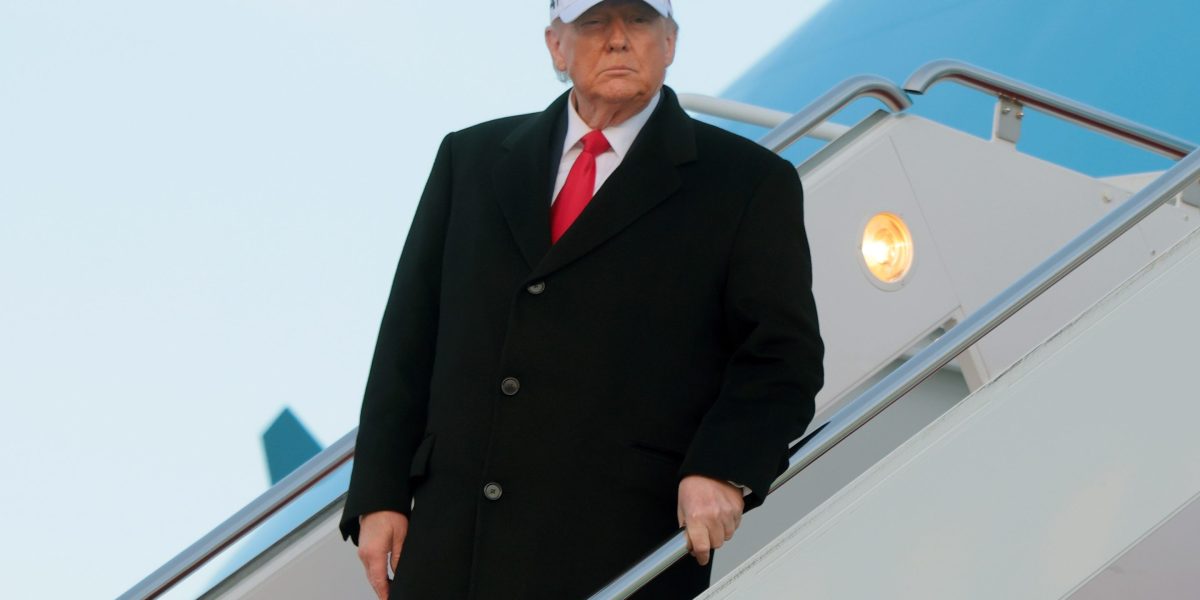
President Trump’s bid to knock four letters off the “Department of Defense” in a rebrand to the “Department of War” could cost upwards of $100 million, the Congressional Budget Office (CBO) has estimated.

On September 5, the president signed an executive order to restore the George Washington-era names of the Department of War and the Office of the Secretary of War as secondary titles for the Department of Defense and the Office of the Secretary of Defense.

Within that order was a stipulation that the Secretary of War would later submit a presidential application to permanently change the name of the department.

However, rebranding the nation’s biggest employer is no small task. The Pentagon oversees 1.32 million people in active duty and 750,000 civilian personnel.

According to the CBO, which responded to a request for information from senators Jeff Merkley and Chuck Schumer, the shift would cost about $10 million for a “modest implementation” of the change, primarily within the department itself. This sum could be absorbed as an opportunity cost, the CBO added, paid out of existing budgets.

But there are two ends to the scale: Minimal implementation might cost a measly few million, the CBO said, but on the extreme end it could cost taxpayers $125 million.

“Broadly, the costs would include staff time spent updating document templates, revising websites, or modifying letterhead, time that could be devoted to the activities that the department had planned to conduct before the executive order was issued,” the CBO wrote. “Similarly, funds used for signage or ceremonial items could reduce resources available for planned items or activities.”

The scale of the costs depends on how “aggressively” the rebrand is rolled out, and how it would be prioritized against remaining activities and “ongoing missions.” A more aggressive rollout, for example, might include “immediately replacing stationery, signage, and nameplates” as opposed to replacing them when existing stock runs out.

“The faster the changes were implemented, the more parts of DoD that the changes applied to, and the more complete the renaming, the costlier it would be,” the CBO added.

“Under President Trump’s leadership, the now aptly-named Department of War is refocused on readiness and lethality—and its title now reflects its status as the most powerful fighting force in the world,” the White House told Fortune. “The White House is working hand-in-glove with the Department of War on implementation of the executive order.”

One of the most expensive endeavours in the proposed change would be renaming the air bases. Even back in March 2023, the Army projected that it would cost at least $39 million to rename nine posts: Forts AP Hill, Benning, Bragg, Gordon, Hood, Lee, Pickett, Polk, and Rucker. That was nearly double an estimate by the Naming Commission a year prior, which put the price at $21 million.

There are also costs incurred for other non-federal entities if the Department of War decides to push its name change through as a blanket approach. For example, the CBO points out that North Carolina spent $400,000 in 2023 to change the name of Fort Bragg to Fort Liberty, just to change it back to Fort Bragg again last summer.


Source link

Continue Reading

Business

As Trump helps Gen Z on student debt, watchdog calls it an ‘incoherent political giveaway’

Published

on


The Trump administration’s announcement on Friday of an indefinite pause on the collection of defaulted federal student loan debt, including through the Treasury Offset Program, at least temporarily extends a program that began more than half a decade ago, as a temporary pandemic measure under the first Trump Administration. It has since been extended through both bipartisan legislation and administrative action during the Biden administration.  

The student-debt relief will likely come as relief to many members of Gen Z, who, as Fortune‘s Jacqueline Munis recently reported, average $94,000 in student-loan debt, driving them into “disillusionomics.” Other pundits, notably Kyla Scanlon, have riffed on the concept of “financial nihilism,” as coined by entrepreneur Demetri Kofinas, to describe how Gen Z’s crushing anxiety over their own futures—be it artificial intelligence, the $38 trillion national debt, or any other long-running financial emergency—drive them to destructive behaviors.

Trump, for his part, has been scrambling to address voter concerns about “affordability,” and has been reportedly in close contact, even texting back and forth in what the New York Post calls a “bromance,” with the bard of affordability himself: New York City Mayor Zohran Mamdani.

In the opinion of the Committee for a Responsible Federal Budget, though, the nonpartisan watchdog that stresses sustainability in fiscal policy, there is no excuse for this development.

CRFB President Maya MacGuineas called the decision “beyond ridiculous,” coming six years removed from the Covid pandemic that first put a stop to student-debt collections.

“This is an incoherent political giveaway, doubling down on the debt cancelation from the Biden era,” she wrote. “We’re not in a pandemic or financial crisis or deep recession. There’s no justification for emergency action on student debt, and no good reason the for the President to back down on efforts to actually begin collecting debt payments again.”

CRFB estimated that Trump’s pivot away from collections would cost about $5 billion a year in lost revenue.

A new pause, old playbook

Until now, Trump’s second-term team had been moving in the opposite direction, restarting the Treasury Offset Program in May 2025 and preparing to resume wage garnishment for borrowers in default. The new policy abruptly reverses that trajectory by restoring and extending a freeze that critics say was supposed to be temporary and tied to the COVID crisis, not a permanent fixture of higher-education finance.

MacGuineas argued that by blocking collections, the administration risks undermining “historic cost-saving reforms” to the federal student loan program that Congress approved this year to put the system on a more sustainable footing with a “fair repayment system.” She warned that taxpayers will end up paying more while borrowers could ultimately face larger balances, and the wider economy could feel upward pressure on interest rates and inflation.

Clash over Congress’s role

At the heart of the fight is who should shape the future of student lending: Congress or the president acting alone. Lawmakers this year enacted significant reforms meant to trim long-term costs and cement a more predictable repayment framework, and the CRFB credits the Trump administration with implementing those changes “with fiscal costs in mind” until now.

“The student loan program isn’t supposed to be a tool to stimulate the economy or buy votes,” MacGuineas argued, “it’s a way to help millions of students access college.” The White House should work with Congress to reform the collection of defaulted loans if that’s what it really wants to do, “But loans are supposed to be repaid, and the Administration should start collecting,” she added.

The action came just days after Trump took another page out of Mamdani’s democratic socialist playbook, suggesting a 10% cap on credit card interest rates. His former communications director, Anthony Scaramucci, suggested that this “hard-left” move could only have come from one place: his text message bromance with the princeling of Gotham.


Source link

Continue Reading

Business

ChatGPT tests ads as a new era of AI begins

Published

on


Two days after Google insisted there are no current plans for ads in its Gemini AI app, OpenAI announced Friday that it is starting to test ads in ChatGPT.

OpenAI CEO of applications Fidji Simo said in a blog post that ads will begin appearing at the bottom of the chatbot’s answers for free users and for Go subscribers (who pay $8 a month) in the U.S. in the coming weeks, opening an important new source of revenue for the high-flying startup which has been valued by investors at $500 billion.

It’s a moment many in tech have long viewed as inevitable: Running frontier AI models is brutally expensive, burning through staggering amounts of computing power, electricity, and GPUs. Advertising’s revenue stream is hard to resist. OpenAI expects to generate “low billions” of dollars in revenue this year, and more each year thereafter, the FT reported on Friday citing an unnamed person “close to the company.”

While Google has so far held back from putting ads in its standalone Gemini chatbot app, the company has incorporated ads into the AI Overviews that appear in its online search results, a move viewed as essential as the company seeks to extend its $265 billion a year advertising business into the AI age.

OpenAI said in its blog post that the forthcoming ads will be clearly labeled, and that users’ conversations with ChatGPT would be kept private. “You need to know that your data and conversations are protected and never sold to advertisers,” the company said. “We need to keep a high bar and give you control over your experience so you see truly relevant, high-quality ads—and can turn off personalization if you want.” In addition, it said that ads will not influence ChatGPT’s answers, which it said “are optimized based on what’s most helpful to you.”

OpenAI emphasized that subscriptions remain its long-term priority, and said that the $20 per month Plus and $200 per month Pro subscriptions, as well as the Business Enterprise version of the product, will remain ad-free. “Our enterprise and subscription businesses are already strong, and we believe in having a diverse revenue model where ads can play a part in making intelligence more accessible to everyone,” the company wrote.

Still, the company doubled down on tying the introduction of ads with its overall mission to ensure that advanced general intelligence, or AGI, “benefits all of humanity,” Simo wrote.

In a separate blog post on Friday, OpenAI said that “ads support our commitment to making AI accessible to everyone by helping us keep ChatGPT available at free and affordable price points.”


Source link

Continue Reading

Business

The Nobel Prize committee doesn’t want Trump getting one, even as a gift—but they treated Obama very differently

Published

on


The Nobel Prize medal has always carried a symbolic weight far beyond its gold content, but in recent years it has also become a mirror for political anxieties, presidential legacies, and staggering wealth.

Some critics argue that the Nobel Committee embarrassed Barack Obama by honoring him too early in his presidency, but the Norway-based awarding panel seems determined to keep Donald Trump away from the honor.

And while the Peace Prize remains tightly controlled, the physical medals themselves have fetched up to $103.5 million at auction, underscoring how the committee may say whatever it wants, but these prizes can go to the highest bidder.​

When Obama accepted the Nobel Peace Prize in 2009, less than a year into his first term, he said he was humbled and undeserving of it. The committee cited his “extraordinary efforts to strengthen international diplomacy.” But his subsequent decisions to send more troops to Afghanistan and wage a bombing campaign via drone would darken the glow of Oslo’s optimism. Even Geir Lundestad, the former Nobel secretary, wrote in his memoir, Secretary of Peace, that he regretted the decision: “Even many of Obama’s supporters believed that the prize was a mistake. In that sense the committee didn’t achieve what it had hoped for.”

Obama’s successor has been reportedly desirous of the same honor, with reports attributing his lust for Nobel glory as the reason that he slapped India with a shocking 50% tariff, as Prime Minister Narendra Modi disagreed with Trump’s claim that he deserved the Nobel for stopping a war between India and Pakistan.

Similarly, Trump’s apparent desire for a Nobel plays a role in the fate of Venezuela. Opposition leader Maria Corina Machado, (who was recently in hiding and fearing for her life from the Maduro regime, won the prize in 2025 but gave it to Trump while meeting him at the White House on Thursday.

Despite receiving the award, he gave no indication about plans for holding elections in the country, and the White House reiterated Trump’s assessment that Machado lacks the support to lead Venezuela. Instead, Trump favors Delcy Rodriguez, who was sworn in as interim president.

The Nobel Committee waded in to clarify that Machado cannot give Trump her prize, but Machado told reporters that she did so anyway.

The episodes illustrate a core quirk of Nobel protocol: the title is immovable, but the tangible benefits are entirely in the laureate’s hands.​

Nobel for sale

Obama tried to defuse some of the controversy around his award by redirecting the spotlight. He donated his entire $1.4 million cash award to a slate of charities, including groups focused on veterans and students, effectively “regifting” the prize money rather than keeping it. Tax experts parsed the move, noting that the gesture was treated as charitable giving for U.S. tax purposes.

The Nobel rules leave no room for that kind of pass-the-parcel prestige: the committee alone decides recipients, and prizes cannot be transferred, re-awarded, or post‑facto reassigned for political convenience. After decades of criticism over premature or politically fraught awards, the institution has grown more cautious, keen to avoid any appearance that a Peace Prize could be used to launder reputations already hardened in the public mind.​

Yet while the committee guards its symbolic authority, the open market has been less restrained. Over the last decade, Nobel medals have quietly evolved into some of the most spectacular lots on the global auction circuit. The watershed moment came in 2022, when Russian journalist Dmitry Muratov’s Nobel Peace Prize medal was sold to benefit Ukrainian child refugees, blasting past all expectations to raise an unprecedented $103.5 million.

Other medals have followed a different script, revealing more mundane – and more American – realities. Physicist Leon Lederman’s medal was sold to help cover his medical expenses, prompting outcries about the dysfunction of the U.S. health system. “Only in America,” wrote Sarah Kliff of the Physicians for a National Health Program.

The Nobel Committee cannot stop any of this. It cannot undo Obama’s early‑term Peace Prize, and it cannot engineer or block a future prize simply to manage how history will judge an American president. It also cannot prevent laureates from turning their medals into liquid capital, even when the hammer price reaches nine figures.


Source link

Continue Reading

Trending

Copyright © Miami Select.