Connect with us

Business

Trump’s ‘AI Action Plan’ to mix tech industry wishlist with culture war attacks on ‘woke AI’

Published

on


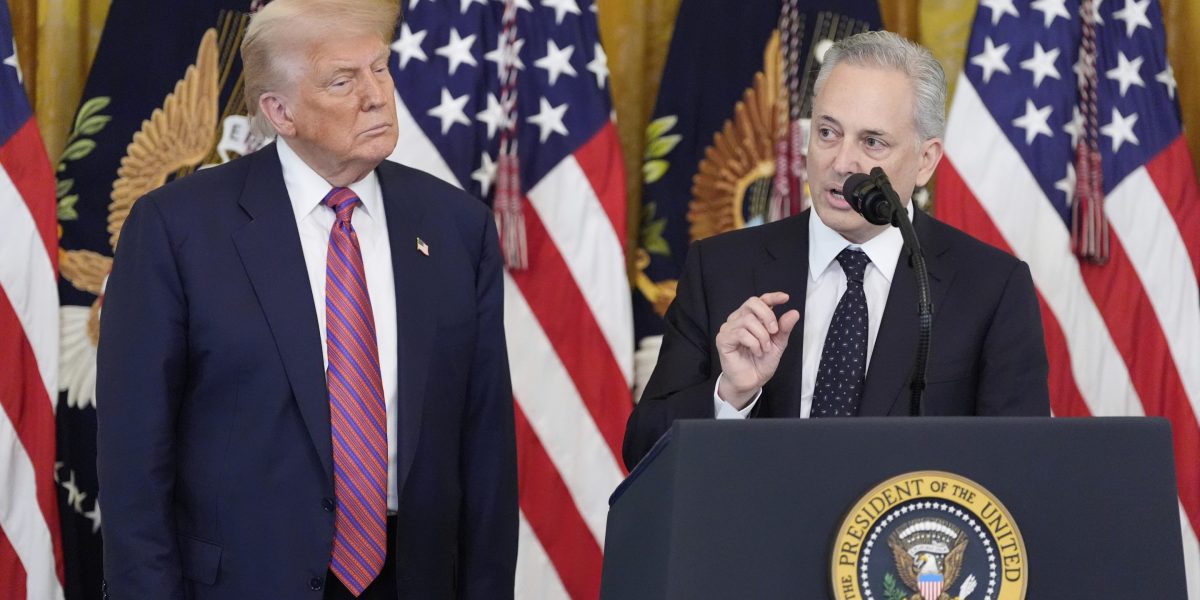
Trump on Wednesday is planning to reveal an “AI Action Plan” he ordered after returning to the White House in January. He gave his tech advisers six months to come up with new AI policies after revoking President Joe Biden’s signature AI guardrails on his first day in office.

The unveiling is co-hosted by the bipartisan Hill and Valley Forum and the All-In Podcast, a business and technology show hosted by four tech investors and entrepreneurs who include Trump’s AI czar, David Sacks.

The plan and related executive orders are expected to include some familiar tech lobby pitches. That includes accelerating the sale of AI technology abroad and making it easier to construct the energy-hungry data center buildings that are needed to form and run AI products, according to a person briefed on Wednesday’s event who was not authorized to speak publicly and spoke on condition of anonymity.

It might also include some of the AI culture war preoccupations of the circle of venture capitalists who endorsed Trump last year.

Blocking ‘woke AI’ from tech contractors

Countering the liberal bias they see in AI chatbots such as ChatGPT or Google’s Gemini has long been a rallying point for the tech industry’s loudest Trump backers.

Sacks, a former PayPal executive and now Trump’s top AI adviser, has been criticizing “woke AI” for more than a year, fueled by Google’s February 2024 rollout of an AI image generator that, when asked to show an American Founding Father, created pictures of Black, Latino and Native American men.

“The AI’s incapable of giving you accurate answers because it’s been so programmed with diversity and inclusion,” Sacks said at the time. Google quickly fixed its tool, but the “Black George Washington” moment remained a parable for the problem of AI’s perceived political bias, taken up by X owner Elon Musk, venture capitalist Marc Andreessen, Vice President JD Vance and Republican lawmakers.

The administration’s latest push against “woke AI” comes a week after the Pentagon announced new $200 million contracts with four leading AI companies, including Google, to address “critical national security challenges.”

Also receiving one of the contracts was Musk’s xAI, which has been pitched as an alternative to “woke AI” companies. The company has faced its own challenges: Earlier this month, xAI had to scramble to remove posts made by its Grok chatbot that made antisemitic comments and praised Adolf Hitler.

Streamlining AI data center permits

Trump has paired AI’s need for huge amounts of electricity with his own push to tap into U.S. energy sources, including gas, coal and nuclear.

“Everything we aspire to and hope for means the demand and supply of energy in America has to go up,” said Michael Kratsios, the director of the White House’s Office of Science and Technology Policy, in a video posted Tuesday.

Many tech giants are already well on their way toward building new data centers in the U.S. and around the world. OpenAI announced this week that it has switched on the first phase of a massive data center complex in Abilene, Texas, part of an Oracle-backed project known as Stargate that Trump promoted earlier this year. Amazon, Microsoft, Meta and xAI also have major projects underway.

The tech industry has pushed for easier permitting rules to get their computing facilities connected to power, but the AI building boom has also contributed to spiking demand for fossil fuel production that will contribute to global warming.

United Nations Secretary-General Antonio Guterres on Tuesday called on the world’s major tech firms to power data centers completely with renewables by 2030.

“A typical AI data center eats up as much electricity as 100,000 homes,” Guterres said. “By 2030, data centers could consume as much electricity as all of Japan does today.”

A new approach to AI exports?

It’s long been White House policy under Republican and Democratic administrations to curtail certain technology exports to China and other adversaries on national security grounds.

But much of the tech industry argued that Biden went too far at the end of his term in trying to restrict the exports of specialized AI computer chips to more than 100 other countries, including close allies.

Part of the Biden administration’s motivation was to stop China from acquiring coveted AI chips in third-party locations such as Southeast Asia or the Middle East, but critics said the measures would end up encouraging more countries to turn to China’s fast-growing AI industry instead of the U.S. as their technology supplier.

It remains to be seen how the Trump administration aims to accelerate the export of U.S.-made AI technologies while countering China’s AI ambitions. California chipmakers Nvidia and AMD both announced last week that they won approval from the Trump administration to sell to China some of their advanced computer chips used to develop artificial intelligence.

AMD CEO Lisa Su is among the guests planning to attend Trump’s event Wednesday.

Who benefits from Trump’s AI action plan

There are sharp debates on how to regulate AI, even among the influential venture capitalists who have been debating it on their favorite medium: the podcast.

While some Trump backers, particularly Andreessen, have advocated an “accelerationist” approach that aims to speed up AI advancement with minimal regulation, Sacks has described himself as taking a middle road of techno-realism.

“Technology is going to happen. Trying to stop it is like ordering the tides to stop. If we don’t do it, somebody else will,” Sacks said on the All-In podcast.

On Tuesday, 95 groups including labor unions, parent groups, environmental justice organizations and privacy advocates signed a resolution opposing Trump’s embrace of industry-driven AI policy and calling for a “People’s AI Action Plan” that would “deliver first and foremost for the American people.”

Amba Kak, co-executive director of the AI Now Institute, which helped lead the effort, said the coalition expects Trump’s plan to come “straight from Big Tech’s mouth.”

“Every time we say, ‘What about our jobs, our air, water, our children?’ they’re going to say, ‘But what about China?’” she said in a call with reporters Tuesday. She said Americans should reject the White House’s argument that the industry is overregulated and fight to preserve “baseline protections for the public” as AI technology advances.


Source link

Continue Reading

Business

New contract shows Palantir working on tech platform for another federal agency that works with ICE

Published

on


Palantir, the artificial intelligence and data analytics company, has quietly started working on a tech platform for a federal immigration agency that has referred dozens of individuals to U.S. Immigration and Customs Enforcement for potential enforcement since September.

The U.S. Citizenship and Immigration Services agency—which handles services including citizenship applications, family immigration, adoptions, and work permits for non-citizens—started the contract with Palantir at the end of October, and is paying the data analytics company to implement “Phase 0” of a “vetting of wedding-based schemes,” or “VOWS” platform, according to the federal contract, which was posted to the U.S. government website and reviewed by Fortune.

The contract is small—less than $100,000—and details of what exactly the new platform entails are thin. The contract itself offers few details, apart from the general description of the platform (“vetting of wedding-based schemes”) and an estimate that the completion of the contract would be Dec. 9.Palantir declined to comment on the contract or nature of the work, and USCIS did not respond to requests for comment for this story.

But the contract is notable, nonetheless, as it marks the beginning of a new relationship between USCIS and Palantir, which has had longstanding contracts with ICE, another agency of the Department of Homeland Security, since at least 2011. The description of the contract suggests that the “VOWS” platform may very well be focused on marriage fraud and related to USCIS’ recent stated effort to drill down on duplicity in applications for marriage and family-based petitions, employment authorizations, and parole-related requests.

USCIS has been outspoken about its recent collaboration with ICE. Over nine days in September, USCIS announced that it worked with ICE and the Federal Bureau of Investigation to conduct what it called “Operation Twin Shield” in the Minneapolis-St. Paul area, where immigration officials investigated potential cases of fraud in immigration benefit applications the agency had received. The agency reported that its officers referred 42 cases to ICE over the period. In a statement published to the USCIS website shortly after the operation, USCIS director Joseph Edlow said his agency was “declaring an all-out war on immigration fraud” and that it would “relentlessly pursue everyone involved in undermining the integrity of our immigration system and laws.” 

“Under President Trump, we will leave no stone unturned,” he said.

Earlier this year, USCIS rolled out updates to its policy requirements for marriage-based green cards, which have included more details of relationship evidence and stricter interview requirements.

While Palantir has always been a controversial company—and one that tends to lean into that reputation no less—the new contract with USCIS is likely to lead to more public scrutiny. Backlash over Palantir’s contracts with ICE have intensified this year amid the Trump Administration’s crackdown on immigration and aggressive tactics used by ICE to detain immigrants that have gone viral on social media. Not to mention, Palantir inked a $30 million contract with ICE earlier this year to pilot a system that will track individuals who have elected to self-deport and help ICE with targeting and enforcement prioritization. There has been pushback from current and former employees of the company alike over contracts the company has with ICE and Israel.

In a recent interview at the New York Times DealBook Summit, Karp was asked on stage about Palantir’s work with ICE and later what Karp thought, from a moral standpoint, about families getting separated by ICE. “Of course I don’t like that, right? No one likes that. No American. This is the fairest, least bigoted, most open-minded culture in the world,” Karp said. But he said he cared about two issues politically: immigration and “re-establishing the deterrent capacity of America without being a colonialist neocon view. On those two issues, this president has performed.”


Source link

Continue Reading

Business

CoreWeave CEO: Despite see-sawing stock, IPO was ‘incredibly successful’ amid challenges of tariff timing

Published

on


CoreWeave has been rocked by dizzying stock swings—with its stock currently trading 52% below its post-IPO high—and a frequent target of market commentators, but CEO Michael Intrator says the company’s move to the public markets has been “incredibly successful. And he takes the public’s mixed reaction in stride, given the novelty of CoreWeave’s “neocloud” business which competes with established cloud providers like Amazon AWS and Google Cloud.

“When you introduce new models, introduce a new way of doing business, disrupt what has been a static environment, it’s going to take some people some time,” Intrator said Tuesday at Fortune’s Brainstorm AI conference in San Francisco. But, he added, more people are beginning to understand the CoreWeave’s business model.

“We came out into one of the most challenging environments,” Intrator said of CoreWeave’s March IPO, which occurred very close to President Trump’s “Liberation Day” tariffs in April. “In spite of the incredible headwinds, we’re able to launch a successful IPO.”

CoreWeave, which priced its IPO at $40 per share, has experienced frequent severe up-and-down price swings in the eight months since its public market debut. At its closing price of $90.66 on Tuesday, the stock remains well above its IPO price.

As Fortune reported last month, CoreWeave’s rapid rise has been fueled by an aggressive, debt-heavy strategy to stand up data centers at unprecedented speed for AI customers. And for now, the bet is still paying off. In its third-quarter results released in November, the company said its revenue backlog nearly doubled in a single quarter—to $55.6 billion from $30 billion—reflecting long-term commitments from marquee clients including Meta, OpenAI, and French AI startup Poolside. Both earnings and revenue came in ahead of Wall Street expectations.

But the numbers were not all celebratory. CoreWeave disclosed a further increase in the debt it has taken on to finance its expansion, and it revised its full-year revenue outlook downward—suggesting that, even with historic demand in the pipeline.

With media headlines calling CoreWeave a “ticking time bomb,” with critics calling out insider stock sales, circular financing accusations and an overreliance on Nvidia, Intrator was asked whether he felt CoreWeave was misunderstood.

“Look, we built a company that is challenging one of the most stable businesses that exist—that cloud business, these three massive players,” he said, referring to AWS, Microsoft Azure and Google Cloud.  I feel like it’s incumbent on CoreWeave to introduce a new business model on how the cloud is going to be built and run. And that’s what we’re doing.” 

He repeatedly framed CoreWeave not as a GPU reseller or traditional data-center operator but as a company purpose-built from scratch to deliver high-performance, parallelized computing for AI workloads. That focus, he said, means designing proprietary software that orchestrates GPUs, building and colocating its own infrastructure, and moving “up the stack” through acquisitions such as Weights & Biases and OpenPipe.

Intrator also defended the company’s debt strategy, saying CoreWeave is effectively inventing a new financing model for AI infrastructure. He pointed to the company’s ability to repurpose power sources, rapidly deploy capacity, and finance large-scale clusters as proof it is solving problems incumbents never had to face.

“When I look back at history of the company, it took us a year with with a company investor like Fidelity, before they were like, ‘Oh, I get it,’” he said. “So look, we’ve been public for eight months. I couldn’t be prouder of what the company has accomplished.” 


Source link

Continue Reading

Business

UK launches $965 million plan to get unemployed Gen Z into AI, hospitality, and engineering

Published

on


Some Gen Zers have been desperately trying to break into the job market, sending out thousands of applications, standing on Wall Street with a sign begging for a job, and waitressing at industry conferences to stealthily hand out their résumés. There’s also a growing camp of disillusioned young adults who have completely checked out of education, employment, and training: NEETs. Now, one country is trying to tackle the youth unemployment crisis with a nearly $1 billion plan.

Earlier this week, the U.K. government announced a $965 million investment to create more apprenticeships and place 50,000 young people into roles.

In partnership with regional leaders, the three-year initiative will equip young hopefuls with the skills training needed for local job opportunities. A $186 million chunk of the eye-watering funding will be used for a pilot in which mayors will connect the Gen Zers, especially NEETs, with nearby employers. And to ease the financial burden on some companies, the plan will also cover the full cost of apprenticeships for talent under 25 years old at small and medium-size businesses.

U.K. Gen Zers will have access to more apprenticeship roles in high-demand industries like hospitality and retail. But the government is still paying close attention to the critical skills young professionals need in the age of AI; new short courses in engineering, digital skills, and AI will also start rolling out starting April 2026. This apprenticeship push by the U.K. is all part of Prime Minister Keir Starmer’s master plan to get two-thirds of young people active in higher-level learning and apprenticeships, after a sharp drop in 2017.

“For too long, success has been measured by how many young people go to university. That narrow view has held back opportunity and created barriers we need to break,” Starmer said. “It’s time to change the way apprenticeships are viewed and to put them on an equal footing with university.”

Gen Zers are struggling with unemployment in the U.K. and abroad

The U.K.’s ambitious billion-dollar strategy is a welcome one, as youth unemployment rates have surged all around the world.

During the first half of last year, more than 16%, or almost 460,000 of 18- to 24-year-old U.K. men, were NEETs—the highest rate in over a decade. On a global scale, about a fifth of people between ages 15 and 24 in 2023 were NEET-status. And for those actively on the job-hunt, options are scarce. In 2023 and 2024, more than 1.2 million applications were submitted for just under 17,000 open graduate roles in the U.K., according to the Institute of Student Employers (ISE). 

It marked the highest number of applications per job ever recorded since the ISE started collecting data in 1991.

But across the pond, the situation doesn’t look any better: In 2022, there were roughly 4.3 million jobless Gen Z NEETs in the United States. And as of September this year, 9.4% of men and 9% of women ages 20 to 24 were jobless—more than two times higher than the general 4.4% unemployment rate, according to a FRED analysis of U.S. Bureau of Labor Statistics data. 

What’s more, U.S. officials caution the problem could get even worse. U.S. Sen. Mark Warner (D-Va.) warned that joblessness among recent college graduates could skyrocket to as high as 25% in the next two to three years, thanks to AI. 

Similar to the U.K. government, Warner proposed a job retraining program—and the issue goes beyond party lines. In partnership with Josh Hawley (R-Mo.), they introduced a bill that would require businesses and federal agencies to report any AI-related job disruption to the Department of Labor, with results to be published to the public. 


Source link

Continue Reading

Trending

Copyright © Miami Select.