Connect with us

Business

Trump: Venezuela to sell 30m-50m barrels of ‘high quality’ oil to U.S. at market price

Published

on


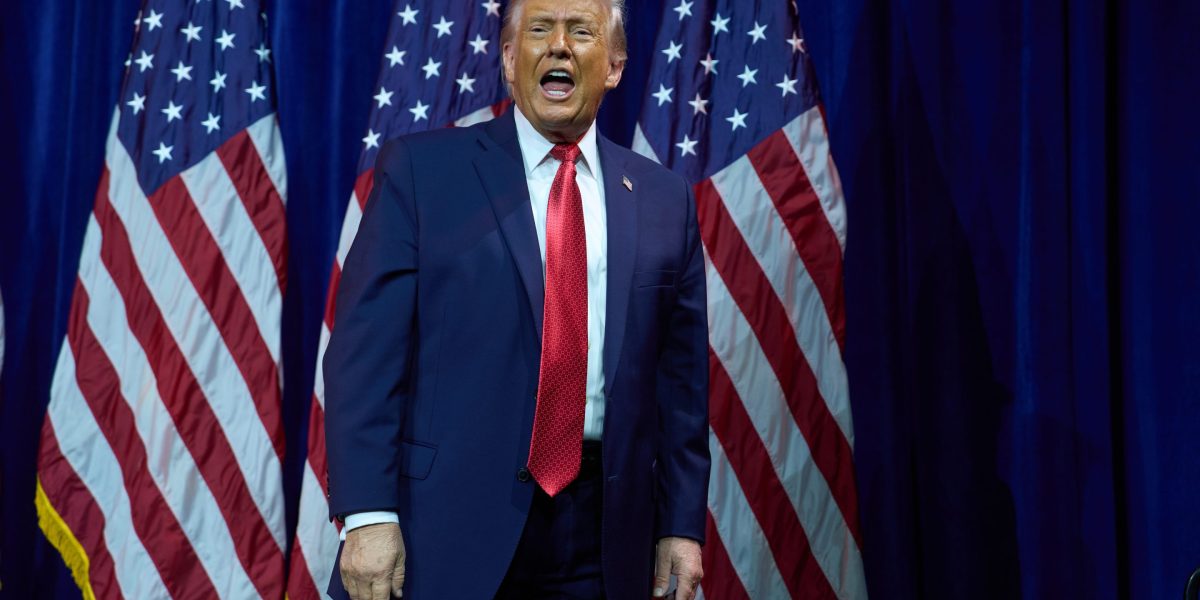
President Donald Trump said Tuesday on his social media site that “Interim Authorities” in Venezuela would be selling 30 million to 50 million barrels of “High Quality” oil to the U.S. at its market price.

“I have asked Energy Secretary Chris Wright to execute this plan, immediately,” Trump posted on Truth Social. “It will be taken by storage ships, and brought directly to unloading docks in the United States.”

Trump said the money would be controlled by him as president but it would be used to benefit the people of Venezuela and the United States.

Separately, the White House is organizing an Oval Office meeting Friday with oil company executives regarding Venezuela, with representatives of Exxon, Chevron and ConocoPhillips expected to attend, according to a person familiar with the matter who requested anonymity to discuss the plans.

THIS IS A BREAKING NEWS UPDATE. AP’s earlier story follows below.

CARACAS, Venezuela (AP) — At least 24 Venezuelan security officers were killed in the dead-of-night U.S. military operation to capture Nicolás Maduro and spirit him to the United States to face drug charges, officials said Tuesday.

Venezuelan officials announced the death count as the country’s acting president, Delcy Rodriguez, pushed back on President Donald Trump, who earlier this week warned she’d face an outcome worse than Maduro’s if she does not “do what’s right” and overhaul Venezuela into a country that aligns with U.S. interests. Trump has said his administration will now “run” Venezuela policy and is pressing the country’s leaders to open its vast oil reserves to American energy companies.

“Personally, to those who threaten me,” Rodriguez said in an address before government agricultural and industrial sector officials. “My destiny is not determined by them, but by God.”

Venezuela’s Attorney General Tarek William Saab said overall “dozens” of officers and civilians were killed in the weekend strike in Caracas and that prosecutors would investigate the deaths in what he described as a “war crime.” He didn’t specify if the estimate was specifically referring to Venezuelans.

In addition to the Venezuelan security officials, Cuba’s government had previously confirmed that 32 Cuban military and police officers working in Venezuela were killed in the raid. The Cuban government says the personnel killed belonged to the Revolutionary Armed Forces and the Ministry of the Interior, the country’s two main security agencies.

Seven U.S. service members were also injured in the raid, according to the Pentagon. Five have already returned to duty, while two are still recovering from their injuries. The injuries included gunshot wounds and shrapnel injuries, according to a U.S. official who was not authorized to comment on the matter publicly and spoke on the condition of anonymity.

A video tribute to the slain Venezuelan security officials posted to the military’s Instagram features faces of the fallen over black-and-white videos of soldiers, American aircraft flying over Caracas and armored vehicles destroyed by the blasts. Meanwhile, the streets of Caracas, deserted for days following Maduro’s capture, briefly filled with masses of people waving Venezuelan flags and bouncing to patriotic music at a state-organized display of support for the government.

“Their spilled blood does not cry out for vengeance, but for justice and strength,” the military wrote in an Instagram post. “It reaffirms our unwavering oath not to rest until we rescue our legitimate President, completely dismantle the terrorist groups operating from abroad, and ensure that events such as these never again sully our sovereign soil.”

Trump grumbles about how Democrats reacted to the raid

Trump on Tuesday pushed back against Democratic criticism of this weekend’s military operation, noting that his Democratic predecessor Joe Biden had also called for the arrest of the Venezuelan leader on drug trafficking charges.

Trump in remarks before a House Republican retreat in Washington grumbled that Democrats were not giving him credit for a successful military operation, even though there was bipartisan agreement that Maduro was not the rightful president of Venezuela.

In 2020, Maduro was indicted in the United States, accused in a decades-long narco-terrorism and international cocaine trafficking conspiracy. White House officials have noted that Biden’s administration in his final days in office last year raised the award for information leading to Maduro’s arrest after he assumed a third term in office despite evidence suggesting that he lost Venezuela’s most recent election. The Trump administration doubled the award to $50 million in August.

“You know, at some point, they should say, ‘You know, you did a great job. Thank you. Congratulations.’ Wouldn’t it be good?” Trump said. “I would say that if they did a good job, their philosophies are so different. But if they did a good job, I’d be happy for the country. They’ve been after this guy for years and years and years.”

Trump’s latest comments came after Secretary of State Marco Rubio and other top officials briefed leaders in Congress late Monday on the Venezuela operation amid mounting concerns that the Republican administration is embarking on a new era of U.S. expansionism without consultation with lawmakers or a clear vision for running the South American country.

Democratic leaders said the session lacked clarity about the Trump administration’s plans for Venezuela. Sen. Tammy Duckworth, D-Ill., an Iraq War veteran, said there is no dispute with Trump that Maduro was a “brutal dictator.”

“But the problem we have is the fact that yet again we have now entered into a war where there is no known off-ramp,” Duckworth said.

What US opinion polls show

Americans are split about the capture of Maduro — with many still forming opinions — according to a poll conducted by The Washington Post and SSRS using text messages over the weekend. About 4 in 10 approved of the U.S. military being sent to capture Maduro, while roughly the same share were opposed. About 2 in 10 were unsure.

Nearly half of Americans, 45%, were opposed to the U.S. taking control of Venezuela and choosing a new government for the country. About 9 in 10 Americans said the Venezuelan people should be the ones to decide the future leadership of their country.

Maduro pleaded not guilty to federal drug trafficking charges in a U.S. courtroom on Monday. U.S. forces captured Maduro and his wife early Saturday in a raid on a compound where they were surrounded by Cuban guards.

In the days since Maduro’s ouster, Trump and top administration officials have raised anxiety around the globe that the operation could mark the beginning of a more expansionist U.S. foreign policy in the Western Hemisphere. The president in recent days has renewed his calls for an American takeover of the Danish territory of Greenland for the sake of U.S. security interests and threatened military action on Colombia for facilitating the global sale of cocaine, while his top diplomat declared the communist government in Cuba is “in a lot of trouble.”

Colombia responds to Trump

Colombia’s Foreign Affairs Minister Rosa Villavicencio said Tuesday she’ll meet with the U.S. Embassy’s charge d’affaires in Bogota to present him with a formal complaint over the recent threats issued by the United States.

On Sunday, Trump said he wasn’t ruling out an attack on Colombia and described its president, who’s been an outspoken critic of the U.S. pressure campaign on Venezuela, as a “sick man who likes making cocaine and selling it to the United States.”

Villavicencio said she’s hoping to strengthen relations with the United States and improve cooperation in the fight against drug trafficking.

“It is necessary for the Trump administration to know in more detail about all that we are doing in the fight against drug trafficking,” she said.

Meanwhile, the leaders of France, Germany, Italy, Poland, Spain and the United Kingdom on Tuesday joined Danish Prime Minister Mette Frederiksen in defending Greenland’s sovereignty. The island is a self-governing territory of the kingdom of Denmark and thus part of the NATO military alliance.

“Greenland belongs to its people,” the statement said. “It is for Denmark and Greenland, and them only, to decide on matters concerning Denmark and Greenland.”

Madhani reported from Washington and Janetsky from Mexico City. AP writers Josh Boak, Konstantin Toropin, Sagar Meghani, Isabel DeBre, Linley Sanders and Manuel Rueda contributed reporting.

This story was originally featured on Fortune.com


Source link

Continue Reading

Business

Investor Michael Burry reveals options bet against Oracle

Published

on


Michael Burry, the famed investor who has drawn attention in recent months for criticism of the artificial intelligence boom, is betting against Oracle Corp.

Burry owns put options on Oracle shares, he said in a Substack post after markets closed on Friday. Puts typically increase in value as the price of the underlying asset falls. Burry, who revealed bearish bets against AI chipmaker Nvidia Corp. and Palantir Technologies Inc. in November, also directly shorted Oracle during the last six months, he said.

Oracle is known for its database software but has recently pushed aggressively into cloud-computing services, requiring a costly build out of data center capacity, for which it is taking on significant debt.

“I do not like how it is positioned or the investments it is making. It did not need to do what it is doing, and I do not know why it is doing this. Maybe ego,” Burry wrote in response to a reader who asked why he had decided to bet against Nvidia and not Oracle. He didn’t disclose details about the put options.

The view follows a volatile year for Oracle shares. The stock jumped 36% in a single session in September after the company issued a bullish forecast for its cloud business, signaling surging demand tied to artificial intelligence. Those gains quickly faded, however, as investors focused on rising capital expenditures, questions around the structure of some cloud deals and a swelling debt load linked to data-center expansion. Oracle finished the year about 40% below its September peak.

Oracle has about $95 billion of debt outstanding, making it the biggest corporate issuer outside the financial sector in the Bloomberg high-grade index. The company didn’t immediately respond to a request for comment outside of regular business hours.

Burry, who became famous for betting against the US housing market during the 2008 financial crisis, said he has avoided shorting larger technology companies whose businesses extend well beyond AI, citing Meta Platforms Inc., Alphabet Inc. and Microsoft Corp. as examples.

“If I short Meta, I’m also shorting its social media and advertising dominance. If I short Alphabet, I’m shorting Google Search in all its forms, Android, Waymo, etc. If I short Microsoft, I’m shorting a global office productivity SaaS goliath,” Burry wrote. “The big ones are not pure shorts on AI.”

Those companies, he said, are likely to rein in spending over time, absorb losses from overbuilt capacity and potentially write down assets, while remaining dominant in their core businesses. “These three will not go away,” he added.

He said he would short OpenAI at a $500 billion valuation, underscoring his broader skepticism about the pace and economics of the AI buildout.

Burry described Nvidia as the most concentrated way to express a bearish view on the artificial intelligence trade.

“Nvidia also is the most loved, and least doubted,” he wrote. “So shorting it is cheap, and its puts are cheaper than some of the other big shorts out there that are more doubted.”


Source link

Continue Reading

Business

No, Trump can’t use example of fraud in Minnesota to block childcare subisidies to 5 blue states, judge says

Published

on


A federal judge ruled Friday that President Donald Trump’s administration cannot block federal money for child care subsidies and other programs aimed at supporting low-income families with children from flowing to five Democratic-led states for now.

The states of California, Colorado, Illinois, Minnesota and New York argued that a policy announced Tuesday to freeze billions of dollars in funds for three grant programs is having an immediate impact on them and creating “operational chaos.” In court filings and a hearing earlier Friday, the states contended that the government did not have a legal reason for withholding the money from them.

The U.S. Department of Health and Human Services said it was pausing the funding because it had “reason to believe” the states were granting benefits to people in the country illegally, though it did not provide evidence or explain why it was targeting those states and not others.

U.S. District Judge Arun Subramanian, who was nominated to the bench by President Joe Biden, did not rule on the legality of the funding freeze but said the five states met a legal threshold “to protect the status quo” for at least 14 days while arguments are made in court.

Health department officials did not immediately respond to a request for comment.

The affected programs are the Child Care and Development Fund, which subsidizes child care for 1.3 million children from low-income families; the Temporary Assistance for Needy Families program, which provides cash assistance and job training; and the Social Services Block Grant, a smaller fund that provides money for a variety of programs.

The five states say they receive a total of more than $10 billion a year from the programs.

New York Attorney General Letitia James, who is leading the lawsuit, called the ruling a “critical victory for families whose lives have been upended by this administration’s cruelty.”

The government had requested reams of data from the five states, including the names and Social Security numbers of everyone who received benefits from some of the programs since 2022.

The states argue that the effort is unconstitutional and is intended to go after Trump’s political adversaries rather than to stamp out fraud in government programs — something the states say they already do.

Jessica Ranucci, a lawyer in James’ office, said during the Friday hearing that at least four of the states had already had money delayed after requesting it. She said that if the states can’t get child care funds, there will be immediate uncertainty for providers and families who rely on the programs.

A lawyer for the federal government, Kamika Shaw, said it was her understanding that the money had not stopped flowing to states.

The other 45 states face a new requirement to check attendance at child care centers and submit “strong justification for the use of funds” that aligns with the program’s purpose.

At about the same time the judge stopped the freeze on the child care subsidies, Agriculture Secretary Brooke Rollins announced that the administration would freeze about $130 million a year in funding from her agency to Minnesota.

Rollins said the state’s inability to stop fraud schemes led to the decision. Seventy-eight people have been charged since 2022 — and 57 convicted — after federal prosecutors said the Minnesota nonprofit group Feeding Our Future stole $250 million from a program meant to feed children in need during the COVID-19 pandemic.

Minnesota Gov. Tim Walz’s office did not immediately have a comment Friday evening. The state’s attorney general, Keith Ellison, said he’d fight the new freeze of funds in court.

In a letter to Walz that Rollins shared on social media, she suggested the state could restore its access to the funding by providing justification for how it spent federal dollars over the past year. All the state’s future transactions involving money from the agency will require the same justification, she said.

Walz and Minnesota have become a main target of the administration in Trump’s second term.

Last month the president called the state’s Somali population “garbage” in the wake of the Feeding Our Futures investigation and other fraud cases involving Somali defendants.

And this week the administration launched the largest immigration enforcement operation in history in Minneapolis, leading to a fatal shooting of a woman by an Immigration and Customs Enforcement agent.


Source link

Continue Reading

Business

Down Arrow Button Icon

Published

on


If the current frenzy over artificial intelligence feels familiar to Peter Cappelli, the George W. Taylor professor of management at the Wharton School, it’s because he’s seen this movie before. He points to the period between 2015 and 2017, when major consultancies and the World Economic Forum confidently predicted that driverless trucks would eliminate truck drivers within a few years.

“You didn’t have to think very long to realize that just wasn’t going to make sense in practice,” Cappelli told Fortune on Zoom from his home in Philadelphia.

“You didn’t have to think very long about driverless trucks to think about, okay, what happens when they need gas? You know? Or what happens if they have to stop and make a delivery? And if they have to have an employee sitting with them, of course it defeats the purpose, right?”

Cappelli, who recently partnered with Accenture on a series of podcasts to get to the bottom of what AI is actually doing to jobs, warned against listening too closely to the companies that are talking their book, or trying to sell you on their new products.

“If you’re listening to the people who make the technology, they’re telling you what’s possible, and they’re not thinking about what is practical.”

Over the course of a wide-ranging conversation with Fortune, Cappelli tackled what AI is really doing to work, much like he talked to Fortune previously about how remote work is, actually, quite bad for most organizations.

“I mean, people say I’m a contrarian,” Cappelli said, “but I don’t think so, so much as I just am skeptical about stuff, you know?”

When pointed out this was an inherently contrarian position, Cappelli laughed, before returning to the main point. “I just get nervous with hype.”

He talked to Fortune about how his research fits into the wider picture that defined the back half of 2025, after the influential MIT study that caught the eye on 95% of generative AI pilots failing to generate any meaningful return. His favorite example was a particular case study on a company that actually made AI work, both cutting headcount and boosting productivity. It still didn’t fit neatly with predictions (say, from Elon Musk or Anthropic’s Dario Amodei, that work will soon be optional, or even a hobby). “It’s hugely expensive to do this,” Cappelli said about his findings. “And this was a success.”

Three times the cost

Cappelli detailed the findings of a case study that he participated in, published in the Harvard Business Review, on Ricoh, an insurance claims processor: the exact type of low-level administrative work that AI is supposed to automate easily. The reality of adoption, however, was a financial shock. While the company eventually achieved three times the performance, the transition was anything but cheap. The firm spent a year with a team of six, three of whom were expensive outside consultants, just to get the system running.

“The first thing they discovered,” Capelli said, “is large language models could do this pretty well — at three times the cost of their employees doing it [manually]. Okay, so that’s not going to work.” Cappelli pointed out that the costs included Ricoh paying roughly $500,000 in fees to outside consultants.

Even after optimizing the process, Ricoh was still spending about $200,000 a month on AI fees—more than their total payroll for the task had been. They were able to cut their headcount from 44 to 39, he added, showing just how far from being a massive job killer AI is in practice. His explanation recalls his self-driving truck example.

“The reason they still need employees is that lots of problems have to be chased down, and they’re harder to chase down if they come off of AI,” he said. The good news, he added, is that this Ricoh division will ultimately be three times as productive.

“So that’s the payoff, but it’s not cheap [and] it took a hell of a long time to do.”

Ashok Shenoy, VP of Ricoh USA, told Fortune that, after starting to use AI for “very routine, repetitive, high-volume tasks,” work for humans didn’t disappear, but “shifted toward areas where human judgment and experience add the most value.” In the year or so since the case study was conducted, he noted that Ricoh has successfully applied AI to mid-level, repetitive, time-consuming tasks at scale, and expects to use AI agents to achieve partial or full workflow automation within the next six to 12 months, “with a human-in-the-loop to resolve missing or unclear information and ensure quality.”

While acknowledging the big-ticket costs highlighted by Cappelli, Shenoy noted that this project reached break-even in less than a year, and it’s $200,000 monthly costs are less expensive than the previous operating model. “The shift to AI delivered an estimated 15% total cost reduction, even though it did not rely on significant labor cuts.” Regarding headcount, he said “this exercise was not driven by cost or headcount reduction,” and AI implementation requires creating new roles, redesigning existing ones, and repurposing team members toward higher-value work. He said there haven’t been further job cuts, either, with staffing levels largely stabilizing as productivity increased and volumes grew. “The bigger change was in how people spent their time. They are doing less repetitive work and are more focused on resolving exceptions, maintaining quality and serving customers.”

Performative AI shame in the boardroom

Cappelli said he found similar dynamics in his partnership with Accenture, which looked at Mastercard, Royal Bank of Scotland, and Jabil. “These are all success stories,” he said, and in the long run, they will see productivity will go up. Companies will be able to do more with fewer people but “it’ll take a long while to get there.” He argued that something crucial is being underestimated. “The key thing, though, is just how much work is involved in doing it.”

Also, regarding headcount reductions, Cappelli said that at least in the areas that he researched, which were specific units within each company, he didn’t see any job cuts whatsoever. When contacted for comment by Fortune, Accenture said it largely agrees with Cappelli’s conclusions, and referred back to CEO Julie Sweet’s recent interview with Fortune Editor-in-Chief Alyson Shontell.

According to Cappelli, so much of the noise around AI—and the distance between what’s possible and what’s practical—is driven by what other commentators have called “AI shame.”

Cappelli wasn’t familiar with the “AI shame” phrase, but told Fortune it was “absolutely right” in describing what he’s seen. “They’re pretending so they can say they’re doing something, right?” he said. “So the pressure is just enormous on them to try to make this stuff work, because the investors love the idea.”

The professor cited the Harris Poll’s finding in early 2025 that 74% of CEOs globally felt they’d lose their job in two years if they couldn’t demonstrate AI success, and roughly a third said they were performatively adopting AI without really understanding what it would entail. As The Harris Poll put it: “CEOs estimate that over a third (35%) of their AI initiatives amount to mere ‘AI washing’ for optics and reputation, but offering little to no real business value at all.”

Cappelli described how markets typically celebrate news of layoffs, and even cited research that “phantom layoffs” get announced by companies that never actually occur, because companies are arbitraging the positive stock-market reaction to the news of a potential layoff.

Cappelli predicted a “slow learning curve” will take place, in which CFOs will start realizing “this is super-expensive stuff to put in place.” The problem, according to Cappelli, is that U.S. management has become “spoiled” and increasingly averse to the hard work of organizational change.

“[Employers] think it should be free. It should be cheap. You should just be able to hang a shingle out, and the right people will just show up,” he says. Real AI success, in his opinion, will require “old-fashioned human resources” work: mapping workflows, breaking down jobs into tasks, and having employees work alongside AI “agents” to refine prompts.

“You can’t do it over the top of employees, because the employees really do know how their job is done,” Cappelli said. The professor was withering about what he sees happening in most C-suites, saying they are largely “ducking” the problem of really grappling with this technology.

“They’re not seeing it as an organization change problem and a big one,” he said. “They’re just stressing everybody out and, you know, hoping that it somehow works itself out.”


Source link

Continue Reading

Trending

Copyright © Miami Select.