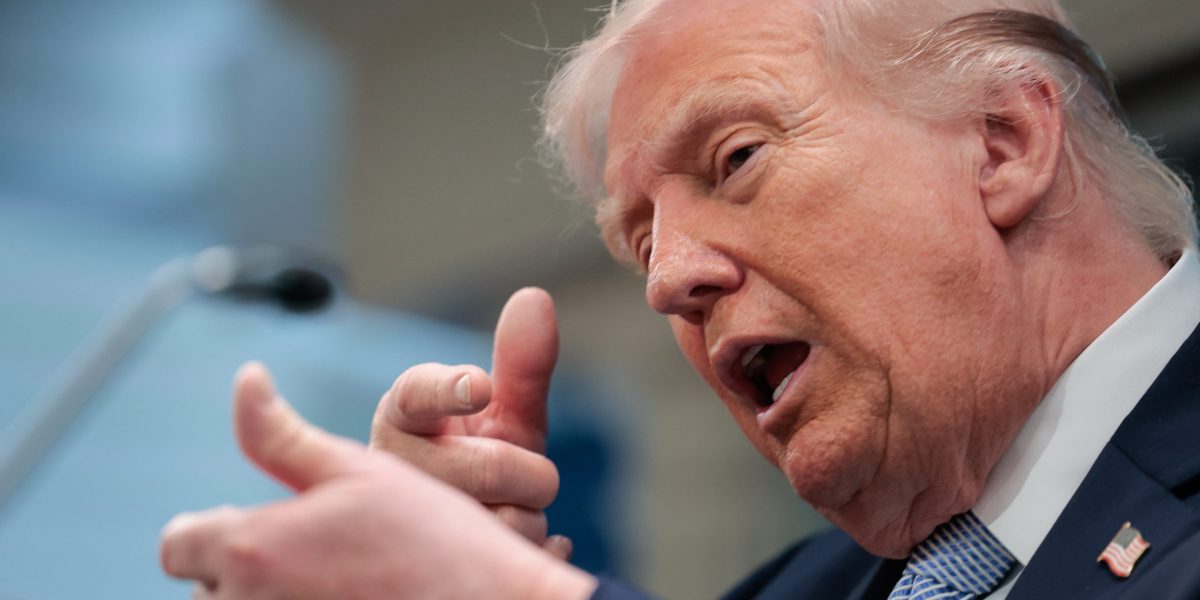
President Donald Trump told reporters Monday that “the entire country” of Iran “can be taken out in one night, and that night might be tomorrow night,” one of his most explicit escalations yet ahead of a Tuesday 8 p.m. ET deadline for Iran to reopen the Strait of Hormuz.
The remark came during a White House press conference that began as a celebration of a dramatic combat rescue of two downed F-15E airmen over Easter weekend and ended with Trump saying that the U.S. is going to be the one charging tolls in the Strait of Hormuz.
Repeatedly, Trump emphasized his final ultimatum: Open the strait or lose your infrastructure. “After that, they’re gonna have no bridges. They’re gonna have no power plants, Stone Ages,” he said.
There are a few ways to interpret Trump’s apocalyptic comments about what the U.S. will do to Iran. Fears spread online that the president was talking about leveling the country, perhaps with a nuclear weapon.
But that would amount to a massive escalation and a huge loss of life that would have catastrophic consequences for both the Iranian people and his own presidency.
More likely, Trump is talking about disrupting Iran’s electrical grid, and the U.S. has a weapon designed for exactly this purpose: the graphite bomb, also known as the “blackout bomb.”
The bomb, officially designated the BLU-114/B, doesn’t destroy power infrastructure with explosives. Instead, it releases dense clouds of chemically treated carbon fiber filaments that drape over transformers and high-voltage lines, causing short circuits that cascade throughout the grid.
So even though the lights go out, the physical equipment remains largely intact, avoiding significant permanent damage to Iran’s economic infrastructure.
The U.S. has used these bombs before. The Navy deployed carbon-fiber warheads on Tomahawk missiles in the opening hours of the 1991 Gulf War, disabling roughly 85% of Iraq’s electricity supply. Later in the decade, the Air Force deployed the more advanced BLU-114/B during the NATO bombing in the Balkans, knocking out more than 70% of Serbia’s national grid in a single night and plunging the country into darkness.
Iran’s grid might be more challenging to “take out.” For one, it’s massive; roughly 130 thermal plants with a combined capacity of 78,000 megawatts, spread across a country more than three times the size of Iraq. However, Iran’s grid is also not at the top of its game. Even before the war, it was suffering from chronic blackouts and massive electricity shortfalls.
The ‘discombobulator’
There’s also a chance that the U.S. could use a more mysterious weapon. Trump drew a direct line from the Easter weekend rescue operation to the January raid that captured Venezuelan dictator Nicolás Maduro, framing both as proof of concept.
“If you look at what we did with Maduro, we went into a military compound, massive, with thousands and thousands of soldiers, and within a matter of minutes … he was in the back of these planes,” he said Monday.
In the immediate aftermath of that operation, Trump referenced a weapon he called “the discombobulator,” which, he said, was designed to disable defensive systems.
On Monday, he alluded again to classified capabilities, describing how Venezuelan forces “pressed the button, nothing happened. They pressed it again and again, nothing happened … There’s a reason it didn’t work. Someday we’ll explain that to people.”
There’s been speculation that that weapon was a sonic or directed-energy weapon. A Venezuelan guard’s account, shared on social media by White House press secretary Karoline Leavitt, described an “intense sound wave” that left defenders bleeding from their noses, vomiting, and unable to stand.
Trump deflected questions on whether targeting civilian infrastructure like power plants is prohibited under international humanitarian law.
“They would be willing to suffer that in order to have freedom,” he said of the Iranian people.