Connect with us

Business

Trump says Ukraine and Russia are ‘closer than ever’ to peace after talking to Zelenskyy and Putin

Published

on


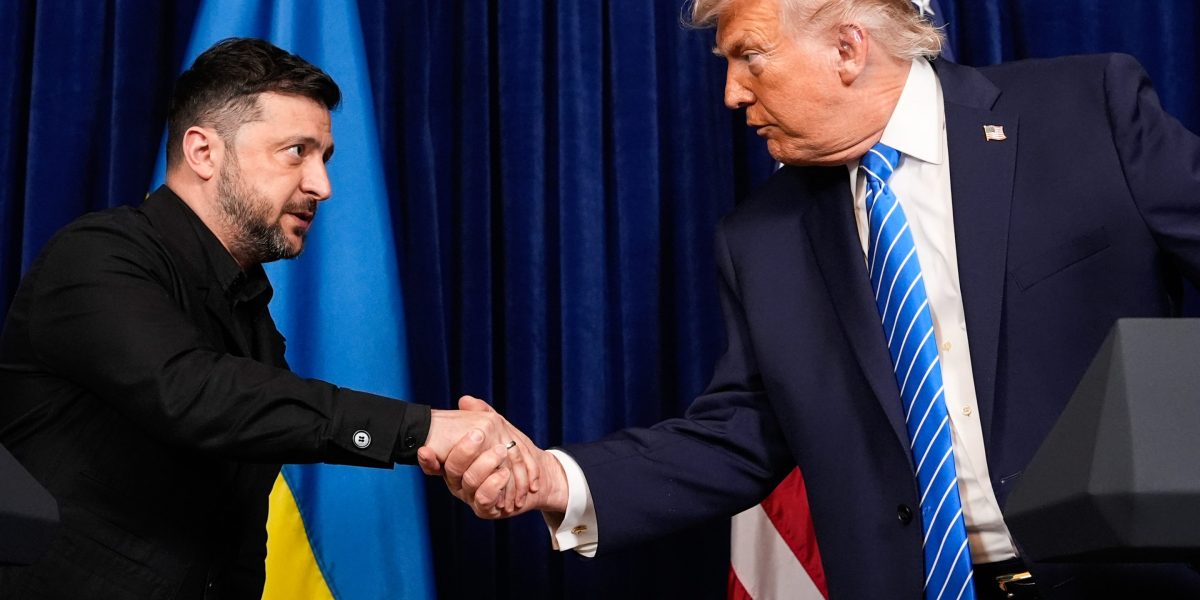
President Donald Trump on Sunday insisted Ukraine and Russia are “closer than ever before” to a peace deal as he hosted Ukrainian President Volodymyr Zelenskyy at his Florida resort, but he acknowledged that negotiations could still break down and leave the war dragging on for years.

The president’s statements came after the two leaders met for a discussion that took place after what Trump described as an “excellent,” two-and-a-half-hour phone conversation with Russian President Vladimir Putin, whose invasion of Ukraine launched the war four years ago. Trump insisted he believed Putin still wants peace, even as Russia launched another round of attacks on Ukraine while Zelenskyy flew to the United States for the latest round of negotiations.

“Russia wants to see Ukraine succeed,” Trump said during a late afternoon news conference following a meeting with Zelenskyy, whom he repeatedly praised as “brave.”

Trump and Zelenskyy both acknowledged thorny issues remain, including whether Russia can keep Ukrainian territory it controls. After their discussion they called a wide group of European leaders, including Ursula von der Leyen, president of the European Commission, and the leaders of Finland, France, Germany, Great Britain and Poland.

Zelenskyy thanked Trump for his work. “Ukraine is ready for peace,” he said.

Trump and Putin will speak again

Trump said he’d follow the meeting with another call to Putin. Earlier Sunday, Putin’s foreign affairs adviser Yuri Ushakov said the Trump-Putin call was initiated by the U.S. side, lasted over an hour, and was “friendly, benevolent and businesslike.” Ushakov said Trump and Putin agreed to speak again “promptly” after Trump’s meeting with Zelenskyy.

But Ushakov added that a “bold, responsible, political decision is needed from Kyiv” on the fiercely contested Donbas region in eastern Ukraine and other matters in dispute for there to be a “complete cessation” of hostilities.

In overnight developments, three guided aerial bombs launched by Russia struck private homes in the eastern city of Sloviansk, according to the head of the local military administration, Vadym Lakh. Three people were injured and one man died, Lakh said in a post on the Telegram messenger app.

The strike came the day after Russia attacked Ukraine’s capital with ballistic missiles and drones on Saturday, killing at least one person and wounding 27, Ukrainian authorities said. Explosions boomed across Kyiv as the attack began in the early morning and continued for hours.

Trump said, however, that he still believes Putin is “very serious” about ending the war.

“I believe Ukraine has made some very strong attacks also,” Trump told reporters as Zelenskyy stood by his side. “And I don’t say that negatively. I think, you probably have to. I don’t say that negatively. But I think, he hasn’t told me that, but there have been some explosions in various parts of Russia. It looks to me, like, I don’t know. I don’t think it came from the Congo.”

Trump noted that it was possible that the negotiations will fall apart. “In a few weeks, we will know one way or the other, I think. … But it could also go poorly.”

The face-to-face sit-down between Trump and Zelenskyy underscored the apparent progress made by Trump’s top negotiators in recent weeks as the sides traded draft peace plans and continued to shape a proposal to end the fighting. Zelenskyy told reporters Friday that the 20-point draft proposal negotiators have discussed is “about 90% ready” — echoing a figure, and the optimism, that U.S. officials conveyed when Trump’s chief negotiators met with Zelenskyy in Berlin earlier this month.

During the recent talks, the U.S. agreed to offer certain security guarantees to Ukraine similar to those offered to other members of NATO. The proposal came as Zelenskyy said he was prepared to drop his country’s bid to join the security alliance if Ukraine received NATO-like protection that would be designed to safeguard it against future Russian attacks.

‘Intensive’ weeks ahead

Zelenskyy also spoke on Christmas Day with U.S. special envoy Steve Witkoff and Jared Kushner, Trump’s son-in-law. The Ukrainian leader said they discussed “certain substantive details” and cautioned “there is still work to be done on sensitive issues” and “the weeks ahead may also be intensive.”

The U.S. president has been working to end the war in Ukraine for much of his first year back in office, showing irritation with both Zelenskyy and Putin while publicly acknowledging the difficulty of ending the conflict. Long gone are the days when, as a candidate in 2024, he boasted that he could resolve the fighting in a day.

After hosting Zelenskyy at the White House in October, Trump demanded that both Russia and Ukraine halt fighting and “stop at the battle line,” implying that Moscow should be able to keep the territory it has seized from Ukraine.

Zelenskyy said last week that he would be willing to withdraw troopsfrom Ukraine’s eastern industrial heartland as part of a plan to end the war, if Russia also pulls back and the area becomes a demilitarized zone monitored by international forces.

Putin wants Russian gains kept, and more

Putin has publicly said he wants all the areas in four key regions that have been captured by his forces, as well as the Crimean Peninsula, illegally annexed in 2014, to be recognized as Russian territory. He also has insisted that Ukraine withdraw from some areas in eastern Ukraine that Moscow’s forces haven’t captured. Kyiv has publicly rejected all those demands.

The Kremlin also wants Ukraine to abandon its bid to join NATO. It warned that it wouldn’t accept the deployment of any troops from members of the military alliance and would view them as a “legitimate target.”

Putin also has said Ukraine must limit the size of its army and give official status to the Russian language, demands he has made from the outset of the conflict.

Ushakov told the business daily Kommersant this month that Russian police and national guard would stay in parts of Donetsk -– one of the two major areas, along with Luhansk, that make up the Donbas region — even if they become a demilitarized zone under a prospective peace plan.

Ushakov cautioned that trying to reach a compromise could take a long time. He said U.S. proposals that took into account Russian demands had been “worsened” by alterations proposed by Ukraine and its European allies.

Trump has been somewhat receptive to Putin’s demands, making the case that the Russian president can be persuaded to end the war if Kyiv agrees to cede Ukrainian land in the Donbas region and if Western powers offer economic incentives to bring Russia back into the global economy.


Source link

Continue Reading

Business

Down Arrow Button Icon

Published

on


With Trump 2.0, markets and the media knew they would get their fair share of double-takes. For me, the image that springs to mind the most was the moment in July when the President of the United States showed up on the doorstep of the Fed, literally. Armed with a disputed list of costs for Fed building renovations, President Trump said that “generally” speaking he would fire a project manager who had gone over budget. The Fed’s Powell, looking visibly uncomfortable, had already provided a breakdown explaining that the project was on track, and he highlighted that Trump had included in his costings a building which was already complete. The Chairman of the Federal Reserve and the president stood stiffly, side-by-side, in matching hard hats, bickering on a building site, for all the world to see.

Trump’s visit to the Fed was only the fourth in U.S. history—the tradition is that the credibility of the central bank and the White House are both strengthened if neither attempts to interfere with the other.

The image summed up the conversations (off the record and, in recent months, increasingly nervously) I regularly have with sources—either within the Fed or at agencies working closely with the financial institution. In my catch-ups with these 10 or so people since January, their mood has shifted. Early on, there was optimism that the focus of politicians would pass (as it so often does). But as the months rolled by, they mentally battened down their hatches against an onslaught of insults, scrutiny, and unprecedented criticism. 

In the run-up to the election, Trump claimed Powell acted politically by lowering interest rates to help President Biden (an insult, given the legally mandated autonomy of the organization). Vice president JD Vance lobbied for more political control over the base interest rate.

While some economists later echoed Trump in saying the Federal Open Market Committee (FOMC) should cut rates, the public outpouring of Trump’s fury was extraordinary: Trump called him “Too Late Powell,” a “stubborn mule,” a “major loser,” and a “stupid person.” 

Wall Street grew uncomfortable with the attacks. Even if it wanted to see rate cuts, it didn’t want to see the central bank’s independence threatened. When Trump pulled back on the notion of firing Powell, he instead focused on other members of the FOMC. In September, he attempted to oust Fed Governor Lisa Cook via social media, alleging she made false statements on a mortgage application. She denies that and has taken her case to the Supreme Court. Hearings begin in January.

Other autonomous agencies got the message: If Trump is willing to take on the Fed, they might be next.

“How much can truly change under a single administration?” I asked one source. “Three years is a long time yet,” was the response. 

The January question

Since January, many federal employees inside and outside the Fed have quietly decided that discretion is the better part of valor. To the relief of Wall Street, the Fed’s most prominent figures haven’t gone to ground entirely.

Outside of monetary policy leaders have publicly stuck to the script when it comes to political questions. Time and again, Powell insisted that base rate decisions are made exclusively and entirely on data pertaining to the economy. On the elephant in the room that is January’s court hearings over the firing of Cook, Powell said it would be “inappropriate” to comment. 

While the temperature has dropped for now, sources say, they’re preparing for the mercury to start rising again early next year. The reasoning that an independent Fed leads to better economic outcomes is widely accepted. But if Trump succeeds in ousting Cook, then the Fed’s autonomy looks less secure—potentially leading to inflationary sentiment.

Analysts’ concerns over the Fed’s independence don’t descend as low as comparisons to President Nixon and Arthur Burns however, when an alignment on monetary policy between the White House and the Fed plunged the economy into a crisis.

Economists more widely believe that there are too many defenders of independence—and too much scrutiny from the markets—to allow politicians to attempt to fundamentally alter the trajectory of the Fed, especially if Jerome Powell sticks around as a governor.

Selective silence is a tactic on which it seems everyone, at last, can agree. Critics argue that the Federal Open Market Committee (FOMC)—with its mysterious dot-plots and the breadcrumbs its members occasionally drop into speeches—engages the attention of Wall Street a little too much. Treasury Secretary Scott Bessent has been lobbying for a “backseat” Federal Reserve, something insiders will be only too happy to oblige. 

On the other hand, the Federal Reserve system is mandated to answer to Congress and, by extension, the American public. In an era of economic volatility, with business leaders and consumers alike unsure of the path forward, a void of insight from key decision-makers could be damaging and frustrating. 

There’s also been a delicate balance to strike between pushing back on claims about bias within the Fed and reminding the public that the Fed is focused mainly on, and is guided by, its mandate. 

The next Fed chairman

Another awkward question is who’s actually in charge. Secretary Bessent has made it clear that in the search for a new Federal Reserve leader, he wants to appoint a “shadow chair”, someone to be the true power at the Fed while Powell is increasingly overlooked as he nears the end of his term in May.

It was not a popular idea, but the White House has proceeded with a very public recruitment process ever since. Potentially impacted parties are keeping an eye on frontrunners, they said, without becoming overly invested in outcomes that may never come to pass. 

One concern is that the broadcast nature of the selection process means pressure is already piling onto the shoulders of the would-be nominee, who must wrangle expectations without having accumulated much real influence within the central bank. 

Wall Street is also preparing for some early hiccups. Until the past few meetings, Powell’s run had been one of steady consensus. As UBS’s Paul Donovan said in a note to clients this week: “What is perhaps more interesting today is the extent of division within the Federal Reserve. This is potentially storing up trouble for Powell’s successor as Fed Chair. A Fed that is prepared to dissent under Powell may be more inclined to dissent under a Fed chair who commands less respect in the institution, and the wider financial markets.”

Whatever the creases that will need to be ironed out under a new Federal regime, Trump’s cabinet seems keen for it to happen behind closed doors. For federal staffers who want to crack on without the weight of the White House breathing down their necks, the diversion of that attention can’t come soon enough.


Source link

Continue Reading

Business

Job market outlook 2026: ‘uncomfortably slow growth’ in the first half, then upward reversal later

Published

on


The labor market cooled during a rollercoaster year for the economy and financial markets, and 2026 should start off slow but then improve later in the year, according to JPMorgan.

In a forecast published earlier this month, economists at the bank attributed 2025’s loss of jobs momentum to business uncertainty created by President Donald Trump’s tariffs and trade policies.

“As a result both long-term and short-term business planning has remained difficult, and layoff and hiring rates have been low,” Michael Feroli, chief U.S. economist at JPMorgan, said in the report. “Businesses are hesitant to make sweeping changes to either grow or shrink their payrolls when they’re unsure what the next six months might hold.”

In addition, Trump’s immigration crackdown and deportation campaign have been more aggressive than expected, JPMorgan added.

This reduced supply of workers plus the relatively flat labor participation rate flat mean that the monthly job gains needed to keep unemployment steady could tumble to just 15,000 from 50,000. Despite the lower breakeven rate, unemployment will creep higher.

“The first half of 2026 will likely deliver uncomfortably slow growth in the labor market, with unemployment peaking at 4.5% in early 2026,” JPMorgan said, a week before the Labor Department released the delayed November jobs report that showed the rate climbing to a four-year high of 4.6%.

The bank blamed sluggish growth due to the labor supply shrinking from deportations, an aging population and fewer visas for workers and students.

Another factor in the early-2026 slump is artificial intelligence, which has spurred massive investment in equipment, software and data centers—but not so much job creation.

While there are still no signs yet of widespread job losses because of AI, some of the sectors most exposed to the technology have seen slower gains, JPMorgan pointed out.

But then the labor market will reverse course in the second half of the year, economists predicted, citing a more consistent tariff policy, tax cuts from Trump’s One Big Beautiful Bill Act, and additional rate cuts from the Federal Reserve.

“We believe supports are coming together that will arrest this labor market slowdown and revive activity growth later next year,” Feroli said. 

JPMorgan sees GDP growth in 2026 at 1.8%, with one-in-three odds of a recession, and inflation remaining sticky at 2.7%. 

Separately, Bank of America CEO Brian Moynihan expects Trump to de-escalate trade tensions next year, telling CBS News’ Face the Nation that an average tariff rate of 15% for a broad group of counties is “not a huge impact.”

Meanwhile, AI could be a wildcard that provides yet another boost next year.

“Usually, it takes several years for general purpose technologies like AI to boost productivity,” Feroli added. “A quicker realization of efficiency gains could lead to stronger GDP growth than expected.”

But that optimism contrasts with continued warnings from computer scientist and “godfather of AI” Geoffrey Hinton, who has said AI will replace more and more human workers.

During an interview on CNN’s State of the Union on Sunday, he was asked for his 2026 predictions after declaring 2025 a pivotal year for AI.

“I think we’re going to see AI get even better,” Hinton replied. “It’s already extremely good. We’re going to see it having the capabilities to replace many, many jobs. It’s already able to replace jobs in call centers, but it’s going to be able to replace many other jobs.”


Source link

Continue Reading

Business

North Korea’s Kim tests long-range cruise missiles over West Sea

Published

on


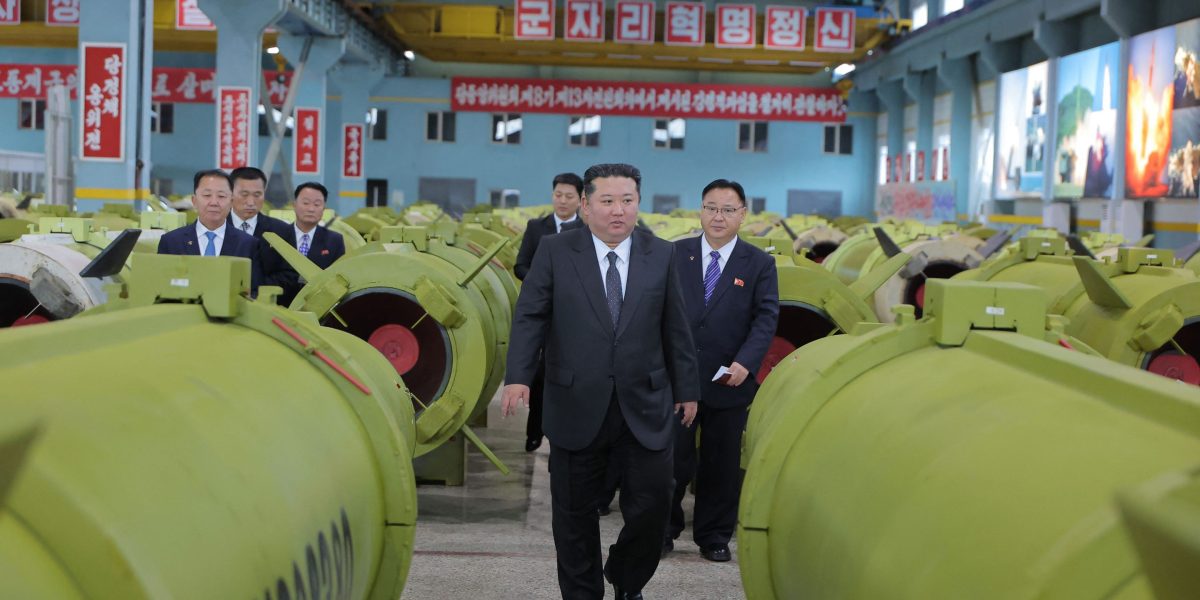
North Korea said it conducted a long-range strategic cruise missile launch drill over the West Sea on Sunday as it continues to showcase its weapons capabilities amid regional tensions.

Leader Kim Jong Un observed the drill, which was carried out to test the counterattack readiness and combat capabilities of long-range missile units, train missile operators in maneuvering and fire-mission procedures, and to verify the reliability of the strategic weapons system, Korean Central News Agency reported Monday.

The strategic cruise missiles flew along preset trajectories over waters off the country’s west coast for 10,199 seconds and 10,203 seconds — around 2 hours and 50 minutes each — before striking their targets, the state news agency said.

The results of the exercise provided a practical verification and a clear demonstration of the reliability and combat power of North Korea’s strategic counterattack capabilities, Kim said, expressing “great satisfaction” with the outcome, according to the report.

Read Also: North Korea’s Kim Seeks Arms Modernization Before Party Congress

He added that regularly testing the reliability and rapid response readiness of components of the country’s nuclear deterrent, and continuing to demonstrate their power, amounted to a responsible exercise of self-defense and a means of deterring war in the current security environment.

Kim stressed that the ruling party and government would continue to make all-out efforts to further strengthen and expand the country’s nuclear combat forces, KCNA reported.

Join us at the Fortune Workplace Innovation Summit May 19–20, 2026, in Atlanta. The next era of workplace innovation is here—and the old playbook is being rewritten. At this exclusive, high-energy event, the world’s most innovative leaders will convene to explore how AI, humanity, and strategy converge to redefine, again, the future of work. Register now.


Source link

Continue Reading

Trending

Copyright © Miami Select.