Connect with us

Business

Trump says the U.S. can grow its way out of $37 trillion in debt. Ray Dalio’s debt-cycle research says not so fast

Published

on


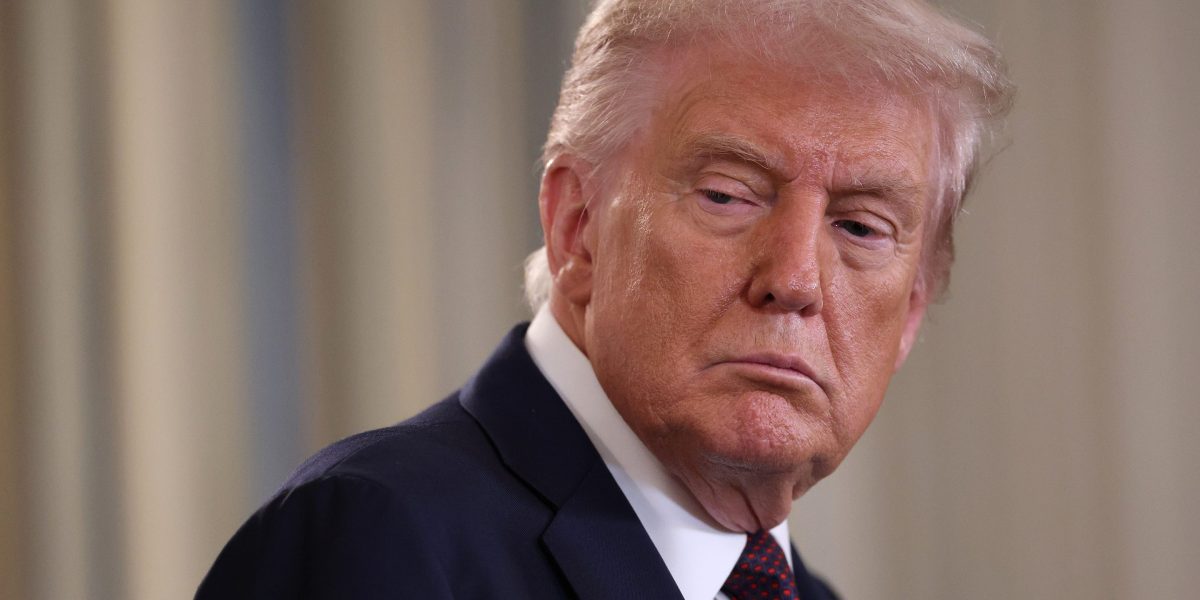
President Donald Trump’s assertion that U.S. growth can tame debt echoes what Ray Dalio has called the most dangerous phase of a debt cycle: when leaders mistake prosperity for immunity.

In an interview with One America News on Thursday, Trump pointed to his “Big, Beautiful Bill” that locks in and expands tax cuts from his first term while adding new deductions on tips, overtime pay, and Social Security income for seniors. Combined with his latest round of tariffs, Trump argued, the package will deliver both “record growth” and an unprecedented fiscal windfall.

“We are becoming a country that is so rich, so powerful,” he said. “With the kind of growth we have now, the debt is very low relatively speaking. You grow yourself out of that debt.”

Real GDP rose at a solid 3.8% annualized pace in Q2 2025, but the debt picture isn’t “very low.” Gross federal debt still sits around $37.4 trillion, and the debt-to-GDP ratio is about 100% for 2025, according to Treasury and CBO-linked dashboards

Tariff receipts are up sharply this year, but estimates show roughly $165 billion by August and about $300 billion on an annualized basis, far short of the trillion needed for paying down the debt.

On top of that, Trump also suggested the government could use tariff revenue to send Americans “distributions” of up to $2,000, which would go into consumers’ pockets instead of helping to offset budget deficits.

But Dalio, who has studied dozens of major debt cycles, wrote in his 2018 book Principles for Navigating Big Debt Crises that during booms, “lending supports spending and investment, which in turn supports incomes and asset prices,” temporarily pushing growth “above the consistent productivity growth of the economy.” But that can’t last, he warned — “eventually income will fall below the cost of the loans.”

Elsewhere, he added that debt burdens only ease when “nominal income growth is higher than nominal interest rates.,” but too much stimulus risks “unacceptable inflation and currency declines.”

The billionaire founder of Bridgewater Associates has cautioned against leaders celebrating prosperity as proof that leverage no longer matters, even as debt quietly outpaces income. To Dalio, that rhetoric is the hallmark of a late-stage debt cycle, before reality intrudes. 

Dalio’s debt-cycle warning

Dalio has spent decades studying how countries borrow, boom, and then buckle under the weight of their obligations. Looking across nearly 50 major debt cycles—from the Roaring Twenties to the 2008 crisis—he sees the same pattern of debt fueling growth in the early stages, but eventually the debt itself grows faster than the income needed to service it.

“Typically debt crises occur because debt and debt service costs rise faster than the incomes that are needed to service them,” Dalio wrote. Policymakers can stretch the party by cutting rates, but “when that happens, the deleveraging begins.”

The real danger, in Dalio’s telling, isn’t just in the debt itself but the psychology. Bubbles form because rising asset prices and higher incomes convince people they’re richer than they really are. They spend more, borrow more, and take on greater risks.

“In the first stage of the bubble, debts rise faster than incomes…borrowers feel rich, so they spend more than they earn and buy assets at high prices with leverage.”

In the U.S., debt held by the public is also projected to climb from about 100% of the GDP in 2025 to 118% by 2035, according to CBO forecasts, meaning debt is growing faster than the underlying economy.  Meanwhile, CBO says the government’s net interest costs also will continue to grow as a share of GDP.

This is the scenario Dalio warns of, namely if interest costs exceed growth rates, growth can no longer carry the debt burden in the way that Trump assumes, because growth is vulnerable to shifts in rates, inflation, or the economic cycle.

The math problem

To be sure, Dalio’s framework stresses that not all debt is created equal. Borrowing for investments that generate income can be self-sustaining. But borrowing to fund consumption or to juice headline growth is not.

In the best case—a “beautiful deleveraging,” as Dalio calls it—governments balance fiscal and monetary policies so that growth outpaces interest costs, but without tipping into runaway inflation.

That’s a narrow path. Too much stimulus, and you spark inflation or currency weakness. Too much austerity, and you trigger a recession. The kind of permanent tax cuts and tariff-driven stimulus Trump is promising doesn’t fit easily into that balance.

Dalio also warned that the most misleading signals come near the top, where easy credit boosts spending, asset prices climb, unemployment falls.

Today, asset prices are at or near record highs (major indexes hit new all-time highs this week) and unemployment remains low at 4.3% as of August. 

 “When the limits of debt growth relative to income growth are reached,” Dalio wrote, “the process works in reverse…a vicious, self-reinforcing contraction.”

Trump insists that trillions in new investment are flowing in, the trade deficit is shrinking, and the nation is flush enough to consider mailing out checks. 

“Nobody thought it was possible to do so quickly—except me,” he said.

But Dalio’s work suggests that’s exactly the mindset that gets countries into trouble. Believing that debt doesn’t matter because growth will take care of it is the last stage of the cycle, when optimism runs ahead of reality. And when the illusion breaks, the “beautiful” part of deleveraging rarely lasts.

As Dalio put it: “When promises to deliver money (i.e., debt) can’t rise any more relative to the money and credit coming in, the process works in reverse and deleveraging begins.”

Fortune Global Forum returns Oct. 26–27, 2025 in Riyadh. CEOs and global leaders will gather for a dynamic, invitation-only event shaping the future of business. Apply for an invitation.


Source link

Continue Reading

Business

Trump finally meets Claudia Sheinbaum face to face at the FIFA World Cup draw

Published

on


Their long-delayed first face-to-face discussion focused on next year’s World Cup — and included side discussions about trade and tariffs — but immigration was not the top issue. That’s despite Trump’s push to crack down on the U.S.-Mexico border being a centerpiece of his administration, and the driving force in the relations between both countries.

Trump has been in office for more than 10 months, and his having taken so long to see Sheinbaum in-person is striking given that meeting with the leader of the country’s southern neighbor is often a top priority for U.S. presidents.

Trump and Sheinbaum had been set to meet in June on the sidelines of the Group of Seven summit in Canada, but that was scrapped after Trump rushed back to Washington early amid rising tensions between Israel and Iran.

Soccer took center stage — but tariffs still loom large

Trump and Sheinbaum sat talking in the president’s box and also appeared onstage with Canadian Prime Minister Mark Carney at the Kennedy Center for Friday’s 2026 World Cup draw. The U.S., Mexico and Canada are co-hosting the tournament, which begins in June.

A senior White House official, who spoke on the condition of anonymity to discuss private meetings, said Trump, Sheinbaum and Carney met privately after participating in the draw.

Sheinbaum had said before leaving Mexico that she’d talk to Trump about tariffs that his administration has imposed on automobiles, steel and aluminum from Mexico, among other things. She said after appearing at the Kennedy Center that the three leaders “talked about the great opportunity that the 2026 FIFA World Cup represents for the three countries and about the good relationship we have.”

“We agreed to continue working together on trade issues with our teams,” Sheinbaum posted on X.

Mexico is the United States’ largest trading partner. The the U.S.-Mexico-Canada Agreement which Trump forged in his first term as a replacement for 1994’s North American Free Trade Agreement also remains in place. But U.S. Trade Representative Jamieson Greer has begun scrutinizing it ahead of a joint review process set for July.

In the meantime, the U.S. and Mexico’s priorities have been reshaped by the steep drop in the number of people crossing into the U.S. illegally along its southern border, as well as the White House’s — so far largely unrealized — threats to impose large trade tariffs on its neighbor.

Before speaking in-person, Trump and Sheinbaum had repeatedly talked by phone, discussing tariffs and Mexican efforts to help combat the trafficking of fentanyl into the U.S. But despite other world leaders, including Russian President Vladimir Putin and Chinese President Xi Jinping, having already met with Trump this term, the meeting with Sheinbaum hadn’t happened until Friday.

The Trump whisperer?

Waiting so long to meet in person hasn’t seemed to hurt Mexico’s president’s standing with Trump.

The two spoke by phone in November 2024, with the then-U.S. president-elect declaring afterward that they’d agreed “to stop Migration through Mexico” — even as Sheinbaum suggested her country had already been doing enough.

Trump soon after taking office threatened to impose a 25% tariff on goods imported from Mexico in an effort to force that country to better combat fentanyl smuggling, only to later agree to a pause.

The White House subsequently backed off tariff threats against most Mexican goods. Then, in October, Sheinbaum announced that the U.S. had given her country another extension to avoid sweeping 25% tariffs on goods it imports to the U.S. — even as many items covered by the USMCA trade deal remain exempt.

Mexico, though, hasn’t avoided all U.S. tariffs. Sheinbaum’s country continues to try to negotiate its way out of import levies Trump has imposed worth 25% on the automotive sector and 50% on steel and aluminum.

Sheinbaum’s success at mitigating many tariffs, and other successes in the bilateral relationship, has led some to wonder if she has a special gift for getting what she wants from him.

She’s largely pulled it off by affording Trump the respect the U.S. president demands from leaders around the world — but especially a neighboring country — and by deploying occasional humor and pushing back, always respectfully, when necessary.

Sheinbaum also defused another potential point of contention, Trump’s renaming of the Gulf of Mexico to the “Gulf of America,” by proposing dryly that North America should be renamed “América Mexicana,” or “Mexican America.” That’s because a founding document dating from 1814 that preceded Mexico’s constitution referred to it that way.

Still, Mexican officials continue to work furiously to lessen the trade blow from tariffs going into 2026 — levies that could wreck its already low-growth economy, particularly in its all-important automotive sector. Sheinbaum’s government has also sought to defend its citizens living in the U.S. as the Trump administration expands its mass deportation operations.

Sheinbaum’s government also lobbied unsuccessfully against a 1% U.S. tax on remittances, or money transfers that millions of Mexicans send home every year from the United States. It was approved as part of Trump’s tax cut and spending package and takes effect Jan. 1.

Trump’s push for mass deportations

Trump has directed federal officials to prioritize major deportation pushes in Democratic-run cities — an extraordinary move that lays bare the politics of the issues. He’s also deployed the National Guard in an effort to curb crime, which has led to a spike in immigration-related arrests, in places like Los Angeles, Chicago and Washington, as well as Memphis, Tennessee, and Portland, Oregon.

The Trump administration says its priority is targeting “the worst of the worst” criminals, but most of the people detained in operations around the country have not had violent criminal histories.

Such operations often meant targeting Mexican citizens who have lived and worked in the United States for years and may face deportation to a homeland they no longer know well. It also has meant serious threats of declining remittance income, which has fallen for seven consecutive months.

The lower number of illegal U.S.-Mexico border crossings has knocked immigration off its perch as the top agenda item for the U.S.-Mexico bilateral relations for the first time in recent memory.

Mexican officials now say conversations around immigration have shifted toward cajoling countries into taking back their citizens and reintegrating them to keep them from leaving again — a major Trump administration priority around the world.

Cooperation on security

Sheinbaum has blunted some of the Trump administration’s tough talk on fentanyl and drug smuggling cartels by giving her security chief Omar García Harfuch more authority.

Mexico has also extradited dozens of drug cartel figures to the U.S., including Rafael Caro Quintero, long sought in the 1985 killing of a DEA agent. That show of goodwill, and a much more visible effort against the cartels’ fentanyl production, has gotten the Trump administration’s attention.

That’s a significant improvement. Only a few years ago, the DEA struggled to get visas for its people in Mexico, and then-President Andrés Manuel López Obrador accused the U.S. government of fabricating evidence against a former Mexican defense secretary, though he never presented evidence to back up the allegation.

Not everything has gone so smoothly, though. Trump criticized Sheinbaum for rejecting his proposal to send U.S. troops to Mexico to help thwart the illegal drug trade.

Last month, Sheinbaum said there was no way the U.S. military would be able to make strikes in Mexico, after Trump said he was open to the idea. And she has denounced U.S. strikes on boats allegedly carrying drugs in the Caribbean and eastern Pacific.

“The president of Mexico is a lovely woman, but she is so afraid of the cartels that she can’t even think straight,” Trump said earlier this year.

Sheinbaum declined to take the bait — and avoided turning up the political pressure — by sidestepping Trump’s criticism.

___

Associated Press writer Chris Sherman contributed from Mexico City.


Source link

Continue Reading

Business

Former Amazon exec warns Netflix-WBD deal will make Hollywood ‘a system that circles a single sun’

Published

on


A Netflix-Warner Bros. merger would risk a monopsony where a single buyer wields enormous control over the marketplace, the former head of Amazon Studios warned.

Roy Price, who is now chief executive of the studio International Art Machine, wrote in a New York Times op-ed on Saturday that predictions of doom are nothing new in the film industry, pointing to the advent of TV, home video, streaming, and AI.

“But if Netflix acquires Warner Bros., this long-prophesied death may finally arrive, not in the sense that filmmaking will cease but in the sense that Hollywood will become a system that circles a single sun, materially changing its cultural output,” he added. “All orbits—every deal, every creative decision, every creative career—will increasingly revolve around the gravitational mass and imprimatur of one entity.”

To be sure, Netflix has said Warner Bros. operations will continue, and the studio’s films will still be released in theaters. Meanwhile, Warner’s TV channels will be spun off via a separate company, though HBO will be included in Netflix.

But Price said the danger “is not annihilation but centralization,” with the combined company accounting for an even bigger slice of overall content spending.

A reduction in bidders also means less content will be produced, while a separate development culture, set of tastes, and risk tolerances will be sidelined, he predicted.

“A Netflix merger with Warner Bros. would create a monopsony problem: too few buyers with too much bargaining power,” Price explained. “Writers, directors, actors, showrunners, puppeteers, visual effects artists—all are suppliers. The fewer buyers competing to hire them, the lower their compensation and the narrower their opportunities.”

Such reasoning sank Penguin Random House’s attempt to merge with Simon & Schuster that would’ve created a book publisher with too much leverage over authors, he pointed out.

Of course, the remaining players in Hollywood and content creation are giants in their own right as well. A KPMG survey of spending in 2024 put NBC Universal parent Comcast at the top with $37 billion, followed by Alphabet’s YouTube ($32 billion), Disney ($28 billion), Amazon ($20 billion), Netflix ($17 billion) and Paramount ($15 billion). Comcast and Paramount also made bids for Warner Bros.

Theater owners, producers and other creative workers have also voiced opposition to the deal. In addition to the business impact of a Warner Bros. takeover, other opponents raised even weightier concerns.

Oscar winner Jane Fonda sounded the alarm on a “constitutional crisis” and demanded that the Justice Department not use its regulatory power to “extract political concessions that influence content decisions or chill free speech.”

For its part, the Trump administration views the deal with “heavy skepticism,” sources told CNBC. The merger is expected to face exceptional antitrust scrutiny, and Netflix’s $5.8 billion breakup fee is among the biggest ever.

On Wall Street, analysts see a tech angle in the merger, namely the importance of content to train and power the next generation of AI models that will shape the entertainment industry’s future.

The acquisition of Warner Bros. would help Netflix stand out in an AI future, Divyaunsh Divatia, research analyst at Janus Henderson Investors, said in a note on Friday.

“They’re also levering up on premium entertainment at a time when competition on engagement from short form video is expected to intensify especially if AI models democratize video creation at an increasing rate,” he wrote.


Source link

Continue Reading

Business

25-year DEA veteran charged with helping Mexican drug cartel launder millions of dollars, secure guns and bombs

Published

on


A former high-level agent with the U.S. Drug Enforcement Administration and an associate have been charged with conspiring to launder millions of dollars and obtain military-grade firearms and explosives for a Mexican drug cartel, according to an indictment unsealed Friday in New York.

Paul Campo, 61, of Oakton, Virginia, who retired from the DEA in 2016 after a 25-year career, and Robert Sensi, 75, of Boca Raton, Florida, were caught in sting involving a law enforcement informant who posed as a member of the Jalisco New Generation Cartel, prosecutors said.

The cartel, also know as CJNG, was designated as a foreign terrorist organization by the U.S. in February.

U.S. Attorney Jay Clayton said Campo betrayed his DEA career by helping the cartel, which he said was responsible for “countless deaths through violence and drug trafficking in the United States and Mexico.”

Campo and Sensi appeared Friday afternoon before a magistrate judge in New York, who ordered them detained without bail. Their lawyers entered not guilty pleas on their behalf.

Campo’s lawyer, Mark Gombiner, called the indictment “somewhat sensationalized and somewhat incoherent.” He denied the two men had agreed to explore obtaining weapons for the cartel.

Prosecutors say pair talked of laundering money, obtaining weapons

Over the past year, Campo and Sensi agreed to launder about $12 million in drug proceeds for the cartel and converted about $750,000 in cash to cryptocurrency, thinking it was going to the group when it really went to the U.S. government, the indictment said. They also provided a payment for about 220 kilograms of cocaine they were told would be sold in the U.S. for about $5 million, thinking they would get a cut of the proceeds, prosecutors said.

The two men also said they would look into procuring commercial drones, AR-15 semiautomatic rifles, M4 carbines, grenade launchers and rocket-propelled grenades for the cartel, the indictment said.

Campo boasted about his law enforcement experience during conversations with the informant and offered to be a “strategist” for the cartel, authorities said. He began his career as a DEA agent in New York and rose to become deputy chief of financial operations for the agency, the indictment said.

Evidence in the case includes hours of recordings of the two men talking with the informant, as well as cellphone location data, emails and surveillance images, Assistant U.S. Attorney Varun Gumaste said in court Friday.

Sensi’s attorney, Amanda Kramer, unsuccessfully argued that Sensi should be freed while he awaits trial, saying he wouldn’t flee partly because he has multiple health problems, including injuries from a fall two months ago, early-stage dementia and Type II diabetes.

Sensi was convicted in the late 1980s and early 1990s of mail fraud, defrauding the government and stealing $2.5 million, said the prosecutor, Gumaste. He said evidence shows Sensi also was engaged in a scheme to procure military-grade helicopters for a Middle East country.

Other criminal cases have roiled the DEA

DEA Administrator Terrance Cole said in a statement that while Campo is no longer employed by the DEA, the allegations undermine trust in law enforcement.

The DEA has been roiled in recent years by several embarrassing instances of misconduct in its ranks. The Associated Press has tallied at least 16 agents over the past decade brought up on federal charges ranging from child pornography and drug trafficking to leaking intelligence to defense attorneys and selling firearms to cartel associates, revealing gaping holes in the agency’s supervision.

Starting in 2021, the agency placed new controls on how DEA funds can be used in money laundering stings, and warned agents they can now be fired for a first offense of misconduct if serious enough, a departure from prior administrations.

Campo and Sensi are charged with four conspiracy counts related to narcoterrorism, terrorism, narcotics distribution and money laundering.

____

Collins reported from Hartford, Connecticut. Associated Press writer Joshua Goodman in Miami contributed to this report.


Source link

Continue Reading

Trending

Copyright © Miami Select.