Connect with us

Business

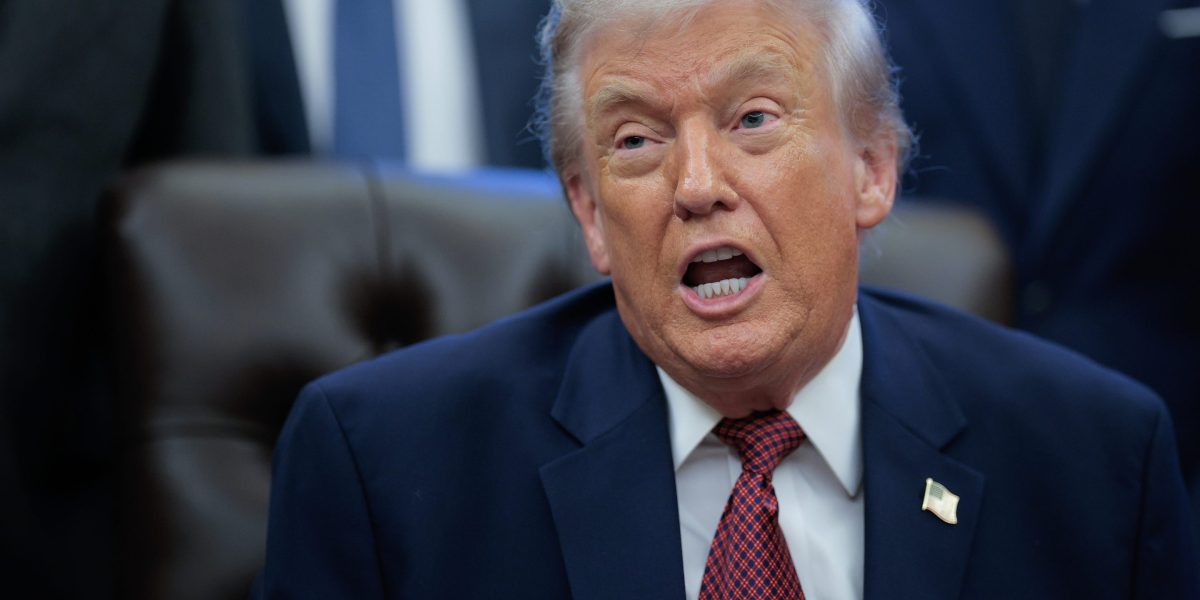
Trump says Netflix-Warner Bros. deal ‘could be a problem’

Published

on


President Donald Trump raised potential antitrust concerns for Netflix Inc.’s planned acquisition of Warner Bros. Discovery Inc., noting that the market share of the combined entity may pose problems. 

“Well, that’s got to go through a process, and we’ll see what happens,” Trump said when asked about the deal as he arrived at the Kennedy Center for an event, confirming that he has met Netflix co-CEO Ted Sarandos last week and complimenting the streaming company. “But it is a big market share. It could be a problem.”

The $72 billion deal would combine the world’s No. 1 streaming player with the No. 4 service HBO Max, which has raised red flags from antitrust regulators. 


Source link

Continue Reading

Business

The Fed delivers a rare ‘hawkish cut’ as Powell tries to steady a softening job market

Published

on


The Federal Reserve cut rates for a third straight meeting on Wednesday in what analysts call a “hawkish” move: an attempt to support a softening labor market while signaling reluctance to keep cutting.

The move was widely anticipated, but the tone was not. Officials paired it with with firmer language about the “extent and timing” of additional adjustments, phrasing that, in what economists call Fed-speak, raises the bar for further cuts and underscores the committee’s unease about inflation, which the statement noted has “moved up” and “remains somewhat elevated.”

The decision also exposed the widening fractures inside the central bank toward the end of Chair Jerome Powell’s term. Three officials dissented, but in opposite directions: Stephen Miran pushed for a larger 50-basis-point cut, while Austan Goolsbee and Jeffrey Schmid argued the Fed should hold rates steady. It’s the rare meeting where hawks and doves both object, a scenario analysts had warned was increasingly probable as disagreements sharpened over how quickly the labor market is cooling, and how much restraint inflation still requires.

The December meeting also carries unusual weight because it may be the final one in which Powell still has his authority as Fed chair. His term expires in May, but President Donald Trump has already vowed to announce a successor early in 2026, effectively creating a “shadow chair” before Powell leaves. 

“Feels like in a way the last Powell Fed meeting,” Bloomberg’s Conor Sen wrote on X. Powell is slated to speak at the conference shortly after the announcement. 

Labor market concerns drove the cut

Wednesday’s decision was justified primarily by weakening conditions in the job market. Hiring has slowed markedly since the summer, while unemployment has ticked up and businesses across industries have begun signaling greater caution, even though the layoffs themselves have not yet surged in the official data.

Private-sector signals have flashed more urgency. ADP’s November report showed employers shedding a net 32,000 jobs, the sharpest decline in more than two years. Nearly all of those losses came from small businesses, which cut 120,000 positions, while medium and large firms kept adding workers. Economists view that pattern as a warning sign: small businesses are the most sensitive to rising costs and weakening demand, and they often pivot first when conditions deteriorate. 

The government’s long-delayed JOLTS report, released Tuesday, added another layer. Job openings in October rose modestly, but remained far below last year’s levels; the quit rate fell to 1.8%, the lowest since early 2021; and hiring remained stuck at 3.2%, consistent with what economists and Powell himself have called a “low hire, low fire” labor market. Companies aren’t slashing staff outright—but they aren’t expanding either. That’s enough to worry economists.

“Low hiring on its own is bad news,” top economist and Fed-watcher Claudia Sahm told Fortune. “It puts upward pressure on unemployment, and that’s the dynamic the Fed is trying to get ahead of.”

A deliberately cautious message

The Fed sought to balance labor-market concerns with the political sensitivity of cutting rates while inflation is still elevated.

Fed officials will want more flexibility than signalling the cutting cycle is open-ended. Unemployment remains low by historical standards; consumption has been resilient among high-income households; and financial markets have surged on expectations of easier policy next year. Powell has warned markets over-read his intentions this year.

Still, Powell cannot declare victory or signal a pause with confidence. The November jobs report arrives just days after the meeting, and he will want flexibility in case that comes out worse than expected, so he doesn’t look “flat-footed,” Sahm said. 

The limits of preemption

For the Fed, the goal is to smooth out the cycle—to cut early enough to prevent a deeper downturn without abandoning the fight against inflation, still sticky at 2.8%, higher than the Fed’s preferred rate of 2%. Sahm, who helped design the Fed’s framework for interpreting labor-market inflection points, argues timing is crucial.

“If the Fed waits to cut until they see clear deterioration, they’ve waited too long,” she said. Initial jobless claims remain low, she noted, but they are not predictive. As a lagging indicator, they tend to spike only after a recession has begun.

The central bank’s challenge now is to navigate between those competing risks while markets, the White House, and Congress push for clarity the Fed cannot yet provide.

If the Fed has to continue easing into early 2026, Sahm argues, it will not be a bullish signal.

“If they end up doing a lot more cuts,” she said, “then something has gone wrong.”


Source link

Continue Reading

Business

Actress Natasha Lyonne is helping to shape the future of AI

Published

on


The actress, director, and wild-style futurist Natasha Lyonne is fascinated by technology. She speaks of the beauty and power of interstellar travel and muses about living long enough to walk a Hollywood red carpet as a reanimated cyborg.

But she also has a grave concern, she explained to Fortune’s Brainstorm AI audience on Monday in San Francisco: With all this boundless possibility, why is AI focused on replacing screenwriters instead of, say, figuring out a solution to fixing plastic bottles polluting the oceans? “I don’t think that’s an accident,”  said Lyonne, 46. “It’s about cutting costs.”

What the co-founder of the media production company Animal Pictures would like to see is people paid for their expertise, work, and creative ideas, and the democratization of filmmaking so more people can engage in a business that has traditionally had sky-high barriers to entry.

Her rallying cry to C-suites and AI leaders—delivered in her signature wry, New York City accent—is to think really hard about what it means to be human in this age where AI is all the rage, and act accordingly. “We are the ones who are deciding what this use is going to be and how we choose to use it,” Lyonne said. “I really want this to mean a seat at the table for more people to do even more extraordinary things.”

Lyonne, who was named one of TIME’s 100 Most Influential People in AI 2025, joked that she anointed herself CEO of Animal Pictures and updated her LinkedIn with the title because it “seemed like a vibe.” So Lyonne now technically shares the title with others in the C-suite, and she observes a widening divide between senior executives of the world who are deciding how AI will be implemented in companies, and the employees who could see their jobs and opportunities dry up. Even though this moment in AI development includes outside factors like competition with China and meeting Wall Street’s expectations, she argues that the industry must remember that there are serious decisions to be made that history will remember. 

Lyonne, who has been in the film business since she was a child actor, pointed out that it takes enormous human legwork—from casts, crews, and everyone from drivers to the creatives who bring ideas onto screens—to keep film and television plodding forward. AI companies that scrape content without permission or payment are neglecting that entire ecosystem, she said. “So I don’t think it’s super-Kosher copacetic to just kind of rob freely under the auspices of acceleration or China, right?”

The Russian Doll and Poker Face star is also a co-founder of Asteria Film Co., a generative AI film and animation studio. Asteria describes itself as being powered by the “first clean AI model”—the “clean” referring to AI that has been trained on models with creative work that is licensed or cleared, rather than content used without payment or permission.  She is also directing an upcoming film called Uncanny Valley using an AI video model called Marey that was created based on copy-right cleared, licensed data. The film reportedly doesn’t include AI actors, but it will blend generative AI filmmaking techniques with traditional human-led filmmaking.

As a child, she said, she studied Talmudic texts and interpretations in Aramaic—the ancient language used in Talmudic writings. The complexity in exploring layers of meaning and iterations of theory now informs her approach to AI in filmmaking., she said.

Lyonne said she dropped out of New York University to pursue a self-taught education in film at the indie movie theater The Film Forum. When asked what advice she’d give her younger teenage self, Lyonne suggested mastery of the kind that takes 10,000 hours of work to develop. “Really, really learn these tools,” she said. “It’s really about technique, and that takes a long time… that’s how you learn how to write and all that.”

The beauty of mastering a skill and knowing how to think and create is that then you can break those rules, said Lyonne. “I’m not so much interested in raging against the machine,” she said. “I’m interested in building new houses, new seats at the table.”


Source link

Continue Reading

Business

AI is taking over managers’ busywork—and it’s forcing companies to reset expectations

Published

on


AI isn’t just a new tool for the modern workplace; it’s already quietly reshaping how some companies are organized. Companies including Amazon, Moderna, and McKinsey are already eliminating management layers, working to flatten organizations, and deploying AI agents to automate routine work. 

As AI rewrites the corporate org chart, humans can avoid some managerial drudgery, according to industry leaders at Fortune’s Brainstorm AI conference. Managers currently spend a lot of time bogged down with digital tools and administrative tasks, Danielle Perszyk, a Cognitive Scientist at Amazon’s AGI SF Lab, said: “Whether you are a manager or an IC, you are tethered to your computer screen, and all of the productivity apps that we are using are actually undermining our productivity.”

AI agents functioning as “universal teammates” and doing some of these tasks could help managers escape this cycle, Perszyk said, allowing them to focus on strategy. Aashna Kircher, Group General Manager in the Office of the CHRO at Workday, said this could free up managers’ time for other kinds of work. “The role of the manager will very much be as a coach and enabler and a team work director, which theoretically has always been the role,” she said.

Toby Roberts, SVP of Engineering and Technology at Zillow, said that the shift toward AI agents could fundamentally change management structure. Escaping day-to-day minutiae could allow managers to oversee larger teams, he said.

However, as AI automates more of managers’ work, companies may need to reset expectations around what management means in the AI age.

“Historically, we’ve measured management by the output of their teams, not necessarily by the human qualities of being a manager,” Kircher said. Organizations need to build “accountability and incentive structures around rewarding the things that are going to be absolutely critical moving forward for people leaders.”

What AI can’t do

AI can also have negative downstream effects on interpersonal relationships if it is overused or misused. When managers over-rely on AI for collaborative work, organizations risk deteriorating people’s ability to work together effectively, said to Kate Niederhoffer, Chief Scientist and Head of BetterUp Labs.

“Direct reports’ perceptions of managers go down the more they perceive AI and agents to be used in moments of recognition or providing constructive feedback,” Niederhoffer said. “People perceive that humans are better at these empathetic and more essentially human tasks.”

Some managers already struggle with the emotional side of leadership, with many becoming “accidental managers”—employees who were promoted for their professional talents rather than people skills. 

But AI’s “synthetic empathy”—even if it’s sometimes more consistent than human interactions—is not the answer, said Stefano Corazza, Head of AI Research at Canva. “The more AI there is, the more authenticity is valued,” he said. “If your manager really shows that he will spend time with you and cares, that goes a long way.”


Source link

Continue Reading

Trending

Copyright © Miami Select.