Connect with us

Business

Trump orders blockade of all ‘sanctioned oil tankers’ into Venezuela

Published

on


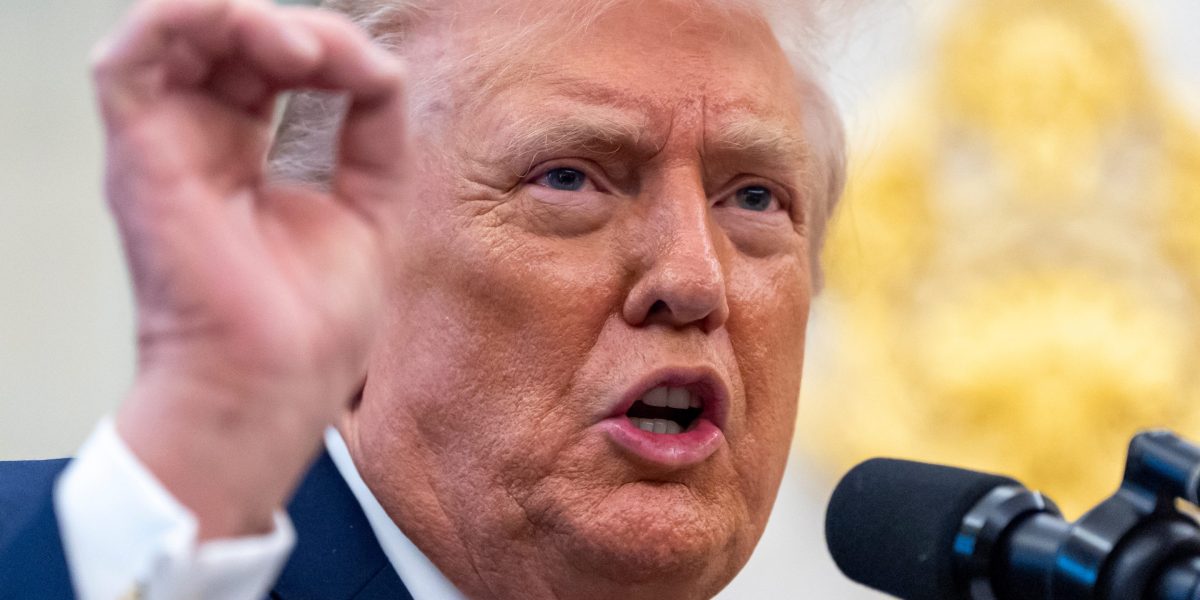
President Donald Trump said Tuesday he is ordering a blockade of all “sanctioned oil tankers” into Venezuela, ramping up pressure on the country’s authoritarian leader Nicolás Maduro in a move that seemed designed to put a tighter chokehold on the South American country’s economy.

Trump’s escalation comes after U.S. forces last week seized an oil tanker off Venezuela’s coast, an unusual move that followed a buildup of military forces in the region. In a post on social media Tuesday night announcing the blockade, Trump alleged Venezuela was using oil to fund drug trafficking and other crimes and vowed to continue the military buildup until the country gave the U.S. oil, land and assets, though it was not clear why he felt the U.S. had a claim.

“Venezuela is completely surrounded by the largest Armada ever assembled in the History of South America,” Trump said in a post on his social media platform. “It will only get bigger, and the shock to them will be like nothing they have ever seen before — Until such time as they return to the United States of America all of the Oil, Land, and other Assets that they previously stole from us.”

Pentagon officials referred all questions about the post to the White House.

Venezuela’s government press office did not immediately respond to a request for comment. But before Trump’s announcement Tuesday, Maduro praised Venezuela for having “proven to be a strong country” in the face of U.S. pressure.

“Venezuela has 25 weeks denouncing, confronting and defeating a campaign of multidimensional aggression, ranging from psychological terrorism to the piracy of the corsairs who assaulted the oil tanker,” Maduro said on state television Tuesday.

He added, “We have taken the oath to defend our homeland, and that on this soil peace and shared happiness triumph.”

The buildup has been accompanied by a series of military strikes on boats in international waters in the Caribbean and eastern Pacific. The campaign, which has drawn bipartisan scrutiny among U.S. lawmakers, has killed at least 95 people in 25 known strikes on vessels.

Trump has for weeks said that the U.S. will move its campaign beyond the water and start strikes on land.

The Trump administration has defended the strikes as a success, saying they have prevented drugs from reaching American shores, and pushed back on concerns that they are stretching the bounds of lawful warfare.

The Trump administration has said the campaign is about stopping drugs headed to the U.S., but Trump’s chief of staff Susie Wiles appeared to confirm in a Vanity Fair interview published Tuesday that the campaign is part of a push to oust Maduro.

Wiles said Trump “wants to keep on blowing boats up until Maduro cries uncle.”

Tuesday night’s announcement seemed to have a similar aim.

Venezuela, which has the world’s largest proven oil reserves and produces about 1 million barrels a day, has long relied on oil revenue as a lifeblood of its economy.

Since the Trump administration began imposing oil sanctions on Venezuela in 2017, Maduro’s government has relied on a shadowy fleet of unflagged tankers to smuggle crude into global supply chains.

The state-owned oil company Petróleos de Venezuela S.A., commonly known as PDVSA, has been locked out of global oil markets by U.S. sanctions. It sells most of its exports at a steep discount in the black market in China.

Francisco Monaldi, a Venezuelan oil expert at Rice University in Houston, said about 850,000 barrels of the 1 million daily production is exported. Of that, he said, 80% goes to China, 15% to 17% goes to the U.S. through Chevron Corp., and the remainder goes to Cuba.

In October, Trump appeared to confirm reports that Maduro has offered a stake in Venezuela’s oil and other mineral wealth in recent months to try to stave off mounting pressure from the United States.

“He’s offered everything,” Trump said at the time. “You know why? Because he doesn’t want to f—- around with the United States.”

It wasn’t immediately clear how the U.S. planned to enact what Trump called a “TOTAL AND COMPLETE BLOCKADE OF ALL SANCTIONED OIL TANKERS going into, and out of, Venezuela.”

But the U.S. Navy has 11 ships, including an aircraft carrier and several amphibious assault ships, in the region.

Those ships carry a wide complement of aircraft, including helicopters and V-22 Ospreys. Additionally, the Navy has been operating a handful of P-8 Poseidon maritime patrol aircraft in the region.

All told, those assets provide the military a significant ability to monitor marine traffic coming in and out of the country.

Trump in his post said that the “Venezuelan Regime has been designated a FOREIGN TERRORIST ORGANIZATION,” but it wasn’t clear what he was referring to.

The foreign terrorist organization designation has been historically reserved for non-state actors that do not have sovereign immunities conferred by either treaties or United Nations membership.

In November, the Trump administration announced it was designating the Cartel de los Soles as a foreign terrorist organization. The term Cartel de los Soles originally referred to Venezuelan military officers involved in drug-running, but it is not a cartel per se.

Governments that U.S. administrations seek to sanction for financing, otherwise fomenting or tolerating extremist violence are usually designated “state sponsors of terrorism.”

Venezuela is not on that list.

In rare cases, the U.S. has designated an element of a foreign government as an “FTO.” The Trump administration in its first term did so with the Iranian Revolutionary Guard Corps, an arm of the Iranian government, which had already been designated a state sponsor of terrorism.

___

Associated Press writers Konstantin Toropin and Matt Le in Washington and Regina Garcia Cano in Caracas, Venezuela, contributed to this report.


Source link

Continue Reading

Business

Walmart’s women truckers surge thanks to $115,000 starting pay and other perks bringing in nontraditional candidates

Published

on


While the rest of the trucking industry faces a driver shortage, Walmart has managed to boost its driver numbers with six-figure starting pay and other perks that are catching the eye of even non-traditional applicants.

The mega retailer, which has claimed the top spot on the Fortune 500 for the past 13 years, has increased its number of in-house truck drivers by 33% over the past three years in part thanks to better wages and benefits.

In 2022, it boosted drivers’ starting pay to around $115,000 from an average salary of $87,000 previously. At the high end, drivers can make $135,000 per year, according to a Walmart spokesperson. The 2024 median pay for heavy and tractor-trailer truck drivers was $57,440 per year, according to the Bureau of Labor Statistics

Apart from a pay increase, Walmart also uses technology that allows for more reliable schedules compared to other companies. While some in the trucking industry are away for weeks at a time, Walmart gives its drivers consecutive days off of work and assigns them regional delivery territories to allow them to be home every week, a Walmart spokesperson told Fortune.

These perks, along with the better-than-average pay, have increasingly helped the company expand its pool of drivers and include more women. Just 9.5% of truck drivers in the U.S. are women as of 2024, according to the Women in Trucking Index—that’s compared to an estimated 18% of drivers at Walmart, according to a study by workforce intelligence company Revelio Labs that was viewed by Fortune. Bloomberg first reported on the study.

Through a 12-week training program that helps store associates transition to the trucking industry, Walmart has also increased its number of women drivers, a spokesperson said. Around 1,000 people have gone through the program, Bloomberg reported, representing about half of the company’s new drivers.

Possibly due to its efforts, Walmart has a five percentage point oversupply of truck drivers compared to its demand, according to the study by Revelio Labs. 

Walmart’s efforts to bring in more drivers, including those with less experience, is pivotal as the broader trucking industry faces a driver shortage that is expected to bring a shortfall of 160,000 drivers by 2028, according to the American Trucking Association. The broader category of U.S. retail, currently faces a shortfall of drivers, with demand for drivers exceeding supply by seven percentage points, according to Revelio Labs.

Older truck drivers are retiring and younger people aren’t keen to jump into trucking partly due to the long hours and time away from home. A 1,000-person survey from heavy-duty truck parts company FinditParts found that a quarter of Americans would not become truck drivers no matter what pay they were offered. 

For Walmart, any disadvantage in its supply chain, including a driver shortfall, could put it at a disadvantage with Amazon, with which it has been increasingly competing with in recent years, especially with its Walmart+ membership.

Without enough drivers, supply chains are delayed and prices go up. Finding and retaining drivers is thus of the utmost importance for companies like Walmart, Paul Bingham, a director of transportation consulting at S&P Global Market Intelligence, told Bloomberg.

“Trucking companies will need more drivers,” he said. “and they’ll have to attract them from the non-traditional population cohorts.”


Source link

Continue Reading

Business

Trump was wrong about tariffs funding the ‘Warrior Dividend’ of $1,776—troops were already set to get the money

Published

on


The “Warrior Dividend” that President Donald Trump announced during his televised address to the nation Wednesday is not a Christmas bonus made possible by tariff revenues, as the president suggested.

Instead, the $1,776 payments to troops are coming from a congressionally-approved housing supplement — money they were already set to receive — that was a part of tax cut extensions and expansions bill signed into law in July. Trump’s administration identified the source of the “dividend” payments Thursday.

In his remarks, Trump alluded to his “One Big Beautiful Bill Act” playing a role, but suggested that tariffs were largely responsible for the payments already on the way to 1.45 million members of the military.

“We made a lot more money than anybody thought because of tariffs and the bill helped us along. Nobody deserves it more than our military,” he said in announcing what he described as a “dividend.”

Trump has teased the idea of using his sweeping tariffs on imports to give Americans dividends ever since he imposed them in April. But these new payments are being disbursed by the Pentagon from a $2.9 billion military housing supplement that was part of Trump’s “One Big Beautiful Bill Act” to augment existing housing allowances, according to a senior administration official who requested anonymity to describe the payments.

The amount of the payments is a nod to next year’s 250th anniversary of the signing of the Declaration of Independence in 1776. In total, the measure is expected to cost $2.6 billion.

Trump’s announcement comes as he’s faced pressure to show he’s working to address rising costs for Americans, with prices remaining stubbornly high as the president has imposed double-digit tariffs on imports from almost every country. Trump has promised to lower prices, but he has struggled to do so. Inflation hit a four-decade high in June 2022 during Joe Biden’s presidency and then began to fall. But inflation has stayed elevated under Trump in part because of his tariffs.

Separately, members of the U.S. Coast Guard will be getting a similar one-time payment, the Department of Homeland Security announced Thursday. The “Devotion to Duty” payments, authorized by Secretary Kristi Noem a day earlier, will be $2,000 because, unlike the “Warrior Dividend,” they are subject to taxes. The amount Coast Guard members take home will be closer to $1,776.

The payments, according to the Coast Guard, will be classified as “special duty pay.” They will be paid for with money in a measure Trump signed in November, after a 43-day shutdown, that funds the government through January.

It’s not the first time Trump has brandished ‘dividends’

Sending money to voters is a timeworn tool for politicians and one that Trump has repeatedly tried to use, including this year.

Trump has for months suggested every American could receive a $2,000 dividend from the import taxes — an effort that seemed designed to try to shore up support for tariffs, which the president has said protect American industries and will lure manufacturing back from overseas.

But that particular pledge appeared to exceed the revenues being generated by his tariffs, according to a November analysis by the right-leaning Tax Foundation. The analysis estimated that the $2,000 payments being promised to taxpayers could add up to between $279.8 billion and $606.8 billion, depending on how they were structured.

The analysis estimated that Trump’s import taxes would produce $158.4 billion in total revenue during 2025 and another $207.5 billion in 2026. That’s not enough money to provide the payments as well as reduce the budget deficit, which Trump has also claimed his tariffs are doing.

Earlier this year, as his Department of Government Efficiency was slashing the U.S. government and its workforce, Trump had briefly proposed sending a DOGE “dividend” back to U.S. citizens.

Neither the tariff dividend or DOGE dividend has come to fruition, and members of Trump’s own party as well as officials in his administration have expressed some skepticism about the idea. There is also the risk that the payments being promised by Trump could push up inflation, as they would likely spur greater consumer spending. Republican lawmakers argued in 2021 that the pandemic relief package from then-President Biden — which included direct payments — helped trigger the run-up in inflation.

___

Associated Press writers Rebecca Santana, Konstantin Toropin and Lisa Mascaro contributed to this report.


Source link

Continue Reading

Business

House Democrats release more Epstein photos, including Bill Gates and a dinner full of wealthy philanthropists

Published

on


House Democrats released several dozen more photos Thursday from the estate of the convicted sex offender Jeffrey Epstein, showing his associations with the rich and famous, as the Department of Justice faces a deadline to release many of its case files on the late financier by the end of the week.

The photos released Thursday were among more than 95,000 that the House Oversight Committee has received after issuing a subpoena for the photos that Epstein had in his possession before he died in a New York jail cell in 2019. Congress has also passed, and President Donald Trump has signed, a law requiring the Justice Department to release its case files on Epstein, and his longtime girlfriend and confidante Ghislaine Maxwell, by Friday. Anticipation about what those files will show is running high after they have been the subject of conspiracy theories and speculation about his friendships with Trump, former President Bill Clinton, the former Prince Andrew, and others.

House Democrats have already released dozens of photos from Epstein’s estate showing Trump, Clinton and Andrew, who lost his royal title and privileges this year amid scrutiny of his relationship with the wealthy financier. The photos released Thursday showed Epstein cooking with Sultan Ahmed bin Sulayem, an Emirati businessman. The photos also include the billionaire Bill Gates and images of a 2011 dinner of notable people and wealthy philanthropists hosted by a nonprofit group. The committee made no accusations of wrongdoing by the men in the photos.

There were also images of passports, visas and identification cards from Russia, the Czech Republic, Ukraine, South Africa and Lithuania with personally identifying information redacted, as well as photos of Epstein with women or girls whose faces were blacked out. The committee has said it is redacting information from the photos that may lead to the identity of victims being revealed.

Rep. Robert Garcia, the top Democrat on the oversight panel, said in a statement that the “new images raise more questions about what exactly the Department of Justice has in its possession. We must end this White House cover-up, and the DOJ must release the Epstein files now.”

Join us at the Fortune Workplace Innovation Summit May 19–20, 2026, in Atlanta. The next era of workplace innovation is here—and the old playbook is being rewritten. At this exclusive, high-energy event, the world’s most innovative leaders will convene to explore how AI, humanity, and strategy converge to redefine, again, the future of work. Register now.


Source link

Continue Reading

Trending

Copyright © Miami Select.