Connect with us

Business

Trump, Greenland threats to dominate high-stakes World Economic Forum in Davos

Published

on


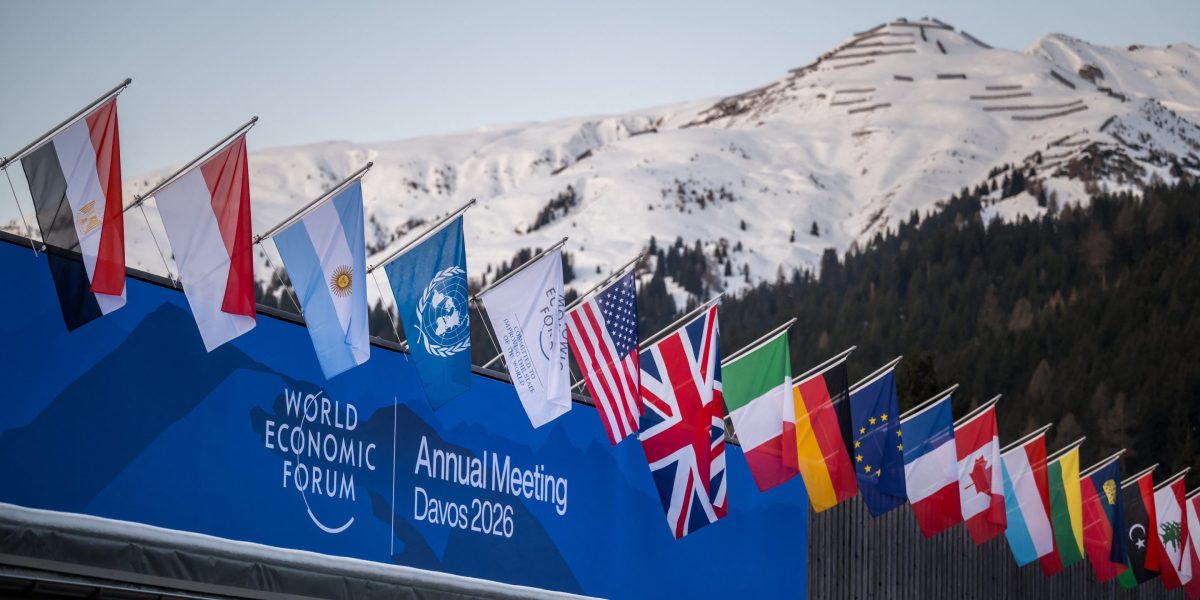
Good morning from Davos, Switzerland where the 56th annual meeting of the World Economic Forum is now underway. Organizers are calling this one of the highest-level gatherings in WEF history, a mix of almost 3,000 global leaders with about 850 top CEOs and chairs and a record 400 top political leaders, including 64 heads of state. All eyes will be on President Donald Trump, who’s coming with five cabinet secretaries and a large delegation of other senior officials. The theme this year, WEF’s first without founding chairman Klaus Schwab at the helm: “A Spirit of Dialogue.”

Some might find that conceit to be ironic in a week when Trump threatened to impose tariffs on European nations that oppose his plan to buy Greenland, and Europe vowed to fight back. No wonder the 2026 Edelman Trust Barometer finds a world retreating into isolationism. All the more reason for leaders around the globe to come together at a time when the stakes feel so high.

As I walked past USA House last night, a man lay sprawled on the icy ground, surrounded by paramedics trying to gauge if he could get up on his own. It felt like an apt metaphor for the sentiment I’ve encountered from several non-U.S. business leaders here so far: shell shock, a burst of unfamiliar pain and a desire to stay as close as possible to the U.S. As Mohamed Kande, the Washington-based global chairman of PwC, explained to me last night: “The U.S. continues to be the No. 1 destination for investment; people respect the fundamentals of the economy and the fundamentals of the companies.”

While geopolitics will likely dominate the news agenda, AI will dominate many of the discussions in hotels and sponsored houses along the Davos Promenade, where large numbers of unofficial attendees spend much of their time. That’s where the coveted parties, receptions, programming and dinners take place.

Fortune, for one, is hosting a series of gatherings, from C-suite lunches and the Fortune Most Powerful Women reception to our annual Global Leadership Dinner and a special block of programming this Wednesday at USA House. You can check out our full schedule here

I’ll be joined on the ground by my colleagues Alyson Shontell, Kamal Ahmed and Jeremy Kahn, who will be filing dispatches, taping vodcasts, and moderating conversations throughout the week. (Kamal’s first column is here.)

One of my favorite places in Davos to experience a true spirit of dialogue is Barry’s Piano Bar, also known as “Cloudflare After Dark” since Cloudflare CEO Matthew Prince rescued veteran WEF pianist Barry Coulson when Coulson’s longstanding Davos gig down the street dried up. If the six G7 members who are in town this week could sit around that piano, belting out some tunes, that might give peace a chance.

Contact CEO Daily via Diane Brady at diane.brady@fortune.com

Top leadership news

There’s no business case for taking Greenland 

President Trump is stressing the national security rationale for the U.S.’s desire to annex Greenland. That may be wise since there’s essentially no business case for the move, as Fortune energy editor Jordan Blum reports. The icy island’s harsh environment is only one reason why.

National debt is killing the American dream

Low housing stock, education barriers, and the high cost of living are all crushing the American dream, but one leading economist is naming another culprit: the U.S.’s ballooning national debt, which now totals $38.5 trillion. Fortune‘s Eleanor Pringle explains why.

Ford CEO’s AI warning

Ford CEO Jim Farley is warning that the U.S. won’t achieve its grand AI ambitions if it doesn’t solve its blue-collar labor shortage; such workers are needed to build the AI data centers and related manufacturing facilities. “How can we reshore all this stuff if we don’t have people to work there?” he said.

The markets

S&P 500 futures were down 1.11% this morning; U.S. markets are closed for MLK Day. The last session closed down 0.06%. STOXX Europe 600 was down 1.24% in early trading. The U.K.’s FTSE 100 was down 0.46% in early trading. Japan’s Nikkei 225 was down 0.65%. China’s CSI 300 was up o.05%. The South Korea KOSPI was up 1.32%. India’s NIFTY 50 was down 0.42%. Bitcoin was at $93K.

Around the watercooler

A filmmaker deepfaked Sam Altman for his movie about AI. Then things got personal by Beatrice Nolan 

When Jamie Dimon poached a top Berkshire exec, he called Warren Buffett, who said ‘If he’s going anywhere, at least he’s going to you’ by Marco Quiroz-Gutierrez

Exclusive: Elon Musk’s Boring Co. is studying a tunnel project to Tesla Gigafactory near Reno by Jessica Mathews

Like DoorDash and Google’s CEOs, Informatica boss is a McKinsey alum—he says being ‘pushed around’ by smart consultants helped him grow by Emma Burleigh

Dollar sinks as Trump’s new tariffs raise fears about U.S. debt and reserve currency status. ‘When it’s lost, economic collapse will follow’ by Jason Ma

CEO Daily is compiled and edited by Joey Abrams, Claire Zillman and Lee Clifford.


Source link

Continue Reading

Business

The curious case of the ICE pastor as Minnesota protesters disrupt church services and DOJ launches investigation

Published

on


The U.S. Department of Justice said Sunday it is investigating a group of protesters in Minnesota who disrupted services at a church where a local official with U.S. Immigration and Customs Enforcement apparently serves as a pastor.

A livestreamed video posted on the Facebook page of Black Lives Matter Minnesota, one of the protest’s organizers, shows a group of people interrupting services at the Cities Church in St. Paul by chanting “ICE out” and “Justice for Renee Good.” The 37-year-old mother of three was fatally shot by an ICE agent in Minneapolis earlier this month amid a surge in federal immigration enforcement activities.

The protesters allege that one of the church’s pastors — David Easterwood — also leads the local ICE field office overseeing the operations that have involved violent tactics and illegal arrests.

U.S. Department of Justice Assistant Attorney General Harmeet Dhillon said her agency is investigating federal civil rights violations “by these people desecrating a house of worship and interfering with Christian worshippers.”

“A house of worship is not a public forum for your protest! It is a space protected from exactly such acts by federal criminal and civil laws!” she said on social media.

Attorney General Pam Bondi also weighed in on social media, saying that any violations of federal law would be prosecuted.

Nekima Levy Armstrong, who participated in the protest and leads the local grassroots civil rights organization Racial Justice Network, dismissed the potential DOJ investigation as a sham and a distraction from federal agents’ actions in Minneapolis-St. Paul.

“When you think about the federal government unleashing barbaric ICE agents upon our community and all the harm that they have caused, to have someone serving as a pastor who oversees these ICE agents, is almost unfathomable to me,” said Armstrong, who added she is an ordained reverend. “If people are more concerned about someone coming to a church on a Sunday and disrupting business as usual than they are about the atrocities that we are experiencing in our community, then they need to check their theology and the need to check their hearts.”

The website of St. Paul-based Cities Church lists David Easterwood as a pastor, and his personal information appears to match that of the David Easterwood identified in court filings as the acting director of the ICE St. Paul field office. Easterwood appeared alongside DHS Secretary Kristi Noem at a Minneapolis press conference last October.

Cities Church did not respond to a phone call or emailed request for comment Sunday evening, and Easterwood’s personal contact information could not immediately be located.

Easterwood did not lead the part of the service that was livestreamed, and it was unclear if he was present at the church Sunday.

In a Jan. 5 court filing, Easterwood defended ICE’s tactics in Minnesota such as swapping license plates and spraying protesters with chemical irritants. He wrote that federal agents were experiencing increased threats and aggression and crowd control devices like flash-bang grenades were important to protect against violent attacks. He testified that he was unaware of agents “knowingly targeting or retaliating against peaceful protesters or legal observers with less lethal munitions and/or crowd control devices.”

“Agitators aren’t just targeting our officers. Now they’re targeting churches, too,” the U.S. Immigration and Customs Enforcement agency stated. “They’re going from hotel to hotel, church to church, hunting for federal law enforcement who are risking their lives to protect Americans.”

Black Lives Matter Minnesota co-founder Monique Cullars-Doty said that the DOJ’s prosecution was misguided.

“If you got a head — a leader in a church — that is leading and orchestrating ICE raids, my God, what has the world come to?” Cullars-Doty said. “We can’t sit back idly and watch people go and be led astray.”


Source link

Continue Reading

Business

Microsoft researchers have revealed the 40 jobs most exposed to AI—and even teachers make the list

Published

on


As companies like Amazon publicly announce AI-driven workforce reductions, workers are scrambling to understand which careers might soon disappear and be outsourced to technology.

A report from Microsoft researchers studying the occupational implications of generative AI offers some clarity.

Translators, historians, and writers are among the roles with the highest AI applicability score, meaning the job’s tasks are most closely aligned with AI’s current abilities, according to the report that ranked professions. Customer service and sales representatives—which make up about 5 million jobs in the U.S.—will also have to compete with AI. 

Overall, the jobs most exposed are ones that involve knowledge work—like people doing computer, math, or administrative work in an office, the researchers wrote. Sales jobs are also high on the list, since they often involve sharing and explaining information.

While Microsoft said high applicability doesn’t automatically mean those jobs will necessarily be replaced by AI, the list of roles quickly went viral—with professionals deeming them “most at risk.” It comes as companies like IBM have been freezing thousands of would-be new roles that it expects AI will take over in the next 5 years, and graduates in the U.K. are facing the worst job market since 2018 as employers pause hiring and use AI to cut costs, said Indeed.

Of course, there are some jobs that are unlikely to be touched by AI: Dredge operators; bridge and lock tenders; and water treatment plant and system operators are among the jobs with virtually no generative AI exposure, thanks in part to their hands-on equipment requirements.

Still, business leaders like Nvidia CEO Jensen Huang have said every job will be touched by AI in some way, and so it’s best to embrace it. 

“Every job will be affected, and immediately. It is unquestionable,” Huang said at the Milken Institute’s Global Conference in 2025. “You’re not going to lose your job to an AI, but you’re going to lose your job to someone who uses AI.”

A degree won’t save you from AI’s jobs revolution

Many of the jobs with high chances of getting upended by AI soon, like political scientists, journalists, and management analysts, are all ones that typically require a four-year degree to land a job. And as the researchers point out, having a degree—which was once considered a surefire path to career advancement—is no longer a safeguard against the changing tides. 

“In terms of education requirements, we find higher AI applicability for occupations requiring a Bachelor’s degree than occupations with lower requirements,” wrote the researchers, who studied 200,000 real-world conversations of Copilot users and cross-compared the AI’s performance with occupational data.

On the flip side, there are some career paths with low AI exposure, that are growing in demand. The health care sector, in particular, is an area that is experiencing this heavily. The home health and personal care aid industry is expected to create among the greatest number of new jobs over the next decade, according to the U.S. Bureau of Labor.

At the same time, the researchers recognized even their findings don’t capture the full scope of the AI revolution—and there could be further automation caused by more than just generative technology: “Our measurement is purely about LLMs: other applications of AI could certainly affect occupations involving operating and monitoring machinery, such as truck driving.”

Kiran Tomlinson, a senior Microsoft researcher, told Fortune the study focused on highlighting where AI might change how work is done, not take away or replace jobs.

“Our research shows that AI supports many tasks, particularly those involving research, writing, and communication, but does not indicate it can fully perform any single occupation. As AI adoption accelerates, it’s important that we continue to study and better understand its societal and economic impact,” Tomlinson said.

Gen Z’s big bet on education might not be all glam

After seeing the rollercoaster of layoffs across the tech industry over the past few years, many Gen Zers have turned to seemingly steadier fields like education.

The sector was the fastest-growing industry among recent U.K. graduates last year, and it was similarly a top career choice for American graduates. And while the profession can provide further work-life balance and decent benefits, the ability for AI to do the work may cause further headache. The report singles out farm and home management educators—as well as postsecondary economics, business, and library science teachers—as roles with relatively high AI applicability.

While it’s unlikely that schools will roll out AI teachers en masse, the report’s findings underscore how quickly the technology could reshape the education profession—and many others.

The top 10 least affected occupations by generative AI:

  1. Dredge Operators
  2. Bridge and Lock Tenders
  3. Water Treatment Plant and System Operators
  4. Foundry Mold and Coremakers
  5. Rail-Track Laying and Maintenance Equipment Operators
  6. Pile Driver Operators
  7. Floor Sanders and Finishers
  8. Orderlies
  9. Motorboat Operators
  10. Logging Equipment Operators

The top 40 most affected occupations by generative AI:

  1. Interpreters and Translators
  2. Historians
  3. Passenger Attendants
  4. Sales Representatives of Services
  5. Writers and Authors
  6. Customer Service Representatives
  7. CNC Tool Programmers
  8. Telephone Operators
  9. Ticket Agents and Travel Clerks
  10. Broadcast Announcers and Radio DJs
  11. Brokerage Clerks
  12. Farm and Home Management Educators
  13. Telemarketers
  14. Concierges
  15. Political Scientists
  16. News Analysts, Reporters, Journalists
  17. Mathematicians
  18. Technical Writers
  19. Proofreaders and Copy Markers
  20. Hosts and Hostesses
  21. Editors
  22. Business Teachers, Postsecondary
  23. Public Relations Specialists
  24. Demonstrators and Product Promoters
  25. Advertising Sales Agents
  26. New Accounts Clerks
  27. Statistical Assistants
  28. Counter and Rental Clerks
  29. Data Scientists
  30. Personal Financial Advisors
  31. Archivists
  32. Economics Teachers, Postsecondary
  33. Web Developers
  34. Management Analysts
  35. Geographers
  36. Models
  37. Market Research Analysts
  38. Public Safety Telecommunicators
  39. Switchboard Operators
  40. Library Science Teachers, Postsecondary

A version of this story originally published on Fortune.com on July 31, 2025.

More on artificial intelligence:

Join us at the Fortune Workplace Innovation Summit May 19–20, 2026, in Atlanta. The next era of workplace innovation is here—and the old playbook is being rewritten. At this exclusive, high-energy event, the world’s most innovative leaders will convene to explore how AI, humanity, and strategy converge to redefine, again, the future of work. Register now.


Source link

Continue Reading

Business

Pro-Greenland protesters mock Trump’s MAGA slogan with ‘Make America Go Away’ caps

Published

on


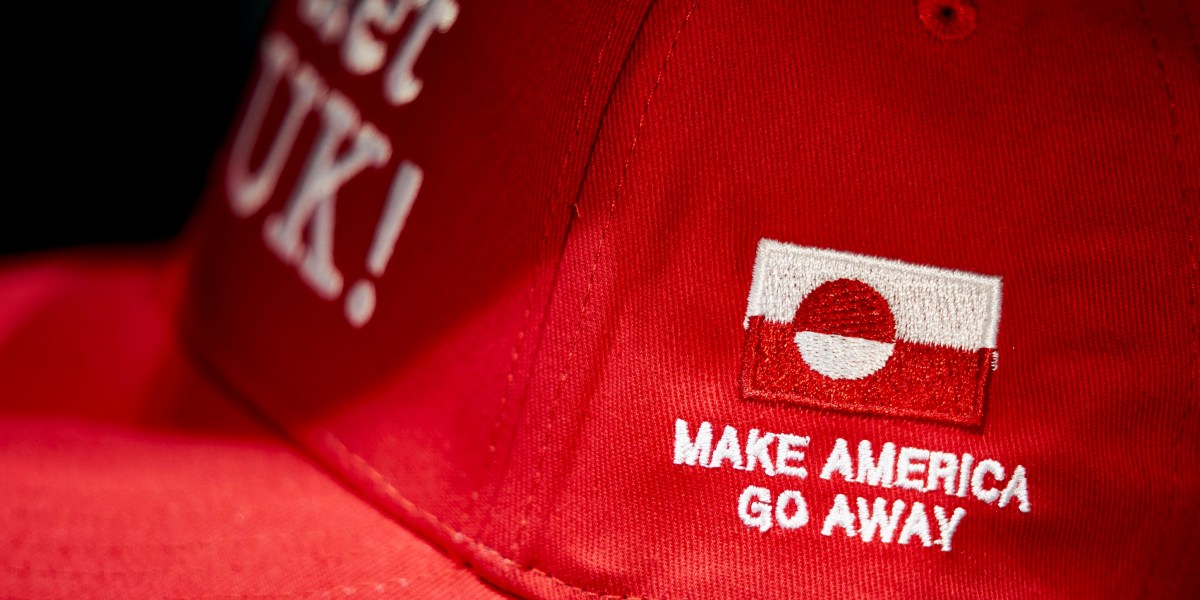
COPENHAGEN, Denmark (AP) — Red baseball caps spoofing Donald Trump’s iconic MAGA hats have become a symbol of Danish and Greenlandic defiance against the U.S. president’s threat to seize the frozen territory.

The caps reading “Make America Go Away” — parodying Trump’s “Make America Great Again” slogan — have gained popularity along with several variants on social media and at public protests, including a weekend demonstration held in freezing weather in the Danish capital.

European governments are rallying behind Denmark, citing the need to defend Arctic regions and warning that threats against Greenland undermine Western security.

Protesters, however, are less diplomatic.

“I want to show my support to Greenland and also show that I don’t like the president of the United States,” said 76-year-old Copenhagen resident Lars Hermansen, who wore one of the red caps at a protest Saturday.

The mock hats were created by Copenhagen vintage clothing store owner Jesper Rabe Tonnesen. Early batches flopped last year — until the Trump administration recently escalated its rhetoric over Greenland. Now there are popping up everywhere.

“When a delegation from America went up to Greenland, we started to realize this probably wasn’t a joke — it’s not reality TV, it’s actually reality,” said Tonnesen, 58. “So I said, OK, what can I do?” Can I communicate in a funny way with a good message and unite the Danes to show that Danish people support the people of Greenland?”

Demand suddenly surged from a trickle to selling out in the space of one weekend. Tonnesen said he has now ordered “several thousand.”

The original version designed by Tonnesen featured a play on words: “Nu det NUUK!” — a twist on the Danish phrase “Nu det nok,” meaning “Now it’s enough,” substituting Nuuk, Greenland’s tiny capital.

Protesters at Saturday’s rally waved red-and-white Danish and Greenlandic flags and carried handmade signs mocking U.S. claims over the territory, which is slightly larger than Saudi Arabia.

“No Means No,” read one sign. Another declared, “Make America Smart Again.”

Wearing one of the spoof hats, protester Kristian Boye, 49, said the gathering in front of Copenhagen City Hall struck a lighthearted tone while delivering a serious message.

“I’m here to support the Greenlanders, who are going through a very hard time right now,” he said. “They are being threatened with having their country invaded. I think it’s totally unacceptable.”

This story was originally featured on Fortune.com


Source link

Continue Reading

Trending

Copyright © Miami Select.