Connect with us

Business

Trump crackdown on ‘radical left’ after Charlie Kirk’s death targets Soros, Indivisible

Published

on


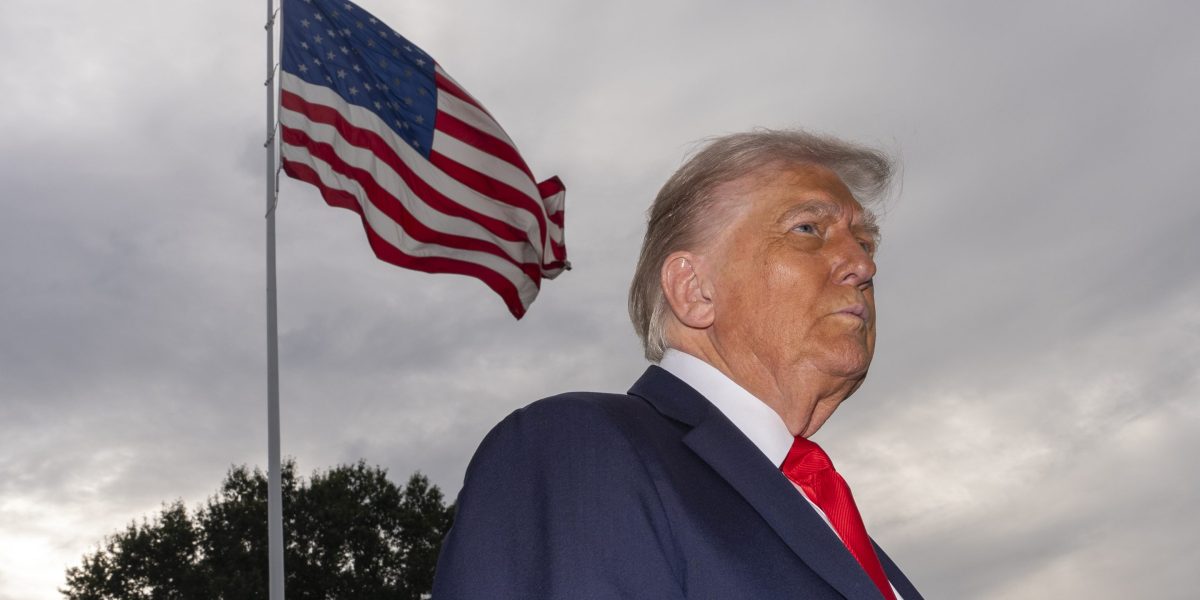
President Donald Trump is escalating threats to crack down on what he describes as the “radical left” following Charlie Kirk’s assassination, stirring fears that his administration is trying to harness outrage over the killing to suppress political opposition.

Without establishing any link to last week’s shooting, the Republican president and members of his administration have discussed classifying some groups as domestic terrorists, ordering racketeering investigations and revoking tax-exempt status for progressive nonprofits. The White House pointed to Indivisible, a progressive activist network, and the Open Society Foundations, founded by George Soros, as potential subjects of scrutiny.

Although administration officials insist that their focus is preventing violence, critics see an extension of Trump’s campaign of retribution against his political enemies and an erosion of free speech rights. Any moves to weaken liberal groups could also shift the political landscape ahead of next year’s midterm elections, which will determine control of Congress and statehouses across the country.

“The radical left has done tremendous damage to the country,” Trump told reporters on Tuesday morning when leaving for a state visit to the United Kingdom. “But we’re fixing it.”

Trump has sometimes made similar threats without following through. But now there’s renewed interest fueled by anger over the killing of Kirk, a conservative activist who was a prominent supporter of Trump and friends with many of his advisers.

More than 100 nonprofit leaders, representing organizations including the Ford Foundation, the Omidyar Network and the MacArthur Foundation, released a joint letter saying “we reject attempts to exploit political violence to mischaracterize our good work or restrict our fundamental freedoms.”

“Attempts to silence speech, criminalize opposing viewpoints, and misrepresent and limit charitable giving undermine our democracy and harm all Americans,” they wrote.

White House blames ‘terrorist networks’

Authorities said they believe the suspect in Kirk’s assassination acted alone, and they charged him with murder on Tuesday.

However, administration officials have repeatedly made sweeping statements about the need for broader investigations and punishments related to Kirk’s death.

Attorney General Pam Bondi blamed “left-wing radicals” for the shooting and said “they will be held accountable.” Stephen Miller, a top policy adviser, said there was an “organized campaign that led to this assassination.”

Miller’s comments came during a conversation with Vice President JD Vance, who was guest-hosting Kirk’s talk show from his ceremonial office in the White House on Monday.

Miller said he was feeling “focused, righteous anger,” and “we are going to channel all of the anger” as they work to “uproot and dismantle these terrorist networks” by using “every resource we have.”

Vance blamed “crazies on the far left” for saying the White House would “go after constitutionally protected speech.” Instead, he said, “We’re going to go after the NGO network that foments, facilitates and engages in violence.”

Asked for examples, the White House pointed to demonstrations where police officers and federal agents have been injured, as well as the distribution of goggles and face masks during protests over immigration enforcement in Los Angeles.

There was also a report that Indivisible offered to reimburse people who gathered at Tesla dealerships to oppose Elon Musk’s leadership of the Department of Government Efficiency. Sometimes cars were later vandalized.

Indivisible’s leadership has said “political violence is a cancer on democracy” and said that their own organization has “been threatened by right-wingers all year.”

Nonprofits brace for impact

Trump’s executive actions have rattled nonprofit groups with attempts to limit their work or freeze federal funding, but more aggressive proposals to revoke tax-exempt status never materialized.

Now the mood has darkened as nonprofits recruit lawyers and bolster the security of their offices and staff.

“It’s a heightened atmosphere in the wake of political violence, and organizations who fear they might be unjustly targeted in its wake are making sure that they are ready,” said Lisa Gilbert, co-president of the government watchdog group Public Citizen.

Trump made retribution against political enemies a cornerstone of his comeback campaign, and he’s mobilized the federal government to reshape law firms, universities and other traditionally independent institutions. He also ordered an investigation into ActBlue, an online liberal fundraising platform.

Some nonprofits expect the administration to focus on prominent funders like Soros, a liberal billionaire who has been a conservative target for years, to send a chill through the donor community.

Trump recently said Soros should face a racketeering investigation, though he didn’t make any specific allegations. The Open Society Foundations condemned violence and Kirk’s assassination in a statement and said “it is disgraceful to use this tragedy for political ends to dangerously divide Americans and attack the First Amendment.”

Sen. Chris Murphy, a Democrat from Connecticut, wrote on social media that “the murder of Charlie Kirk could have united Americans to confront political violence” but “Trump and his anti-democratic radicals look to be readying a campaign to destroy dissent.”

White House spokeswoman Abigail Jackson said “it is disingenuous and false for Democrats to say administration actions are about political speech.” She said the goal is to “target those committing criminal acts and hold them accountable.”

Republicans back Trump’s calls for investigations

Trump’s concerns about political violence are noticeably partisan. He described people who rioted at the U.S. Capitol on Jan. 6, 2021, as “hostages” and “patriots,” and he pardoned 1,500 of them on his first day back in the Oval Office. He also mocked House Speaker Emerita Nancy Pelosi after an attack on her husband.

When Trump condemned Kirk’s killing in a video message last week, he mentioned several examples of “radical left political violence” but ignored attacks on Democrats.

Asked on Monday about the killing of Minnesota state Rep. Melissa Hortman over the summer, Trump said “I’m not familiar” with the case.

“Trump shrugs at right-wing political violence,” said Ezra Levin, the co-executive director of Indivisible, in a newsletter.

Some conservative commentators have cheered on a potential crackdown. Laura Loomer, a conspiracy theorist with a long record of bigoted comments, said “let’s shut the left down.” She also said that she wants Trump “to be the ‘dictator’ the left thinks he is.”

Katie Miller, the wife of Stephen Miller and a former administration spokeswoman, asked Bondi whether there would be “more law enforcement going after these groups” and “putting cuffs on people.”

“We will absolutely target you, go after you, if you are targeting anyone with hate speech,” Bondi said. “And that’s across the aisle.”

Her comments sparked a backlash from across the political spectrum, since even hate speech is generally considered to be protected under the First Amendment. Bondi was more circumspect on social media on Tuesday morning, saying they would focus on “hate speech that crosses the line into threats of violence.”

Trump is getting more support from Republicans in Congress. Sen. Ted Cruz of Texas and others proposed legislation that would enable the Justice Department to use racketeering laws, originally envisioned to combat organized crime, to prosecute violent protesters and the groups that support them.

Rep. Chip Roy of Texas wants the House to create a special committee to investigate the nonprofit groups, saying “we must follow the money to identify the perpetrators of the coordinated anti-American assaults being carried out against us.”

___
Associated Press writer Bill Barrow in Atlanta contributed to this report.


Source link

Continue Reading

Business

Warner Bros. plans to reject Paramount bid on funding, terms

Published

on


Warner Bros. Discovery Inc. is planning to reject Paramount Skydance Corp.’s hostile takeover bid due to concerns about financing and other terms, people familiar with the matter said.

After deliberating and reviewing Paramount’s bid, Warner Bros.’ board will urge shareholders to reject the tender offer, said the people, who asked not to be identified discussing confidential information. The board still views the company’s existing agreement with streaming leader Netflix Inc. as offering greater value, certainty and terms than what Paramount has proposed, they said.

Warner Bros.’ response to Paramount’s tender offer could be filed as early as Wednesday, the people added. No final decision has been made and the situation remains fluid, they said. Representatives for Warner Bros. and Paramount declined to comment.

One major sticking point is Warner Bros.’ concern about the financing proposed by Paramount, which is led by David Ellison.

The equity is backstopped by a trust that manages the wealth of his father, software billionaire Larry Ellison. Because it’s a revocable trust, assets can be taken out of it at any time, and Warner Bros. may have no recourse if that happens, the people said. 

One of Paramount’s backers dropped out the deal Tuesday. Affinity Partners, led by President Donald Trump’s son-in-law Jared Kushner, told Bloomberg News it was withdrawing from the proposed transaction, citing the involvement of “two strong competitors.”

Earlier Tuesday, President Trump criticized Paramount, saying on social media that he’s been treated “far worse” by the company’s CBS division since the Ellison family took control earlier this year. The Ellisons have touted their friendly ties to the president.

Warner Bros.’ board is also concerned about the company’s ability to conduct business for the year or more it could take for a sale to win regulatory approval. Paramount isn’t offering the company enough flexibility to run its business or manage its balance sheet, the people said. 

Paramount said in a filing last week that it had addressed Warner Bros. concerns about the company’s flexibility in refinancing debt as well as payment of a $5 billion break up fee that would be backstopped by the Ellison family. 

Paramount has adjusted terms of its bid in response to Warner Bros.’ requests in other ways. Some $1 billion in financing from China’s Tencent Holdings Ltd. was withdrawn over concerns the funding could cause national security concerns with US regulators. 

Warner Bros. agreed this month to sell its studios, streaming business and HBO to Netflix for $27.75 a share, or about $83 billion including debt, capping off a multiweek bidding war between Netflix, Paramount and Comcast Corp. Warner Bros. separately plans to spin off cable networks like CNN and TNT to its shareholders before the Netflix deal closes.

Paramount, which owns MTV and the Paramount+ streaming service, has offered to buy all of Warner Bros. for $30 a share, or more than $108 billion, including debt. Three days after Netflix and Warner Bros. announced their deal, Paramount took its offer directly to shareholders by launching a public tender offer for Warner Bros. shares. 

Paramount has said that its $30-a-share offer for Warner Bros. isn’t its “best and final,” implying it has room to raise its bid. Shares of Warner Bros. closed at $28.90 in New York, suggesting some investors expect the company to fetch a higher price. 

Warner Bros.’ agreement with Netflix bars it from soliciting proposals from other bidders but it’s allowed to entertain proposals that come in. In the event of a superior proposal, it’s required to give Netflix the opportunity to match the better offer to try to keep their existing deal intact, according to their agreement. 

This story was originally featured on Fortune.com


Source link

Continue Reading

Business

Trump turns on CBS, Kushner pulls out and Paramount’s hostile bid for Warner Bros. shows signs of collapse

Published

on


Paramount’s hostile bid for Warner Bros. showed signs of unraveling just moments after President Donald Trump aired fresh grievances about the flagship newsmagazine 60 Minutes. Just hours after Trump’s latest lashed out at CBS News, accusing the Paramount-owned network of treating him “far worse” since its new ownership took over earlier this year, Jared Kushner pulled his Affinity Partners private equity firm out of the Warner bid, as reports swirled that the Looney Tunes studio planned to reject the star-topped mountain. 

“For those people that think I am close with the new owners of CBS, please understand that 60 Minutes has treated me far worse since the so-called ‘takeover,’ than they have ever treated me before,” Trump said. “If they are friends, I’d hate to see my enemies!”

Paramount had entered the bidding for Warner, with its $77.9 billion offer for all of Warner Bros. Discovery coming one working day after Netflix’s $72 billion offer for the studio and HBO Max, as a seeming friend of the White House.

CEO David Ellison has repeatedly highlighted his ties to Trump, with his father Larry a longtime Trump donor (and second-richest man alive). CBS News, under Ellison, recently installed Bari Weiss, owner of independent news organization The Free Press and a prominent critic of progressive media culture, in a senior editorial role, a move widely read in Hollywood and Washington as gestures toward an anti-“woke” White House. Kushner’s participation, as son-in-law to the President, reinforced that impression. His roughly $200 million equity commitment via his firm functioned, some analysts said, as a political signal as much as a financing tool.

Trump’s outburst disrupted that calculus. By openly distancing himself from Paramount and criticizing its flagship news division, the president stripped the bid of its most implicit advantage: the perception of regulatory goodwill. Almost immediately after Trump’s post circulated, Affinity announced it was exiting the deal, citing a shift in “investment dynamics” amid competition from Netflix. Now, reports indicate that Warner Bros. plans to reject Paramount’s hostile bid over financing concerns. 

Trump’s public remarks have continuously scrambled assumptions about his supposed friendships, or loyalties. He confirmed to reporters at the Kennedy Center, the weekend after Netflix’s bid, that he had met with Co-CEO Ted Sarandos, who he called a “fantastic man.” Later, he said that neither Paramount nor Netflix were “great friends” of his. As the corporate takeover saga unfolds, who will be revealed next as friend or enemy?

Join us at the Fortune Workplace Innovation Summit May 19–20, 2026, in Atlanta. The next era of workplace innovation is here—and the old playbook is being rewritten. At this exclusive, high-energy event, the world’s most innovative leaders will convene to explore how AI, humanity, and strategy converge to redefine, again, the future of work. Register now.


Source link

Continue Reading

Business

Kushner’s Affinity withdraws from Warner Bros. takeover battle

Published

on


Jared Kushner’s Affinity Partners is exiting from the takeover battle for Warner Bros. Discovery Inc. 

The private equity firm this month emerged as a participant in Paramount Skydance Corp.’s hostile bid for Warner Bros., which valued the media and entertainment company at $108.4 billion including debt. Paramount is seeking to scupper Netflix Inc.’s agreed $82.7 billion deal for Warner Bros.

Affinity was helping to finance Paramount’s move. It now believes the dynamics ​of an investment have changed since it became involved in the process in October, a representative for the firm said.

“With ​two ​strong competitors ​vying to secure ​the future ​of this ​unique American ​asset, ​Affinity ​has ​decided no longer to pursue ​the opportunity,” the firm said. “We ​continue to ​believe ​there is a strong strategic rationale for Paramount’s offer.”

Warner Bros. is planning to reject Paramount’s offer due to concerns about financing and other terms, people familiar with the matter said Tuesday. Affinity’s investment in the bid is about $200 million in equity, Bloomberg News has reported. 

The battle for Warner Bros. stands to reshape the entertainment industry regardless of which bidder emerges victorious. With the company’s films and TV shows, Netflix would wield tremendous new power over the content offered to online audiences. Paramount, meanwhile, aims to marry two legacy Hollywood studios to counter the influence of Netflix, Walt Disney Co. and Amazon.com Inc.

Both bids raise significant antitrust concerns — something underscored by multibillion-dollar breakup fees the parties have offered. Netflix and Paramount have each been laying the groundwork to win over the White House, with US President Donald Trump having indicated he will weigh in on the approval process for a sale of Warner Bros. Kushner is Trump’s son-in-law.

Paramount’s offer is being bankrolled by a list of influential Middle Eastern investors, including Saudi Arabia’s Public Investment Fund and the Qatar Investment Authority, as well as a little-known group from Abu Dhabi called L’imad Holding Co. Kushner has strong ties to the Middle East. He founded Affinity in 2021 with funding from sovereign wealth funds from the region. 

This week, Bloomberg News reported that Affinity dropped plans for a hotel in Serbia after tensions around the project culminated in the indictment of a government official who helped clear a path for its development.

This story was originally featured on Fortune.com


Source link

Continue Reading

Trending

Copyright © Miami Select.