Connect with us

Business

Trump claims China holding the world ‘hostage’ on rare earths is ‘especially inappropriate’ after Gaza peace deal

Published

on


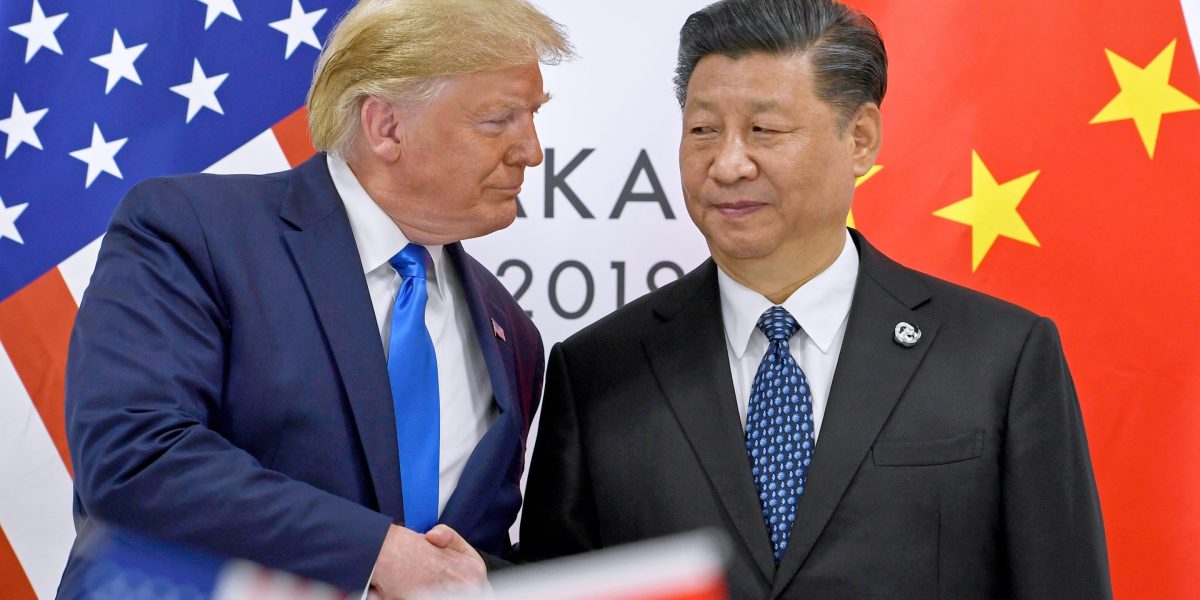
President Donald Trump said Friday that “there seems to be no reason” to meet with Chinese leader Xi Jinping as part of an upcoming trip to South Korea and threatened additional tariffs after China restricted exports of rare earths needed for American industry.

The Republican president suggested that he was looking at a “massive increase” of import taxes on Chinese products in response to Xi’s moves. It’s possible that this could amount to either posturing by the United States for eventual negotiations or a retaliatory step that could foster new fears about the stability of the global economy.

“One of the Policies that we are calculating at this moment is a massive increase of Tariffs on Chinese products coming into the United States of America,” Trump posted on his Truth Social platform. “There are many other countermeasures that are, likewise, under serious consideration.”

The United States and China have been jostling for advantage in trade talks, after the import taxes announced earlier this year triggered a trade war between the world’s two largest economies. Both nations agreed to ratchet down tariffs after negotiations in Switzerland and the United Kingdom, yet tensions remain as China has continued to restrict America’s access to the difficult-to-mine rare earths needed for a wide array of U.S. technologies.

Trump did not formally cancel the meeting with Xi, so much as indicate that it might not happen as part of a trip at the end of the month in Asia. The trip was scheduled to include a stop in Malaysia, which is hosting the Association of Southeast Asian Nations summit; a stop in Japan; and a visit to South Korea, where he was slated to meet with Xi ahead of the Asia-Pacific Economic Cooperation summit.

“I was to meet President Xi in two weeks, at APEC, in South Korea, but now there seems to be no reason to do so,” Trump posted.

Trump’s threat shattered a monthslong calm on Wall Street, and the S&P 500 fell as much as 2% on worries about rising tensions between the world’s two largest economies.

China’s new restrictions

On Thursday, the Chinese government restricted access to the rare earths ahead of the scheduled Trump-Xi meeting. Beijing would require foreign companies to get special approval for shipping the metallic elements abroad. It also announced permitting requirements on exports of technologies used in the mining, smelting and recycling of rare earths, adding that any export requests for products used in military goods would be rejected.

Trump said that China is “becoming very hostile” and that it’s holding the world “captive” by restricting access to the metals and magnets used in electronics, computer chips, lasers, jet engines and other technologies.

“I have not spoken to President Xi because there was no reason to do so,” Trump posted. “This was a real surprise, not only to me, but to all the Leaders of the Free World.”

The Chinese Embassy in Washington did not immediately respond to an Associated Press request for comment.

The U.S. president said the move on rare earths was “especially inappropriate” given the announcement of a ceasefire between Israel and Hamas in Gaza so that the remaining hostages from Hamas’ Oct. 7, 2023, attack can be released. He raised the possibility without evidence that China was trying to steal the moment from him for his role in the ceasefire, saying on social media, “I wonder if that timing was coincidental?”

There is already a backlog of export license applications from Beijing’s previous round of export controls on rare earth elements, and the latest announcements “add further complexity to the global supply chain of rare earth elements,” the European Union Chamber of Commerce in China said in a statement.

Gracelin Baskaran, director of the Critical Minerals Security Program at the Center for Strategic and International Studies in Washington, D.C., said China signaled it is open to negotiations, but it also holds leverage because to dominates the market for rare earths with 70% of the mining and 93% of the production of permanent magnets made from them that are crucial to high-tech products and the military.

“These restrictions undermine our ability to develop our industrial base at a time when we need to. And then second, it’s a powerful negotiating tool,” she said. And these restrictions can hurt efforts to strengthen the U.S. military in the midst of global tensions because rare earths are needed.

Trump’s trade war

The outbreak of a tariff-fueled trade war between the U.S. and China initially caused the world economy to shudder over the possibility of global commerce collapsing. Trump imposed tariffs totaling 145% on Chinese goods, with China responding with import taxes of 125% on American products.

The taxes were so high as to effectively be a blockade on trade between the countries. That led to negotiations that reduced the tariff charged by the U.S. government to 30% and the rate imposed by China to 10% so that further talks could take place. But differences continue over America’s access to rare earths from China, U.S. restrictions on China’s ability to import advanced computer chips, sales of American-grown soybeans and a series of tit-for-tat port fees being levied by both countries starting on Tuesday.

Just what Trump’s threat meant was open to interpretation, as it could simply be an attempt to gain some leverage under the belief that China has overplayed its hand or an ominous sign of trade tensions leading to a potentially destructive increase in tariff rates.

Nebraska Republican Rep. Don Bacon said “China has not been a fair-trade partner for years,” but the Trump administration should have anticipated China’s restrictions on rare earths and refusal to buy American soybeans in response to the tariffs.

How analysts see moves by US and China

Wendy Cutler, senior vice president of the Asia Society Policy Institute, said Trump’s post shows the fragility of the détente between the two countries and it’s unclear whether the two sides are willing to de-escalate to save the bilateral meeting.

Cole McFaul, a research fellow at Georgetown University’s Center for Security and Emerging Technology, said that Trump appeared in his post to be readying for talks on the possibility that China had overplayed its hand. By contrast, China sees itself as having come out ahead when the two countries have engaged in talks.

“From Beijing’s point of view, they’re in a moment where they’re feeling a lot of confidence about their ability to handle the Trump administration,” McFaul said. “Their impression is they’ve come to the negotiating table and extracted key concessions.”

Craig Singleton, senior director of the China program at the Foundation for Defense of Democracies, a think tank, said Trump’s post could “mark the beginning of the end of the tariff truce” that had lowered the tax rates charged by both countries.

It’s still unclear how Trump intends to follow through on his threats and how China plans to respond.

“But the risk is clear: Mutually assured disruption between the two sides is no longer a metaphor,” Singleton said. “Both sides are reaching for their economic weapons at the same time, and neither seems willing to back down.”

_

AP writers Stan Choe in New York and Josh Funk in Omaha, Nebraska, contributed to the report.


Source link

Continue Reading

Business

U.S. trade chief says China has complied with terms of trade deals

Published

on


Trade Representative Jamieson Greer said China has been complying with the terms of the bilateral trade agreements and that the US is constantly monitoring commitments made by China in a bid to maintain a stable trade relationship.

“With China, it’s always we verify and we monitor and we watch the commitments. The commitments are quite specific,” Greer said Sunday on Fox News’ The Sunday Briefing. “So all of these things that we’ve agreed to with the Chinese recently are very concrete, we can monitor them with some ease, and so far, we’re seeing that they’re in compliance.”

Greer said China has gotten approximately “a third” of the way through its soybean purchase commitment for this growing season.

Bloomberg previously reported that after a series of orders placed in late October — the first of this season — China’s purchases of American soybeans appeared to have stalled. 

President Donald Trump and Chinese President Xi Jinping in late October agreed to extend a tariff truce, roll back export controls and reduce other trade barriers. But some elements of the deal — including the soybean purchases, sale of social media app TikTok and an increase in licenses to export critical rare earths from China — remain in progress.

US Treasury Secretary Scott Bessent and Greer held a video call with Chinese Vice Premier He Lifeng on Friday, according to China’s state-run news agency Xinhua, during which the officials had an “in-depth and constructive” discussion in which they vowed to keep stable ties and address “respective concerns” on trade and the economy, the outlet said.

Read More: Top US, Chinese Officials Pledge Cooperation on Trade Deal

Bessent on Sunday told CBS News’ Face the Nation that China will not speed up purchases, but they are still expected to take place this crop season and said soybean prices are up 12% to 15% since the agreement with China. He also said he divested from a soybean farm to comply with an ethics agreement

The Trump administration is expected to release its long-awaited farm aid plan this week, US Agriculture Secretary Brooke Rollins said in a cabinet meeting last Tuesday.

Asked whether chipmakers like Nvidia should give China advanced chips or if doing so would pose a security risk to the US, Greer expressed a need for the US to be cautious.

“My own view is we need to be very cautious about this,” Greer said on Fox News. “We want companies’ bottom lines to do well, but as policymakers, we need to make sure that the national security is placed first and foremost, and that’s why you’ve heard President Trump talk about the types of chips that maybe would be restricted and there’s always an open discussion on where that threshold lies, and it changes over time.”


Source link

Continue Reading

Business

HP’s chief commercial officer predicts the future will include AI PCs that don’t use the cloud

Published

on


Increased focus on “privacy and security” may open the door for AI-enabled devices rather than rely entirely on cloud computing and remote data centers. 

“In a world where sovereign data retention matters, people want to know that if they input data to a model, the model won’t train on their data,” David McQuarrie, HP’s chief commercial officer, told Fortune in October. Using an AI locally provides that reassurance.

HP, like many of its devicemaking peers, is exploring the use of AI PCs, or devices that can use AI locally as opposed to in the cloud. “Longer term, it will be impossible not to buy an AI PC, simply because there’s so much power in them,” he said. 

More broadly, smaller companies might be served just as well by a smaller model running locally than a larger model running in the cloud. “A company, a small business, or an individual has significant amounts of data that need not be put in the cloud,” he said. 

Asian governments have often had stricter rules on data sovereignty. China, in particular, has significantly tightened its regulations on where Chinese user data can be stored. South Korea is another example of an Asian country that treats some locally sourced data as too sensitive to be housed overseas. 

Governments the world over, and particularly in Asia, are also investing in local sovereign AI capabilities, trying to avoid relying entirely on systems and platforms housed wholly overseas. South Korea, for example, is partnering with local tech companies like search giant Naver to build its own AI systems. Singapore is investing in projects like the Southeast Asian Languages in One Network (SEA-LION), which are better tailored to Southeast Asian countries. 

Asian AI adoption

Asia is HP’s smallest region, but also its fastest-growing. Revenue from Asia-Pacific and Japan grew by 7% over the company’s 2025 fiscal year, which ended in October, to hit $13.3 billion. That’s around a quarter of HP’s total revenue of $55.3 billion. (HP’s other two regions are the Americas; and Europe, the Middle East, and Africa.)

McQuarrie also suggested that there was an opportunity to be “disruptive” in Asia. While many business leaders have been eager to embrace AI, at least rhetorically, actual adoption is proving more difficult. A recent survey from McKinsey reports that two-thirds of companies are still in the experimentation phase of AI. 

But McQuarrie believed that AI adoption in Asia could be “just as quick, if not quicker,” than other regions. 

Asia seems to be more comfortable with the use of AI, at least when it comes to users. An October survey from Pew found that fewer people in countries like India, South Korea and Japan reported feeling “more concerned than excited” about AI compared to the U.S. 

When it comes to convincing more companies to adopt AI, let alone AI PCs, McQuarrie said the answer was to make AI functions as seamless as possible, so “that it doesn’t really matter whether you understand that you’re embracing AI or not.”

“What we’re doubling down on is the future of work,” McQuarrie said. “The future of work is a device that makes your experience better and your productivity greater.”

“The fact that we’re using AI in the background? They don’t need to know that.”


Source link

Continue Reading

Business

Trump administration waives part of a Biden-era fine against Southwest Air for canceled flights

Published

on


The U.S. Department of Transportation is waiving part of a fine assessed against Southwest Airlines after the company canceled thousands of flights during a winter storm in 2022.

Under a 2023 settlement reached by the Biden administration, Southwest agreed to a $140 million civil penalty. The government said at the time that the penalty was the largest it had ever imposed on an airline for violating consumer protection laws.

Most of the money went toward compensation for travelers. But Southwest agreed to pay $35 million to the U.S. Treasury. Southwest made a $12 million payment in 2024 and a second $12 million payment earlier this year. But the Transportation Department issued an order Friday waiving the final $11 million payment, which was due Jan. 31, 2026.

The department said Southwest should get credit for significantly improving its on-time performance and investing in network operations.

“DOT believes that this approach is in the public interest as it incentivizes airlines to invest in improving their operations and resiliency, which benefits consumers directly,” the department said in a statement. “This credit structure allows for the benefits of the airline’s investment to be realized by the public, rather than resulting in a government monetary penalty.”

The fine stemmed from a winter storm in December 2022 that paralyzed Southwest’s operations in Denver and Chicago and then snowballed when a crew-rescheduling system couldn’t keep up with the chaos. Ultimately the airline canceled 17,000 flights and stranded more than 2 million travelers.

The Biden administration determined that Southwest had violated the law by failing to help customers who were stranded in airports and hotels, leaving many of them to scramble for other flights. Many who called the airline’s overwhelmed customer service center got busy signals or were stuck on hold for hours.

Even before the settlement, the nation’s fourth-biggest airline by revenue said the meltdown cost it more than $1.1 billion in refunds and reimbursements, extra costs and lost ticket sales over several months.


Source link

Continue Reading

Trending

Copyright © Miami Select.