Connect with us

Business

Trump claims all the U.S. automakers are ‘doing great.’ Gretchen Whitmer says ‘this will only get worse without a serious shift’

Published

on


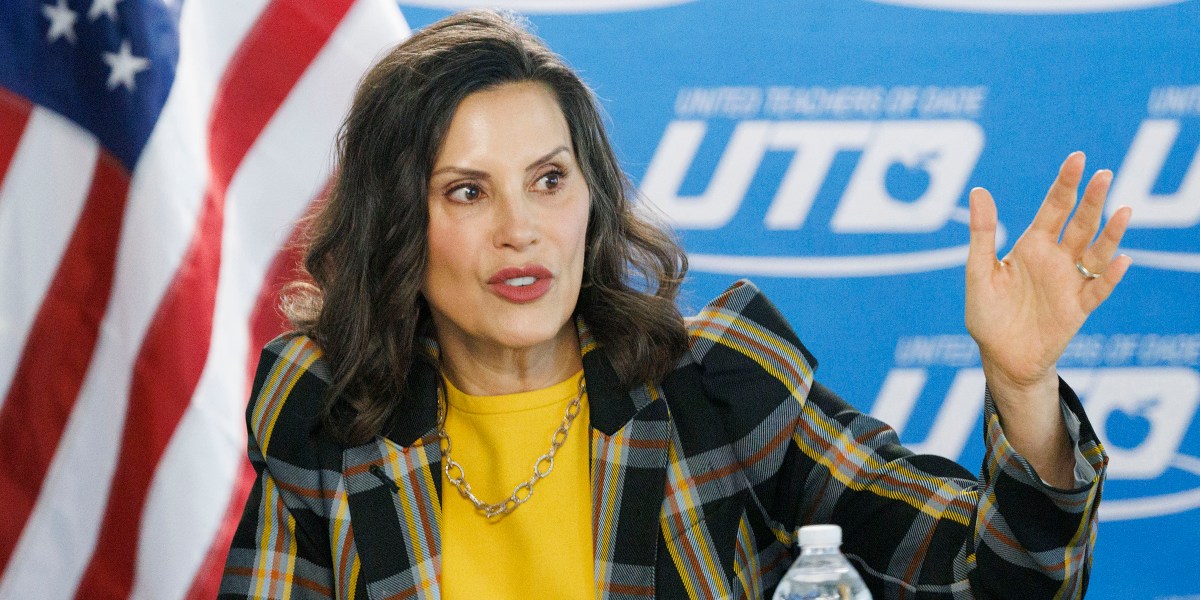
Michigan Gov. Gretchen Whitmer offered a contrasting view of manufacturing in Detroit Thursday, two days after President Donald Trump defended his tariff strategy in the Motor City.

Whitmer, a term-limited Democrat who is in her last year as governor, said in a speech at the Detroit Auto Show that the administration’s tariff strategy has hurt American auto manufacturing and is benefiting Chinese competitors. It’s a message she has repeated over the past year as economic uncertainty has rippled across the automobile sector.

“This will only get worse without a serious shift in national policy,” Whitmer said.

Her remarks followed Trump’s speech defending his economic policy Tuesday in Detroit, a major hub of automobile manufacturing. He also toured the factory floor of a Ford plant in Dearborn.

“All U.S. automakers are doing great,” Trump said.

Whitmer offered a differing picture of the impact, saying that American manufacturing has contracted for months leading to job loss and production cuts. She has remained firmly opposed to Trump’s tariff strategy since last year, especially as her state partners closely with Canadian business. Automobile parts often cross the U.S.-Canadian border several times in the assembly process.

“America stands more alone than she has in decades,” Whitmer said. “And perhaps no industry has seen more change and been more impacted than our auto industry.”

The White House did not immediately respond to a request for comment on Whitmer’s speech.

Whitmer has kept a more cordial relationship with Trump in his second term compared to his first. The relationship included a few White House visits last year. Long considered a possible Democratic candidate for president, Whitmer’s strategy is notably different than other potential 2028 names who have take more public, combative approaches to Trump, including California Gov. Gavin Newsom and Illinois Gov. J.B. Pritzker.

In her address, her first of the year, Whitmer said every time she has met with Trump this past year, she has told him that hurting the U.S.-Canadian relationship only helps Chinese competition.

Trump changed his tune when it comes to automobiles in the last year. He originally announced a 25% tariff on automobiles and parts only to later relax the policy as domestic manufactures sought relief from the threat of rising production costs.

On his tour in the Detroit area, Trump suggested the United States-Mexico-Canada Agreement, a major trade agreement he negotiated in his first term, was irrelevant, although he provided few other details The UMCA is up for review this year.

Whitmer defended the trade agreement in her speech.

“When we fight our neighbors, however, China wins,” she said.


Source link

Continue Reading

Business

Down Arrow Button Icon

Published

on


Kyle Hency started Chubbies in 2011 with three Stanford friends as a fun, weekend‑and‑beer‑vibe shorts brand.

The irreverent direct-to-consumer clothing brand—one popular item was a tear-away pair of shorts with a speedo-style bathing suit underneath—”was objectively maybe a bad idea,” Hency says, half joking. Nevertheless, the company caught fire—revenue went from $1 million to $8 million. And when Chubbies was acquired by Solo Stove in 2021, it marked a rare retail exit just as the direct-to-consumer boom began to collapse.

After spending a few years on the sidelines, Hency is back: He cofounded Good Day in 2024 with former Chubbies CFO Dave Wardell, and the startup just raised its seed round to solve one of retail’s biggest problems: managing inventory. 

It’s an area in which Hency has hard-earned, first-hand experience. Despite its ultimate success (Hency says Chubbies now does $100 million or more in sales under its new owner), Chubbies almost ran out of cash three times, and at one point managed with negative $2 million cash for 18 months. Managing inventory became critical, and Hency says he struggled with the software tools available at the time.

And in today’s market, clothing brands are under even more pressure to run a tight ship and obsess about everything below the revenue line, Hency says.

“Every single brand now has to manage revenue all the way down to profits, because those profits are the only way they can fund their business,” he says. “The lenders have gone out of business. The VCs aren’t backing brands as much as they were before. If you look up how much VC investments into consumer deals have gone down since before that period, some numbers show over 90% reduction.”

Good Day has raised $7 million in seed funding from current investors like Ridge Ventures, FirstMark Capital, and Flex Capital, the company exclusively told Fortune. New investors include Long Journey Ventures, Adverb Ventures, and Seguin Ventures. This brings the Good Day’s total capital raised to $13.5 million and current customers include Hill House Home, The Normal Brand, Margaux NY, and Kenny Flowers. 

Amish Jani, cofounder and partner at FirstMark, described Good Day as “AI-native, ERP-lite”—an enterprise resource planning system that stands apart from traditional options. He sees an opportunity for startups to capitalize on the AI boom as retailers redesign their systems of record for this new era.

“If agentic solutions are driving real utility and replacing labor costs directly, I expect e-commerce brands to be amongst the first adopters of these tools,” Jani said via email. “GoodDay is a good example of this in the ERP space, but you can also see this emerging very quickly in every major vertical SaaS category both in consumer and beyond.”

While Hency’s latest startup may seem more staid than the loud Chubbies shorts he once flogged, the entrepreneur has not completely left the attitude behind. An important part of Good Day’s brand marketing is taunting established ERP competitors like Netsuite.

“Do you think NetSuite, created 20 years ago by a bunch of suits, is helping anybody during Black Friday, Cyber Monday?,” said Hency.

Hency’s rhetoric isn’t an accident, it’s strategy. In the ERP jungle, he’s aware he’s new—but he thinks he can get customers to switch from established competitor NetSuite. There’s some evidence this could perhaps happen. Take Jimmy Sansone, co-owner of The Normal Brand and Good Day customer, who said via email: “From an operational perspective, we did not have accurate visibility into our inventory balances, and our ops teams had to rely on offline spreadsheets and manual tools to move, fulfill, buy and receive inventory.”

Hency’s directness is part of his philosophy about business.

“I think it’s so important when you’re building a brand to be different,” he said. “It’s way more important than it is to be cool.”


Source link

Continue Reading

Business

Down Arrow Button Icon

Published

on


Venezuelan opposition leader María Corina Machado visited the White House on Thursday to discuss her country’s future with President Donald Trump, even though he has dismissed her credibility to take over after an audacious U.S. military raid captured then-President Nicolás Maduro.

Visiting Trump presented something of a physical risk for Machado, whose whereabouts have been largely unknown since she left her country last year after being briefly detained in Caracas. Nevertheless, after a closed-door discussion with Trump, she greeted dozens of cheering supporters waiting for her near the gates —stopping to hug many.

“We can count on President Trump,” she told them, prompting some to briefly chant “Thank you, Trump,” but she didn’t elaborate.

The jubilant scene stood in contrast to Trump having repeatedly raised doubts about Machado and his stated commitment to backing democratic rule in Venezuela. He has signaled his willingness to work with acting President Delcy Rodríguez, who was Maduro’s No. 2.

Along with others in the deposed leader’s inner circle, Rodríguez remains in charge of day-to-day government operations and was delivering her first state of the union speech during Machado’s Washington trip.

In endorsing Rodríguez so far, Trump sidelined Machado, who has long been a face of resistance in Venezuela. That’s despite Machado seeking to cultivate relationships with the president and key administration voices like Secretary of State Marco Rubio, in a gamble to ally herself with the U.S. government and some of its top conservatives.

White House press secretary Karoline Leavitt called Machado “a remarkable and brave voice” for the people of Venezuela, but also said that the meeting didn’t mean Trump’s opinion of her changed, calling it “a realistic assessment.”

Trump has said it would be difficult for Machado to lead because she “doesn’t have the support within or the respect within the country.” Her party is widely believed to have won 2024 elections rejected by Maduro.

Leavitt went on to say that Trump supported new Venezuelan elections “when the time is right” but did not say when he thought that might be.

Trump administration plays down meeting expectations

Leavitt said Machado sought the face-to-face meeting without setting expectations for what would occur. Machado previously offered to share with Trump the Nobel Peace Prize she won last year, an honor he has coveted.

“I don’t think he needs to hear anything from Ms. Machado,” the press secretary said, other than to have a ”frank and positive discussion about what’s taking place in Venezuela.”

All told, Machado spent about two and a half hours at the White House but left without answering questions on whether she’d offered to give her Nobel prize to Trump, saying only “gracias.” It wasn’t clear she’d heard the question as she hugged and her waiting supporters.

Machado was next appearing on Capitol Hill, for a meeting in the Senate before planning to speak to reporters.

Her Washington stop began after U.S. forces in the Caribbean Sea seized another sanctioned oil tanker that the Trump administration says had ties to Venezuela.

It is part of a broader U.S. effort to take control of the South American country’s oil after U.S. forces seized Maduro and his wife at a heavily guarded compound in the Venezuelan capital of Caracas and brought them to New York to stand trial on drug trafficking charges.

Leavitt said Venezuela’s interim authorities have been fully cooperating with the Trump administration and that Rodríguez’s government said it planned to release more prisoners detained under Maduro. Among those released were five Americans this week.

Rodríguez has adopted a less strident position toward Trump then she did immediately after Maduro’s ouster, suggesting that she can make the Republican administration’s “America First” policies toward the Western Hemisphere, work for Venezuela — at least for now.

Trump said Wednesday that he had a “great conversation” with Rodríguez, their first since Maduro was ousted.

“We had a call, a long call. We discussed a lot of things,” Trump said during an Oval Office bill signing. “And I think we’re getting along very well with Venezuela.”

Machado doesn’t get the nod from Trump

Even before indicating the willingness to work with Venezuela’s interim government, Trump was quick to snub Machado. Just hours after Maduro’s capture, Trump said of Machado that “it would be very tough for her to be the leader.”

Machado has steered a careful course to avoid offending Trump, notably after winning the peace prize. She has since thanked Trump, though her offer to share the honor with him was rejected by the Nobel Institute.

Machado remained in hiding even after winning the Nobel Peace Prize. She missed the ceremony but briefly reappeared in Oslo, Norway, in December after her daughter received the award on her behalf.

The industrial engineer and daughter of a steel magnate, Machado began challenging the ruling party in 2004, when the nongovernmental organization she co-founded, Súmate, promoted a referendum to recall then-President Hugo Chávez. The initiative failed, and Machado and other Súmate executives were charged with conspiracy.

A year later, she drew the anger of Chávez and his allies again for traveling to Washington to meet President George W. Bush. A photo showing her shaking hands with Bush in the Oval Office lives in the collective memory. Chávez considered Bush an adversary.

Almost two decades later, she marshaled millions of Venezuelans to reject Chávez’s successor, Maduro, for another term in the 2024 election. But ruling party-loyal electoral authorities declared him the winner despite ample credible evidence to the contrary. Ensuing anti-government protests ended in a brutal crackdown by state security forces.

___

Garcia Cano reported from Caracas, Venezuela, and Janetsky from Mexico City. AP Diplomatic Writer Matthew Lee in Washington contributed to this report.


Source link

Continue Reading

Business

America’s $952 billion annual burden: The math behind the exploding interest on the national debt

Published

on


America has had gigantic budget deficits and debt that have been dangerous and ballooning for years, yet it’s only recently that they’re stirring alarm among voters in a big way. In the spring of 2025, a poll conducted by the nonpartisan Peterson Foundation found that 76% of all voters, including 73% of Democrats and 89% of Republicans, agree that addressing the rampant borrowing that’s endangering our economic standing and threatens their own financial futures should be a top priority for the president and Congress.

Since that survey’s release, the picture’s deteriorated at a far faster pace than the Congressional Budget Office and private forecasters anticipated, due in part to the coming tax rate reductions and spending increases embodied in President Trump’s One Big Beautiful Bill. The single major line item that’s now growing fastest, and that has added the most to the budget shortfall since start of the pandemic, is a dark horse: interest expense. This burgeoning cost that contributes nothing toward supporting national defense, funding the nation’s promises on delivering health care for seniors, and funding border control, is the one budget feature most likely to increasingly outrage the folks. Recall that in the 1992 presidential race, independent candidate and political unknown Ross Perot made the exploding interest on the national debt a centerpiece of his maverick campaign and captured nearly 20% of the popular vote, thanks in large part to hammering home the looming danger ahead.

Since 2019, interest on the debt has exploded

In the 2019 fiscal year, net interest expense was still no big deal. It totaled just $375 billion, accounting for a modest 1.7% of GDP. By FY 2025 (ended in September), the figure had jumped to $952 billion, a rise of 153%, or 17% a year. In that same six-year period, its trajectory far outstripped the still alarming surges in Medicare (25%) and Medicaid (32%), not to mention national defense (7%). In FY 2025, interest ranked as the third-largest spending area after Social Security, and nearly caught Medicare, which at $997 billion was less than 5% ahead of debt service. Interest gobbled 3.2% of national income, almost twice its share pre-COVID.

From FY ’19 to FY ’25, interest soared from under one dollar in 10 to more than one dollar in six-and-a-half of all U.S. spending.

The ramp only accelerated from October through December, the first quarter of FY 2026. Interest expense hit $179 billion, versus $160 billion in the first three months of FY 2025. For that period at the close of last year, it towered as the nation’s second-largest expenditure, narrowly beating both Medicare and national defense. In its most recent long-term budget projections, the CBO estimates that interest will keep gobbling more and more of national income, going from today’s 3.2% by 4.0% by 2034. At that level, interest costs would reach $1.6 trillion—almost 70% more than today—and replace Medicare by a hair as the budget’s second-highest cost. At that point, interest would be absorbing the equivalent of one in four dollars collected in all individual income taxes.

It’s the basic, “primary” deficit that’s causing the jump in interest costs

The interest takeoff arises from a fundamental problem. The underlying source is the “primary” deficit, the structural gap between revenues and outlays that that creates big shortfalls before counting interest expense. As the primary deficit grows, the U.S. must borrow the expanding difference, and that’s been the story. Adding to the pain: As the principal amount owed has kept expanding, so too has the cost of financing each new billion dollars added to the tab. Since 2019, the average rate on U.S. debt has risen substantially, from a super-bargain 2.49% seven years ago, to 3.35% in FY 2025. And it’s only at its current range in the mid-3’s because the U.S. is relying heavily on short-term borrowings to hold down the overall expense, meaning that if the Treasury wants to reduce risk by refinancing that debt with 10-year or even longer-duration bonds, the rates it pays to rise well beyond the current numbers, hiking total interest expense even more.

As the gulf between what the U.S. spent and collected kept waxing, interest became a bigger and bigger contributor to the deficits that now raise such dread. The shortfall between revenues and expenses vaulted from $998 billion in 2019 to $1.8 trillion in FY 2025. That’s a leap of $800 billion, or 80%. In that span, interest added $577 billion to the federal budget, accounting for roughly 70% of the notorious deficit. The CBO projects that under current law, the gap will zoom to $1 trillion in FY 2025, a staggering 6% of GDP, to 117% in 2034. The agency forecasts that interest will join Medicare as the top drivers of that 17-point advance.

It’s important to note that the additional tariffs imposed by the Trump administration, though a significant fundraiser, haven’t come close to slowing that growing “V” between receipts and spending. Interest is a big part of the story. In FY 2025, the U.S. raised around $200 billion from import duties and associated revenues, some $125 billion more than the previous fiscal year. In the same interval, interest expense grew from $881 billion to $952 billion. That extra $71 billion offsets almost 60% of the gains from tariffs.

All told, debt service is claiming an ever-greater share of the dollars America has promised to spend on benefits for future generations. Those payments hogging more and more of our tax dollars are the price we’re paying for years of overspending and under-taxing. If anything decisively gets American voters to focus on the damage from debt and deficits, it’s the ravages of Big Interest.


Source link

Continue Reading

Trending

Copyright © Miami Select.