Business
Trump added $2.25 trillion to the national debt in his first year back in charge, watchdog says
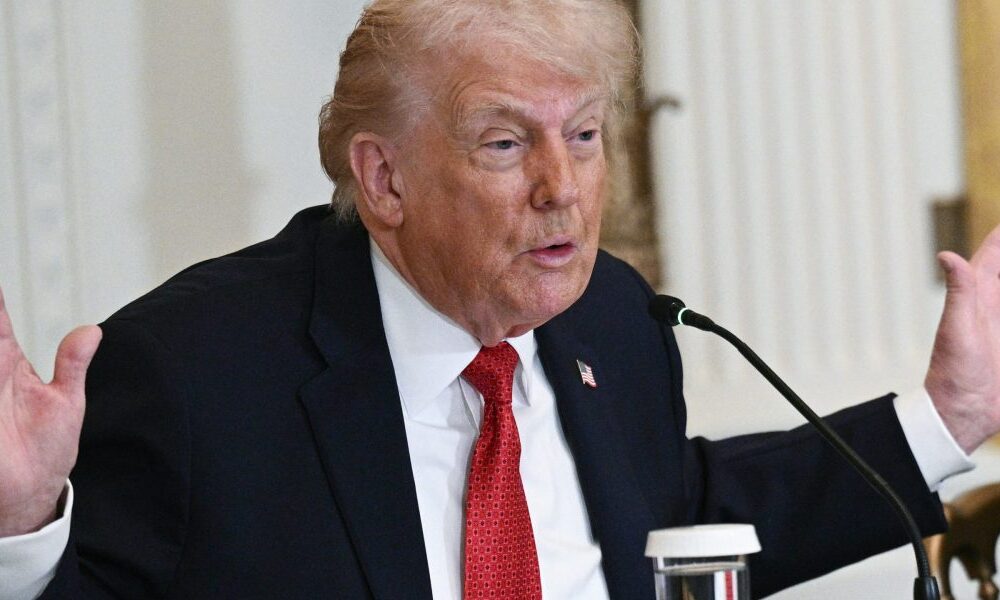
Trump’s first year back in the White House closed with the U.S. national debt roughly $2.25 trillion higher than when he retook the oath of office, showing how fast Washington’s red ink is piling up even amid DOGE hype and promises to pay it down. Over the calendar year 2025, the growth in the national debt was even higher, some $2.29 trillion.
The acceleration in borrowing, with the national debt standing at $38.4 trillion and growing as of January 9, is sharpening warnings from budget watchdogs and Wall Street alike that the country’s fiscal path is becoming a growing vulnerability for the economy. The total national debt has grown by $71,884.09 per second for the past year, according to Congressman David Schweikert’s Daily Debt Monitor.
Over the 12 months from the close of trading on Jan. 17, 2025, to the end of day Jan. 15, 2026, the federal government added approximately $2.25 trillion to the national debt, according to calculations shared exclusively with Fortune by the Peter G. Peterson Foundation. That period roughly captures President Donald Trump’s first year back in office, as it is the last business day before last year’s Inauguration Day and the most recent day for which data are available. The jump from $37 trillion to $38 trillion in just two months between August and October was particularly notable, with the Peterson Foundation calculating at the time that it was the fastest rate of growth outside the pandemic. Michael A. Peterson, CEO of the nonpartisan watchdog dedicated to fiscal sustainability, told Fortune at the time that “if it seems like we are adding debt faster than ever, that’s because we are.”
As for how these figures compare to recent presidencies, the Peterson Foundation provided calculations (below) for each calendar year over the last quarter-century, revealing that President Joe Biden owns the highest year of national debt growth outside the pandemic, with almost $2.6 trillion in 2023. President Trump far and away holds the record, with nearly $4.6 trillion of national-debt growth occurring during the pandemic year of 2020, when massive federal spending occurred in the form of economic relief measures.
Trump and Biden together own the top five highest-debt-incurring years, two for Trump and three for Biden, across five of the last six years. While the figures are not adjusted for inflation, by and large, Trump and Biden have roughly doubled the rate of debt accumulation under President Barack Obama and tripled, even quadrupled the rate of growth under President George W. Bush, depending on which term you’re looking at. To be sure, both Bush and Obama presided over the aftermath of the Great Recession of 2008, with experts still debating whether their fiscal responses were large enough.
Interest costs explode
The surge in debt is landing just as interest costs on that debt become one of Washington’s fastest‑growing expenses. The specific line item for net interest in the federal budget totaled $970 billion for fiscal year 2025, but the Congressional Budget Office (CBO) calculated that, including spending for net interest payments on the public debt, this broke the $1 trillion barrier for the first time. The Committee for a Responsible Federal Budget, another nonpartisan watchdog, projects $1 trillion per year in interest payments from here on out.
Trump has repeatedly argued that his ambitious tariff program will be enough to tame the debt burden, casting duties on imports as a kind of magic revenue source for Washington. Treasury data show tariffs are bringing in significantly more money than before—likely in the $300 billion to $400 billion‑a‑year range—but even optimistic projections suggest those sums only cover a fraction of annual interest costs and an even smaller slice of total federal spending. As Trump retreated from many of his tariff threats—before the January 2026 spike that he threatened in relation to his desire for U.S. possession of Greenland—the CBO calculated that $800 billion of projected deficit reduction had also vanished.
At the same time, the administration has promised to share some of that tariff revenue directly with households through a proposed $2,000 “dividend” for every American, a pledge that independent analysts estimate could cost around $600 billion per year and further widen the deficit unless offset elsewhere. Economists say that the combination—more borrowing, high interest rates, and new permanent commitments—risks locking in structural deficits that keep the debt rising faster than the overall economy.
Markets and America’s ‘Achilles’ heel’
Financial markets are taking notice. As Washington auctions hundreds of billions of dollars in new Treasury securities each week, yields on longer‑term notes and bonds have moved higher, reflecting both tighter monetary conditions and investor unease about the sheer volume of U.S. borrowing. Recent analysis from Deutsche Bank and others has described America’s mounting debt load as an “Achilles heel” that could leave the dollar and broader economy more vulnerable to shocks, particularly as geopolitical tensions and tariff fights escalate.
Those worries are amplified by the prospect of future recessions or emergencies that could force the government to borrow even more heavily on top of today’s already‑elevated baseline. Rating agencies and international lenders have not sounded any immediate alarm about U.S. solvency, but they have increasingly highlighted fiscal risks in their outlooks, pointing to widening deficits and a political system that has struggled to impose discipline.
Voters are paying attention
If there is one thing Americans still broadly agree on, it is that the debt problem matters. Recent polling sponsored by the Peterson Foundation found that roughly 82% of voters say the national debt is an important issue for the country, even as they remain divided over which programs to cut or taxes to raise.
Trump first won office vowing to erase the national debt over time; a decade later, after his return to power, that figure has instead climbed to record highs. As the administration prepares for another year of governing—and another season of fiscal showdowns on Capitol Hill—the question is shifting from whether the debt is growing too fast to how long the world’s largest economy can keep outrunning its own balance sheet.
For this story, Fortune journalists used generative AI as a research tool. An editor verified the accuracy of the information before publishing.