Connect with us

Fashion

Trader Joe’s creates retail buzz around its totes

Published

on


By

Bloomberg

Published


November 5, 2025

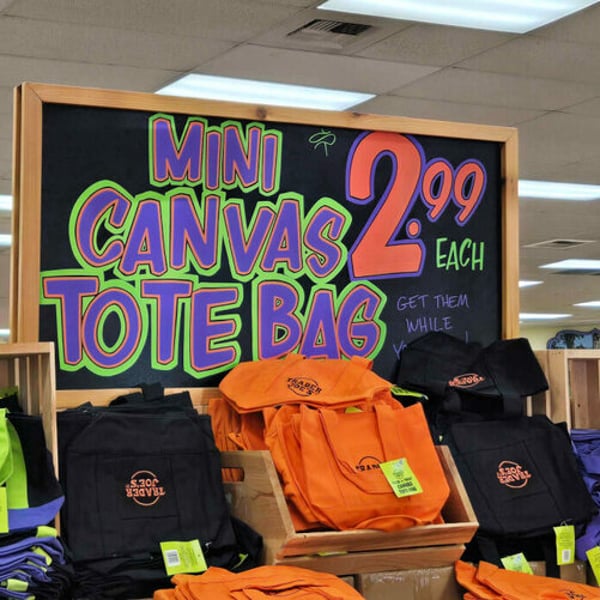
On an October afternoon, a delivery of new bags arriving at a store in midtown Manhattan was driving fashionistas wild. But it wasn’t fresh supplies of Hermes SCA’s Birkin, Chanel’s 25, or even The Row’s Margaux. The bag in question cost $2.99 and is sold by grocery store Trader Joe’s.

Trader Joe’s Halloween tote bags in store – Hip2Save- Facebook

The chain’s mini-totes- available in Halloween colours and restricted to four per customer- take a page from the book of luxury retailers, which have long known that scarcity stokes demand and limited drops create excitement.

But it’s also true that luxury brands, which have recently alienated many younger, affluent shoppers with eye-watering price increases, could learn something from Trader Joe’s. The TJ bags (both the new mini-totes and the original cream, navy and red shopper costing $3.99) are what you might call a subtle flex; they manage to signify status and mark those who carry them as in-the-know- while also offering a sense of fun and accessibility. Few luxury houses are able to walk that line, despite the potential rewards.

In the US, where the brand is based, Trader Joe’s has acquired something like cult status. Founded in 1967 by Joseph Coulomb, the store, with its friendly staff and quirky Hawaiian-style décor, is known for its unique and affordable products, such as Everything But the Bagel Sesame Seasoning Blend. The brand has only about 600 stores in the US, most of which are in or around cities, (compare that with the country’s roughly 4,600 Walmart Inc. locations). It doesn’t sell online and its notoriously long checkout lines often stretch throughout the store.

For American shoppers, carrying a Trader Joe’s bag might signal a kind of urban sophistication- that you’re clued-in and discerning, with the time and taste to shop for your Speculoos Cookie Butter and fancy yet cheap cheeses in person. 

And if there’s a performative element to carrying the bags in the US, it’s multiplied when the user is piling their groceries into one in Europe, Japan, or South Korea. Indeed, the brand’s canvas shoppers are getting more popular abroad; there is no anti-Americanism when it comes to Trader Joes, apparently.

Because the company has no stores outside of the US, toting one abroad suggests you have the means to travel internationally- or at least the savvy to pick one up on a resale site. It also amplifies the bag’s IYKYK (that’s if-you-know-you-know, for those who aren’t fluent in internet speak) status, which has been amplified by influencers on Instagram and TikTok. That’s allowed the bags to claim a place typically occupied by luxury items, which once has a chokehold on this type of signalling.

So, how can luxury reclaim the ground now occupied by the likes of Trader Joe’s bags?

Finding the formula for lasting desirability and virality is like “unlocking the secret to eternal youth,” Oliver Chen, analyst at TD Cowen told me. But there are some clues as to how top-end brands might crack the code.

Firstly, you must offer some items that are relatively affordable. Accessories like bag charms, which have helped Tapestry Inc.’s Coach connect with Gen-Z customers, fit the bill, as do Prada SpA hair scrunchies. Beauty and fragrance products can also work.

Secondly, there must be an element of experience- and bonus points if it’s something you can post on your social feeds to let your followers know you’re part of the in crowd. This isn’t about fashion brands carefully curating their own Instagram posts. Rather, it’s about creating something customers can’t wait to see and do, and providing physical environments designed for photos and sharing.

Food is particularly promising. That explains why so many luxury brands, from Coach to Cie Financiere Richemont’s Alaia, are introducing restaurants or cafes. The model is Ralph Lauren Corp.’s Ralph’s Coffee, which has opened in about 40 locations around the world since its creation in 2014.  In addition to providing the background for an uncountable number of TikToks, Ralph’s also sells merch, including, yes, totes, as well as reusable mugs and baseball caps. Carrying, say, the brand’s green-and-white tumbler gives off some of insider vibe you might get with a Trader Joe’s bag. 

Events and quirky stores can play a similar role. Louis Vuitton opened a series of pop-ups around the world earlier this year to promote the reissue of its collaboration with Japanese artist Takashi Murakami. Locations were brimming with selfie-spots and short-films capturing the colour and style of Murakami’s work, while attendees could buy LV-logoed drinks and cakes. Those purchasing from the collection were issued a token, which could be inserted into a vending machine to win branded novelty prizes.

The Louis, a store in the shape of a ship in Shanghai, and Louis Vuitton’s flagship store in New York City, which is temporarily covered in an installation of monogrammed trunks, have become surprise tourist attractions. Creating that level of spectacle required LVMH’s considerable resources, which certainly help when it comes to capturing the public’s attention. That said, even the world’s biggest luxury group can’t always buy its way to virality: LV’s beautifully packaged beauty products should have been TikTok sensations, but with lipsticks priced at $160 a pop, they failed to take algorithmic flight.

As for Trader Joe’s, it’s hard to say how long its affordable totes will retain their exclusive status. If I had to put my bet on what might displace them, I’d go with Erewhon, the California grocer best known for its exorbitantly priced smoothies, which is opening its first New York location in a private members club in Manhattan. Though with a reported $36,000 joiners fee, plus $7,000 in annual dues, flexing with an Erewhon bag is more steroidal than subtle.


Source link

Continue Reading

Fashion

Cosmetics giant Unilever finalises business demerger

Published

on


By

AFP

Published


December 5, 2025

The demerger of Unilever‘s ice cream division, to be named ‘The Magnum Ice Cream Company,’ which had been delayed in recent months by the US government shutdown, will finally go ahead on Saturday, the British group announced.

Reuters

Unilever said in a statement on Friday that the admission of the new entity’s shares to listing and trading in Amsterdam, London, and New York, as well as the commencement of trading… is expected to take place on Monday, December 8.

The longest federal government shutdown in US history, from October 1 to November 12, fully or partially affected many parts of the federal government, including the securities regulator, after weeks without an agreement between Donald Trump‘s Republicans and the Democratic opposition.

Unilever, which had previously aimed to complete the demerger by mid-November, warned in October that the US securities regulator (SEC) was “not in a position to declare effective” the registration of the new company’s shares. However, the group said it was “determined to implement in 2025” the separation of a division that also includes the Ben & Jerry’s and Cornetto brands, and which will have its primary listing in Amsterdam.

“The registration statement” for the shares in the US “became effective on Thursday, December 4,” Unilever said in its statement. Known for Dove soaps, Axe deodorants and Knorr soups, the group reported a slight decline in third-quarter sales at the end of October, but beat market expectations.

Under pressure from investors, including the activist fund Trian of US billionaire Nelson Peltz, to improve performance, the group last year unveiled a strategic plan to focus on 30 power brands. It then announced the demerger of its ice cream division and, to boost margins, launched a cost-saving plan involving 7,500 job cuts, nearly 6% of the workforce. Unilever’s shares on the London Stock Exchange were steady on Friday shortly after the market opened, at 4,429 pence.
 

This article is an automatic translation.
Click here to read the original article.

Copyright © 2025 AFP. All rights reserved. All information displayed in this section (dispatches, photographs, logos) are protected by intellectual property rights owned by Agence France-Presse. As a consequence you may not copy, reproduce, modify, transmit, publish, display or in any way commercially exploit any of the contents of this section without the prior written consent of Agence France-Presses.


Source link

Continue Reading

Fashion

Burberry elevates two SVPs to supply chain and customer exec roles

Published

on


Published


December 5, 2025

Burberry has named a new chief operating and supply chain officer as well as a new chief customer officer. They’re both key roles at the recovering luxury giant and both are being promoted from within.

Burberry – Spring-Summer2026 – Womenswear – Royaume-Uni – Londres – ©Launchmetrics/spotlight

Matteo Calonaci becomes chief operating and supply chain officer, moving from his role as senior vice-president of strategy and transformation at the firm. 

In his new role, he’ll be oversee supply chain and planning, strategy and transformation, and data and analytics. He succeeds Klaus Bierbrauer, who’s currently Burberry supply chain and industrial officer. Bierbrauer will be leaving the company following its winter show and a transition period.

Matteo Calonaci - Burberry
Matteo Calonaci – Burberry

Meanwhile, Johnattan Leon steps up as chief customer officer. He’s currently currently Burberry’s senior vice-president of commercial and chief of staff. In his new role he’ll be leading Burberry’s customer, client engagement, customer service and retail excellence teams, while also overseeing its digital, outlet and commercial operations.

Both Calonaci and Leon will join the executive committee, reporting to Company CEO Joshua Schulman.

JohnattanLeon - Burberry
JohnattanLeon – Burberry

Schulman said of the two execs that the appointments “reflect the exceptional talent and leadership we have at Burberry. Both Matteo and Johnattan have been instrumental in strengthening our focus on executional excellence and elevating our customer experience. Their deep understanding of our business, our people, and our customers gives me full confidence that their leadership will help drive [our strategy] Burberry Forward”.

Copyright © 2025 FashionNetwork.com All rights reserved.


Source link

Continue Reading

Fashion

Puneet Gupta steps into fine jewellery

Published

on


Published


December 5, 2025

Traditional and occasion wear designer Puneet Gupta has stepped into the world of fine jewellery with the launch of ‘Deco Luméaura,’ a collection designed to blend heritage and contemporary aesthetics while taking inspiration from the dramatic landscapes of Ladakh.

Hints of Ladakh’s heritage can be seen in this sculptural evening bag – Puneet Gupta

 
“For me, Deco Luméaura is an exploration of transformation- of material, of story, of self,” said Puneet Gupta in a press release. “True luxury isn’t perfect; it is intentional. Every piece is crafted to be lived with and passed on.”

The jewellery collection features cocktail rings, bangles, chokers, necklaces, and statement evening bags made in recycled brass and finished with 24 carat gold. The stones used have been kept natural to highlight their imperfect and unique forms and each piece in the collection has been hammered, polished, and engraved by hand.

An eclectic mix of jewels from the collection
An eclectic mix of jewels from the collection – Puneet Gupta

 
Designed to function as wearable art pieces, the colourful jewellery echoes the geometry of Art Deco while incorporating distinctly South Asian imagery such as camels, butterflies, and tassels. Gupta divides his time between his stores in Hyderabad and Delhi and aims to bring Indian artistry to a global audience while crafting a dialogue between designer and artisan.

Copyright © 2025 FashionNetwork.com All rights reserved.


Source link

Continue Reading

Trending

Copyright © Miami Select.