
Fashion
Tosca Blu set to boost retail growth in Middle East, Asia

Translated by
Nicola Mira
Published
September 22, 2025
Italian women’s footwear and accessories brand Tosca Blu is set to turbo-charge its international retail growth. The brand is deploying an international expansion plan that includes entering the Middle East and Asia via a strategy combining franchising and selective distribution.
“We have recently developed our new retail concept. Our goal is to deploy it into countries such as the UAE, South Korea, Thailand and India. The global geopolitical context is unstable, but the project is set to become operational in 2026,” said Maria Sole Ronzoni, CEO of Tosca Blu, speaking to FashionNetwork.com.
The young businesswoman has recently taken charge of the company founded in the late 90s by her father Giacomo, who passed away in February. Her sister Virginia has assumed the creative director role.
The generational handover has triggered a reorganisation within the company, which is part of the Minoronzoni group. “We have inaugurated a new showroom in Palazzo Serbelloni [in Milan], and we’re working on new marketing strategies,” said Ronzoni.
In 2024, Tosca Blu generated revenue of €12 million, while the Minoronzoni group’s total revenue was €45 million. The brand is targeting annual medium-term growth rates of 5%-10% in Europe, 20% in non-EU markets, and 25% online.
The Italian market accounts for 60% of Tosca Blu’s revenue, while the remaining 40% is generated abroad, with Germany, Portugal, Spain and Russia its main markets. E-tail revenue currently accounts for 10% of the total, and increased by 75% in 2024.
Tosca Blu operates 15 monobrand stores, 10 of which in Italy, as well as several retail corners and partnerships with international e-tailers like Zalando. It is aiming to open three new monobrand stores per year.

As well as reorganising the company, Tosca Blu is changing its brand positioning, and is increasingly keen to capture a new generation of consumers. “We’re focusing on a premium-affordable [positioning], without losing sight of Tosca Blu’s identity and history. Our handbags are priced between €150 and €300, while shoes range from €120 to €250,” said Ronzoni.
The company is preparing its next sustainability report. “We have embarked on a restructuring process to meet environmental standards and have greater control over our entire supply chain. We’ve launched a novelty handbag made in recycled material. Our products are mainly made of leather, currently still the greenest material choice possible,” said Ronzoni.
The generational handover has also boosted the brand’s digitalisation efforts. “We have a new e-commerce partner in Filo Blu. Since we started collaborating, we’ve seen very significant revenue growth in this channel. We’ll continue to invest on digital. Technology use is becoming increasingly widespread in young people. Our stores are important, but we want to have a strong online presence,” said Ronzoni.
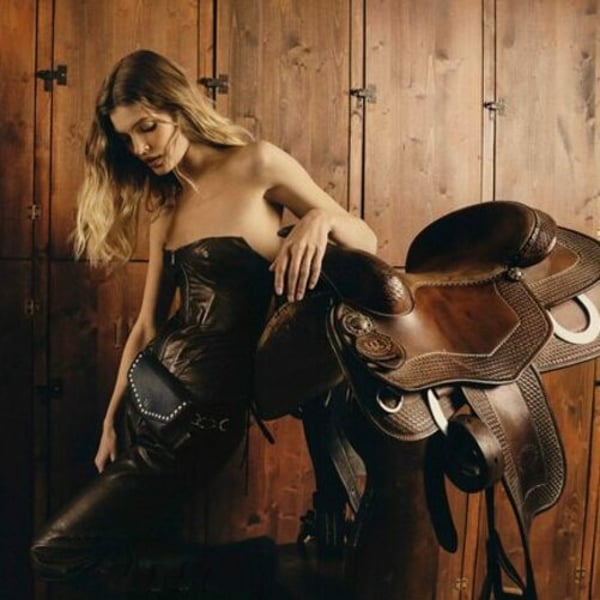
“We’re a women-led team running a family business and dealing with a host of challenges,” she underlined. To further its message of unity and determination, Tosca Blu has released a campaign for next fall/winter dedicated to contemporary Amazons. “A deliberate choice to convey strength and independence. We have travelled extensively, for our studies and in our profession. We have always been women of the world,” concluded Ronzoni.
Copyright © 2025 FashionNetwork.com All rights reserved.

Fashion
Milan Men’s Fashion Week schedules 76 events for January 2026, including 18 in-person catwalk shows
Published
December 10, 2025
Carlo Capasa reports a 3% drop in turnover for Italy’s textile and apparel industry in 2025- a relatively contained figure given the extremely challenging economic and geopolitical backdrop. The president of CNMI unveiled the upcoming Milan Men’s Fashion Week, to be held in Milan from January 16–20, 2026, announcing 76 appointments in total: 18 physical and seven digital shows, 39 presentations, and 12 events.
Italian fashion: exports hold up in 2025, but 3,000 companies lost in three years
“We expect a decrease in turnover of only 3% for the full 2025 financial year for textiles and apparel, including accessories, because the last few months have been better than the first. Unfortunately, however, we cannot delude ourselves by looking only at the elements that drive the sector, as there are weaknesses and difficulties along the supply chain, as ICE president Matteo Zoppas has also pointed out,” explains Carlo Capasa. “A striking figure is that in 2022 we had 62,000 companies and now there are 59,000. We have lost 3,000 in three years. All together- we, the associations- with the support of the government, which is and remains fundamental, must do our utmost to overcome this phase.”
Exports amount to 87.5 billion euros, still a very high share of the total 93 billion euros in turnover. Moreover, Capasa recalls, in 2023 the shortfall in domestic consumption was 13 billion euros; now it is half that. “Unfortunately, if salaries have grown little compared to the cost of living, this weighs heavily on domestic consumption,” says the president of Camera Nazionale della Moda Italiana, adding that “imports have increased because we are importing much more from China (+11.8%), while exports have decreased because we are exporting much less to China (around -20%).”
The positive note, according to Capasa, is that US duties have been absorbed fairly well and, after an initial period of difficulty, trade relations with the US are improving. Companies are not standing still; many will present their Cruise collections in the US- Moncler, for example, will be in Aspen- as a signal of their intention to stimulate this key market.
Jewellery and eyewear, which performed strongly in recent years, have run into headwinds in 2025. Most notably, jewellery was down 4.1% in the first nine months, with eyewear down 2%. “We hope for a better result in 2026, since in the last two years we have lost 10 billion in turnover- a significant loss, also in absolute terms,” Capasa recalled.

In menswear, Italy is the world’s second-largest exporter after China, with an 8% share. “Here too, from April to August, after a negative start to the year, exports grew by 5% across all categories. The final outcome, after the first eight months were flat, is that we are at the same level as last year, so menswear has, in some respects, outperformed womenswear,” said the executive. Exports to the US were strong for menswear, outperforming other categories, rising by 9% from January to November.
Turning to Fashion Week, the communications campaign, created with the City of Milan and Yes Milano, again shines a spotlight on new talents and emblematic locations in Milan, weaving a narrative that includes collaboration with the Milan Cortina 2026 Olympic and Paralympic Winter Games. The location chosen this time is the entrance to a historic 1940s building on Via Foppa. The campaign was shot by photographer Alessandro Burzigotti, with styling by Daria Di Gennaro and the support of Stilema Studio for set design, and is enriched with objects loaned by the Olympic Museum in Lausanne. The brands involved are Ascend Beyond, Cascinelli, Federico Cina, Gams Note, Meriisi, Moarno, Mordecai, Mtl Studio, Noskra, Setchu and Viapiave33.
MFW men’s January 2026: 9 new runway shows, 7 presentation debuts
The official Milan Fashion Week menswear show calendar will feature Ralph Lauren, Domenico Orefice, and Victor Hart for the first time. Meanwhile, the digital show calendar will welcome Absent Findings, Ajabeng, Kente Gentlemen, Raimondi, State of Chaos, and Subwae as new additions. Returning to the runway calendar are Zegna and Dsquared2, whose show will be followed by a party.
As for the presentations calendar, there will be seven new brands: Bottega Bernard, Dunhill, K-Way, Plās Collective, Moarno, Sagaboi, and Stone Island, while Ferragamo returns.

The major names in Italian menswear are all confirmed. Showing (or presenting) at this Fashion Week are leading names such as Brunello Cucinelli, Prada, Giorgio Armani, Corneliani, Tod’s, Brioni, Lardini, Kiton, Mordecai, and Montecore.
MFW men’s January 2026: anniversaries and events
This edition also sees the celebration of important anniversaries: Blauer will mark its 25th anniversary, Pronounce its 10th and Marcello Pipitone–Bonola its 5th. Among the events, EA7 Emporio Armani will celebrate in store the Milan Cortina 2026 Olympic and Paralympic Games. K-Way, together with Vogue and GQ, will present ‘Montagna Milano: The Alpine Club in Town.’ The event, open to the public, will take place over three days and include panels, workshops, and après-ski experiences.
Li-Ning will then celebrate movement, culture, and the brand’s evolution in sportswear with a runway presentation of its Autumn–Winter 2026/27 Men’s and Women’s collections. Stone Island will present ‘Prototype Research_Series 09, Air Blown Lamination On Knit’ through an installation by Ken-Tonio Yamamoto featuring garments born of non-industrial research and experimentation processes.
Finally, for this edition, Fondazione Sozzani will serve as CNMI’s space during Men’s Fashion Week, with the aim of supporting and promoting the new generation of designers. Domenico Orefice and Simon Cracker will show there, while the labels Bottega Bernard, Maragno, Marcello Pipitone–Bonola, Moarno, Mtl Studio, Pecoranera, and Sagaboi will be present with a showcase.

“It will be a vibrant space where many things will happen; it will be a pleasure to spend time there, because it is a special environment,” Carlo Capasa assured about the location chosen by CNMI at Fondazione Sozzani. “Streaming and international broadcasting of the Milan Fashion Week Collection will be ensured in this edition as well,” he added. “The event will be streamed on the Milan Fashion Week platform, which will also host a section dedicated to virtual showrooms, both multi-brand and mono-brand. This is an important point, because we must always remember that Milan has the most important fair in the world, which is the citywide showroom fair- 800 showrooms with 3,000 brands, open seven months a year, that showcase and sell to the world the visions of a great many designers.”
A Fashion Week intertwined with the Milan Cortina 2026 Olympic Games
“As with every Fashion Week, Milan becomes an international crossroads of meetings, contacts and relationships that constitute that precious heritage supporting creativity, know-how and innovation recognised all over the world. A Men’s Fashion Week with events and locations that will surely make it rich and interesting and that will herald a moment we hope will be fruitful for Milan and for fashion as a whole: the Olympic Games. A union that already begins with the advertising campaign,” recalled Alessia Cappello, councillor for Economic Development and Labour Policies with responsibility for Commerce, Fashion, and Design, in her speech.
“The economic impact that the event will generate is not yet precisely known. Our research centre believes that dovetailing with the Winter Olympic Games will bring even more visitors and tourists to Milan- namely people who will be interested not only in fashion but also, and above all, in sport,” Cappello continued. “It will be a relay: Men’s Milan Fashion Week in January, the Olympics in February, women’s fashion week placed between the end of the Games and the beginning of the Paralympics. Usually the economic impact is around 80 million euros during men’s Fashion Weeks and 100 million during women’s Fashion Weeks, but we think it will be even higher this time. I also want to mention the very important synergy with Florence, with which there is a solid and fruitful relationship. Because men’s fashion week starts in Florence and ends in Milan,” concluded Alessia Cappello.
This article is an automatic translation.
Click here to read the original article.
Copyright © 2025 FashionNetwork.com All rights reserved.



‘RHOSC’s Jen Shah Released From Prison, Now Under Supervision

India’s Foxtale announces shift from D2C label to House of Brands

Did immigration turn Miami blue?
-

 Politics8 years ago
Congress rolls out ‘Better Deal,’ new economic agenda
-
Entertainment8 years ago
New Season 8 Walking Dead trailer flashes forward in time
-
Politics8 years ago
Poll: Virginia governor’s race in dead heat
-
Entertainment8 years ago
The final 6 ‘Game of Thrones’ episodes might feel like a full season
-
Entertainment8 years ago
Meet Superman’s grandfather in new trailer for Krypton
-
Politics8 years ago
Illinois’ financial crisis could bring the state to a halt
-
Business8 years ago
6 Stunning new co-working spaces around the globe
-
Tech8 years ago
Hulu hires Google marketing veteran Kelly Campbell as CMO