Connect with us

Politics

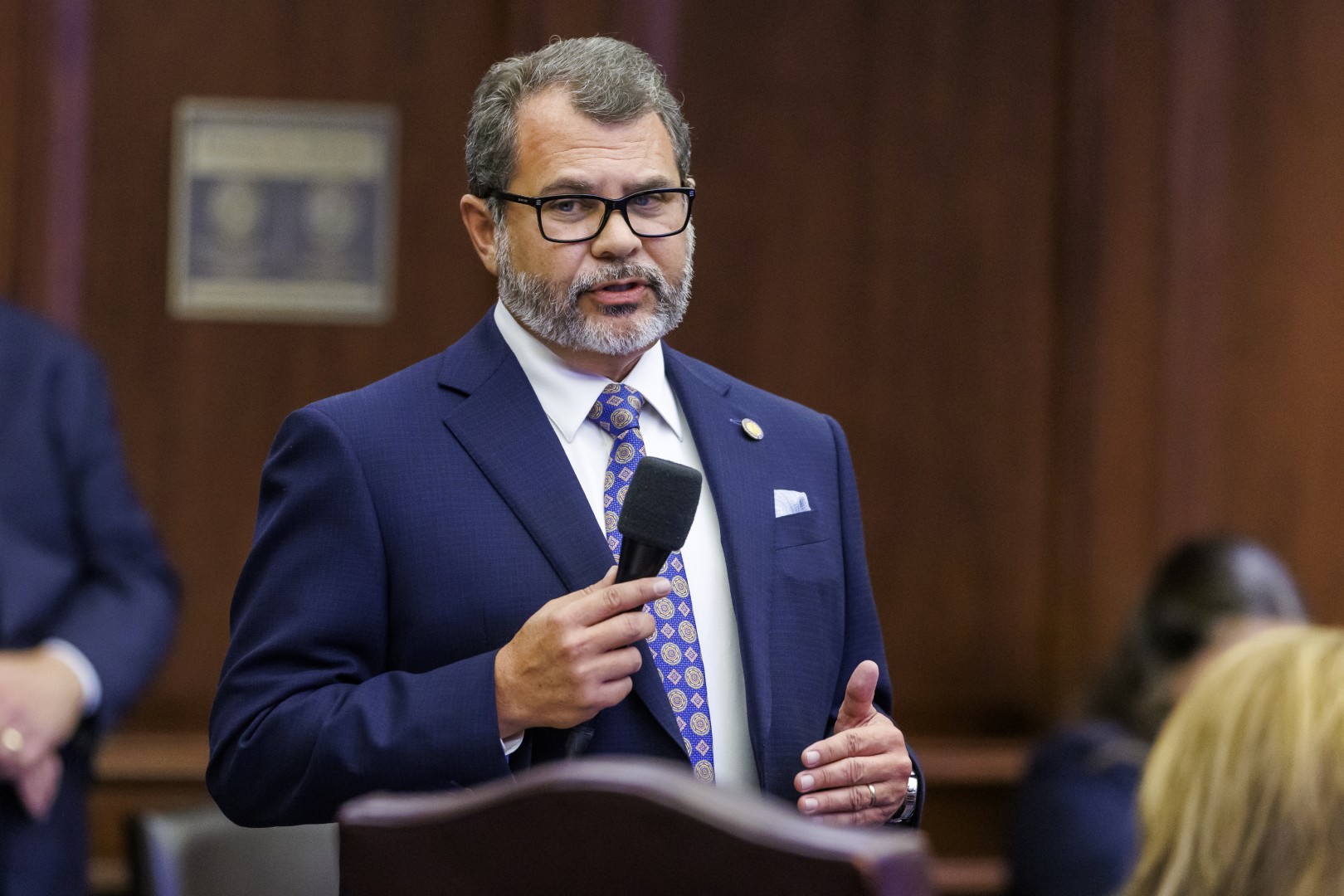
Tom Leek will carry AI bill of rights prioritized by Gov. DeSantis

Published

on


The President’s executive order isn’t stopping the Port Orange Republican from delivering for the Governor.

Legislation sought by Gov. Ron DeSantis to curb potential overreaches in artificial intelligence has been filed in the Senate.

Republican Sen. Tom Leek’s bill (SB 482) proposes a number of changes to combat what DeSantis calls an “age of darkness and deceit,” including banning governmental agencies from contracting with AI companies controlled, owned or governed by countries of concern.

Leek’s legislation seeks to protect parental rights regarding AI. Children would not be allowed to communicate with chatbots without parental authorization if this bill becomes law. Chatbots would also have to disclose being artificial intelligence, and programmers would have to ensure that adult materials are not accessed by children.

The legislation would confer other rights, including warning people when they are communicating with AI chatbots rather than human beings, and whether identifying data or biometric data is being exposed.

Additionally, the proposal would ban using AI to appropriate name, image and likeness of nonconsenting people for commercial purposes, as well as for fraud, identity theft and cyber bullying.

It also addresses political advertising, saying that it must be declared when AI is used to craft the ads.

The legislation has emerged after President Donald Trump issued a “one rule” executive order to protect artificial intelligence from state laws.

DeSantis has said he’s not worried about the order as it “doesn’t/can’t preempt state legislative action.”

DeSantis has decried overstretched stock market valuations for “Mag 7” companies Alphabet, Amazon, Apple, Meta Platforms, Microsoft, Nvidia and Tesla, all of which are in the AI space. He has also suggested the “Founding Fathers” would hate the technology, and argued it will be used to perpetuate fraud.


Source link

Continue Reading

Politics

Clay School Board member Robert Alvero under fire after saying most Black people are ‘nasty’ and ‘rude’

Published

on


Clay County School Board member Robert Alvero is getting ripped for recent racially-charged comments disparaging Black people, and is going to have to answer for them next year in front of a statewide audience

“I am requiring him to appear before the State Board of Education at their meeting in January to explain this conduct. School Board Members have a responsibility to represent all students and families and uphold the professionalism due of an elected official,” wrote Commissioner of Education Anastasios Kamoutsas Monday.

Alvero, a first-generation Cuban immigrant who arrived in the U.S. in 2008, has worked as a firefighter in Jacksonville and a member of the Florida State Guard before being elected to the Clay County School Board last year.

In a recent video, Alvero insisted he has “had 80% more negative experience(s) with the African American community in this country than with White people.”

“Eighty percent, they’ve been nasty, they’ve been rude, they’ve been problematic — always trying to fight, disrespecting,” Alvero said, in comments first reported by Clay News and Views.

While Alvero says he now regrets the “wrong and offensive” comments, he’s under pressure to resign from Clay County Republicans, including School Board Chair Misty Skipper and state legislators.

“I listened to these comments by Clay County School Board member, Mr. Alvero, with the heaviest heart. They are beyond the pale and unfitting of his position of public trust with our children. As School Board Chair Skipper has stated, he should resign,” said Sen. Jennifer Bradley Monday.

House Speaker-designate Sam Garrison is also calling for Alvero to step down.

The Clay County Republican Executive Board issued a statement saying Alvero should step down “immediately due to extremely disappointing and hurtful remarks.”

As of Monday morning, Alvero is hoping this blows over.

“While I faced some negative interactions, including being called names and even physically assaulted, I also met many good, decent people, some of whom remain my friends today,” he said.

“I want to clarify that these experiences are personal and not meant to generalize. It was an attempt to say people’s character is not defined by their visual characteristics, life experiences, or socioeconomic standards. We as people are divisive, and through the best of my ability, I was trying to point out how people can judge each other while not seeing both sides and how stereotypes of a whole group are not accurate.”

The School Board next meets in January. If Alvero has not resigned by then, Skipper vows his comments will be addressed “appropriately.”

His resignation would not preclude his appearance before the State Board of Education though.


Source link

Continue Reading

Politics

This holiday season, let’s help our kids be safe online

Published

on


Who would have thought that the small device I use for nearly all my work as an adult would spark so much debate when placed in the hands of our kids?

Smartphones, as much as we love (and occasionally hate) them, aren’t going anywhere. As the mom of a twelve-year-old girl, I’ve had to think long and hard about how to introduce this technology and create a family plan that feels both safe and realistic.

My husband and I decided to gift our daughter a smartphone for Christmas after her ballet teacher explained that she needed to record her Nutcracker dances to rehearse after hours. We turned off cell service and let her gradually ease into using it under our watchful eyes during the holiday break.

Later, we turned on her cell service and set strict parameters: texting, streaming during travel, and using it as a safety/convenience tool for pick-ups and drop-offs. We also made one non-negotiable decision: No social media until age 13.

That didn’t stop her from asking, especially about Instagram.

Now, with Meta’s new Teen Accounts, I feel confident that she can manage her own account, which includes real safety features designed to protect teens by default. They are automatically set to the most private and protective settings; accounts cannot contact them if they don’t follow them, and content filters block sensitive topics.

Here’s a little bonus for me: as a content creator, I’m on Instagram constantly! If my daughter ever posts something questionable or makes a typical teen mistake, I’ll likely see it before she even puts her phone down. With Instagram’s latest supervision tools, I can also see who she messages, set daily screen-time limits, and schedule “quiet hours” (think 10 p.m. to 7 a.m., because nothing productive happens on a phone after midnight).

But let’s be clear: this isn’t about “spying on my kid.” It’s about helping families create healthy boundaries, build trust, and keep lines of communication open–something technology can support, but not replace.

The truth is, even with stronger tech safeguards, nothing can substitute parental connection. These tools only work when paired with open, ongoing conversations with your child about what they see, feel, and share online.

And if you’re a parent who’s not on Instagram yet, consider this a sign and make an account ASAP. Learn the app and understand the landscape your kids want to step into.

When it’s used safely and with supervision, social media isn’t a big bad wolf. There’s a lot of educational content available that can spark curiosity and learning. And yes, while misinformation exists, it also gives kids a head start in building media-literacy skills, which they’re going to need as technology evolves. Plus, social media can help teens find their people, whether they’re part of a minority community, into niche or “nerdy” interests, or staying connected with long-distance friends and family.

These decisions are never straightforward. I’m lucky I have a daughter who considers it a “personal challenge” to lower her screen time each week!

With the holidays (and winter break) approaching, now is an ideal time to start having those meaningful conversations with your kids as they enter this next digital chapter.

Take it from me: setting expectations early and guiding them with confidence can make all the difference.

___

Michelle E. Olson-Rogers is a Boca Raton-based writer, influencer and founder of  ModernBocaMom.com.


Source link

Continue Reading

Politics

Bye-bye yellow sticker? Lawmakers propose eliminating license plate decals

Published

on


Earlier this month, Miami-Dade Tax Collector Dariel Fernandez called on state lawmakers to eliminate the physical yellow registration decal that is currently required on almost all Florida license plates.

Doral Sen. Ana Maria Rodriguez and Miami Lakes Rep. Tom Fabricio have since answered that call.

The Republican legislators just filed twin bills (SB 982, HB 841) to require all vehicle registration renewals to be recorded electronically and repeal the state law mandating the yellow validation stickers.

In a phone interview Monday, Fabricio credited Fernandez with presenting the change, which is already policy in states like Connecticut, Pennsylvania and Vermont, and is estimated to save Miami-Dade alone $2.5 million yearly.

Fernandez has argued that the physical stickers are no longer needed and, in some cases, counterproductive, since they can fade, peel and get stolen.

Fabricio said he fully agrees.

“I want to say this proposal cuts red tape, but it literally cuts yellow tape because it’s going to reduce a hurdle that people have to deal with on an annual basis, which is nonsensical,” he said, adding that the current policy is based on “an ancient technology.”

“Every police officer and police agency I’ve spoken to tells me that all license plates are called in one form or another during a traffic stop, so it doesn’t provide safety; it’s just a burden and a cost for motorists.”

Rodriguez said her legislation presents a “common-sense change” that “reduces burdens on taxpayers, prevents fraud, and streamlines government, exactly what Floridians expect from their leaders.”

“In an era of real-time digital verification, clinging to physical decals is outdated,’ she said in a statement.

Notable Florida political figures are supportive. Fabricio announced the legislation in a Sunday post on X that had been viewed more than 197,300 times by noon Monday. Gov. Ron DeSantis shared the post, writing, “Good job Tom — get it done!” Florida GOP Chair Evan Power did similarly, calling the proposal “an interesting idea.”

Fernandez, who has expanded and secured his Office’s operations since taking over in January, said he is grateful Rodriguez and Fabricio turned his proposal into legislation. He added that other states with the policy have seen accountability improve, not worsen, under the change.

“Electronic systems provide exact registration status at the moment of a traffic stop, rather than relying on a small piece of plastic that may be expired or counterfeit. Physical decals are also a known target for fraud and can create a false sense of security,” he said.

“Public safety should never depend on outdated tools. Today’s technology allows real-time, accurate verification. through systems already used every day, supporting lawful enforcement while improving efficiency and public trust.”

If approved in the coming Session, the legislation would go into effect July 1.


Source link

Continue Reading

Trending

Copyright © Miami Select.