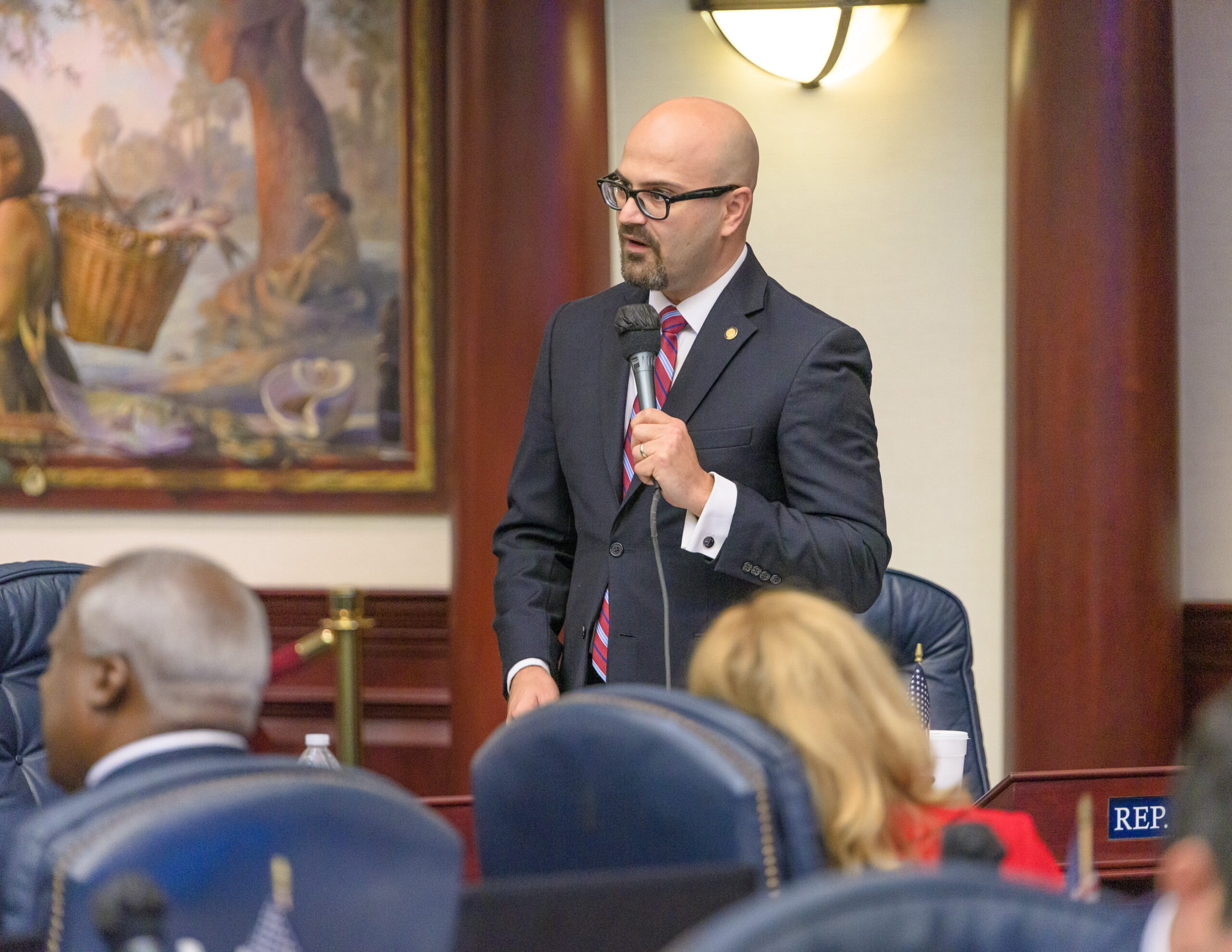
Every year since he took office, Republican Rep. Tom Fabricio has filed legislation to deliver relief to homeowners whose properties have been damaged by blast mining at nearby limestone quarries.
The Legislature has largelyignored his effort. But he’s not stopping.
This week, Fabricio refiled legislation (HB 115) to establish a path to compensation to residents whose homes sit within 3 miles of mining operations.
If passed, the measure would guarantee eligible homeowners the ability to seek payment through a complaint filed with the Division of Administrative Hearings (DOAH). It would also ensure that this state-level proceeding preempts local claims processes.
The issue is close to home for Fabricio — literally. A Miami Lakes resident by way of Miramar, he has long lived in the area between northwest Miami-Dade and southwest Broward that has dealt for years with the effects of repeat quarry explosions.
Residents and experts weighed in on the matter during a House presentation last year that featured photos of cracked foundations, walls, pools and roofs of South Florida properties.
Industry professionals described the damage as cosmetic and not a safety issue. Homeowners and members of a Miami-Dade advisory board tasked with analyzing the problem disputed that assertion, arguing any damage is unacceptable.
“For years, families in our communities have endured the consequences of quarry blasting, including shaking homes and causing costly damage,” he said in a statement, urging residents to share their stories to build momentum.
“This bill is about fairness, ensuring that those living closest to these operations are supported while allowing an essential industry to operate responsibly.”
HB 115, filed Tuesday, follows a frustrating Spring in which companion measures filed by Fabricio and Hialeah Gardens Republican Sen. Bryan Ávila both died without hearings. Legislation they carried in 2024 that would have capped the force of blast mining to less destructive levels also went unheard.
Fabricio’s new bill also comes less than four months after the Miami Lakes Town Council voted unanimously to file a lawsuit against Florida challenging the constitutionality of a state law that today forces blast mining damage claims to go through DOAH rather than be heard in a courtroom.
Cracks in the floors and walls at Spanish Lakes Elementary in Hialeah. Image via the Miami Lakes Blasting Advisory Board.
Council member Steven Herzberg said in June that the existing restriction “strips an entire class of claims from the court.” Mayor Bryan Morera noted that the town had “tried every possible alternative” before taking legal action, but that the state, Legislature and former CFO Jimmy Patronis — who also served as Florida State Fire Marshal — either ignored the issue or sided with miners.
That isn’t to say lawmakers have done nothing. In 2019, the Legislature directed Patronis to set vibration limits and require seismographs at mines through a measure championed by then-Sen. Manny Díaz Jr. and Sen. Ana Maria Rodriguez, both Miami-Dade Republicans.
A year later, Ávila, Díaz and Miami Gardens Democratic Sen. Shevrin Jones led the passage of another law that gave the Fire Marshal exclusive authority to regulate construction mining standards and launched the Miami-Dade Mining Pilot Program with a state-hired seismologist to monitor blasts.
Industry leaders said last year that those limits have worked, with quarry representatives testifying that while permitted blasting can still lead to hairline cracks in drywall, there’s no structural harm at current thresholds. Residents countered with photos of fissures in concrete slabs, tiles and ceilings, arguing such “cosmetic” harms still cost thousands to repair and that repeated shaking worsens the damage over time.
Florida consumes more than 130 million tons of limestone annually, according to Ananth Prasad of the Florida Transportation Builders Association, and more than a third comes from Miami-Dade. Six mining companies operating at eight northwest Miami-Dade quarries detonate tons of explosives weekly to dislodge aggregate, according to Fabricio’s Office.
A map of limestone quarries near residential areas in northwest Miami-Dade County. Image via the Miami-Dade Limestone Products Association.
White Rock Quarries, Miami-Dade’s largest operator, has donated heavily to state candidates over the years, including Ávila. Nearly half of Florida’s 40 Senators and a fifth of its Representatives have accepted contributions from the company.
Fabricio has long maintained that his goal is a workable compromise that keeps limestone rock, a primary ingredient in concrete and asphalt, moving to construction sites while giving nearby homeowners a fair route to relief.
“Our view is pretty simple,” he said earlier this year. “The statewide limits are generally fine. But when homes 1,000 yards away are shaking every day, that’s a problem.”
HB 115 reflects that perspective. It wouldn’t halt mining. Instead, it would simply codify how claims are evaluated and paid, focusing on the area closest to the blasts, where complaints are most concentrated.
“This is about protecting our families and preserving the communities we love,” he said. “Together, we can find a solution that works for everyone.”
HB 115 awaits a Senate companion and committee assignments. If passed as-is, it would go into effect upon becoming law.
Early voting is now underway in Miami for a Dec. 9 runoff that will decide whether political newcomer Rolando Escalona can block former Commissioner Frank Carollo from reclaiming the District 3 seat long held by the Carollo family.
The contest has already been marked by unusual turbulence: both candidates faced eligibility challenges that threatened — but ultimately failed — to knock them off the ballot.
Escalona survived a dramatic residency challenge in October after a rival candidate accused him of faking his address. A Miami-Dade Judge rejected the claim following a detailed, three-hour trial that examined everything from his lease records to his Amazon orders.
After the Nov. 4 General Election — when Carollo took about 38% of the vote and Escalona took 17% to outpace six other candidates — Carollo cleared his own legal hurdle when another Judge ruled he could remain in the race despite the city’s new lifetime term limits that, according to three residents who sued, should have barred him from running again.
Those rulings leave voters with a stark choice in District 3, which spans Little Havana, East Shenandoah, West Brickell and parts of Silver Bluff and the Roads.
The runoff pits a self-described political outsider against a veteran official with deep institutional experience and marks a last chance to extend the Carollo dynasty to a twentieth straight year on the dais or block that potentiality.
Escalona, 34, insists voters are ready to move on from the chaos and litigation that have surrounded outgoing Commissioner Joe Carollo, whose tenure included a $63.5 million judgment against him for violating the First Amendment rights of local business owners and the cringe-inducing firing of a Miami Police Chief, among other controversies.
A former busboy who rose through the hospitality industry to manage high-profile Brickell restaurant Sexy Fish while also holding a real estate broker’s license, Escalona is running on a promise to bring transparency, better basic services, lower taxes for seniors and improved permitting systems to the city.
He wants to improve public safety, support economic development, enhance communities, provide more affordable housing, lower taxes and advocate for better fiscal responsibility in government.
He told the Miami Herald that if elected, he’d fight to restore public trust by addressing public corruption while re-engaging residents who feel unheard by current officials.
Carollo, 55, a CPA who served two terms on the dais from 2009 to 2017, has argued that the district needs an experienced leader. He’s pointed to his record balancing budgets and pledges a residents-first agenda focused on safer streets, cleaner neighborhoods and responsive government.
Carollo was the top fundraiser in the District 3 race this cycle, amassing about $501,000 between his campaign account and political committee, Residents First, and spending about $389,500 by the last reporting dates.
Escalona, meanwhile, reported raising close to $109,000 through his campaign account and spending all but 6,000 by Dec. 4.
For the first time in a decade, hunters armed with rifles and crossbows are fanning out across Florida’s swamps and flatwoods to legally hunt the Florida black bear, over the vocal opposition of critics.
The state-sanctioned hunt began Saturday, after drawing more than 160,000 applications for a far more limited number of hunting permits, including from opponents who are trying to reduce the number of bears killed in this year’s hunt, the state’s first since 2015.
The Florida Fish and Wildlife Conservation Commission awarded 172 bear hunt permits by random lottery for this year’s season, allowing hunters to kill one bear each in areas where the population is deemed large enough. At least 43 of the permits went to opponents of the hunt who never intend to use them, according to the Florida chapter of the Sierra Club, which encouraged critics to apply in the hopes of saving bears.
The Florida black bear population is considered one of the state’s conservation success stories, having grown from just several hundred bears in the 1970s to an estimated more than 4,000 today.
The 172 people who were awarded a permit through a random lottery will be able to kill one bear each during the 2025 season, which runs from Dec. 6 to Dec. 28. The permits are specific to one of the state’s four designated bear hunting zones, each of which have a hunting quota set by state officials based on the bear population in each region.
In order to participate, hunters must hold a valid hunting license and a bear harvest permit, which costs $100 for residents and $300 for nonresidents, plus fees. Applications for the permits cost $5 each.
The regulated hunt will help incentivize maintaining healthy bear populations, and help fund the work that is needed, according to Mark Barton of the Florida chapter of Backcountry Hunters and Anglers, an advocacy group that supported the hunt.
Having an annual hunt will help guarantee funding to “keep moving conservation for bears forward,” Barton said.
According to state wildlife officials, the bear population has grown enough to support a regulated hunt and warrant population management. The state agency sees hunting as an effective tool that is used to manage wildlife populations around the world, and allows the state to monetize conservation efforts through permit and application fees.
“While we have enough suitable bear habitat to support our current bear population levels, if the four largest subpopulations continue to grow at current rates, we will not have enough habitat at some point in the future,” reads a bear hunting guide published by the state wildlife commission.
___
Republished with permission of the Associated Press.