
Politics
Tom Fabricio highlights bills on tax relief, vehicle registration, teacher oath

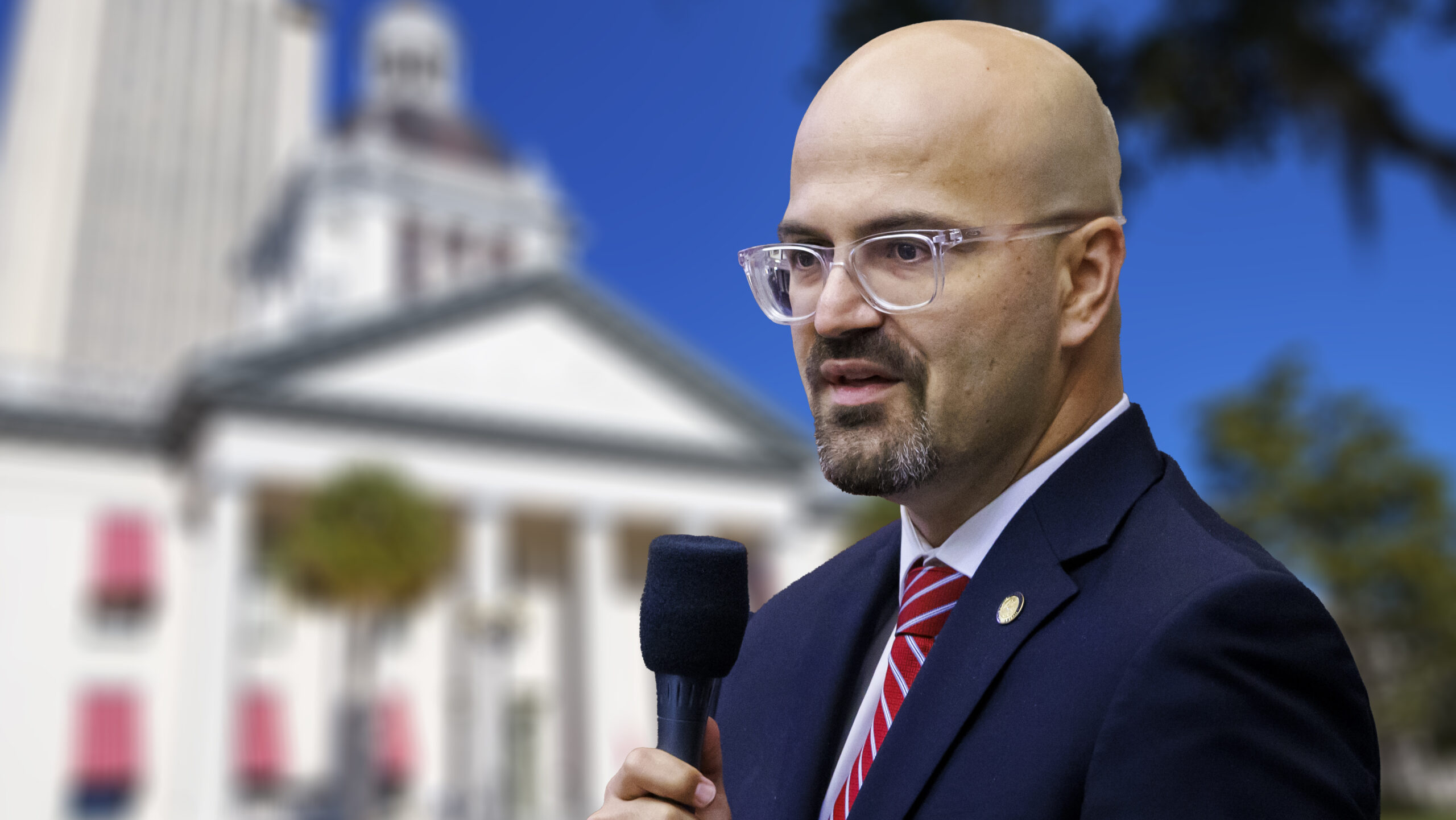
Miami Lakes Republican Rep. Tom Fabricio is bringing a package of policy proposals both new and familiar into the 2026 Legislative Session.
Some cover widely publicized issues, such as property taxes and affordability. Others center on more under-the-radar concerns, from red tape in day-to-day government transactions to a renewed push for what he calls constitutional clarity in Florida’s classrooms.”
“This Legislative Session will, yet again, be an opportunity to do the work of the people,” Fabricio said in a statement.
On affordability, Fabricio is carrying legislation (SB 1184, HB 6027) with Doral Republican Sen. Ana Maria Rodriguez to tighten rules around homestead portability, the system that lets many homeowners carry forward accumulated property tax savings when they move from one primary residence to another.
Fabricio described the measure as an attempt to match state law to the promise 64% of voters thought they were approving when they OK’d the provision in 2008. He called it a “technical fix.”
If passed, the measure would simply change references from an “immediate prior homestead” to a “prior homestead,” while keeping the same Save Our Homes portability calculation formulas and $500,000 cap.
That minor alteration would allow a homeowner’s portability calculation to be based on a previous qualifying homestead within an existing three-year window, rather than only the most recent homestead, which could help people who had an intervening non-homestead situation — like renting — to still transfer their Save Our Homes benefit.
“By tightening the rules around Homestead portability, this bill ensures that homeowners can actually carry their hard-earned property tax savings with them when they move, just as voters intended,” he said.
Fabricio is also pitching what he describes as a government-modernization bill targeting something most Floridians encounter far more often than tax policy: renewing their car registration.
He and Rodriguez also filed twin bills (SB 982, HB 841) to require renewals to be recorded electronically and eliminate the requirement for yellow registration decals to be placed on a vehicle’s license plate.

That small change, which Miami-Dade County Tax Collector Dariel Fernandez called for, is already policy in states like Connecticut, Pennsylvania and Vermont, and it’s estimated to save Miami-Dade alone $2.5 million yearly.
Fabricio said it’s an overdue departure from outdated processes.
“This legislative proposal … would overhaul and streamline an ancient technology by cutting outdated red tape,” he said, adding that the switch would improve government efficiency “while also saving taxpayers time and money.”
Another measure (SB 416, HB 115) Fabricio is again sponsoring with Miami Springs Republican Sen. Bryan Ávila would tackle a persistent problem in northwest Miami-Dade and southwest Broward: property damage due to limestone blast mining.
The two lawmakers have tried for years to give property owners a clear route to compensation when nearby quarry activities damage their homes, with little to no attention from leadership in the Legislature.
Taking note of this inaction, including a complete snubbing in both chambers last Session, Fabricio’s home city voted to sue Florida over the state’s ban on lawsuits against limestone mining operators.
Like its past iterations, this year’s version of the legislation would establish a path for compensation for residents whose homes sit within 3 miles of limestone quarries, while also setting standards for how claims are evaluated and paid.
It’s “about fairness,” Fabricio said.
“These repeat explosions have caused significant damage to South Florida properties,” he said, “and this bill will serve as a compromise to mining operations and relief for affected residents.”
Rounding out Fabricio’s priority slate is an education-focused proposal built around an explicit pledge to state and federal charters.
The bill (HB 147) would require teachers and administrative personnel in public schools — from prekindergarten to the college level — to take an oath to protect and defend the Florida Constitution and the U.S. Constitution.
Fabricio said the proposed mandate, which Jacksonville Republican Sen. Clay Yarborough is carrying in the upper chamber (SB 430), is meant to underscore the foundational role the documents play in civic life.
“Florida’s Constitution and the U.S. Constitution are the backbone of our republic,” he said. “It’s critical that those entrusted with educating our children respect and uphold the principles that define our nation and our state, and that they protect those constitutional values across classrooms in the Sunshine State.”
The 2026 Legislative Session began Tuesday and is scheduled to run until March 13.
Politics
Ron, Casey DeSantis herald groundbreaking carbon-ion therapy investment at Jacksonville’s Mayo Clinic
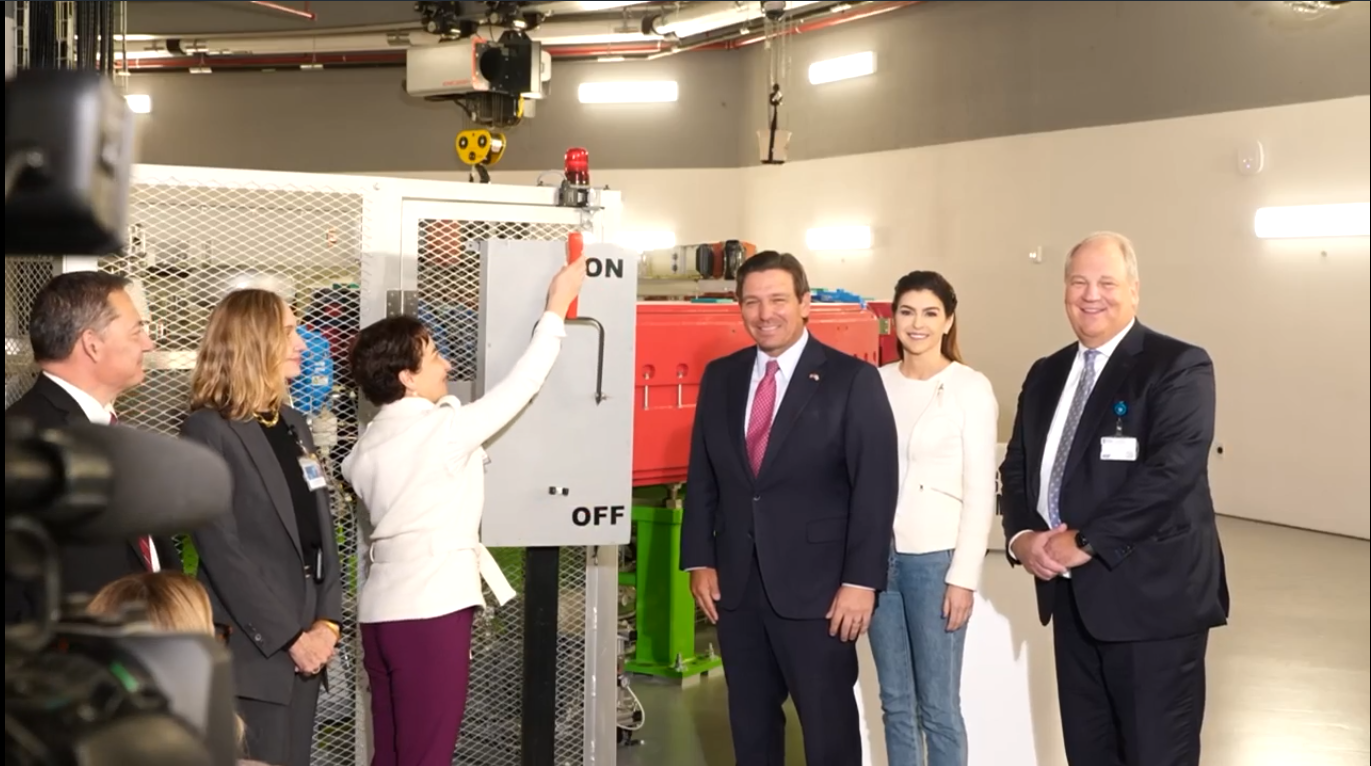
Florida’s First Couple continues to demonstrate a commitment to cancer research, helping to bring new technology to the state that can help those with the toughest forms of the disease.
Gov. Ron DeSantis and First Lady Casey DeSantis returned to Jacksonville to highlight new investments at the Duan Family Building at the Mayo Clinic. It’s part of $218 million appropriated last year, marking over a billion dollars since the Governor was elected, with more than $100 million going to Mayo alone.
“We are here today with the backdrop of all the heavy artillery you see for treating cancer to announce the next major step forward,” the Governor said.
“Mayo Clinic is now launching the technology for the first carbon ion therapy program anywhere in the United States of America. And in fact, it’ll be the only carbon ion therapy program in the entire Western Hemisphere. So this is newer technology. Japan has really embraced it. Mayo’s the first one in the United States.”
Roughly $30 million of state money went into this initiative, which the Governor said is the most advanced form of radiation treatment for cancers that don’t respond well to traditional radiation. He also said it’s a way to continue boosting the “upward trajectory of the medical community” in Florida.
DeSantis said proton and carbon-ion treatments would be available in 2027 and 2028, respectively, with the latter pending federal approval by the Food and Drug Administration. He said carbon-ion had been proven successful in Japan, and had benefits beyond the localized cancer itself.
“There’s a school of thought that it basically helps with your natural immunity or some of the other medications for other parts of your body that would potentially be subjected (to cancer risk),” DeSantis said.
Dr. Kent R. Thielen, Vice President of the Mayo Clinic, called this investment a “transformative moment in the future of family care,” with the most technologically advanced treatment modality anywhere. Carbon-ion treatment particularly helps patients and cancers resistant to proton therapy, he said, as the former is 12 times heavier than the latter and therefore can be more medically effective than proton therapy alone.
Adults and children could be treated in the coming years, Thielen added.
Casey DeSantis said this was a “huge deal” for Florida and well beyond. A cancer survivor who has ongoing effects from radiation therapy herself, she expressed hope that the new technology would improve the quality of life of those who beat the dreaded disease.


With a bipartisan unanimous vote, the Senate has passed a bill to add more oversight for the taxpayer-funded private school voucher program because thousands of students — and the money that follows them — are missing in the system.
SB 318 does not currently have a House companion bill even though the lengthy package of reforms has cleared the upper chamber.
Florida’s $4 billion universal school choice industry has experienced explosive growth but left an education system ripe for abuse.
“On any given day of the week, the (Florida) Department of Education (FDOE) can’t find 30,000 students we’re paying for,” Sen. Don Gaetz, the SB 318 co-sponsor, said on the Senate floor. “That’s $270 million we’re paying for students we can’t locate. The Auditor General criticizes our funding model as ‘pay and chase,’ and they don’t mean it as a compliment.”
SB 318, approved late Wednesday, would make sweeping changes, including creating a separate category for the Family Empowerment Scholarship (FES) so it would no longer be mixed into the state’s K-12 funding formula calculation.
SB 318 also would expand the education stabilization fund to $250 million so that if more students leave traditional public schools than expected, they can still get fully funded vouchers.
Democrats told Gaetz they wished his bill could have helped public school districts facing declining enrollment and big funding losses as the voucher program has grown to more than 500,000 students. Gaetz told lawmakers he was trying to get a stabilization fund provision in a conforming bill to help buffer public schools and give them a declining enrollment subsidy.
The bill also would reduce scholarship administrative fees from 3% to 2% to fund more scholarships through the Florida Tax Credit Scholarship program.
Other changes would streamline the process, including requiring one single application for all scholarship programs and ordering the necessary documentation, like a child’s birth certificate, be submitted when the application is turned in.
To improve transparency, the child’s guardian would need to attest that the student is not enrolled in a public school and say where the child is educated. A private school can speak out in some cases on behalf of the parent.

Going forward, the FDOE would be required to assign a Florida student ID for all voucher recipients to process their scholarship information to make sure the families receive the taxpayer funds.
“It’s kind of hard to keep track of hundreds of thousands of students if we don’t know who they are and where they are, but by giving every student a number, that is a first step,” Gaetz said.
FDOE would also be required to create a standard withdrawal form when voucher students leave the traditional public school system.
“Fraudsters, unfortunately, have discovered our school choice program, and they spammed millions of dollars by creating fictitious students — not Minnesota, but not a good look,” Gaetz said. “So this bill provides that each provider will receive funding for students only if, and after, they are confirmed as being actually enrolled.”
The bill also would stop the practice of organizations, like Step Up For Students, keeping large sums of taxpayer money in their own accounts, Gaetz added.
“Last year, the Department of Education advanced $600 million to the school funding organizations even before the parents made their school choices. And then the Department chased the money to find if the dollars wound up in the right place for the right students, and the result is that public schools were shortchanged by $100 million for students they served, but the money was sent someplace else,” said Gaetz, a former Superintendent of Schools for Okaloosa County.
The FDOE would also reexamine how it works with those organizations and create a business plan to become more competitive and create contracts with performance requirements.
“If this bill passes, the Department of Education will no longer work with a scholarship funding organization in the way that we have done in the past,” Gaetz said. “Right now, there is performance, but there are not always performance requirements. And as a consequence, there has been some ragged performance, candidly.”
The bill also addresses problems parents are experiencing, Gaetz said.
For instance, some parents homeschooling their children wait months to get reimbursed for materials and services.
His bill “reduces red tape and reduces long waits for payments,” Gaetz said. “Our bill asks families to help us help them by confirming monthly with a simple checkoff where their student is attending school so that the right amount can be disbursed to the right place and private schools can do that on parents’ behalf in this bill.”
After a scathing report, the Auditor General would audit the FDOE and the nonprofits issuing the vouchers, like Step Up, every year going forward under the bill’s direction.
“To all of us who believe in parental choice and education as I do, the Auditor General’s report was tough medicine,” Gaetz said. “To disregard the Auditor General’s findings and warnings and recommendations and just let things roll on as they are, would be legislative malpractice.
Democrat Sen. Shevrin Jones praised Gaetz’s bill but warned more legislation is needed in future bills to add more oversight to private schools. Some of these private schools, now getting public dollars, are not good learning environments or properly teaching students, he said.
Gaetz joked it was the first-ever “tripartisan” bill to be heard on the Senate floor since the legislation was also co-sponsored by Republicans Sens. Corey Simon and Danny Burgess, Democratic Sens. Rosalind Osgood and Darryl Rouson, and Sen. Jason Pizzo, who is independent.
Orange County Public Schools, the fourth-largest school district in the state, welcomed the bill’s passage in the Senate. The district is planning to close seven schools as it faces a financial crisis from a student enrollment dip.
“SB 318 puts students first and protects taxpayer dollars,” Orange County School Board member Angie Gallo said in a statement. “It supports public school classrooms, respects local decision-making, and brings much-needed accountability to Florida’s state K-12 education taxpayer-funded voucher system.”


Trump’s ‘Department of War’ rebrand could cost $125 million, says the CBO

Luigi Mangione’s Cousin Signs With Brooklyn Pro Soccer Team

Samantha Ruth Prabhu launches new apparel brand Mile Collective
-

 Politics8 years ago
Congress rolls out ‘Better Deal,’ new economic agenda
-
Entertainment8 years ago
New Season 8 Walking Dead trailer flashes forward in time
-
Politics9 years ago
Poll: Virginia governor’s race in dead heat
-
Politics8 years ago
Illinois’ financial crisis could bring the state to a halt
-
Entertainment8 years ago
The final 6 ‘Game of Thrones’ episodes might feel like a full season
-
Entertainment8 years ago
Meet Superman’s grandfather in new trailer for Krypton
-
Business8 years ago
6 Stunning new co-working spaces around the globe
-
Tech8 years ago
Hulu hires Google marketing veteran Kelly Campbell as CMO