Tod’s has picked a luxury expert with a strong track record in the American continent to spearhead this strategic market. The high-end Italian footwear label has appointed Marco Felci as CEO Americas. He assumed his new role on September 15. He succeeds Roberto Lorenzini, who resigned from the post last week, after 14 years with Tod’s. Felci has been poached from Dolce & Gabbana, where he was executive vice-president commercial, wholesale and retail, based in New York.
Marco Felci – Tod’s
“Thanks to his in-depth knowledge of the American market and his proven leadership ability in luxury goods retail, Marco will play a key role in deploying the group’s strategy and in boosting the brand’s expansion throughout the region,” said Tod’s in a press release. Felci’s appointment marks a new stage in the group’s strategic journey following John Galantic’s appointment as group CEO. At the end of 2024, Galantic took over in the role from founder Diego Della Valle, who is still the group’s president.
Felci has been active in the luxury sector for over 20 years, working for various leading fashion labels, mostly in the USA. He began his business career in 2004, when he joined Hermès in Italy as retail manager, before moving to Loro Piana as US sales manager.
After that, Felci assumed increasingly senior roles at the US subsidiaries of several different labels. He was head of wholesale at Lanvin, vice-president in charge of wholesale at Versace, CEO Americas at Sergio Rossi and later Etro, before joining Dolce & Gabbana in 2023.
Felci’s experience will be crucial in helping the Tod’s group, owner of Tod’s, Roger Vivier, Hogan and Fay, grow on the American market, which currently accounts for only 7.6% of total revenue. The group reported a revenue of €1.12 billion in 2023. It was the last fiscal year for which Tod’s published its financial results, having since de-listed. At the time, the group’s revenue in the Americas region was €85 million, up 3.5% over fiscal 2022.
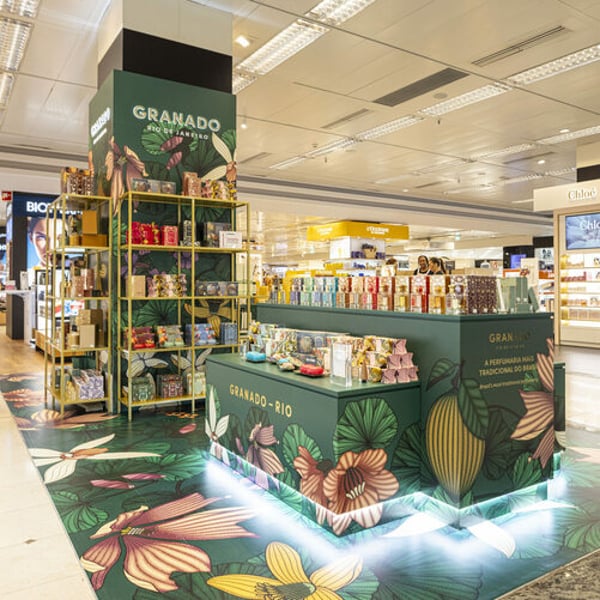
After two months of operating a Portuguese pop-up at Amoreiras Shopping Center in Lisbon, Granado, Brazil’s heritage perfumery and personal care house, has confirmed in a statement that the temporary space will remain open for six months, noting that this presence underscores its international expansion.
Granado
Granado began by launching a pop-up at El Corte Inglés, then invested in this kiosk, which opened on October 20, as part of a project to create a tropical oasis in the heart of one of the Portuguese capital’s most emblematic shopping centres, inviting visitors to immerse themselves in the world of luxury fragrances.
The pop-up showcases a little of almost everything the brand offers, from eau de parfum, eau de toilette, eau de cologne, soaps, perfumes, a home fragrance range, and coffrets ideal for Christmas.
Granado Pharmácias, founded in 1870 in Rio de Janeiro by the Portuguese José Antonio Coxito Granado, drew on empirical knowledge of botany and pharmacy to create remedies and hygiene products using plants from Brazil’s biodiversity. The brand stays true to this DNA and maintains a strong physical presence in Lisbon.
Since 2017, Granado has been bringing its carioca spirit to European capitals and leading retailers in Portugal, France and the UK, and sells online throughout Europe via its official website at Granado.eu.
The store in central Lisbon is at 98 Rua Garrett, in Chiado; and the one in the heart of Porto is at 354-360 Rua de Cedofeita. In Paris, it has stores at 21 Rue Bonaparte, in Saint-Germain-des-Prés; 11 Rue des Francs Bourgeois, in the Marais; 4 Rue du Marché Saint-Honoré; and in major Parisian department stores such as Galeries Lafayette, Samaritaine, and BHV. In London, it can be found at 44 Floral Street, in Covent Garden; and 59 King’s Road, in Chelsea; as well as in selected department stores, such as Liberty of London. It is also present in Brussels, at INNO.
In the US, it has its own stores in New York at 611 Madison Avenue; at 51 Prince Street in SoHo; and at Aventura Mall, Florida, among others. Not to mention the more than 100 standalone stores across Brazil.
This article is an automatic translation. Click here to read the original article.
Swiss watch exports fell for a fourth month as companies waited for the US agreement to ease punitive import tariffs to take effect.
A watch by Tag Heuer – DMR/Tag Heuer
Exports dropped 7.3% in November from a year earlier, the Federation of the Swiss Watch Industry said Thursday, the most since August when President Donald Trump’s administration slapped a 39% levy on Switzerland’s products. Exports to the US, the industry’s biggest market, fell 52% last month.
Manufacturers of watches, machines, and precision instruments were among sectors hit hardest by the US trade tariffs on Switzerland, according to the country’s central bank. A deal to reduce the levy to 15% finally came on November 14, but companies only found out in December that the lower tariffs would be backdated to the day the agreement was announced.
Watch exports are likely to pick up in the coming months as the tariff deal reassures companies, Citigroup analyst Thomas Chauvet said in a note.
Still, Switzerland’s overall exports to the US rose in November, underscoring the challenging backdrop facing the watch sector. The 15% import levy is still higher than the 2% faced by companies before Trump’s trade measures.
Shares of both Richemont and Swatch Group AG slipped in early Zurich trading. Overall, exports were down in almost all price bands, and in every material, the Federation of the Swiss Watch Industry said.
Exports to Japan dropped, while the picture also turned negative in China after two months of growth. That’s dampening hopes for a recovery in luxury demand in the country, especially given its recent slow retail sales growth.
“The luxury watch sector enters 2026 with mixed fundamentals,” Vontobel analyst Jean-Philippe Bertschy said in a note. Asia comparisons will ease, he said, “but the US remains unpredictable, and discretionary spending in Europe is showing fatigue.”
Intimates and swim specialist Bravissimo Limited has filed its accounts for the period to the end of March and they showed much higher sales. However, it’s hard to get a clear picture of just how the company is faring.
Bravissimo
The UK-based company is part of Bravissimo Group Limited, which acts as its holding entity, as well as being the holding company for the US arm of the business.
That parent company was wholly acquired by Wacoal Europe Ltd partway through the period in late September last year. But the firm’s year-end date was changed to 31 March from 31 October at that point, which means the current period is 17 months against 12 months the ‘year’ before.
But with that in mind, its’s still worth looking at the figures for the UK operation.
For the 17 months reported, the company’s revenue was £79.3 million. For the comparison period (the 12 months to the end of October 2023) it was £57.6 million. Gross profit in the latest period was £49 million compared to £36.2 million for the shorter period previously. The gross profit margin for the most recent extra long ‘year’ was 61.8% compared to 6.2% in the previous year. That’s because the elongated period included two autumn seasons and autumn and winter sales typically have lower margins due to fewer swimwear pieces being shifted (swimwear has higher margins).
But the company said that despite the challenging inflationary environment cost were well controlled and the reported operating profit for the 17 months was £1.4 million. Had the firm being reporting its financial year as it did previously, that figure would have been £2.6 million, up from £2.5 million the year before.
Bravissimo also said that it had more active customers at the end of the latest period compared to the previous year and its website traffic was up as well, although retail store footfall dropped slightly. The website conversion rate edged upwards and the retail conversion rate was broadly stable.
In the previous year, the company said it had fully recovered from the effects of the pandemic, but it’s likely that the current year will feature worse results than those just filed.
In June 2025, the company said a warehouse fire meant disruption and delays to supply chains for its online customers. The fire was quickly extinguished, but the disruptions involving having to find temporary storage facilities. The brand stopped accepting orders online or over the phone until the issue was resolved.
It only reported being back online in late September but at least it said the business saw a 70% year-on-year rise in total sales on the day of its relaunch. Lingerie sales alone were up 90% compared to the same day last year.