Connect with us

Business

Thousands protest in Minneapolis after deadly ICE shooting as agents continue city-wide sweeps

Published

on


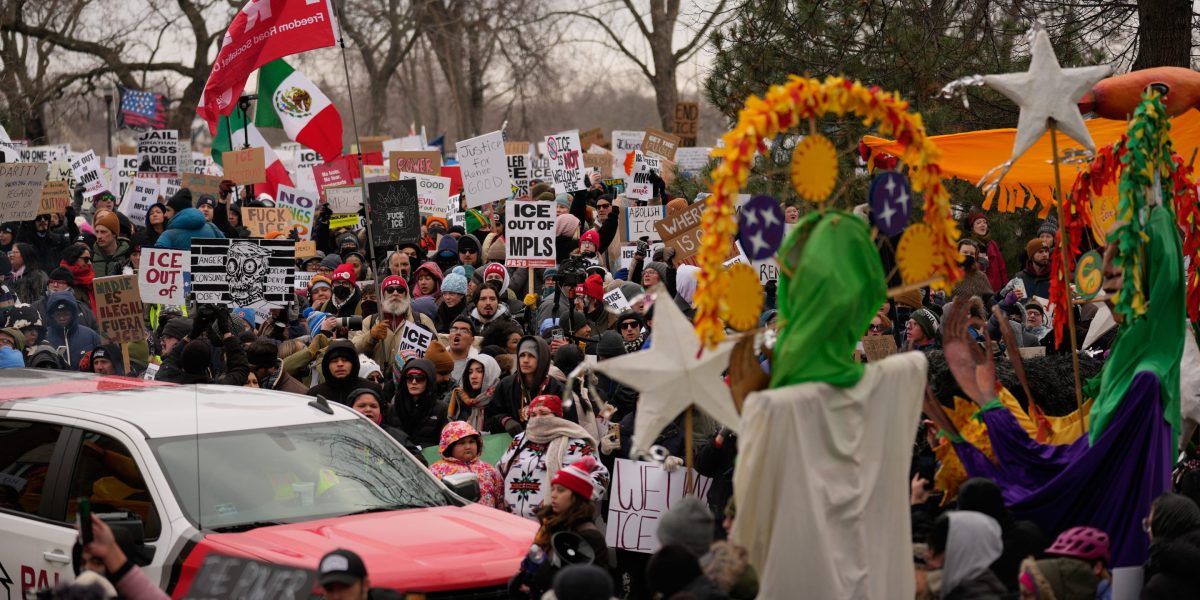
Thousands of people marched in Minneapolis Saturday to protest the fatal shooting of a woman by a federal immigration officer there and the shooting of two people in Portland, Oregon, as Minnesota leaders urged demonstrators to remain peaceful.

The Minneapolis gathering was one of hundreds of protests planned in towns and cities across the country over the weekend. It came in a city on edge since the killing of Renee Good on Wednesday by an Immigration and Customs Enforcement officer.

“We’re all living in fear right now,” said Meghan Moore, a mother of two from Minneapolis who joined the protest Saturday. “ICE is creating an environment where nobody feels safe and that’s unacceptable.”

On Friday night, a protest outside a Minneapolis hotel that attracted about 1,000 people turned violent as demonstrators threw ice, snow and rocks at officers, Minneapolis Police Chief Brian O’Hara said Saturday. One officer suffered minor injuries after being struck with a piece of ice, O’Hara said. Twenty-nine people were cited and released, he said.

Minneapolis Mayor Jacob Frey stressed that while most protests have been peaceful, those who cause damage to property or put others in danger will be arrested. He faulted “agitators that are trying to rile up large crowds.”

“This is what Donald Trump wants,” Frey said of the president who has demanded massive immigration enforcement efforts in several U.S. cities. “He wants us to take the bait.”

Minnesota Gov. Tim Walz echoed the call for peace.

“Trump sent thousands of armed federal officers into our state, and it took just one day for them to kill someone,” Walz posted on social media. “Now he wants nothing more than to see chaos distract from that horrific action. Don’t give him what he wants.”

Communities unite in frustration

The U.S. Department of Homeland Security says its deployment of immigration officers in the Twin Cities is its biggest ever immigration enforcement operation. Trump’s administration has said both shootings were acts of self-defense against drivers who “weaponized” their vehicles to attack officers.

Connor Maloney said he was attending the Minneapolis protest to support his community and because he’s frustrated with the immigration crackdown.

“Almost daily I see them harassing people,” he said. “It’s just sickening that it’s happening in our community around us.”

He was among thousands of protesters, including children, who braved sub-freezing temperatures and a light dusting of snow, carrying handmade signs saying declaring, “De-ICE Minnesota!” and “ICE melts in Minnesota.”

They marched down a street that is home to restaurants and stores where various nationalities and cultures are celebrated in colorful murals.

Steven Eubanks, 51, said he felt compelled to attend a protest in Durham, North Carolina, on Saturday because of the “horrifying” killing in Minneapolis.

“We can’t allow it,” Eubanks said. “We have to stand up.”

Indivisible, a social movement organization that formed to resist the Trump administration, said hundreds of protests were scheduled in Texas, Kansas, New Mexico, Ohio, Florida and other states.

ICE activity across Minneapolis

In Minneapolis, a coalition of migrant rights groups organized the demonstration that began in a park about half a mile from the residential neighborhood where the 37-year-old Good was shot on Wednesday.

But the large protest apparently did not deter federal officers from operating in the city.

A couple of miles away, just as the demonstration began, an Associated Press photographer witnessed heavily armed officers — at least one in Border Patrol uniform — approach a person who had been following them. Two of the agents had long guns out when they ordered the person to stop following them, telling him it was his “first and final warning.”

The agents eventually drove onto the interstate without detaining the driver.

Protests held in the neighborhood have been largely peaceful, and in general there has been minimal law enforcement presence, in contrast to the violence that hit Minneapolis in the aftermath of the killing of George Floyd in 2020. Near the airport, some confrontations erupted on Thursday and Friday between smaller groups of protesters and officers guarding the federal building used as a base for the Twin Cities crackdown.

O’Hara said city police officers have responded to calls about cars abandoned because their drivers have been apprehended by immigration enforcement. In one case, a car was left in park and a dog was left inside another.

He said immigration enforcement activities are happening “all over the city” and that 911 callers have been alerting authorities to ICE activity, arrests and abandoned vehicles.

The Trump administration has deployed thousands of federal officers to Minnesota under a sweeping new crackdown tied in part to allegations of fraud involving Somali residents. More than 2,000 officers were taking part.

Lawmakers snubbed

Three congresswomen from Minnesota attempted to tour the ICE facility in the Minneapolis federal building on Saturday morning and were initially allowed to enter but then told they had to leave about 10 minutes later.

U.S, Reps. Ilhan Omar, Kelly Morrison and Angie Craig accused ICE agents of obstructing members of Congress from fulfilling their duty to oversee operations there.

A federal judge last month temporarily blocked the Trump administration from enforcing policies that limit congressional visits to immigration facilities. The ruling stems from a lawsuit filed by 12 members of Congress who sued in Washington, D.C. to challenge ICE’s amended visitor policies after they were denied entry to detention facilities.


Source link

Continue Reading

Business

Hundreds more federal agents heading to Minnesota, Noem says

Published

on


Homeland Security Secretary Kristi Noem signaled that hundreds more federal agents are being deployed to Minneapolis, where the fatal shooting of a woman has inflamed strife around President Donald Trump’s immigration crackdown.

“We’re sending more officers today and tomorrow,” Noem said on Fox News’ Sunday Morning Futures when asked about the government’s response. “They’ll arrive — there’ll be hundreds more, in order to allow our ICE and our Border Patrol individuals that are working in Minneapolis to do so safely.”

Protests erupted in Minneapolis after a US Immigration and Customs Enforcement officer shot and killed Renée Nicole Good during a tense confrontation on Jan. 7. Thousands marched to the shooting site on Saturday.

Read More: Thousands March to Shooting Site in Minneapolis, Protesting ICE

Noem renewed warnings by senior administration officials that people who try to hamper federal law enforcement risk arrest and criminal prosecution.

“If they impede our operations, that’s a crime and we will hold them accountable to those consequences,” she said.

Good’s fatal shooting has sparked a bitter national debate over whether the officer was justified in using deadly force. The Trump administration and other supporters of the ICE agent argue he acted in self-defense as Good’s SUV moved forward. Noem has said he followed his training.

Critics, including Minnesota officials, law-enforcement experts and civil rights advocates, point to video footage and witness accounts that didn’t show an imminent threat, calling the shooting unjustified.

With each side broadly blaming the other for the circumstances that led to the woman’s death, state and federal officials on Sunday called for lowering the political temperature.

“Of course I bear responsibility to bring down the temperature,” Minneapolis Mayor Jacob Frey said on NBC’s Meet the Press. Yet, he said, “the way that these institutions are being utilized right now by the Trump administration is wrong, and to be clear, is unconstitutional.”

“This was clearly a law enforcement action, where the officer acted on his training and defended himself and his life and his fellow colleagues,” Noem said on CNN’s State of the Union. Good’s death shows “why we need our leaders to turn down their rhetoric,” she said, referring to local leaders in Minnesota.

On Friday evening, hundreds of protesters spent hours outside a local hotel in downtown Minneapolis believed to be housing federal agents as part of a social-media-driven campaign dubbed “No Sleep for ICE.”  Armed with musical instruments, air horns and other noisemakers, demonstrators chanted and played music as passing cars honked horns and shouted at ICE to leave the city. 


Source link

Continue Reading

Business

A Supreme Court ruling to undo Trump tariffs would be fastest way to revive job growth, Zandi says

Published

on


Moody’s Analytics chief economist Mark Zandi warned the labor market is stagnating and placed part of the blame on President Donald Trump’s tariffs.

But the Supreme Court, which is due to rule soon on the administration’s global tariffs, could provide relief and help revive job growth, he said in a social media post on Sunday.

That comes after the latest monthly jobs report showed payrolls rose by 50,000 in December, while the unemployment rate edged down to 4.4%. For all of 2025, employers added just 584,000 jobs, a sharp decline from 2 million jobs in 2024 and the weakest year outside of a recession since the early 2000s.

Since Trump shocked global markets with his “Liberation Day” tariffs in April, there has been no job growth, Zandi said, adding that subsequent revisions will likely show net declines.

“This reflects the direct effects of the tariffs on manufacturing, transportation and distribution, and ag-related businesses, which are steadily losing jobs, as well as the indirect uncertainty hit to hiring by most other businesses,” he explained.

Indeed, trade-exposed industries suffered steep losses last year. The manufacturing sector, for example, has hemorrhaged 70,000 jobs since April. Tens of thousands have also been lost in mining and logging as well as warehousing.

Meanwhile, the health care and social services are among the few industries that are hiring steadily. Without those two sectors, the U.S. economy would have seen payrolls drop for the year.

“Other factors are certainly at play, including highly restrictive immigration policies, DOGE cuts, and artificial intelligence; however, the global trade war’s fingerprints are all over the ailing job market,” Zandi added. “Thus, the fastest way to boost the job market would be for the Supreme Court to declare the reciprocal tariffs unlawful and for lawmakers to let them become a thing of the past.”

Justices are expected to hand down a decision any day now on Trump’s ability to impose tariffs under the International Emergency Economic Powers Act (IEEPA).

That law has been used for the bulk of Trump’s trade war, including the so-called reciprocal tariffs and fentanyl-related duties. The administration has also leveraged the IEEPA tariffs to secure trade deals with the European Union, Japan, South Korea and others.

But if the Supreme Court rules against Trump, that won’t put an end to his tariff regime. Other levies are based on separate laws and aren’t under consideration at the high court.

New tariffs could also be imposed outside IEEPA, though those would take longer to roll out with some offering only shorter periods to tax imports.

While administration officials have expressed confidence that they have alternate ways to enact tariffs, Trump may not immediately jump at the chance.

As the affordability crisis has become top of mind for lawmakers, Trump has rolled back some duties on coffee, pasta and other staples, while delaying tariffs on furniture.


Source link

Continue Reading

Business

Elon Musk told X users to upload their medical information to train AI bot Grok

Published

on


In Elon Musk’s world, AI is the new MD. The X owner is encouraging users to upload their medical test results—such as CT and bone scans—to the platform so that Grok, X’s artificial intelligence chatbot, can learn how to interpret them efficiently.

He’s previously said this information will be used to train X’s artificial intelligence chatbot Grok on how to interpret them efficiently.

Earlier this month, Elon Musk reposted a video on X of himself talking about uploading medical data to Grok, saying: “Try it!”

“You can upload your X-rays or MRI images to Grok and it will give you a medical diagnosis,” Musk said in the video, which was uploaded in June. “I have seen cases where it’s actually better than what doctors tell you.

In 2024, Musk said medical images uploaded to Grok would be used to train the bot.

“This is still early stage, but it is already quite accurate and will become extremely good,” Musk wrote on X. “Let us know where Grok gets it right or needs work.”

Musk also claimed in his response Grok saved a man in Norway by diagnosing a problem his doctors failed to notice. The X owner was willing to upload his own medical information to his bot. 

“I did an MRI recently and submitted it to Grok,” Musk said in an episode of the Moonshots with Peter Diamandis podcast released on Tuesday. “None of the doctors nor Grok found anything.”

Musk did not disclose in the podcast why he received an MRI. XAI, which owns X, told Fortune in a statement: “Legacy Media Lies.”

Grok is facing some competition in the AI health space. This week OpenAI launched ChatGPT Health, an experience within the bot feature that allows users to securely connect medical records and wellness apps like MyFitnessPal and Apple Health. The company said it would not train the models using personal medical information.

AI chatbots have become a ubiquitous source of medical information for people. OpenAI reported this week 40 million people seek health information from the model, 55% of which used to bot to look up or better understand symptoms.

Dr. Grok will see you now

So far, Grok’s ability to detect medical abnormalities have been mixed. The AI successfully analyzed blood test results and identified breast cancer, some users claimed. But it also grossly misinterpreted other pieces of information, according to physicians who responded to some of Musk’s about Grok’s ability to interpret medical information. In one instance, Grok mistook a “textbook case” of tuberculosis for a herniated disk or spinal stenosis. In another, the bot mistook a mammogram of a benign breast cyst for an image of testicles.

A May 2025 study found that while all AI models have limitations in processing and predicting medical outcomes, Grok was the most effectively compared to Google’s Gemini and ChatGPT-4o when determining the presence of pathologies in 35,711 slices of brain MRI.

“We know they have the technical capability,” Dr. Laura Heacock, associate professor at the New York University Langone Health Department of Radiology, wrote on X. “Whether or not they want to put in the time, data and [graphics processing units] to include medical imaging is up to them. For now, non-generative AI methods continue to outperform in medical imaging.”

The problems with Dr. Grok

Musk’s lofty goal of training his AI to make medical diagnoses is also a risky one, experts said. While AI has increasingly been used as a means to make complicated science more accessible and create assistive technologies, teaching Grok to use data from a social media platform presents concerns about both Grok’s accuracy and user privacy.

Ryan Tarzy, CEO of health technology firm Avandra Imaging, said in an interview with Fast Company asking users to directly input data, rather than source it from secure databases with de-identified patient data, is Musk’s way of trying to accelerate Grok’s development. Also, the information comes from a limited sample of whoever is willing to upload their images and tests—meaning the AI is not gathering data from sources representative of the broader and more diverse medical landscape.

Medical information shared on social media isn’t bound by the Health Insurance Portability and Accountability Act (HIPAA), the federal law that protects patients’ private information from being shared without their consent. That means there’s less control over where the information goes after a user chooses to share it.

“This approach has myriad risks, including the accidental sharing of patient identities,” Tarzy said. “Personal health information is ‘burned in’ too many images, such as CT scans, and would inevitably be released in this plan.”

The privacy dangers Grok may present aren’t fully known because X may have privacy protections not known by the public, according to Matthew McCoy, assistant professor of medical ethics and health policy at the University of Pennsylvania. He said users share medical information at their own risk.

“As an individual user, would I feel comfortable contributing health data?” he previously told the New York Times. “Absolutely not.”

A version of this story originally published on Fortune.com on Nov. 20, 2024.

More on AI and health:


Source link

Continue Reading

Trending

Copyright © Miami Select.