Business
This pastor fills up arenas by not sugarcoating the Bible
Published
4 days agoon
By
Jace Porter
After Atlanta pastor Philip Anthony Mitchell stopped dwelling on growing his congregation about three years ago, its attendance surged. Now, lines packed with young adults snake outside 2819 Church, some arriving as early as 5:30 a.m. to secure a spot for Sunday worship.
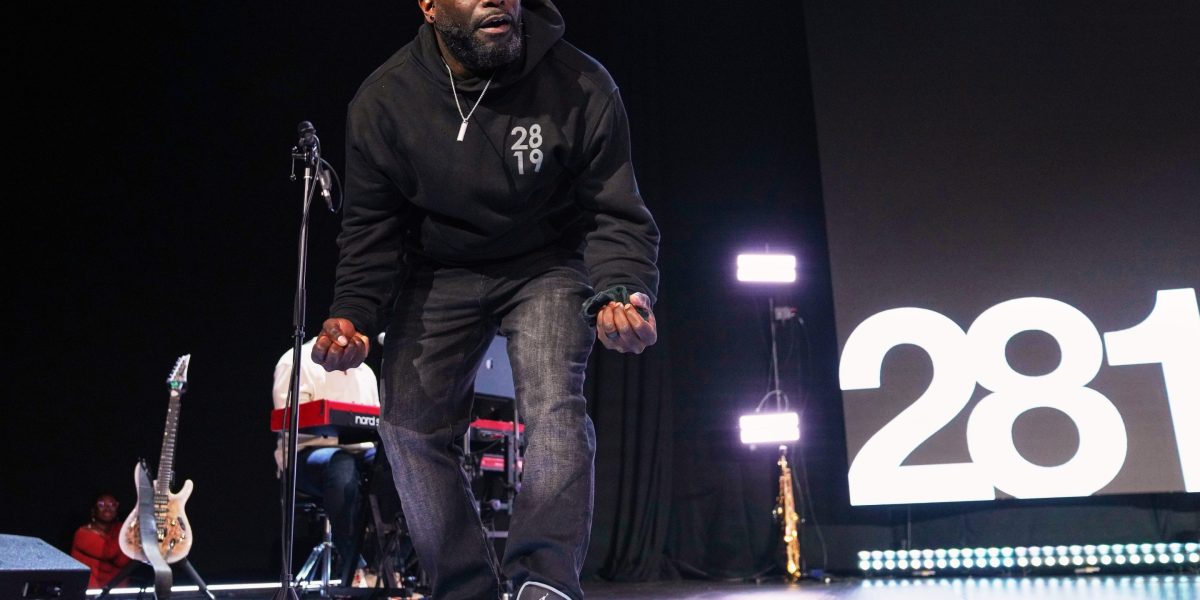
Christian rap and contemporary music blast like a block party as volunteers cheer into megaphones for around 6,000 weekly churchgoers — up from less than 200 in 2023, the church reports. Inside the sanctuary, the atmosphere turns serious. Many drawn to 2819’s riveting worship are hungry for Mitchell’s animated intensity and signature preaching: No sugarcoating the Bible.
After spirited prayers and songs leave many crying, Mitchell ambles onstage in his all-black uniform, sometimes in quiet contemplation or tears, before launching into a fiery sermon. His messages, unpolished and laden with challenges to revere God and live better, often spread quickly online. A recent prayer event drew far more people than State Farm Arena could handle, with many flying in.
Crying, shouting, storming across the platform and punching the air, Mitchell preaches with his whole body — and an urgency to bring people to faith before they die or what he calls Jesus’ impending return to Earth.
“It is life or death for me,” Mitchell told The Associated Press, comparing preaching to the front lines of war. “There are souls that are hanging in the balance. … I think about the fact that in that room somebody might hear the Gospel, and that might be their last opportunity.”
The church — whose name references Matthew 28:19, a Bible verse commanding believers to go “make disciples of all the nations” — is nondenominational and theologically conservative, with beliefs opposing abortion and in support of marriage only between a man and a woman.
The congregation’s growth has attracted people of many races and ages, but it’s predominantly young Black adults. Their youth is notable since Americans ages 18 to 24 are less likely than older adults to identify as Christian or attend religious services regularly, according to Pew Research Center.
Sharp sermons and moving worship
Warren Bird, an expert on fast-growing churches, believes the right leader is key to a church’s growth — along with God’s help — and described Mitchell as “speaking a language” that connects with young people who other pastors haven’t reached.
Churchgoers say Mitchell’s message resonates because he carefully walks them through scripture and talks candidly about his spiritual transformation, including his past dealing drugs, paying for abortions and attempting suicide.
“I’m still a little rough around the edges, right? I still got a little hood in me,” said Mitchell, who still speaks with a regional New York accent.
Many at 2819 want more than motivational speeches and say Mitchell’s sermons are counterweights to the feel-good American preaching he criticizes.
“I’m preaching without watering that down, without filtering out things that we think might be too controversial,” said Mitchell, who wants people to mature spiritually and insists they can’t deal with sin and its consequences without Jesus.
“I think that there is a generation that is gravitating towards that authenticity and truth,” he said. “As a result of that, we are seeing lives being radically transformed.”
Christian podcaster Megan Ashley said she brought a friend to 2819 who had stepped away from her faith, and Mitchell had an impact. The friend told Ashley, “When he speaks, I believe him.”
The tougher messages might hurt some people’s feelings, said Donovan Logan, 23.
“But that’s what it’s supposed to do. If you don’t come to church and want to change, then that’s not the church you’re supposed to be going to,” Logan said.
Elijah McCord, 22, said Mitchell’s sermons about sin touch on what’s happening around him in Atlanta, and Mitchell’s story shows that “there’s life in what God has commanded.” He also values Mitchell’s pleadings to wait until marriage to have sex.
“He biblically talks about sin and repentance and how there’s actually hope in the Gospel,” McCord said.
Churchgoers say 2819’s draw goes beyond Mitchell. It’s the entire worship experience.
Passing the dancing greeters, the Sunday crowd enters the dark auditorium. It’s permeated with prayer and bold instrumental music before the service, which 2819 calls a gathering, officially begins, with hands already lifted amid shouts of praise. Tissue boxes sit at the end of aisles, ready to aid those moved to tears.
“The worship is crazy. The Holy Spirit is just there. Like, tangible presence. You feel it!” said Desirae Dominguez, 24.
Mitchell feels ‘ill-equipped’ to lead 2819
Mitchell spent 10 years preaching, racking up unfruitful notes from church growth conferences, and eventually started struggling with depression. During that time, he took a transformative trip to Israel where he said encounters with God and other Christians changed him. Then, in 2023, he changed the church’s name to 2819.
Mitchell, who has spent three years preaching just from the Book of Matthew alone, said God told him to preach without bringing prepared notes onstage. Although he attended Bible college, he sometimes doubts himself because of his past.
“I shed a lot of tears because I feel often ill-equipped, undeserving,” said Mitchell. “I would not have called me if I was God to steward something like this, and sometimes I don’t know why my preaching is reaching (people). … I’m still shocked myself.”
When preparing to preach, “I’m thinking about the brokenness of the people in the room, the troubled marriages, the one who is suicidal. I’m thinking about the young lady who’s battling crippling insecurities and don’t know that she has a father up there that loves her more than any man she’s going to find down here.”
When not preaching, Mitchell’s demeanor is quieter. He and his staff are “here to serve,” he often says.
His large online platform exposes him and sometimes his family to public critique, pushback, and even threats. Some accuse him of self-righteousness or say he’s too harsh. He also issued a public apology earlier this year for comments in a sermon about obeying authority that were seen as dismissive of police brutality.
At times, he says he is deeply affected by criticism and said he repents for some of what critics decried. But Mitchell also finds solace in better understanding Jesus by enduring it.
Staff constantly adjusts for growth
The church recently moved into its own building, having outgrown the charter school where they held the services, and added a third one. On the first two Sundays at the new location, they added an impromptu fourth gathering because so many people came.
The staff faced similar conundrums at Access, the church’s October prayer event that drew an estimated 40,000 people. State Farm Arena was filled to capacity, as was an overflow space in a nearby convention center, leaving thousands outside, the church reported.
“We’re constantly tinkering. We’re constantly fixing things,” said Tatjuana Phillips, 2819’s ministries director.
Logistical challenges, such as packed parking lots and swamped staff, are common at fast-growing churches, said Bird, the church growth expert.
Despite its size, the church encourages community through its small groups, called “squads,” that give about 1,700 people a place to discuss sermons and support each other’s personal growth. Staff also engage with about 75,000 people weekly who watch gatherings online.
The long lines also yield friendships. Ashley Grimes, 35, said that’s where she’s “met so many brothers and sisters in Christ that I now get to do life with.”
Many of those new friends can be found shuffling into the church’s auditorium on Sundays while volunteers, called servant leaders, pray over each seat before Mitchell preaches.
On a recent Sunday, Mitchell told the crowd that they can turn to Jesus regardless of what they’ve done. It worked for him. God, he said, “used failure to transform my life.”
You may like
Business
Business leaders make their 2026 predictions for the Magnificent 7
Published
23 minutes agoon
December 11, 2025By
Jace Porter
Good morning. What do business leaders predict next year for the Magnificent 7? They know all too well how Alphabet, Amazon, Apple, Meta, Microsoft, Nvidia and Tesla have delivered more than half of the S&P 500’s gains in recent years, setting a high bar for everyone else to clear. But things change: One minute, Alphabet is behind the curve on AI and then Google’s latest Gemini launch sparked a ‘Code Red’ from ChatGPT’s Sam Altman.
Earlier this week, while speaking with former Cisco CEO John Chambers about his tech predictions for the year ahead, our discussion turned to his outlook for the Magnificent 7. Having built Cisco from a router manufacturer to the world’s most valuable company in March 2000—and since nurtured a new generation of unicorns through JC2 Ventures—Chambers is a student of market shifts.
He believes 2026 will be a year of divergence within the Magnificent 7. “Two or three do real well, two or three do not do well at all and you have one or two in the middle,” he told me. “If I were betting on momentum today, I would bet Google (Alphabet), Microsoft and Nvidia. By the way, Google would not have made that list a year ago.”
I subsequently asked two dozen leaders at the Fortune Brainstorm AI conference and the Fortune CEO Initiative dinner in San Francisco for their views on the Mag 7. Alphabet was also the winner. The primary source of enthusiasm is Gemini 3, its latest AI model. Though as one CEO cautioned: “I’m more confident about the health of the business than the health of the stock.”
Microsoft and Nvidia were more of a toss-up for second among the leaders I polled. A Fortune 100 leader pointed out that Microsoft has “deep relationships in the enterprise and something tangible to offer in AI,” while an enterprise-tech leader pointed to its struggles with Copilot. As for Nvidia: “I’d rather be in Jensen’s seat than anywhere else,” said one AI founder.
The company that prompted most debate: Amazon. Some ranked it top as a growth bet for next year, saying it’s gaining on AI rivals; others said last, arguing it’s “not attracting top talent.” Several were lukewarm for reasons ranging from recession fears to the Netflix-Warner Bros. deal. Meta also got a mixed prognosis, with one entrepreneur telling me “you can’t win with low morale.”
Apple and Tesla attracted the most pessimism. Several leaders pointed to the departure of key leaders at Apple, along with its mature product line and lack of visible leadership in AI. And the word cloud around Tesla included “China,” “distracted,” “policy risk,” “consumers,” and “Elon Musk.” Said one dinner attendee: “Go test drive a BYD.”
Contact CEO Daily via Diane Brady at diane.brady@fortune.com
Top news
The Fed’s jobs data fears
As expected, the Federal Reserve cut interest rates by 25 basis points on Wednesday, despite the biggest revolt among policy makers since 2019. In explaining the cut, Chair Jerome Powell suggested that federal jobs data could be inaccurate. Rather than adding 40,000 jobs a month since April, the U.S. could be losing 20,000 jobs a month. The Bureau of Labor Statistics’ so-called birth-death statistical model has a tendency to juice job numbers; the agency is revamping it in February, which may produce more accurate figures.
What Powell should focus on
Meanwhile, Fed Chair Jerome Powell “risks the Fed’s inflation-fighting credibility” if he continues to primarily blame weak demand for the slowdown in hiring rather than AI,” according to a new analysis shared with Fortune by KPMG Chief Economist Diane Swonk. Cutting rates won’t help declining labor rates if AI and immigration are the true culprits, Swonk argues.
Oracle’s reality check
The Fed decision had boosted markets Wednesday, but Oracle’s disappointing earnings served as a reality check, reigniting concerns about AI overspending. The cloud giant said its capital spending will hit $50 billion next year, up $15 billion from previous estimates, but it missed analysts’ targets for cloud sales and infrastructure business revenue.
DeepMind x U.K.
Google DeepMind, an AI lab, is partnering with the U.K. government to achieve breakthroughs in materials science and clean energy, including nuclear fusion, and to study the societal impacts of AI and ways to make AI decision-making more interpretable and safer. DeepMind will open its first automated research center in the U.K. in 2026 as part of the collaboration.
Circle CEO praises Trump for embracing crypto
In this week’sepisode of Leadership Next, Circle CEO Jeremy Allaire credits the Trump administration with creating an “innovation-forward, technology-forward, entrepreneur-forward environment.” Allaire, once a kid who traded baseball cards, went from being a lone wolf in Washington to having one of the most influential IPOs of the year.
Disney nominates former Apple COO to board
Disney nominated Jeff Williams, the former Apple COO who retired last month after 27 years with the company, to its board of directors. In a press release, Disney praised Williams’ “leadership and unique experience at the intersection of technology, global operations, and product design.” Williams will stand for election at Disney’s 2026 annual shareholders meeting.
The markets
S&P 500 futures were down 0.57% this morning. The last session closed up 0.67%. STOXX Europe 600 was up 0.11% in early trading. The U.K.’s FTSE 100 was up 0.06% in early trading. Japan’s Nikkei 225 was down 0.9%. China’s CSI 300 was down 0.86%. The South Korea KOSPI was down 0.59%. India’s NIFTY 50 is up 0.55%. Bitcoin is down at $90K.
Around the watercooler
Walmart’s retiring CEO Doug McMillon spent 40 years climbing the ranks—he reveals the one thing he’s most looking forward to is a ‘blank calendar’ by Emma Burleigh
MacKenzie Scott’s $7 billion year: Philanthropist credits dentist and college roommate as inspirations for monumental giving by Sydney Lake
CEO Daily is compiled and edited by Joey Abrams, Claire Zillman and Lee Clifford.
Business
Student Beans made him a millionaire, a heart condition made this millennial founder rethink life
Published
3 hours agoon
December 11, 2025By
Jace Porter
Today, we meet James Eder, the 42-year-old cofounder of Student Beans (a discount coupon company targeting the college crowd), who is now a work-life coach splitting his time between London and the French Alps, and author of The Collision Code.
Eder was inspired to build Student Beans in 2005 after organising his university’s summer ball—a party for over 600 students where he was responsible for sponsorship. Seeing how much brands wanted access to students—and how much students loved a deal—sparked the idea.
“My calls to big brands led to me asking for samples and raffle prizes,” Eder recalls to Fortune. “Soon, my student hall bedroom was filled with condoms from Durex, Jelly Belly Jelly Beans, Coffee from Starbucks, Pot Noodles and Lush soaps that made it fragrant for months after.”
At the same time, Eder was working as a brand manager for Yell, where he says he’d already worked with more than 30 brands. A business plan assignment in his degree became the perfect place to shape the concept.
So after graduating, he and his older brother—who worked at an investment bank and had his own side hustle, selling titanium power on Ebay—bootstrapped what became one of the U.K.’s defining student platforms, with a £3,000 loan.
Over 15,000 students signed up to get exclusive discount vouchers from over 200 local businesses in its first year. By year three, Student Beans had 150,000 users. And today? It’s rebranded as Pion, works with over 3,500 brands from Gymshark to Uber, with over 5 million customers in more than 100 countries.
While Eder still holds a 35% stake in the £30-million-a-year turnover company, he walked away from day-to-day operations 10 years ago to pursue another idea: A location-based rival to LinkedIn called Causr, where you’d be able to see professionals nearby and connect.
But despite raising £500,000 and attracting 3,000 users, Eder’s second startup collapsed. A heart condition diagnosis forced him to rethink everything.
Having a defibrillator implanted in his chest quietly reshaped how he approaches purpose, work, and the limited resource none of us get back: time.
Today, Eder spends up to half the year in Méribel. He skis most mornings, and is fresh off the launch of The Collision Code—his book, which hit No. 1 on Amazon’s “Most Gifted” list and has already raised more than £8,500 for heart-health charities.
Yet even with the mountain air and flexible schedule, he says the real “good life” is less about escape, and more about learning how to design a life you don’t need to run away from.
The finances
What’s been your best-ever investment?
The best investment I ever made was £400 on a three-day personal development programme called The Landmark Forum in 2009. A friend invited me to an introductory evening. I was sceptical, but I also knew I had nothing to lose. At the very least, I thought it would be three days of reflection, learning about myself and meeting new people.
But it helped me understand how I operate, why I behave the way I do and which beliefs were holding me back. It shifted how I showed up for myself and for others. It gave me the confidence to speak up, build meaningful relationships and say yes to opportunities that scared me. Everything I have done since, from founding companies to writing my book The Collision Code, traces back to the moment I decided to invest in myself.
Once I became a qualified coach, these stepping stones enabled me to design a life that means I live in the French Alps up to six months of the year, enjoying the mountain air and skiing whilst balancing my clients and health.
And the worst?
My second startup, Causr. I raised £150,000, registered for VAT (value added tax) and qualified for R&D tax credits, which brought the total investment closer to £200,000. I also invested three years of my life. We built an app for both Apple and Android and attracted around 3,000 users, but engagement was almost non-existent.
I thought with the success behind me, having built Student Beans, I was so confident the world needed this and I could make this work. But I made the mistake of moving too fast. The moment the funding landed, I felt pressure to spend it and scale immediately. If I could go back, I would have continued testing, validating and learning with a much smaller audience before committing to a full build.
What are your living arrangements like?
I’m fortunate to spend time in between London, Kentish Town, in an old converted school with floor-to-ceiling windows, and a roof terrace that gets the sun for most of the day. I moved there when we relocated the Student Beans offices to Kentish Town and when I was there day-to-day it was just a ten-minute walking commute.
For almost half the rest of the year I’ve chosen to live in the French Alps in a beautiful studio apartment just above Meribel Centre in one of the best and largest ski areas of the world, The Three Valleys. I first fell in love with the mountains, skiing in the same area at around four or five. When I was diagnosed with my heart condition, it was a dream to be able to go back there and make this happen. I feel like I’ve got the perfect balance of the buzz of London and having everything on my doorstep, then mountain escape.
What’s in your wallet?
I never carry any cash. I have two default bank cards I use: The Virgin Atlantic Credit card which affords me to travel regularly in premium and upperclass, or my Revolut, which offers such convenience for different currencies whilst travelling and a brilliant interface.
Do you invest in shares?
I used an advisor for a number of years, making sure I benefited from the ISA tax-free allowances (similar to a Roth IRA in the U.S.). The most fantastic thing I did was invest in a money coach. For the first time, I understood how it works, what a bull and bear market is, what a tracker fund is … I now manage my funds and use Vanguard and Interactive Investor to do the work. I also invest in premium bonds, which are also tax-free investments.
What personal finance advice would you give your 20-year-old self?
I would emphasise the importance of monthly contributions, however small and maximising the tax-free ISA allowances as much as possible.
What’s the one subscription you can’t live without?
My EasyJet Plus subscription. Due to most of my European travel being short-haul with the majority served by EasyJet, it’s a useful perk—priority security, speedy boarding, seat selection and extra handheld luggage.
What’s your most ridiculous ongoing expense?
I don’t have ridiculous ongoing expenses, but I make up for it with travel. Most of my outgoings are on destination travel and related expenses. My annual ski pass for those who don’t ski might be questionable.
Courtesy of James Eder
The Necessities
How do you get your daily coffee fix?
I don’t drink coffee. I never got into it. My weakness is hot chocolate with cream, which I usually drink daily during the winter in the Alps, and it ranges in price from €5 to €10—so a habit of up to €40 a week.
What about eating on the go?
My go-to when I’m in the U.K. is PizzaExpress and Wagamama, reasonably priced and quick eats. I usually eat out three to four times a week. If I’m in town and in between meetings a Pret-A-Manger is a frequent destination. For meetings, I will often be at The Ivy, The Granary Square Brasserie in Kings Cross, The Wolseley or The Delaunay. Novikov or Sketch are also favourites.
Where do you buy groceries?
When I’m in London, I’ll grab food on the way home from being out—a stir fry, or salmon. In France, I do a weekly shop from Carrefour and feel like I have a better balanced diet as I have more time to spend planning and in the kitchen. It’s just a different way of living.
What’s a typical work outfit for you?
I’m usually in jeans from Citizens of Humanity with a shirt and a tailored jacket, polished but relaxed. Day-to-day, I’ve been leaning more casual and think Uniqlo is great for quality basics. I budget up to £1,000 a year on clothes and focus on things I’ll wear again and again.

The Treats
Are you the proud owner of any tech gadgets?
My Apple Watch has been a game-changer. I originally got it with my Vitality Health Care insurance plan and it has helped me identify when I had a change in heart rhythm as well as give me more confidence in exercising.
The one gadget that I think would really improve the quality of my life is a kitchen robot. Of course, there are private chefs, but the idea of having something in my kitchen that can cook with anything is wild.
How do you unwind from the top job?
What’s your take on work-life balance at the top?
In the early days of Student Beans, I was definitely working for over 12 hours a day and felt like I was always on. That was the same at Causr. Since I’m now a coach and author, work ebbs and flows.
Some days I’m out first thing for a breakfast meeting, working through the day, having an interview, doing a photo shoot, a lunch appointment, writing content, speaking at an event, recording a podcast and out for dinner. My take on work-life balance is to reframe it as being about life and whether you’re enjoying it or not.
How do you treat yourself when you get a promotion?
Because I have always worked for myself, promotions were never my milestone. Instead, I celebrated big moments like signing a major client, or raising investment. Those were the times I treated myself to something special. I love the art in my flat and choosing pieces that connect to a memory makes them even more meaningful. One of my favourites is an original limited edition Paul Kenton print of London and the Thames.
How many days annual leave do you take a year?
Whenever I am in France, it naturally feels like a holiday even though I am working. On top of that, I actively take around three months each year to travel and explore.
Take us on holiday with you, where did you go this year?
When I go on the heart transplant list, I’ll need to be within four hours of Cambridge and the transplant hospital at all times, so it’s made me focus on making the most of travelling.
I started 2025 in France, in March, visiting Tignes, another ski resort where I was a social host on European Snow Pride, a week-long gay festival. In April, I went to Gran Canaria for a few days. From there, I flew to Geneva and visited Meribel to get the keys to my new apartment, followed by a few days in Paris for my birthday. I spent a couple of weeks in Sardinia, including a sailing trip on a catamaran around Sardinia and Corsica. I then went to Wales for The Do Lectures, a few days of glamping with a community of over a hundred inspiring people.
Business
Google DeepMind agrees to sweeping partnership with the U.K. government
Published
11 hours agoon
December 10, 2025By
Jace Porter
AI lab GoogleDeepMind announced a major new partnership with the U.K. government Wednesday, pledging to accelerate breakthroughs in materials science and clean energy, including nuclear fusion, as well as conducting joint research on the societal impacts of AI and on ways to make AI decision-making more interpretable and safer.
As part of the partnership, Google DeepMind said it would open its first automated research laboratory in the U.K. in 2026. That lab will focus on discovering advanced materials including superconductors that can carry electricity with zero resistance. The facility will be fully integrated with Google’s Gemini AI models. Gemini will serve as a kind of scientific brain for the lab, which will also use robotics to synthesize and characterize hundreds of materials per day, significantly accelerating the timeline for transformative discoveries.
The company will also work with the U.K. government and other U.K.-based scientists on trying to make breakthroughs in nuclear fusion, potentially paving the way for cheaper, cleaner energy. Fusion reactions should produce abundant power while producing little to no nuclear waste, but such reactions have proved to be very difficult to sustain or scale up.
Additionally, Google DeepMind is expanding its research alliance with the government-run U.K. AI Security Institute to explore methods for discovering how large language models and other complex neural network-based AI models arrive at decisions. The partnership will also involve joint research into the societal impacts of AI, such as the effect AI deployment is likely to have on the labor market and the impact increased use of AI chatbots may have on mental health.
British Prime Minister Keir Starmer said in a statement that the partnership would “make sure we harness developments in AI for public good so that everyone feels the benefits.”
“That means using AI to tackle everyday challenges like cutting energy bills thanks to cheaper, greener energy and making our public services more efficient so that taxpayers’ money is spent on what matters most to people,” Starmer said.
Google DeepMind cofounder and CEO Demis Hassabis said in a statement that AI has “incredible potential to drive a new era of scientific discovery and improve everyday life.”
As part of the partnership, British scientists will receive priority access to Google DeepMind’s advanced AI tools, including AlphaGenome for DNA sequencing; AlphaEvolve for designing algorithms; DeepMind’s WeatherNext weather forecasting models; and its new AI co-scientist, a multi-agent system that acts as a virtual research collaborator.
DeepMind was founded in London in 2010 and is still headquartered there; it was acquired by Google in 2014.
Gemini’s U.K. footprint expands
The collaboration also includes potential development of AI systems for education and government services. Google DeepMind will explore creating a version of Gemini tailored to England’s national curriculum to help teachers reduce administrative workloads. A pilot program in Northern Ireland showed that Gemini helped save teachers an average of 10 hours per week, according to the U.K. government.
For public services, the U.K. government’s AI Incubator team is trialing Extract, a Gemini-powered tool that converts old planning documents into digital data in 40 seconds, compared to the current two-hour process.
The expanded research partnership with the U.K. AI Security Institute will focus on three areas, the government and DeepMind said: developing techniques to monitor AI systems’ so-called “chain of thought”—the reasoning steps an AI model takes to arrive at an answer; studying the social and emotional impacts of AI systems; and exploring how AI will affect employment.
U.K. AISI currently tests the safety of frontier AI models, including those from Google DeepMind and a number of other AI labs, under voluntary agreements. But the new research collaboration could potentially raise concerns about whether the U.K. AISI will remain objective in its testing of its now-partner’s models.
In response to a question on this from Fortune, William Isaac, principal scientist and director of responsibility at Google DeepMind, did not directly address the issue of how the partnership might affect the U.K. AISI’s objectivity. But he said the new research agreement puts in place “a separate kind of relationship from other points of interaction.” He also said the new partnership was focused on “question on the horizon” rather than present models, and that the researchers would publish the results of their work for anyone to review.
Isaac said there is no financial or commercial exchange as part of the research partnership, with both sides contributing people and research resources.
“We’re excited to announce that we’re going to be deepening our partnership with the U.K. AISI to really focus on exploring, really the frontier research questions that we believe are going to be important for ensuring that we have safe and responsible development,” he said.
He said the partnership will produce publicly accessible research focused on foundational questions—such as how AI impacts jobs or how talking to chatbots effects mental health—rather than policy-specific recommendations, though the findings could influence how businesses and policymakers think about AI and how to regulate it.
“We want the research to be meaningful and provide insights,” Isaac said.
Isaac described the U.K. AISI as “the crown jewel of all of the safety institutes” globally and said deepening the partnership “sends a really strong signal” about the importance of engaging responsibly as AI systems become more widely adopted.
The partnership also includes expanded collaboration on AI-enhanced approaches to cybersecurity. This will include the U.K. government exploring the sue of tools like Big Sleep, an AI agent developed by Google that autonomously hunts for previously unknown “Zero Day” cybersecurity exploits, and CodeMender, another AI agent that can search for and then automatically patch security vulnerabilities in open source software.
British Technology Secretary Liz Kendall is visiting San Francisco this week to further the U.K.-U.S. Tech Prosperity Deal, which was agreed to during U.S. President Trump’s state visit to the U.K. in September. In November alone, the British government said the pact helped secure more than $32.4 billion of private investment committed to the U.K tech sector.
The Google-U.K. partnership builds on a £5 billion ($6.7 billion) investment commitment from Google made earlier this year to support U.K. AI infrastructure and research, and to help modernize government IT systems.
The British government also said collaboration supports its AI Opportunities Action Plan and its £137 million AI for Science Strategy, which aims to position the UK as a global leader in AI-driven research.
White House Kills SZA With Kindness After Singer Blasts ICE Ad
Business leaders make their 2026 predictions for the Magnificent 7
‘Starving’ For Hailee Steinfeld’s Sexy Shots To Kick Off her 29th Bday!
Trending
-
Politics8 years agoCongress rolls out ‘Better Deal,’ new economic agenda
-
Entertainment8 years agoNew Season 8 Walking Dead trailer flashes forward in time
-
Politics8 years agoPoll: Virginia governor’s race in dead heat
-
Entertainment8 years agoThe final 6 ‘Game of Thrones’ episodes might feel like a full season
-
Entertainment8 years agoMeet Superman’s grandfather in new trailer for Krypton
-
Politics8 years agoIllinois’ financial crisis could bring the state to a halt
-
Business8 years ago6 Stunning new co-working spaces around the globe
-
Tech8 years agoHulu hires Google marketing veteran Kelly Campbell as CMO