Connect with us

Business

This pastor fills up arenas by not sugarcoating the Bible

Published

on


After Atlanta pastor Philip Anthony Mitchell stopped dwelling on growing his congregation about three years ago, its attendance surged. Now, lines packed with young adults snake outside 2819 Church, some arriving as early as 5:30 a.m. to secure a spot for Sunday worship.

Christian rap and contemporary music blast like a block party as volunteers cheer into megaphones for around 6,000 weekly churchgoers — up from less than 200 in 2023, the church reports. Inside the sanctuary, the atmosphere turns serious. Many drawn to 2819’s riveting worship are hungry for Mitchell’s animated intensity and signature preaching: No sugarcoating the Bible.

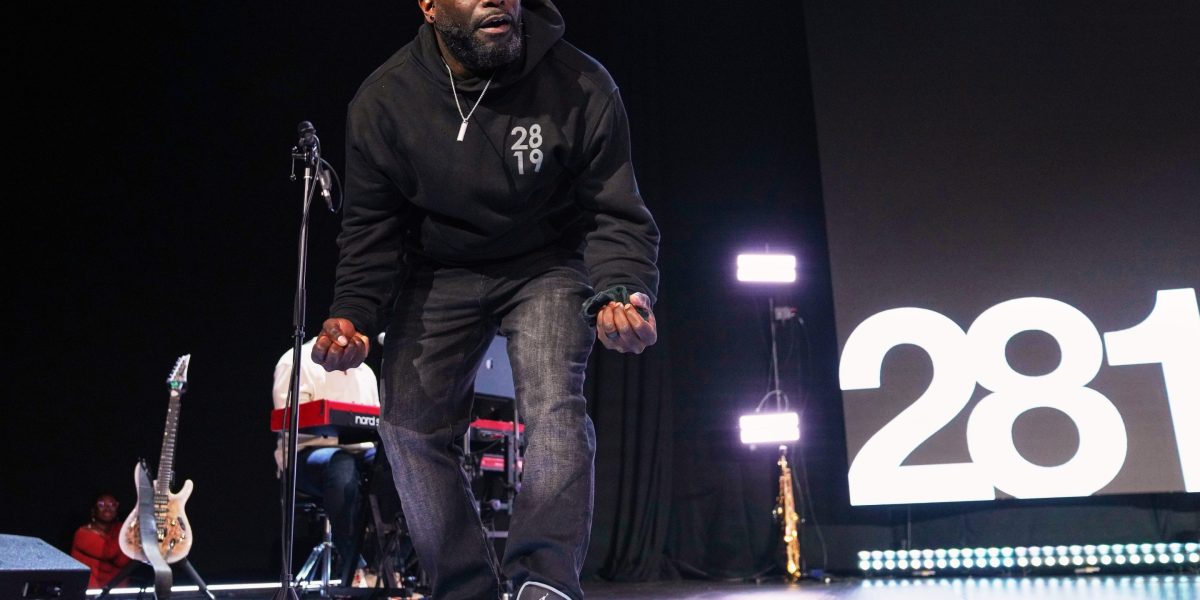
After spirited prayers and songs leave many crying, Mitchell ambles onstage in his all-black uniform, sometimes in quiet contemplation or tears, before launching into a fiery sermon. His messages, unpolished and laden with challenges to revere God and live better, often spread quickly online. A recent prayer event drew far more people than State Farm Arena could handle, with many flying in.

Crying, shouting, storming across the platform and punching the air, Mitchell preaches with his whole body — and an urgency to bring people to faith before they die or what he calls Jesus’ impending return to Earth.

“It is life or death for me,” Mitchell told The Associated Press, comparing preaching to the front lines of war. “There are souls that are hanging in the balance. … I think about the fact that in that room somebody might hear the Gospel, and that might be their last opportunity.”

The church — whose name references Matthew 28:19, a Bible verse commanding believers to go “make disciples of all the nations” — is nondenominational and theologically conservative, with beliefs opposing abortion and in support of marriage only between a man and a woman.

The congregation’s growth has attracted people of many races and ages, but it’s predominantly young Black adults. Their youth is notable since Americans ages 18 to 24 are less likely than older adults to identify as Christian or attend religious services regularly, according to Pew Research Center.

Sharp sermons and moving worship

Warren Bird, an expert on fast-growing churches, believes the right leader is key to a church’s growth — along with God’s help — and described Mitchell as “speaking a language” that connects with young people who other pastors haven’t reached.

Churchgoers say Mitchell’s message resonates because he carefully walks them through scripture and talks candidly about his spiritual transformation, including his past dealing drugs, paying for abortions and attempting suicide.

“I’m still a little rough around the edges, right? I still got a little hood in me,” said Mitchell, who still speaks with a regional New York accent.

Many at 2819 want more than motivational speeches and say Mitchell’s sermons are counterweights to the feel-good American preaching he criticizes.

“I’m preaching without watering that down, without filtering out things that we think might be too controversial,” said Mitchell, who wants people to mature spiritually and insists they can’t deal with sin and its consequences without Jesus.

“I think that there is a generation that is gravitating towards that authenticity and truth,” he said. “As a result of that, we are seeing lives being radically transformed.”

Christian podcaster Megan Ashley said she brought a friend to 2819 who had stepped away from her faith, and Mitchell had an impact. The friend told Ashley, “When he speaks, I believe him.”

The tougher messages might hurt some people’s feelings, said Donovan Logan, 23.

“But that’s what it’s supposed to do. If you don’t come to church and want to change, then that’s not the church you’re supposed to be going to,” Logan said.

Elijah McCord, 22, said Mitchell’s sermons about sin touch on what’s happening around him in Atlanta, and Mitchell’s story shows that “there’s life in what God has commanded.” He also values Mitchell’s pleadings to wait until marriage to have sex.

“He biblically talks about sin and repentance and how there’s actually hope in the Gospel,” McCord said.

Churchgoers say 2819’s draw goes beyond Mitchell. It’s the entire worship experience.

Passing the dancing greeters, the Sunday crowd enters the dark auditorium. It’s permeated with prayer and bold instrumental music before the service, which 2819 calls a gathering, officially begins, with hands already lifted amid shouts of praise. Tissue boxes sit at the end of aisles, ready to aid those moved to tears.

“The worship is crazy. The Holy Spirit is just there. Like, tangible presence. You feel it!” said Desirae Dominguez, 24.

Mitchell feels ‘ill-equipped’ to lead 2819

Mitchell spent 10 years preaching, racking up unfruitful notes from church growth conferences, and eventually started struggling with depression. During that time, he took a transformative trip to Israel where he said encounters with God and other Christians changed him. Then, in 2023, he changed the church’s name to 2819.

Mitchell, who has spent three years preaching just from the Book of Matthew alone, said God told him to preach without bringing prepared notes onstage. Although he attended Bible college, he sometimes doubts himself because of his past.

“I shed a lot of tears because I feel often ill-equipped, undeserving,” said Mitchell. “I would not have called me if I was God to steward something like this, and sometimes I don’t know why my preaching is reaching (people). … I’m still shocked myself.”

When preparing to preach, “I’m thinking about the brokenness of the people in the room, the troubled marriages, the one who is suicidal. I’m thinking about the young lady who’s battling crippling insecurities and don’t know that she has a father up there that loves her more than any man she’s going to find down here.”

When not preaching, Mitchell’s demeanor is quieter. He and his staff are “here to serve,” he often says.

His large online platform exposes him and sometimes his family to public critique, pushback, and even threats. Some accuse him of self-righteousness or say he’s too harsh. He also issued a public apology earlier this year for comments in a sermon about obeying authority that were seen as dismissive of police brutality.

At times, he says he is deeply affected by criticism and said he repents for some of what critics decried. But Mitchell also finds solace in better understanding Jesus by enduring it.

Staff constantly adjusts for growth

The church recently moved into its own building, having outgrown the charter school where they held the services, and added a third one. On the first two Sundays at the new location, they added an impromptu fourth gathering because so many people came.

The staff faced similar conundrums at Access, the church’s October prayer event that drew an estimated 40,000 people. State Farm Arena was filled to capacity, as was an overflow space in a nearby convention center, leaving thousands outside, the church reported.

“We’re constantly tinkering. We’re constantly fixing things,” said Tatjuana Phillips, 2819’s ministries director.

Logistical challenges, such as packed parking lots and swamped staff, are common at fast-growing churches, said Bird, the church growth expert.

Despite its size, the church encourages community through its small groups, called “squads,” that give about 1,700 people a place to discuss sermons and support each other’s personal growth. Staff also engage with about 75,000 people weekly who watch gatherings online.

The long lines also yield friendships. Ashley Grimes, 35, said that’s where she’s “met so many brothers and sisters in Christ that I now get to do life with.”

Many of those new friends can be found shuffling into the church’s auditorium on Sundays while volunteers, called servant leaders, pray over each seat before Mitchell preaches.

On a recent Sunday, Mitchell told the crowd that they can turn to Jesus regardless of what they’ve done. It worked for him. God, he said, “used failure to transform my life.”


Source link

Continue Reading

Business

Binance has been proudly nomadic for years. A new announcement suggests it’s chosen an HQ

Published

on


For years, Binance has dodged questions about where it plans to establish a corporate headquarters. On Monday, the world’s largest crypto exchange made an announcement that indicates it has chosen a location: Abu Dhabi, the capital of the United Arab Emirates.

In its announcement, Binance reported that it has secured three global financial licenses within Abu Dhabi Global Market, a special economic zone inside the Emirati city. The licenses regulate three different prongs of the exchange’s business: its exchange, clearinghouse, and broker dealer services. The three regulated entities are named Nest Exchange Limited, Nest Clearing and Custody Limited, and Nest Trading Limited, respectively.

Richard Teng, the co-CEO of Binance, declined to say whether Abu Dhabi is now Binance’s global headquarters. “But for all intents and purposes, if you look at the regulatory sphere, I think the global regulators are more concerned of where we are regulated on a global basis,” he said, adding that Abu Dhabi Global Market is where his crypto exchange’s “global platform” will be governed.

A company spokesperson declined to add more to Teng’s comments, but did not deny Fortune’s assertion that Binance appears to have chosen Abu Dhabai as its headquarters.

Corporate governance

The Abu Dhabi announcement suggests that Binance, which has for years taken pride in branding itself as a company with no fixed location, is bowing to the practical considerations that go with being a major financial firm—and the corporate governance obligations that entails.

When Changpeng Zhao, the cofounder and former CEO of Binance, launched the company in 2017, he initially established the exchange in Hong Kong. But, weeks after he registered Binance in the city, China banned cryptocurrency trading, and Zhao moved his nascent trading platform. Binance has since been itinerant. “Wherever I sit is going to be the Binance office,” Zhao said in 2020.

The location of a company’s headquarters impacts its tax obligations and what regulations it needs to follow. In 2023, after Binance reached a landmark $4.3 billion settlement with the U.S. Department of Justice, Zhao stepped down as CEO and pleaded guilty to failing to implement an effective anti-money laundering program.

Teng took over and promised to implement the corporate structures—like a board of directors—that are the norm for companies of Binance’s size. Teng, who now shares the CEO role with the newly appointed Yi He, oversaw the appointment of Binance’s first board in April 2024. And he’s repeatedly telegraphed that his crypto exchange is focused on regulatory compliance.

Binance already has a strong footprint in the Emirates. It has a crypto license in Dubai, received a $2 billion investment from an Emirati venture fund in March, and, that same month, said it employed 1,000 employees in the country. 


Source link

Continue Reading

Business

Leaders in Congress outperform rank-and-file lawmakers on stock trades by up to 47% a year

Published

on


Stocks held by members of Congress have been beating the S&P 500 lately, but there’s a subset of lawmakers who crush their peers: leadership.

According to a recent working paper for the National Bureau of Economic Research, congressional leaders outperform back benchers by up to 47% a year.

Shang-Jin Wei from Columbia University and Columbia Business School along with Yifan Zhou from Xi’an Jiaotong-Liverpool University looked at lawmakers who ascended to leadership posts, such as Speaker of the House as well as House and Senate floor leaders, whips, and conference/caucus chairs.

Between 1995 and 2021, there were 20 such leaders who made stock trades before and after rising to their posts. Wei and Zhou observed that lawmakers underperformed benchmarks before becoming leaders, then everything suddenly changed.

“Importantly, whilst we observe a huge improvement in leaders’ trading performance as they ascend to leadership roles, the matched ‘regular’ members’ stock trading performance does not improve much,” they wrote.

Leadership’s stock market edge stems in part from their ability to set the regulatory or legislation agenda, such as deciding if and when a particular bill will be put to a vote. Setting the agenda also gives leaders advanced knowledge of when certain actions will take place.

In fact, Wei and Zhou found that leaders demonstrate much better returns on stock trades that are made when their party controls their chamber.

In addition, being a leader also increases access to non-public information. The researchers said that while companies are reluctant to share such insider knowledge, they may prioritize revealing it to leaders over rank-and-file lawmakers.

Leaders earn higher returns on companies that contribute to their campaigns or are headquartered in their states, which Wei and Zhou said could be attributable to “privileged access to firm-specific information.”

The upper echelon also influences how other members of Congress vote, and the paper found that a leader’s party is much more likely to vote for bills that help firms whose stocks the leader held, or vote against bills that harmed them. And stocks owned by leadership tend to see increases in federal contract awards, especially sole-source contracts, over the following one to two years.

“These results suggest that congressional leaders may not only trade on privileged knowledge, but also shape policy outcomes to enrich themselves,” Wei and Zhou wrote.

Stock trades by congressional leaders are even predictive, forecasting higher occurrences of positive or negative corporate news over the following year, they added. In particular, stock sales predict the number of hearings and regulatory actions over the coming year, though purchases don’t.

Investors have long suspected that Washington has a special advantage on Wall Street. That’s given rise to more ETFs with political themes, including funds that track portfolios belonging to Democrats and Republicans in Congress.

And Paul Pelosi, former House Speaker Nancy Pelosi’s husband, even has a cult following among some investors who mimic his stock moves.

Congress has tried to crack down on members’ stock holdings. The STOCK Act of 2012 requires more timely disclosures, but some lawmakers want to ban trading completely.

A bipartisan group of House members is pushing legislation that would prohibit members of Congress, their spouses, dependent children, and trustees from trading individual stocks, commodities, or futures.

And this past week, a discharge petition was put forth that would force a vote in the House if it gets enough signatures.

“If leadership wants to put forward a bill that would actually do that and end the corruption, we’re all for it,” said Rep. Anna Paulina Luna, R-Fla., on social media on Tuesday. “But we’re tired of the partisan games. This is the most bipartisan bipartisan thing in U.S. history, and it’s time that the House of Representatives listens to the American people.”


Source link

Continue Reading

Business

Macron warns EU may hit China with tariffs over trade surplus

Published

on


French President Emmanuel Macron warned that the European Union may be forced to take “strong measures” against China, including potential tariffs, if Beijing fails to address its widening trade imbalance with the bloc.

“I’m trying to explain to the Chinese that their trade surplus isn’t sustainable because they’re killing their own clients, notably by importing hardly anything from us any more,” Macron told Les Echos newspaper in an interview published on Sunday.

“If they don’t react, in the coming months we Europeans will be obliged to take strong measures and decouple, like the US, like for example tariffs on Chinese products,” he said, adding that he had discussed the matter with European Commission President Ursula von der Leyen.

Macron has just returned from a three-day state visit in China, where he pressed for more investment as Paris seeks to recalibrate its relationship with the world’s second-largest economy. France’s goods trade deficit with China reached around €47 billion ($54.7 billion) last year, according to the French Treasury. Meanwhile, China’s goods trade surplus with the EU swelled to almost $143 billion in the first half of 2025, a record for any six-month period, according to data released by China earlier this year.

Tensions between France and China escalated last year after Paris backed the EU’s decision to impose tariffs on Chinese electric vehicles. Beijing retaliated by imposing minimum price requirements on French cognac, sparking fears among pork and dairy producers that they could be targeted next.

‘Life or Death’

Macron said the US approach to China was “inappropriate” and had worsened Europe’s position by diverting Chinese goods toward the EU market.

“Today, we’re stuck between the two, and it’s a question of life or death for European industry,” Macron said, while noting that Germany — Europe’s biggest economy — doesn’t entirely share France’s stance.

In addition to Europe needing to become more competitive, the European Central Bank too has a role to play in strengthening the EU’s single market, Macron said, arguing that monetary policy should take growth and jobs into account, not just inflation, he said.

He also said the ECB’s decision to continue selling the government bonds it holds risks pushing up long-term interest rates and weighing on economic activity.

“Europe must — and wants to — remain a zone of monetary stability and credible investment,” Macron said.


Source link

Continue Reading

Trending

Copyright © Miami Select.