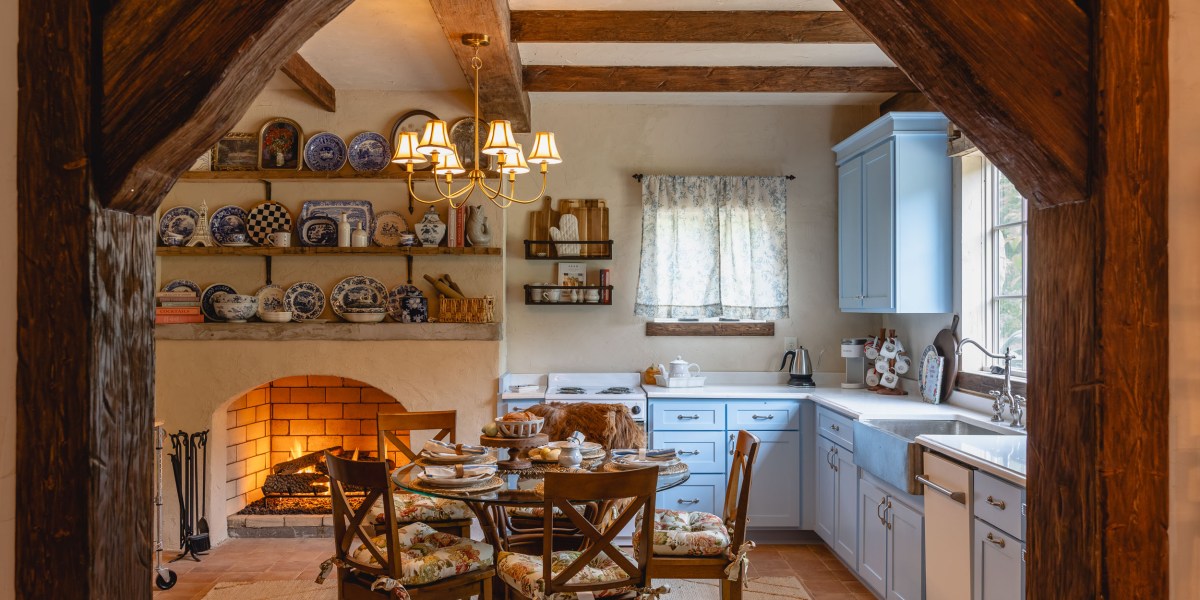
Everyone has must-watch holiday movies that they binge during the festive season, from Love Actually to Home Alone. But few actually get the chance to step inside the world of their favorite comfort flicks—that is, until now. Superfans of The Holiday can now rent out a replica of the quaint English cottage where fictional Hollywood bigwig Amanda Woods (played by Cameron Diaz) was charmed by heartthrob British book editor Graham (played by Jude Law). They’ll have to wait four months, and make the trek to Georgia instead of the Cotswolds.
Home designer Lucy Small put The Holiday Cottage up for short-term rentals this October after a nine-month build—and a fan frenzy quickly ensued. The 37-year-old has spent the past six years designing homes in the Blue Ridge Mountains; she’s worked on three dozen houses, from bathroom and kitchen rebuilds to hardcore construction projects. But nothing could have prepared her for the rush of attention that came with her latest project: replicating the cozy Rosehill Cottage featured in The Holiday, from the ground up. After all, nearly two decades after the movie’s release, it continues to be a top-watched festive flick—in 2023, The Holiday was streamed 2.3 million times, according to an analysis from Samba TV.
As it turned out, the house featured in the 2006 film—owned by Kate Winslet’s character Iris, who home-swapped with Amanda’s L.A. mansion for the Christmas season—never actually existed in real life. It was a big undertaking, but Small saw a potential hit on her hands.
“The Holiday Cottage was really a fun thing. I was like, ‘Hey, why don’t I do this? I have everything at my disposal to be able to do it, I know how to build, and I can find land,’” Small tells Fortune, adding she’s a fan of the iconic movie. “Honestly, it was just one of those situations where I had this wacky idea, and everyone got excited about it, and no one stopped me.”
David Cannon Photography/Courtesy of Lucy Small
Before the foundation of the two-bedroom, two-and-a-half bath home was even built, Small had attracted attention from thousands of customers. She first announced her plan to build the cottage in 2022, and fan fervor started pouring in. The entrepreneur says they only had digital renders of the cottage at the time, but people were already sending her handwritten letters about how they couldn’t wait to stay there. Around 4,000 people left their emails on a website Small threw together to update the public on its availability. Now, just one month after going live on the market, the short-term stay is fully booked out until March 2026.
“People have really loved it, and every time I get one of those letters of, ‘This means so much to me, thank you so much for making it possible,’ that’s just way more worthwhile to me than anything else,” Small continues. “Anyone can build a house, have it be a good investment, and sell it to an investor. But this seems to really have meaning to people, and that makes it important.”
The nine-month process to bring The Holiday cottage to life
It’s no easy feat bringing a piece of cinema into the real world—especially when you’re up against a home that’s impossible to replicate. In truth, the Rosehill Cottage featured in The Holiday was just a bit of movie magic; the home’s weathered facade was built in an open field, while the interior was filmed on sets. Home-makers might hesitate at the idea of building an unbuildable home—but Small was actually excited by the premise.
“I found out that the house never actually existed in real life, which, for me, is a big deal. Because if you can actually go visit the Brady Bunch house, or the Home Alone house, me building another one is less interesting,” she explains. “But if it never existed, if it’s a set that was torn down 20 years ago, that’s a lot more interesting, because there is literally nothing else in the world like it.”
Small put the project into motion several years ago, but quickly ran into some time-consuming roadblocks. Georgia, a popular tourist getaway and filming location, was slow to issue more short-term rental licenses as temporary stays flooded the market. Heavy taxes and fees also had to be factored into the price, as counties wanted in on the industry’s growing success. Finding the right land to build on was a struggle—but once they settled on a plot in North Georgia, it was off to the races.
David Cannon Photography/Courtesy of Lucy Small
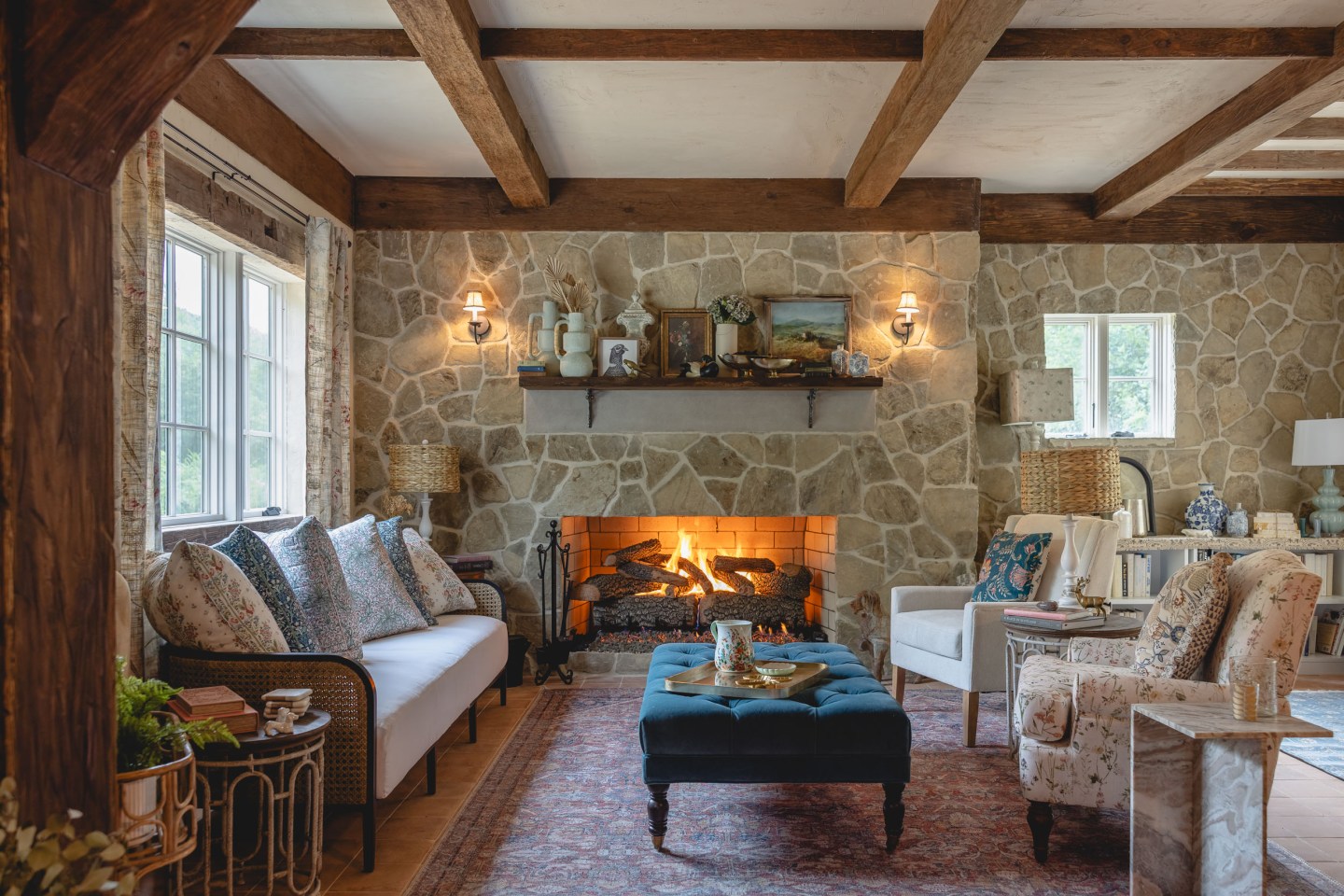
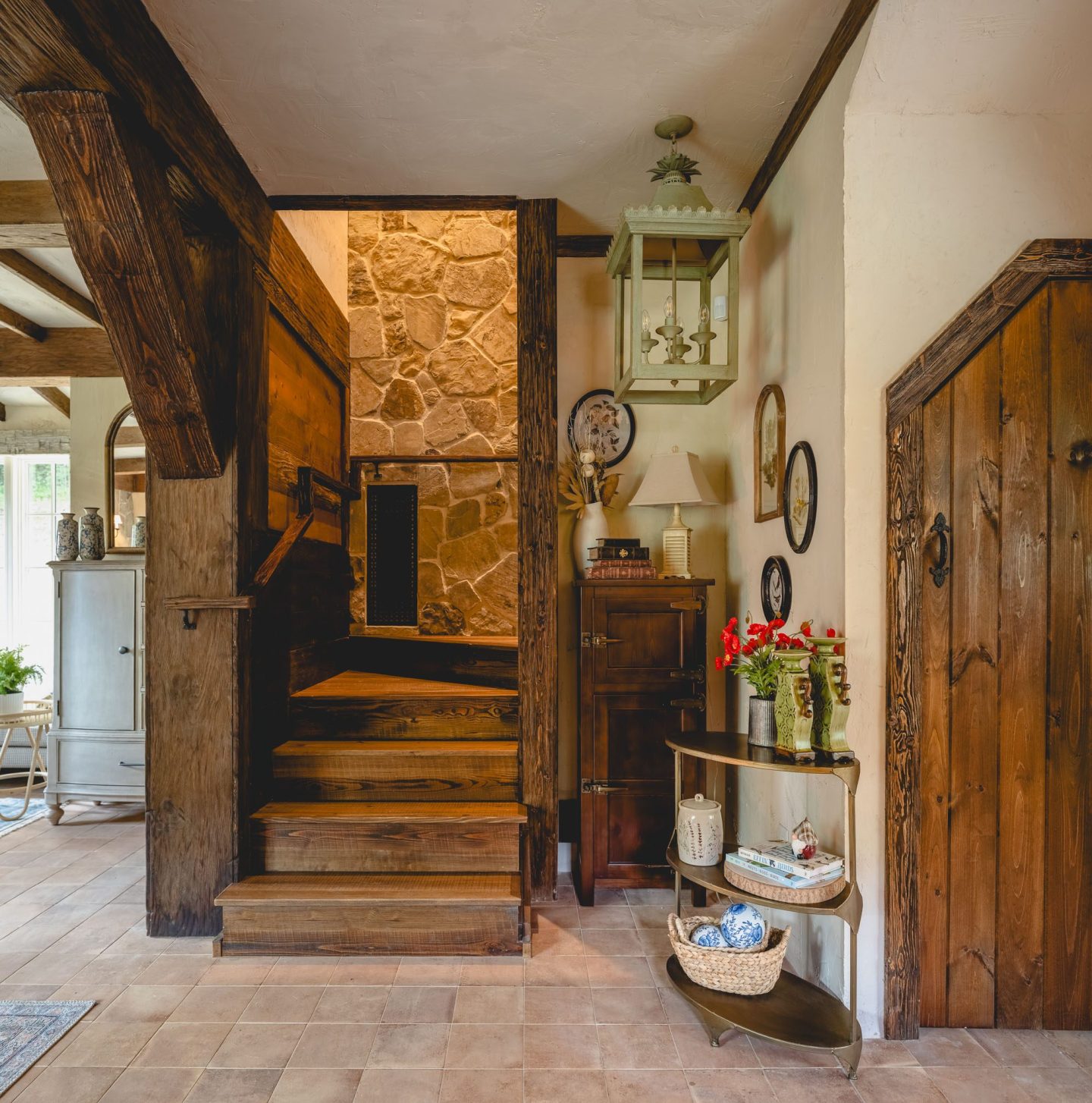
In total, it took nine months to build The Holiday Cottage, from breaking ground to putting in the final flourishes. Small worked with an architectural designer, watching the romcom together “1,000 times” to try and get it right. The first hurdle: they realized the house would never meet code. When trying to build at scale, they discovered the ceilings would be too low, standing at only seven feet tall, based on where the windows were positioned in the movie. The film version of the cottage had only two chimneys but featured three fireplaces; the bathroom floor was sloped; and, in reality, one window would cut halfway through the kitchen cabinet. Small and her team did everything to match the same aesthetic, even setting up fake walls and slopes.
Replicating the home’s furnishings proved to be a bit pricey, too. Despite the quaint movie cottage, seemingly adorned with humble, second-hand furniture, the kitsch decor was beyond Small’s budget. Using Google image reverse search, she tracked down antiques identical to the ones in the set, which ran upwards of $30,000 each. The bamboo umbrella tree shown in the cottage entryway, for example, was priced at over $15,000. Eventually, Small was able to parallel the same warm, charming atmosphere with similar decor. She declines to share how much the entire build set her back, or even when she’ll recoup on costs. Small says she rents out the home at a modest price—$399 per night during the low season, and $499 during high season—and is adamant that The Holiday Cottage has been a worthwhile investment.
“It’s not like we were totally surprised and totally blew the budget. We knew what it would be—we don’t charge a stupid amount,” Small says. “And so it’s still been a good investment, given that we did not like cheap out on the build at all.”
Having 4,000 eager fans lined up—and why Small is fine being a “one-hit-wonder”
With 4,000 eager renters already waiting for the pin to drop, The Holiday Cottage’s instant success wasn’t a huge surprise. However, Small wasn’t used to her projects getting so much attention.
“As someone who, frankly, does not know how to use social media at all, who doesn’t have it, who’s pretty private, I’m usually unable to get eyeballs on any of my projects,” she continues. “For this one, [attention has] just been pouring in completely, even though I haven’t gone out to seek it, which has been a very new position for me as a designer.”
Once The Holiday Cottage booking site went live on October 4, Small says dates started filling up “immediately.” And media attention only riled up more interest; the millennial home designer says she “can’t think of a magazine” that hasn’t covered her new build. And just in time for the holidays, it’s proved to be the perfect place to get into the festive spirit. Currently, there is only one open day in March, a few available slots in April, and just one in May. The Holiday Cottage isn’t available for a multi-day booking until June 2026—the house is nearly booked out for six straight months.
David Cannon Photography/Courtesy of Lucy Small
Small’s latest project has proved a huge success, and she says renters have so far been loving it. Travelers leave their stories in the home’s guest book; a trio of sisters brought their mother, a big fan of The Holiday, along for the ultimate dream stay; another visitor used to watch the movie with her mom every Christmas, and after her passing, rented the place with her dad. For the people who stay there, the short-term rental is more than a place to crash. It’s the chance to be immersed in romcom nostalgia and reconnect with loved ones.
When asked if she is planning another movie-related build, Small says she’s perfectly happy being the homeowner of this one viral sensation. Right now, she has no other ideas—all she knows is she will only take projects like this, where people are excited about the result. Plus, Small believes there’s no other home built that can replicate the same magic as The Holiday Cottage.
“Honestly, I’m fine being a one-hit-wonder,” Small says. “I don’t need it to be a big money-maker or big success, because a lot of the things that make this house—The Holiday Cottage—so special, I don’t think can be replicated.”
Alfia Ilicheva came from the world of public markets, including four years at one of the world’s largest hedge funds, Bridgewater. But when she transitioned over to the private side, including serving as the CEO of an Apollo-backed investment platform, she realized the difficulty of fund administration for operations like private equity and venture capital. Instead of having access to real-time and accurate data like at Bridgewater, which can rely on publicly available information, this new world was filled with manually compiled and fragmented data subject to human error and inconsistent metrics. “How could it be that hedge funds are so into the future and private capital markets are so backward,” she remembers thinking.
As private markets explode and AI makes automation increasingly possible, Ilicheva saw an opportunity to build the next generation of fund administration software for everyone from venture capital outfits to PE giants like Apollo. After initially planning to bootstrap the project, which she named Formulary, Ilicheva was introduced to Hari Arul, a partner at Khosla Ventures, who immediately saw the appeal of the idea. Khosla is leading Formulary’s $4.6 million seed round, which Ilicheva says is three times oversubscribed, with participation from Human Ventures, Serena Williams’s venture firm, and others.
In the red-hot field of private investments, buoyed by the rise of private credit and massively valued companies like SpaceX and OpenAI, fund administration may not be the most alluring area for innovation. But the ability to track investments, returns, and performance—and accurately convey the information to investors, or limited partners—is a necessary foundation.
The existing options fall into two camps: the service side, or high-touch accounting companies, like SS&C and Citco, or the software side, like Carta. As Ilicheva interviewed general partners and former clients in her user research, she realized that nearly everyone was dissatisfied with the existing options to the point that most turned to shadow fund administration, where they would hire outside firms but keep their own books at the same time. “When you raise a fund, your dream is to generate alpha by investing capital, not redoing someone’s work,” Ilicheva said.
Ilicheva planned to find a happy medium between the two models by leveraging AI to massively scale up the service approach, creating software for their own in-house accountants, which Ilicheva playfully calls bionic accountants. “They’re really focused on having a grip on the numbers and delivering service, but they’re not manually entering things in an Excel spreadsheet, which has been the industry’s burden for the past decades,” she said.
The challenge in creating a tech-enabled services company, of course, is scale, with a pure SaaS model able to grow at a much faster clip. When I asked Khosla’s Arul how he thought about the approach, he said the key is to deliver the vast majority of the product through technology: “It’s important for any entrepreneur or any investor to look at an AI-enabled services business and say, the margin of how this business runs looks more like a technology company than a services company.”
Arul said that while Khosla is not yet using Formulary, which is just now coming out of stealth, he’s optimistic for a future where tedious processes like ensuring data accuracy for LPs can be fully, reliably automated. Ilicheva mentioned one possible future use case for Formulary as drafting LP letters, which Arul wholeheartedly endorsed, along with a portal where investors could communicate directly with the system to understand the value of positions, fund deployment, and future capital calls. “[That] sounds pie in the sky relative to what the reality is today,” Arul said, “But it doesn’t feel out of reach.”
In today’s CEO Daily:Fortune‘s AI editor Jeremy Kahn reports on the AI buzz at Davos
The big story: SCOTUS could upend Trump’s leverage to acquire Greenland.
The markets: Jolted by Trump’s renewed tariff threats.
Plus: All the news and watercooler chat from Fortune.
Good morning. I’m on the ground in Davos, Switzerland, for this year’s World Economic Forum. As Diane wrote yesterday, U.S. President Donald Trump’s arrival later this week along with a large delegation of U.S. officials eclipses pretty much every other discussion at Davos this year. But, when people here aren’t talking about Trump, they are talking about AI.
At Davos last year, the hype around AI agents was pierced by the shock of DeepSeek’s R1 model, which was released during the conference. We’ll see if a similar bit of news upends the AI narrative again this year. (There are rumors that DeepSeek is planning to drop another model.) But, barring that, business leaders seem to be less wowed by the hype around AI this year and more concerned with the nitty-gritty of how to implement the technology successfully at scale.
On Monday, Srini Tallapragada, Salesforce’s chief engineering and customer success officer, told me the company is using ‘forward deployed engineers’ to tighten feedback loops between customers and product teams. Salesforce is also offering pre-built agents, workflows, and playbooks to help customers re-engineer their businesses—and avoid getting stuck in “pilot purgatory.”
Meanwhile, at a side event in Davos called A Compass for Europe, that focused on how to restore the continent’s flagging competitiveness, AI was front-and-center. Christina Kosmowski, the CEO of LogicMonitor, told the assembled CEOs that to achieve AI success at scale, companies should take a “top down” approach, with the CEO and leadership identifying the highest value use cases and driving the whole organization to align around achieving them. Neeti Mehta Shukla, the cofounder and chief impact officer at Automation Anywhere, said it was critical to move beyond measuring automation’s impact only through the lens of labor savings. She gave specific customer examples where uplifting data quality, improving customer satisfaction, or moving more workers to new tasks, were better metrics than simply looking at cost per unit output. Finally, Lila Tretikov, head of AI strategy at NEA, said Europe has enough talent and funding to build world-beating AI companies—what it lacks is ambition and willingness to take big bets.
Later, I met with Bastian Nominacher, co-founder and co-CEO of process analytics software platform Celonis. He echoed some of these points, telling me that to achieve ROI with AI generally required three things: strong leadership commitment, the establishment of a center of excellence within the business (this led to an 8x higher return than for companies that didn’t do this!), and finally having enough live data connected to the AI platform.
For further AI insights from Davos, check out Fortune’s Eye on AI newsletter. Meanwhile, Fortune is hosting a number of events in Davos throughout the week. View that lineup here. And my colleagues will be providing more reporting from Davos to CEO Daily and fortune.com throughout the week.—Jeremy Kahn
This is the web version of CEO Daily, a newsletter of must-read global insights from CEOs and industry leaders. Sign up to get it delivered free to your inbox.
U.S. stock futures dropped late Monday after global equities sold off as President Donald Trump launches a trade war against NATO allies over his Greenland ambitions.
Futures tied to the Dow Jones industrial average sank 401 points, or 0.81%. S&P 500 futures were down 0.91%, and Nasdaq futures sank 1.13%.
Markets in the U.S. were closed in observance of the Martin Luther King Jr. Day holiday. Earlier, the dollar dropped as the safe haven status of U.S. assets was in doubt, while stocks in Europe and Asia largely retreated.
On Saturday, Trump said Denmark, Norway, Sweden, France, Germany, the United Kingdom, the Netherlands, and Finland will be hit with a 10% tariff starting on Feb. 1 that will rise to 25% on June 1, until a “Deal is reached for the Complete and Total purchase of Greenland.”
The announcement came after those countries sent troops to Greenland last week, ostensibly for training purposes, at the request of Denmark. But late Sunday, a message from Trump to European officials emerged that linked his insistence on taking over Greenland to his failure to be award the Nobel Peace Prize.
The geopolitical impact of Trump’s new tariffs against Europe could jeopardize the trans-Atlantic alliance and threaten Ukraine’s defense against Russia.
But Wall Street analysts were more optimistic on the near-term risk to financial markets, seeing Trump’s move as a negotiating tactic meant to extract concessions.
Michael Brown, senior research strategist at Pepperstone, described the gambit as “escalate to de-escalate” and pointed out that the timing of his tariff announcement ahead of his appearance at the Davos World Economic Forum this week is likely not a coincidence.
“I’ll leave others to question the merits of that approach, and potential longer-run geopolitical fallout from it, but for markets such a scenario likely means some near-term choppiness as headline noise becomes deafening, before a relief rally in due course when another ‘TACO’ moment arrives,” he said in a note on Monday, referring to the “Trump always chickens out” trade.
Similarly, Jonas Goltermann, deputy chief markets economist at Capital Economics, also said “cooler heads will prevail” and downplayed the odds that markets are headed for a repeat of last year’s tariff chaos.
In a note Monday, he said investors have learned to be skeptical about all of Trump’s threats, adding that the U.S. economy remains healthy and markets retain key risk buffers.
“Given their deep economic and financial ties, both the US and Europe have the ability to impose significant pain on each other, but only at great cost to themselves,” Goltermann added. “As such, the more likely outcome, in our view, is that both sides recognize that a major escalation would be a lose-lose proposition, and that compromise eventually prevails. That would be in line with the pattern around most previous Trump-driven diplomatic dramas.”