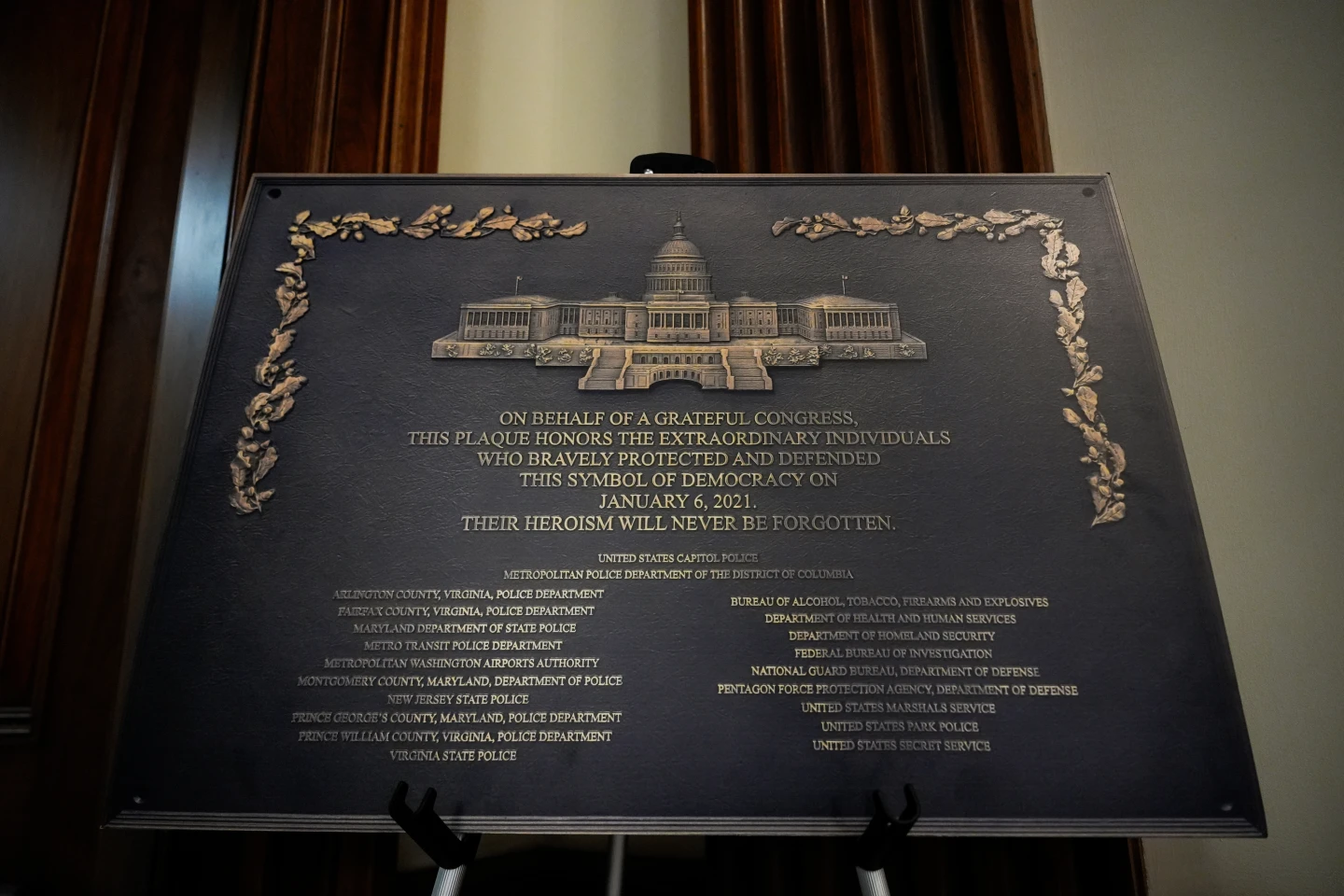
It’s not on display at the Capitol, as is required by law. Its whereabouts aren’t publicly known, though it’s believed to be in storage.
House Speaker Mike Johnson, a Louisiana Republican, has yet to formally unveil the plaque. And the Trump administration’s Department of Justice is seeking to dismiss a police officers’ lawsuit asking that it be displayed as intended. The Architect of the Capitol, which was responsible for obtaining and displaying the plaque, said in light of the federal litigation, it cannot comment.
A replica plaque commemorating the Jan. 6, 2021 Capitol riot hangs outside the office of Speaker Emerita Nancy Pelosi, D-Calif., Tuesday, Dec. 30, 2025, at the Longworth House Office Building on Capitol Hill in Washington. (AP Photo/Julia Demaree Nikhinson)
Determined to preserve the nation’s history, some 100 members of Congress, mostly Democrats, have taken it upon themselves to memorialize the moment. For months, they’ve mounted poster board-style replicas of the Jan. 6 plaque outside their office doors, resulting in a Capitol complex awash with makeshift remembrances.
“On behalf of a grateful Congress, this plaque honors the extraordinary individuals who bravely protected and defended this symbol of democracy on Jan. 6, 2021,” reads the faux bronze stand-in for the real thing. “Their heroism will never be forgotten.”

Jan. 6 void in the Capitol
In Washington, a capital city lined with monuments to the nation’s history, the plaque was intended to become a simple but permanent marker, situated near the Capitol’s west front, where some of the most violent fighting took place as rioters breached the building.
But in its absence, the missing plaque makes way for something else entirely — a culture of forgetting.
Visitors can pass through the Capitol without any formal reminder of what happened that day, when a mob of President Donald Trump’s supporters stormed the building trying to overturn the Republican’s 2020 reelection defeat to Democrat Joe Biden. With memory left unchecked, it allows new narratives to swirl and revised histories to take hold.
Five years ago, the jarring scene watched the world over was declared an “insurrection” by the then-GOP leader of the Senate, while the House GOP leader at the time called it his “saddest day” in Congress. But those condemnations have faded.

A replica plaque commemorating the Jan. 6, 2021 Capitol riot hangs outside the office of Rep. Jamie Raskin, D-Md., Tuesday, Dec. 30, 2025, at the Rayburn House Office Building on Capitol Hill in Washington. (AP Photo/Julia Demaree Nikhinson)
Trump calls ita “day of love.” And Johnson, who was among those lawmakers challenging the 2020 election results, is now the House Speaker.
“The question of January 6 remains – democracy was on the guillotine — how important is that event in the overall sweep of 21st century U.S. history,” said Douglas Brinkley, a professor of history at Rice University and noted scholar.
“Will January 6 be seen as the seminal moment when democracy was in peril?” he asked. Or will it be remembered as “kind of a weird one-off?”
“There’s not as much consensus on that as one would have thought on the fifth anniversary,” he said.
Memories shift but violent legacy lingers
At least five people died in the riot and its aftermath, including Trump supporter Ashli Babbitt, who was fatally shot by police while trying to climb through a window toward the House chamber. More than 140 law enforcement officers were wounded, some gravely, and several died later, some by suicide.
All told, some 1,500 people were charged in the Capitol attack, among the largest federal prosecutions in the nation’s history. When Trump returned to power in January 2025, he pardoned all of them within hours of taking office.
Unlike the twin light beams that commemorated the Sept. 11, 2001, attack or the stand-alone chairs at the Oklahoma City bombing site memorial, the failure to recognize Jan. 6 has left a gap not only in memory but in helping to stitch the country back together.
“That’s why you put up a plaque,” said Rep. Mary Gay Scanlon, a Pennsylvania Democrat. “You respect the memory and the service of the people involved.”
Police sued, DOJ seeks to dismiss
The Speaker’s office said in a statement late Monday the statute authorizing the plaque is “not implementable” and proposed alternatives also “do not comply.” Johnson’s spokesman said if Democrats are serious about commemorating the police, they’re free to work with the appropriate committees to develop a framework for proper vetting and consideration.
Lawmakers approved the plaque in March 2022 as part of a broader government funding package. The resolution said the U.S. “owes its deepest gratitude to those officers,” and it set out instructions for an honorific plaque listing the names of officers “who responded to the violence that occurred.” It gave a one-year deadline for installation at the Capitol.
This summer, two officers who fought the mob that day sued over the delay.
“By refusing to follow the law and honor officers as it is required to do, Congress encourages this rewriting of history,” saidthe claim by officers Harry Dunn and Daniel Hodges. “It suggests that the officers are not worthy of being recognized, because Congress refuses to recognize them.”
The Justice Department is seeking to have the case dismissed. U.S. Attorney Jeanine Pirro and others argued Congress “already has publicly recognized the service of law enforcement personnel” by approving the plaque and displaying it wouldn’t alleviate the problems they claim to face from their work.
“It is implausible,” the Justice Department attorneys wrote, to suggest installation of the plaque “would stop the alleged death threats they claim to have been receiving.”
The department also said the plaque is required to include the names of “all law enforcement officers” involved in the response that day — some 3,600 people.
Makeshift memorials emerge
Lawmakers who’ve installed replicas of the plaque outside their offices said it’s important for the public to know what happened.
“There are new generations of people who are just growing up now who don’t understand how close we came to losing our democracy on Jan 6, 2021,” said Rep. Jamie Raskin, a Maryland Democrat, a member of the Jan. 6 committee, which was opposed by GOP leadership but nevertheless issued a nearly 1,000-page report investigating the run-up to the attack and the attempt to overturn the 2020 election.
A replica plaque commemorating the Jan. 6, 2021 Capitol riot stands outside the office of House Minority Leader Hakeem Jeffries, D-N.Y, Tuesday, Dec. 30, 2025, at the U.S. Capitol in Washington. (AP Photo/Julia Demaree Nikhinson)
Raskin envisions the Capitol one day holding tours around what happened. “People need to study that as an essential part of American history,” he said.
“Think about the dates in American history that we know only by the dates: There’s the 4th of July. There’s December 7th. There’s 9/11. And there’s January 6th,” said Rep. Zoe Lofgren, a California Democrat, who also served on the committee and has a plaque outside her office.
“They really saved my life, and they saved the democracy and they deserve to be thanked for it,” she said.
But as time passes, there are no longer bipartisan memorial services for Jan. 6. On Tuesday, the Democrats will reconvene members from the Jan. 6 committee for a hearing to “examine ongoing threats to free and fair elections,” House Democratic Leader Hakeem Jeffries of New York announced. It’s unlikely Republicans will participate.
The Republicans under Johnson have tapped Rep. Barry Loudermilk of Georgia to stand up their own special committee to uncover what the speaker calls the “full truth” of what happened. They’re planning a hearing this month.
“We should stop this silliness of trying to whitewash history — it’s not going to happen,” said Rep. Joe Morelle, a New York Democrat, who helped lead the effort to display the replica plaques.
“I was here that day so I’ll never forget,” he said. “I think that Americans will not forget what happened.”
The number of makeshift plaques that fill the halls is a testimony to that remembrance, he said.
Instead of one plaque, he said, they’ve “now got 100.”
___
Republished with permission of The Associated Press.
Republican House District 74 candidate Jennifer Winkler is reporting a sharp uptick in fundraising as the GOP Primary field continues to take shape.
Winkler announced that she has raised nearly $105,000 between her campaign account and her affiliated political committee, Friends of Jennifer Winkler, since entering the race. That total includes roughly $50,000 raised during the fourth quarter of 2025, according to figures released by the campaign.
Winkler’s campaign brought in nearly $26,000 during the final quarter of the year, while her political committee raised just over $24,000. Winkler’s campaign said she has now surpassed the $105,000 mark heading into 2026.
“I am truly humbled by the incredible support and financial backing from so many friends and neighbors across our community,” Winkler said in a statement.
“Together, we have a clear mandate to keep Florida’s economy charging ahead while working to keep housing and insurance costs down for our residents. This campaign is all about connecting with every corner of our community and earning the trust of those looking for an effective representative in Tallahassee, and we are just getting started!”
Winkler is seeking the Republican nomination for HD 74. The seat will be open in 2026 due to incumbent James Buchanan facing term limits. Buchanan has filed to run for Senate District 22 that will be vacated by Sen. Joe Gruters, who is term-limited himself and recently took up the mantle as Chair of the Republican National Committee.
Winkler joins a crowded GOP Primary field that includes Kelly Ann Walker, Nick Pachota, Chris Felder and Les Nichols. Walker recently reported more than $250,000 cash on hand between her campaign and committee. Pachota has raised $89,035 as of September, while Felder has raised $3,883 and added $1,300 in loans. Nichols has raised $6,937 and taken $4,250 in loans as of December. That’s all according to their most recent reports or news releases.
Buchanan has already endorsed Pachota in the race.
The district spans communities across Sarasota County, including Sarasota, North Port and Venice. Republicans make up roughly half of registered voters in the district, with Democrats accounting for about 23% and the remainder registered as unaffiliated or with minor parties.
Winkler owns and operates The Peeples Insurance Agency, an independent insurance business she founded in 2014. Her campaign has emphasized small-business experience, workforce development, housing affordability and health care costs. She has lived in Sarasota County since 2010, is a graduate of the University of Central Florida, and “is the proud mom of two sons, Logan and Luke.”
The winner of the Republican Primary will advance to the General Election, where Democrat Nancy M. H. Simpson has filed, though additional candidates could still enter the race.
Florida’s rural hospitals are set to receive a major boost following the federal government’s announcement last week that the state will receive a $209 million award through the Rural Health Transformation Program (RHTP) for fiscal year 2026.
The Florida Hospital Association (FHA) applauded the award earlier this week, calling it the largest single federal investment in rural health care in the state’s history. The program is designed to improve access to care, modernize technology, strengthen the health care workforce, and drive innovation across Florida’s rural communities.
“Florida’s rural hospitals are lifelines in their communities, providing access to care for the families who live in rural areas,” said Mary C. Mayhew, president and CEO of the Florida Hospital Association. “This critical funding not only sustains these essential lifelines but strengthens them. By building a stronger workforce, implementing modern technologies and establishing collaborative partnerships across rural care providers, we can better meet the needs of every community from the Panhandle to the Glades.”
Florida is a major beneficiary of the nationwide effort to improve rural health care delivery. The RHTP will distribute a total of $50 billion nationally — $10 billion annually from 2026 through 2030 — to states approved for participation, according to the Centers for Medicare and Medicaid Services. Florida’s $209 million award represents the first tranche of funding under the five-year grant program.
The RHTP was established under the One Big Beautiful Bill, which was signed into law on July 4, 2025. FHA cited its collaboration with a broad group of stakeholders to produce more than 60 pages of data analysis and recommendations for the Florida Agency for Health Care Administration (AHCA) to consider as part of its application for federal funds.
AHCA is expected to seek legislative approval to expend the awarded funds. Once approved, the agency will issue a Request for Application, allowing regional collaboratives across the state to submit grant proposals in the coming months.
Florida’s rural hospitals continue to face significant challenges, including rising costs and low occupancy rates. Ensuring their long-term viability and preserving timely access to care for rural residents remain top priorities for FHA. Over the past 20 years, five rural hospitals in Florida have closed, and three others have transitioned to emergency- or urgent-care-only facilities.
“Floridians deserve timely access to quality care, no matter where they live,” Mayhew said. “The Rural Health Transformation Program provides a comprehensive framework and an influx of resources to ensure rural residents are not left behind as Florida’s health care system evolves.”
Care at home helps people heal, manage chronic illness, and age with dignity in the place they feel safest. For more than 385,000 Floridians each year, home health care is not a luxury — it is essential. Skilled nurses, therapists, social workers, and aides help patients remain stable and independent in their homes, often preventing unnecessary hospitalizations.
The Centers for Medicare & Medicaid Services recently finalized changes to the Home Health Prospective Payment System for 2026. While CMS made adjustments in response to concerns from the home health community, the final rule still includes a 1.3% overall reduction in payments, totaling roughly $220 million less in federal funding nationwide. Even modest cuts threaten access to care, particularly for not-for-profit providers that reinvest every dollar into patient services.
These reductions arrive at a time when Floridians need more support, not less. Florida is home to 4.9 million residents age 65 and older — nearly 22% of the population — one of the highest proportions in the nation. That number continues to grow. Home health care allows older adults to remain independent, avoid preventable hospitalizations, and receive consistent care from professionals who understand their needs.
At Empath Health, the impact of at-home care is evident every day. Teams support individuals and families across the region through a coordinated approach to care. Each year, more than 80,000 Floridians are served through Empath Health’s Full Life Care model, which includes home health, palliative care, hospice, and Programs of All-Inclusive Care for the Elderly (PACE). This integrated approach ensures continuity while addressing physical, emotional, and social needs with compassion.
Care at home is not only preferred by patients; it is also a smart investment. Home-based care reduces hospital readmissions, lowers overall health care costs, and improves outcomes. Yet despite these benefits, Medicare home health has faced repeated payment reductions year after year. The cumulative impact has strained providers, contributed to agency closures in some communities, and increased pressure on hospitals and emergency departments.
When reimbursement fails to reflect the true cost of care, families feel the consequences directly: fewer home visits, longer wait times, and limited service availability. For patients recovering from surgery or managing conditions such as heart failure or COPD, delays in care can lead to avoidable complications or hospitalizations.
As a mission-driven, not-for-profit organization and a proud member of the National Alliance for Care at Home, Empath Health stands with providers nationwide who believe high-quality care should never be compromised. Protecting access to home-based care means protecting dignity, independence, and quality of life.
Floridians deserve to understand how federal payment decisions affect care in their own communities. Home health care is a cornerstone of Florida’s health care system, and its importance will only grow as the population ages. Sustaining access will require deliberate action from policymakers to ensure the long-term stability of this essential benefit.
Empath Health remains committed to standing beside families and advocating for the care they rely on. Home health care has long helped Florida families stay strong. Protecting access protects peace of mind, stability, and dignity for those who need it most.