Connect with us

Politics

This Jan. 6 plaque was made to honor law enforcement. It’s nowhere to be found at the Capitol
Published

on


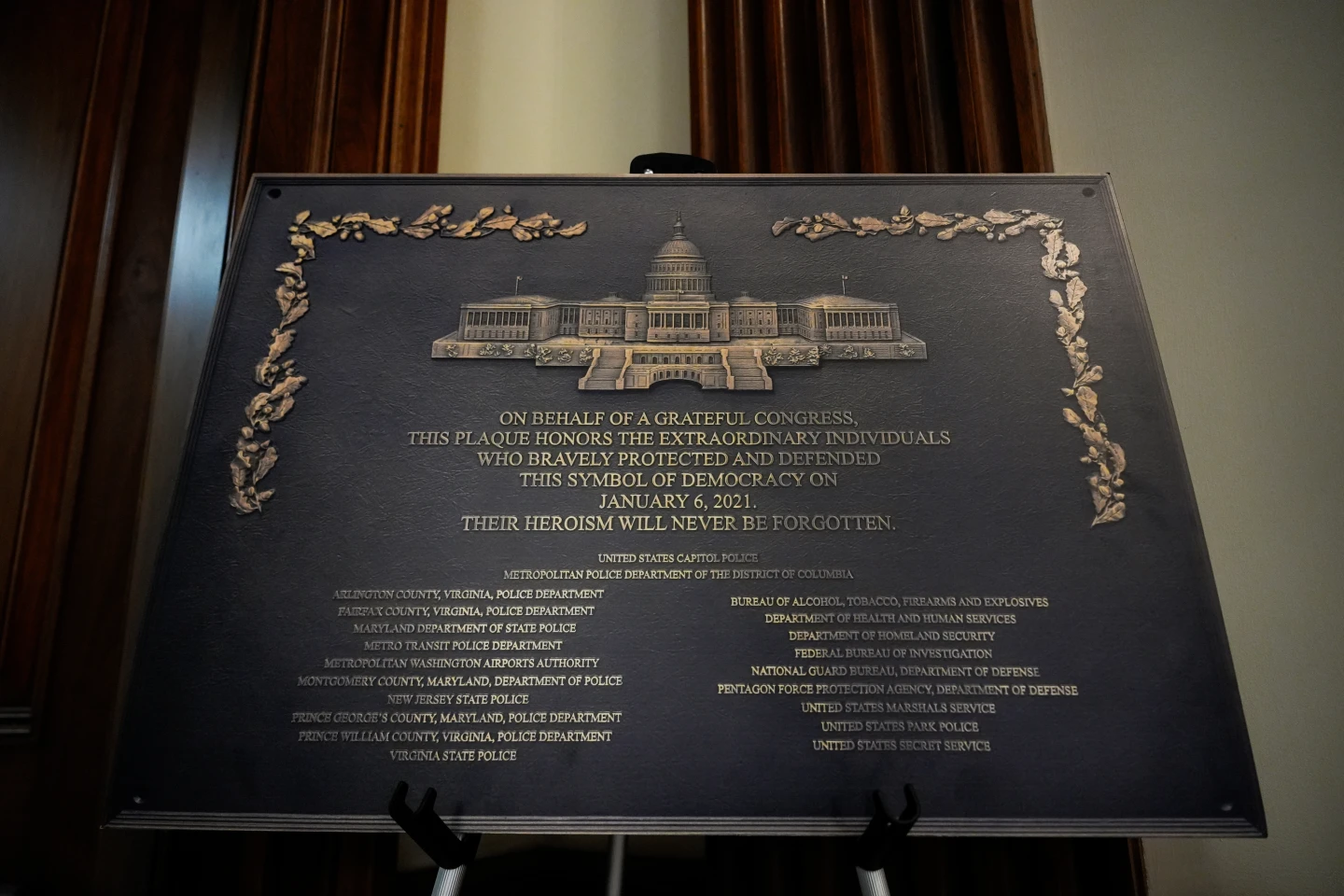
Approaching the fifth anniversary of the Jan. 6, 2021, attack on the Capitol, the official plaque honoring the police who defended democracy that day is nowhere to be found.

It’s not on display at the Capitol, as is required by law. Its whereabouts aren’t publicly known, though it’s believed to be in storage.

House Speaker Mike Johnson, a Louisiana Republican, has yet to formally unveil the plaque. And the Trump administration’s Department of Justice is seeking to dismiss a police officers’ lawsuit asking that it be displayed as intended. The Architect of the Capitol, which was responsible for obtaining and displaying the plaque, said in light of the federal litigation, it cannot comment.

A replica plaque commemorating the Jan. 6, 2021 Capitol riot hangs outside the office of Speaker Emerita Nancy Pelosi, D-Calif., Tuesday, Dec. 30, 2025, at the Longworth House Office Building on Capitol Hill in Washington. (AP Photo/Julia Demaree Nikhinson)

Determined to preserve the nation’s history, some 100 members of Congress, mostly Democrats, have taken it upon themselves to memorialize the moment. For months, they’ve mounted poster board-style replicas of the Jan. 6 plaque outside their office doors, resulting in a Capitol complex awash with makeshift remembrances.

“On behalf of a grateful Congress, this plaque honors the extraordinary individuals who bravely protected and defended this symbol of democracy on Jan. 6, 2021,” reads the faux bronze stand-in for the real thing. “Their heroism will never be forgotten.”

Jan. 6 void in the Capitol

In Washington, a capital city lined with monuments to the nation’s history, the plaque was intended to become a simple but permanent marker, situated near the Capitol’s west front, where some of the most violent fighting took place as rioters breached the building.

But in its absence, the missing plaque makes way for something else entirely — a culture of forgetting.

Visitors can pass through the Capitol without any formal reminder of what happened that day, when a mob of President Donald Trump’s supporters stormed the building trying to overturn the Republican’s 2020 reelection defeat to Democrat Joe Biden. With memory left unchecked, it allows new narratives to swirl and revised histories to take hold.

Five years ago, the jarring scene watched the world over was declared an “insurrection” by the then-GOP leader of the Senate, while the House GOP leader at the time called it his “saddest day” in Congress. But those condemnations have faded.

Trump calls it a “day of love.” And Johnson, who was among those lawmakers challenging the 2020 election results, is now the House Speaker.

“The question of January 6 remains – democracy was on the guillotine — how important is that event in the overall sweep of 21st century U.S. history,” said Douglas Brinkley, a professor of history at Rice University and noted scholar.

“Will January 6 be seen as the seminal moment when democracy was in peril?” he asked. Or will it be remembered as “kind of a weird one-off?”

“There’s not as much consensus on that as one would have thought on the fifth anniversary,” he said.

Memories shift but violent legacy lingers

At least five people died in the riot and its aftermath, including Trump supporter Ashli Babbitt, who was fatally shot by police while trying to climb through a window toward the House chamber. More than 140 law enforcement officers were wounded, some gravely, and several died later, some by suicide.

All told, some 1,500 people were charged in the Capitol attack, among the largest federal prosecutions in the nation’s history. When Trump returned to power in January 2025, he pardoned all of them within hours of taking office.

Unlike the twin light beams that commemorated the Sept. 11, 2001, attack or the stand-alone chairs at the Oklahoma City bombing site memorial, the failure to recognize Jan. 6 has left a gap not only in memory but in helping to stitch the country back together.

“That’s why you put up a plaque,” said Rep. Mary Gay Scanlon, a Pennsylvania Democrat. “You respect the memory and the service of the people involved.”

Police sued, DOJ seeks to dismiss

The Speaker’s office said in a statement late Monday the statute authorizing the plaque is “not implementable” and proposed alternatives also “do not comply.” Johnson’s spokesman said if Democrats are serious about commemorating the police, they’re free to work with the appropriate committees to develop a framework for proper vetting and consideration.

Lawmakers approved the plaque in March 2022 as part of a broader government funding package. The resolution said the U.S. “owes its deepest gratitude to those officers,” and it set out instructions for an honorific plaque listing the names of officers “who responded to the violence that occurred.” It gave a one-year deadline for installation at the Capitol.

This summer, two officers who fought the mob that day sued over the delay.

“By refusing to follow the law and honor officers as it is required to do, Congress encourages this rewriting of history,” said the claim by officers Harry Dunn and Daniel Hodges. “It suggests that the officers are not worthy of being recognized, because Congress refuses to recognize them.”

The Justice Department is seeking to have the case dismissed. U.S. Attorney Jeanine Pirro and others argued Congress “already has publicly recognized the service of law enforcement personnel” by approving the plaque and displaying it wouldn’t alleviate the problems they claim to face from their work.

“It is implausible,” the Justice Department attorneys wrote, to suggest installation of the plaque “would stop the alleged death threats they claim to have been receiving.”

The department also said the plaque is required to include the names of “all law enforcement officers” involved in the response that day — some 3,600 people.

Makeshift memorials emerge

Lawmakers who’ve installed replicas of the plaque outside their offices said it’s important for the public to know what happened.

“There are new generations of people who are just growing up now who don’t understand how close we came to losing our democracy on Jan 6, 2021,” said Rep. Jamie Raskin, a Maryland Democrat, a member of the Jan. 6 committee, which was opposed by GOP leadership but nevertheless issued a nearly 1,000-page report investigating the run-up to the attack and the attempt to overturn the 2020 election.

Raskin envisions the Capitol one day holding tours around what happened. “People need to study that as an essential part of American history,” he said.

“Think about the dates in American history that we know only by the dates: There’s the 4th of July. There’s December 7th. There’s 9/11. And there’s January 6th,” said Rep. Zoe Lofgren, a California Democrat, who also served on the committee and has a plaque outside her office.

“They really saved my life, and they saved the democracy and they deserve to be thanked for it,” she said.

But as time passes, there are no longer bipartisan memorial services for Jan. 6. On Tuesday, the Democrats will reconvene members from the Jan. 6 committee for a hearing to “examine ongoing threats to free and fair elections,” House Democratic Leader Hakeem Jeffries of New York announced. It’s unlikely Republicans will participate.

The Republicans under Johnson have tapped Rep. Barry Loudermilk of Georgia to stand up their own special committee to uncover what the speaker calls the “full truth” of what happened. They’re planning a hearing this month.

“We should stop this silliness of trying to whitewash history — it’s not going to happen,” said Rep. Joe Morelle, a New York Democrat, who helped lead the effort to display the replica plaques.

“I was here that day so I’ll never forget,” he said. “I think that Americans will not forget what happened.”

The number of makeshift plaques that fill the halls is a testimony to that remembrance, he said.

Instead of one plaque, he said, they’ve “now got 100.”

___

Republished with permission of The Associated Press.


Source link

Continue Reading

Politics

Gov. DeSantis awards $168M to rural communities for infrastructure improvements

Published

on


The state is giving nearly $168 million to small and rural counties, primarily to improve infrastructure in areas hit hard by hurricanes last year, Gov. Ron DeSantis said.

One of the biggest winners was Taylor County in the Big Bend region, which will receive $36 million out of the Community Development Block Grant Disaster Recovery and the Rural Infrastructure Fund. Taylor will get $4.9 million for a special needs ceremony, the Governor highlighted.

The city of Perry in Taylor County, will receive $12 million for a new parallel treatment train, $8.5 million to replace current wastewater infrastructure, and $4.5 million to create an independent water source, according to DeSantis.

Meanwhile Doctors’ Memorial Hospital in Perry will receive $4.4 million to install a facility emergency power system, replace the phone and communication system and modernize the facility’s water treatment system.

“All these different things, huge for Perry, Taylor County Commissioners,” DeSantis said.

Cross City will get $32 million to build a new waste water treatment plant and another $5.7 million to upgrade stormwater drains.

The Governor said $7.3 million is earmarked to construct and harden the Cedar Key Water and Sewer District potable water system, while $4.5 million is for the Big Bend Water Authority to repair and replace critical water mains in Steinhatchee

Other grants ranged from $100,000 up to a few million dollars.

“Every single one of these grants is a partnership and a relationship with a community, if not several partners in that community,” FloridaCommerce Secretary Alex Kelly said while speaking next to DeSantis.

DeSantis joked that he was awarding so many grants, it was impossible for him to bring his giant ceremonial mock checks that he normally hands out at press ceremonies.

“There’s too many awards,” DeSantis said. “I’d be taking pictures until dinnertime. I can’t, I’ve got to get back. I’ve got meetings.”

At Wednesday’s press conference, DeSantis made splashier political news by announcing he plans to call an April Special Session on congressional reapportionment. DeSantis also teased another Special Session focused on eliminating property taxes.


Source link

Continue Reading

Politics

Canadians are getting jitters about owning property in Florida and other states

Published

on


Many Canadians are considering selling Florida homes, while fewer are looking to buy in the U.S.

Canadian snowbirds have long owned property throughout the Sunshine State. But two prominent real estate analysis firms say more Canadians are looking to sell their properties in the U.S. due to growing tensions between the countries.

Royal LePage and Realtor.com have released new analyses showing the trend. Royal LePage recently concluded a study that showed 54% of Canadians who currently own residential property in America say they’re planning to sell those homes within the next year. Out of those, 62% say President Donald Trump’s administration is the main reason they are looking to sell.

Phil Soper, President and CEO of Royal LePage, said perceived antagonism from the U.S. is contributing to Canadians souring on owning property in the U.S.

“The polarizing political climate in the United States is prompting many Canadians to reconsider how and where they spend their time and money. Canadians have been the most important foreign investors in America’s residential real estate market for years, and a significant wave of property sales would leave a noticeable mark on the regional economies that snowbirds support,” Soper said.

“Places like Florida, Arizona and California stand to lose millions in economic activity each year — and thousands of neighbors — if Canadian owners pull their capital from U.S. housing markets.”

Realtor.com analysts say trade tariffs imposed by Trump’s administration have directly impacted Canadians who own U.S. property. Data from the real estate company indicates that Canadians looking for U.S. property declined 4.5% from the third quarter of 2024 when compared to the same time frame in 2025.

“This retreat coincided with the period during which the U.S. imposed a series of tariffs on Canadian goods, sharply adjusting prior trade relations with the neighbor to the North,” said Realtor.com economist Jiayi Xu.


Source link

Continue Reading

Politics

Marco Rubio offers threefold plan for future of Venezuela, including release of political prisoners

Published

on


Secretary of State Marco Rubio is laying out a “threefold process” to make Venezuela’s government secure going forward.

He spoke to press after detailing the plan to Congress, and as Florida lawmakers call for the release of political prisoners incarcerated under deposed President Nicolás Maduro.

“Step one is the stabilization of the country. We don’t want it descending into chaos,” Rubio told press after briefing lawmakers. “Part of that stabilization, and the reason why we understand and believe that we have the strongest leverage possible, is our quarantine.”

Even before Maduro was arrested in an overnight raid last weekend, the U.S. ordered a quarantine of all oil being shipped out of Venezuela in violation of sanctions, as reported by Reuters. U.S. Southern Command on Wednesday morning announced the capture of a Venezuelan tanker in the Caribbean by the U.S. Coast Guard. Rubio announced another ship was also captured the same day.

Rubio said the U.S. will control the flow of the crude now.

“We are in the midst right now, and in fact, about to execute on a deal to take all the oil. They have oil that is stuck in Venezuela,” Rubio said. “They can’t move it because of our quarantine and because it’s sanctioned. We are going to take between 30 and 50 million barrels of oil. We’re going to sell it in the marketplace at market rates, not at the discounts Venezuela was getting.”

He said under U.S. control, the profits will be disbursed in a way that benefits the Venezuelan people, not the Maduro regime. On the horizon, Rubio wants to see a return to legitimate economic activity.

“The second phase will be a phase that we call recovery, and that is ensuring that American, western and other companies have access to the Venezuela market in a way that’s fair,” he said.

He also wants to “begin to create the process of reconciliation nationally within Venezuela, so that the opposition forces can be amnestied and released and from prisons or brought back to the country, and begin to rebuild civil society.”

That is an especially important goal to several lawmakers in Florida, a state home to 49% of Venezuelans living in the U.S.

U.S. Rep. María Elvira Salazar, a Coral Gables Republican, posted messages on social media several times on Wednesday demanding Venezuela Interim President Delcy Rodríguez release individuals from custody.

“For decades, the Venezuelan regime has imprisoned, tortured and disappeared dissidents. From (Hugo) Chávez to Maduro, political prisoners have been used as weapons of terror to silence an entire nation,” Salazar posted on X.

“Delcy Rodríguez must FREE all political prisoners IMMEDIATELY. The United States will not stand idly by while the Venezuelan regime continues to imprison and torture innocent people. FREE THEM ALL. NOW.”

Rubio said the final phase in Venezuela will be a transition, which could overlap with reconciliation and recovery.

He said operational details of current efforts in Venezuela could not be discussed for “obvious” reasons related to national security.


Source link

Continue Reading

Trending

Copyright © Miami Select.