
Business
This is how Scott Kupor plans to handle the elimination of more federal jobs

It was December 16, 2024 when Scott Kupor, the former managing partner at venture capital juggernaut Andreessen Horowitz, arrived at Mar-a-Lago to meet with Donald Trump and his chief of staff, Susie Wiles, for his interview for a director role in the White House.
Kupor—who had been introduced to transition team co-chair Howard Lutnick via his longtime venture capital bosses, Marc Andreessen and Ben Horowitz—arrived at Trump’s Palm Beach estate just as the infamous billionaire Japanese investor Masayoshi Son was wrapping up a press conference with Trump, where Son pledged to pour $100 billion into the American economy.
Kupor sat through the briefing, then snapped a photo of Son—whom he had never met before—as Son posed in front of the lectern. In an interview with Fortune in August, Kupor laughed as he recounted it: “I’m a short guy. He was even shorter than I,” says Kupor, who says he is 5’5” tall “on a good day” when he isn’t sporting his cowboy boots for an extra inch of height. Later, Kupor was ushered into a ballroom where his interview was repeatedly pushed back for five hours, apparently so the President-Elect could work on a TikTok deal as the impending ban that same day approached.
“It was a lot of sitting around in an empty ballroom in Mar-a-Lago on my phone, trying to keep myself occupied,” Kupor recounts. “It was well worth waiting for, for sure.”
Kupor was officially sworn-in as director of the Office of Personnel Management (OPM) in July, where the venture capital operator is now overseeing the independent agency of the U.S. government that handles human resources policy, personnel oversight, and administration of key employee benefits, among other things. While not historically a very exciting or newsworthy White House agency, the OPM has, under President Trump, been at the forefront of one of the largest-scale federal labor cost-cutting efforts in modern U.S. history.
Kupor’s Senate confirmation hearing, which took place in April, became contentious at times, as Democratic Senators pelted him with questions, trying to get him to comment on the rapid-fire and chaotic cost-slashing effort across Washington, D.C. that preceded him. After all, OPM—once a little-known agency—had played a central role as Elon Musk, with Trump’s blessing, took it upon himself to try to address the U.S. government’s multi-trillion-dollar deficit and terminate tens of thousands of workers at agencies like the Department of Veterans Affairs, Department of Education, Department of Energy, and Department of Homeland Security; or attempted to disband agencies such as USAID or the Consumer Financial Protection Bureau. Dozens of lawsuits attempting to block DOGE’s cuts have been filed and are still playing out in court.
Anna Moneymaker/Getty Image
Musk is no longer in the White House following his public fallout with the President, and according to Kupor, DOGE is effectively no longer operational as its own entity.
“DOGE—as a coalesced, centralized organization—at least from my perspective, it doesn’t exist in that form anymore,” Kupor said.
Still, the cost-cutting efforts are far from over and “efficiency” across the federal government continues to be a Trump Administration priority—and one that Kupor is now instrumental in seeing through. OPM, Kupor says, is part of the “implementation” or “institutionalization” of the efforts that Musk’s org had started. While the approach Kupor plans to take will likely look rather different than the first six months of Trump’s Administration—putting a kinder, gentler, and less controversial face to the job—Americans can still expect that the cuts will be sweeping.
That puts the 53-year-old VC in the starring role of a fascinating real-time test case for the MAGA program: Can a level-headed operator not encumbered by his predecessor’s need for chaos and provocation, demonstrate that deep workforce reductions and reforms can actually produce a more efficient government? Or will he prove to simply be nicer packaging for a bad policy—effective at carrying out the DOGE mission without all the intense backlash, but ultimately leaving Americans with a shoddier outcome?
Kupor clearly believes the former. “You have to find ways to rebuild trust, and the way you rebuild trust, in my mind, is, number one: You actually treat with respect the people who are walking out the door,” Kupor told Fortune.
In with the cowboy boots, out with the chain saws
In true venture capital fashion, one of Kupor’s first orders of business at OPM was to start a blog, where he writes frequent missives about his thoughts on the federal deficit, discusses U.S. political history, or cites the legendary late investor Charlie Munger. As you might expect, Kupor eventually plans to launch a podcast, too.
But the Houston, Tex. native, who has a cheerful and casual flair, dresses in cowboy boots, and is quick to respond to an email, is candid about the bigger changes he has in mind. Shortly after he took the role, Kupor announced he expected a total of 300,000 federal roles would be eliminated by the end of 2025. While there are no firm figures just yet, some tallies have estimated that only more than 50,000—or some 17% of those roles—have already been cut, suggesting that there is much more ahead. As we spoke, Kupor emphasized that about 90% of the cuts that have already taken place have been either deferred resignations, standard resignations, early retirement, or buyouts, versus pure layoffs: And he says that, moving forward, the “vast majority” of people no longer employed by the U.S. government will be people who decided to leave of their own accord.

SAUL LOEB/AFP via Getty Images
While Musk gleefully whipped around a chainsaw at the Conservative Political Action Conference and demanded federal workers prove in an email that they were productive to their managers, Kupor describes a more sensitive approach. “You have to know that you’re being judged by the people who are staying in the organization about how you do this,” he says of layoffs and deferred resignations. “And so do you go hide in your desk, in your corner, and don’t tell them about it? Or do you bad-mouth people once they leave? Everybody’s watching your behavior to see how you conduct yourself.”
In one early sign of course correcting, Kupor says that many of the federal agencies that OPM’s 250-person consulting team works with are taking a fresh look at their staffing plans to account for greater-than-expected attrition from deferred resignations. “A lot of people are going through and revisiting,” he said.
Within OPM itself, Kupor says his team is evaluating whether there were areas that “we cut too deep” during the layoffs or whether there were special skills that people had that were lost. Approximately 1,000 people—or 33% of its workforce—will no longer be with OPM by the end of the year, he said.
Still, in a display of the diplomacy necessary for navigating Silicon Valley’s fraught terrain of founders, frenemies, and big egos, Kupor wouldn’t comment on Musk or DOGE’s approach before he arrived at OPM. “I don’t know all the ins and outs of decisions that were made on how they did stuff in those first several months when I wasn’t here. And so, look, I just think it’s not constructive for me to try to Monday morning quarterback that,” he said.
Andreessen Horowitz’s ‘very first hire’
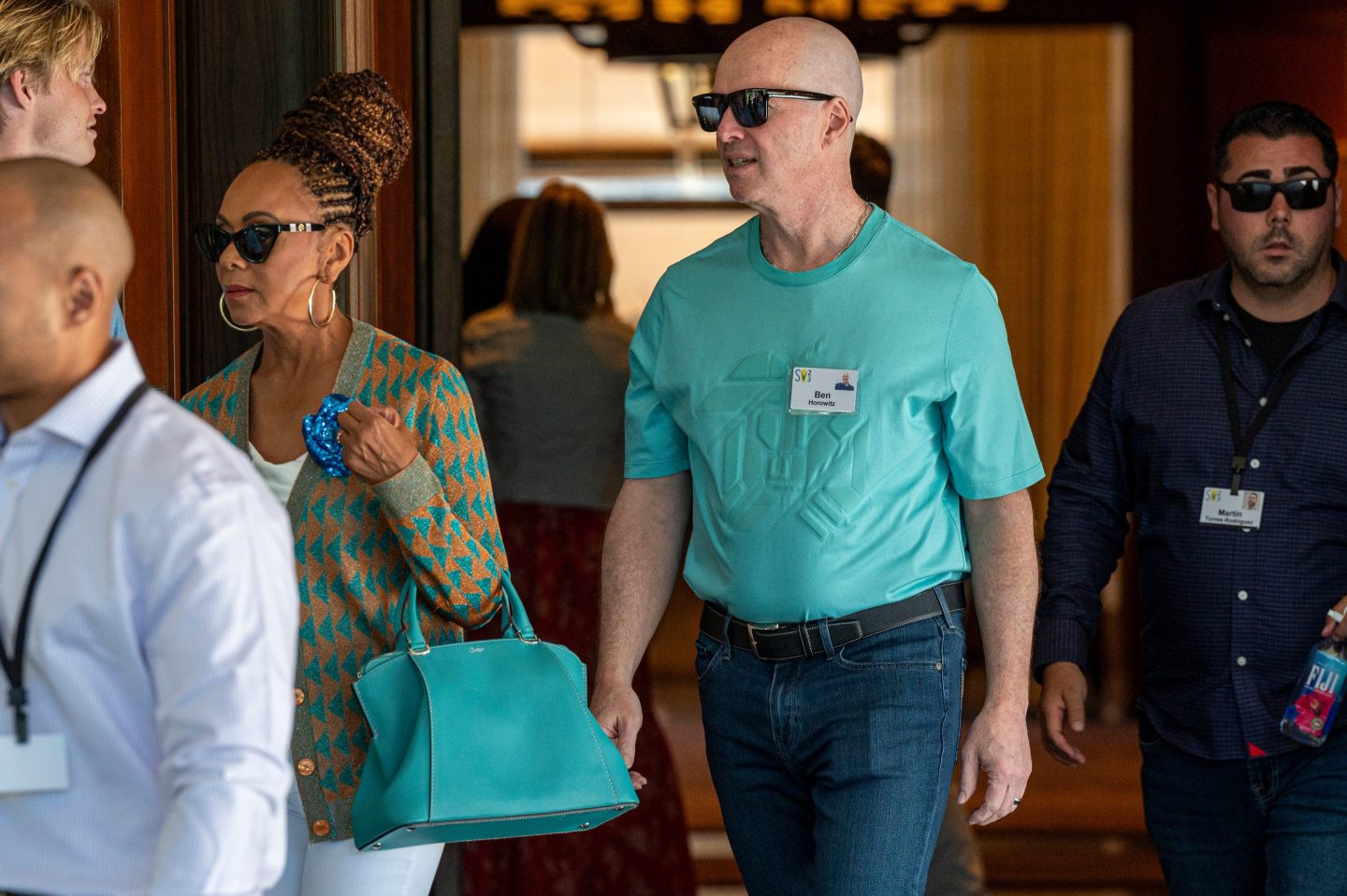
Kupor had spent the last couple decades in venture capital and tech before joining OPM. He was the first hire of Marc Andreessen and Ben Horowitz in 2009, right around the time they set up their storied venture capital firm. And he had worked with them a decade previously at Loudcloud, Opsware, and HP.
“He was our very first hire at a16z, because he is the best executive that we’ve worked with. He’s super smart, detail-oriented, great culturally, and the hardest working man in the business,” Horowitz told Fortune in an email, noting that Kupor’s leadership will translate “extremely well” into government and that “his tireless energy will enable him to crack through the bureaucracy and enable people to do their best work.”
After being sworn in as OPM Director this summer, Kupor became one of several prominent Silicon Valley investors and entrepreneurs to join the Trump administration, alongside Craft Ventures’ David Sacks, who is the AI and Crypto Czar; Senior White House AI policy advisor Sriram Krishnan, who also previously worked at a16z; and Gregory Barbaccia, a former Palantir employee who is now Federal Chief Information Officer at the Office of Management and Budget.
David Paul Morris/Bloomberg via Getty Images
Kupor’s decision to step into public service may seem in and of itself a bit puzzling. Joining the U.S. government meant stepping away from one of the most reputable jobs in venture capital, forfeiting carried interest in several of its funds, divesting from companies like Microsoft and Apple and Lockheed Martin, and resigning from boards of companies he had advised. More than that, it means succumbing oneself to intense public scrutiny and freedom of information.
For Kupor, he makes it out as a natural fit. He was a public policy major at Stanford University, where he worked on behalf of the Japanese government at a policy institute during undergrad and law school and later worked as an intern for a health care policy advisor during the George H. W. Bush Administration, the late Gail Wilensky. For a time, Kupor served as chair of the National Venture Capital Association, a trade association that lobbies Washington for the interests of private market investors, and he also did crypto and capital markets-related policy work at a16z.
“I always thought I wanted to do something at some point in government service. Life got in the way,” Kupor said later, noting that “everything sort of came together to make this role a reality.”
Kupor has never supported any candidates financially, but he says he has always been a fiscal conservative, and “probably a libertarian in many ways” when it comes to other issues. He pointed out that he was part of a group of students that sued Stanford University in 1995, successfully arguing that the university’s speech code, which restricted “insulting speech,” violated the first amendment. While Andreessen and Horowitz surprised Silicon Valley by announcing their firm’s endorsement of Trump last year, Kupor said his political leanings have “never really changed.”
A16z might have much to gain by having a former top partner in the White House. Horowitz and Andreessen said in a widely-viewed video last year that the Biden Administration had not been accessible. Kupor’s seat in the Cabinet surely helps with some of that access, or may put some of their portfolio companies in better positions to win government contracts.
When I followed up with Kupor about conflicts of interest, he said he doesn’t see any, as he is not in a policy position that has influence over the matters a16z is interested in, and that he “specifically wanted to take a role that was focused on very different things.”
“I don’t see any conflict in what I am doing,” he said. “As an American, I believe that tech and entrepreneurship are key to our ongoing economic strength, national security and sovereignty… My role at OPM is simply to ensure that the government can attract and retain the very best people to work efficiently on behalf of the American taxpayer.”
When asked for comment, an a16z spokeswoman said there were no conflicts of interest.
This is not venture capital
Since being named as director, Kupor has been focused on performance management and hiring—two areas he cites as priorities of President Trump that came up during his initial interview—as well as trying to find areas where technology could make federal workers more efficient.
Heidi Gutman/CNBC/NBCU Photo Bank/NBCUniversal via Getty Images
In the last few weeks, OPM issued a rule change that eliminates categorization requirements from agency hiring processes and, as was required from one of President Trump’s first executive orders, eliminated diversity, equity, and inclusion hiring requirements for senior executive hiring. Kupor has also publicly raised concerns about other areas he has been looking at, though he has yet to issue any formal rulemaking. Those include his opinions about there being too many senior level managers getting outstanding performance reviews—a system, he wrote, that does “not encourage excellence” or allow the heads of various agencies to determine who truly deserves a performance reward—or his concerns about potentially “excessive” administrative costs from the government’s “Combined Federal Campaign,” which allow federal workers to donate to charities of their choosing, saying he is considering whether to discontinue the program altogether.
Some of the changes Kupor hopes to make are more cultural, he says. He wants to see federal workers experimenting with different technologies and tools. For example, Kupor said he hopes to roll out an AI tool to help rulemaking committees parse through public comments for new rule proposals and respond to them.
“We have teams of people who are literally manually reading all those things, drafting responses. I saw one response that was literally 80 pages long to one comment. It doesn’t take that much imagination to imagine: There’s probably ways where AI can increase the efficiency.”
Kupor’s approach to the role is undeniably influenced by his background in tech—espeically in the way he talks about the federal government’s approach to risk.
“There’s just such a culture here of such risk aversion, and I understand why it is, but we got to just fight against that,” Kupor said. He added: “It’s a cultural change as much as it is a learning and a technological change. And look, I’m highly confident we’ll get there, but it does require kind of a reset on people’s willingness to take some level of risk.”
But Kupor also emphasizes in our conversation that he understands government is not the private sector.
“This is not venture capital—so we’re not going to shoot-for-the-moon risk. But we can afford to take some risk on things…Where maybe the payoff is we get a five or ten percent increase in efficiency. That would be awesome. I’d take that any day.”