Connect with us

Business

This CEO laid off nearly 80% of his staff because they refused to adopt AI fast enough. 2 years later, he says he’d do it again
Published

on


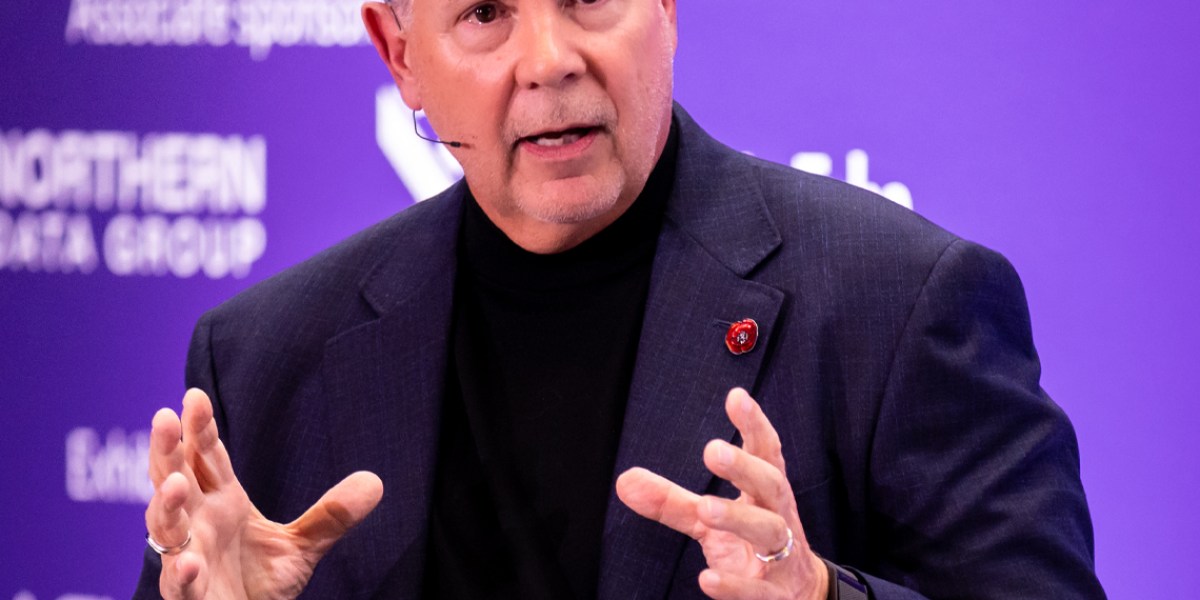
Eric Vaughan, CEO of enterprise-software powerhouse IgniteTech, is unwavering as he reflects on the most radical decision of his decades-long career. In early 2023, convinced that generative AI was an “existential” transformation, Vaughan looked at his team and saw a workforce not fully on board. His ultimate response: He ripped the company down to the studs, replacing nearly 80% of staff within a year, according to headcount figures reviewed by Fortune.

Over the course of 2023 and into the first quarter of 2024, Vaughan said IgniteTech replaced hundreds of employees, declining to disclose a specific number. “That was not our goal,” he told Fortune. “It was extremely difficult … But changing minds was harder than adding skills.” It was, by any measure, a brutal reckoning—but Vaughan insists it was necessary, and says he’d do it again.

For Vaughan, the writing on the wall was clear and dramatic. “In early 2023, we saw the light,” he told Fortune in an interview, adding that he believed every tech company was facing a crucial inflection point around adoption of artificial intelligence. “Now I’ve certainly morphed to believe that this is every company, and I mean that literally every company, is facing an existential threat by this transformation.”

Where others saw promise, Vaughan saw urgency—believing that failing to get ahead on AI could doom even the most robust business. He called an all-hands meeting with his global, remote team. Gone were the comfortable routines and quarterly goals. Instead, his message was direct: Everything would now revolve around AI. “We’re going to give a gift to each of you. And that gift is tremendous investment of time, tools, education, projects … to give you a new skill,” he explained. The company began reimbursing for AI tools and prompt engineering classes, and even brought in outside experts to evangelize.

“Every single Monday was called ‘AI Monday,’” Vaughan said, with his mandate for staff that they could only work on AI. “You couldn’t have customer calls, you couldn’t work on budgets, you had to only work on AI projects.” He said this happened across the board, not just for tech workers, but also for sales, marketing, and everybody at IgniteTech. “That culture needed to be built. That was… that was the key.”

This was a major investment, he added: 20% of payroll was dedicated to a mass-learning initiative, and it failed because of mass resistance, even sabotage. Belief, Vaughan discovered, is a hard thing to manufacture. “In those early days, we did get resistance, we got flat-out, ‘Yeah, I’m not going to do this’ resistance. And so we said goodbye to those people.”

The pushback: Why didn’t they get on board?

Vaughan was surprised to find it was often the technical staff, not marketing or sales, who dug in their heels. They were the “most resistant,” he said, voicing various concerns about what the AI couldn’t do, rather than focusing on what it could. The marketing and salespeople were enthused by the possibilities of working with these new tools, he added.

This friction is borne out by broader research. According to the 2025 enterprise AI adoption report by WRITER, an AI platform that specifically helps enterprise clients with AI integration, one in three workers say they’ve “actively sabotaged” their company’s AI rollout—a number that jumps to 41% of millennial and Gen Z employees. This can take the form of refusing to use AI tools, intentionally generating low-quality outputs, or avoiding training altogether. Many act out due to fears that AI will replace their jobs, while others are frustrated by lackluster AI tools or unclear strategy from leadership.

WRITER’s Chief Strategy Officer Kevin Chung told Fortune the “big eye-opening thing” from this survey was the human element of AI resistance. “This sabotage isn’t because they’re afraid of the technology … It’s more like there’s so much pressure to get it right, and then when you’re handed something that doesn’t work, you get frustrated.” He added that WRITER’s research shows that workers often don’t trust where their organizations are headed. “When you’re handed something that isn’t quite what you want, it’s very frustrating, so the sabotage kicks in, because then people are like, ‘Okay, I’m going to run my own thing. I’m going to go figure it out myself.’” You definitely don’t want this kind of “shadow IT” in an organization, he added.

Vaughan says he didn’t want to force anyone. “You can’t compel people to change, especially if they don’t believe.” He added that belief was really the thing he needed to recruit for. Company leadership ultimately realized they’d have to launch a massive recruiting effort for what became known as “AI Innovation Specialists.” This applied across the board, to sales, finance. marketing, everywhere. Vaughan said this time was “really difficult” as things inside the company were “upside down … We didn’t really quite know where we were or who we were yet.”

A couple key hires helped, starting with the person who became IgniteTech’s chief AI officer, Thibault Bridel-Bertomeu. That led to a full reorganization of the company that Vaughan called “somewhat unusual.” Essentially, every division now reports into the AI organization, regardless of domain.

This centralization, Vaughan says, prevented duplication of efforts and maximized knowledge sharing—a common struggle in AI adoption, where WRITER’s survey shows 71% of the C-suite at other companies say AI applications are being created in silos and nearly half report their employees left to “figure generative AI out on their own.”

No pain, no gain?

In exchange for this difficult transformation, IgniteTech reaped extraordinary results. By the end of 2024, the company had launched two patent-pending AI solutions, including a platform for AI-based email automation (Eloquens AI), with a radically rebuilt team.

Financially, IgniteTech remained strong. Vaughan disclosed that the company, which he said is in the nine-figure revenue range, finished 2024 at “near 75% EBITDA”—all while completing a major acquisition, Khoros. “You multiply people … give people the ability to multiply themselves and do things at a pace,” he said, touting the company’s ability to build new customer-ready products in as little as four days—an unthinkable timeline in the old regime.

What does Vaughan’s story say for others? On one level, it’s a case study in the pain and payoff of radical change management. But his ruthless approach arguably addresses many challenges identified in the WRITER survey: lack of strategy and investment, misalignment between IT and business, and the failure to engage champions who can unlock AI’s benefits.

The ‘boy who cried wolf’ problem

To be sure, IgniteTech is far from alone in wrestling with these challenges. Joshua Wöhle is the CEO of Mindstone, a firm similar to WRITER that provides AI upskilling services to workforces, training hundreds of employees monthly at companies including Lufthansa, Hyatt, and NBA teams. He recently discussed the two approaches described by Vaughan—upskilling and mass replacement—in an appearance on BBC Business Today.

Wöhle contrasted the recent examples of Ikea and Klarna, arguing the former’s example shows why it’s better to “reskill” existing employees. Klarna, a Swedish buy-now pay-later firm, drew considerable publicity for a decision to reduce members of its customer support staff in a pivot to AI, only to rehire for the same roles. “We’re near the point where [AI is] more intelligent than most people doing knowledge work. But that’s precisely why augmentation beats automation,” Wöhle wrote on LinkedIn.

A representative for Klarna told Fortune the company did not lay off employees, but has instead adopted several approaches to its customer service, which is managed by outsourced customer-service providers who are paid according to the volume of work required. The launch of an AI customer-service assistant reduced the workload by the equivalent of 700 full-time agents—from roughly 3,000 to 2,300—and the third-party providers redeployed those 700 workers to other clients, according to Klarna. Now that the AI customer service agent is “handling more complex queries than when we launched,” Klarna says, that number has fallen to 2,200. Klarna says its contractor has rehired just two people in a pilot program designed to combine highly trained human support staff with AI to deliver outstanding customer service. 

In an interview with Fortune, Wöhle said one client of his has been very blunt with his workers, ordering them to dedicate all Fridays to AI retraining, and if they didn’t report back on any of their work, they were invited to leave the company. He said it can be “kinder” to dismiss workers who are resistant to AI: “The pace of change is so fast that it’s the kinder thing to force people through it.” He added that he used to think that if he got all workers to really love learning, then that could help Mindstone make a real difference, but he discovered after training literally thousands of people that “most people hate learning. They’d avoid it if they can.”

Wöhle attributed much of the AI resistance in the workforce to a “boy who cried wolf” problem from the tech sector, citing NFTs and blockchain as technologies that were billed as revolutionary but “didn’t have the real effect” that tech leaders promised. “You can’t really blame them” for resisting, he said. Most people “get stuck because they think from their work flow first,” he added, and they conclude AI is overhyped because they want AI to fit into their old way of working. “It takes a lot more thinking and a lot more kind of prodding for you to change the way that you work,” but once you do, you see dramatic increases. A human can’t possibly keep five call transcripts in their head while you’re trying to write a proposal to a client, he offers, but AI can.

Ikea echoed Wöhle when reached for comment, saying that its “people-first AI approach focuses on augmentation, not automation.” A spokesperson said Ikea is using AI to automate tasks, not jobs, freeing up time for value-added, human-centric work.

The WRITER report notes that companies with formal AI strategies are far more likely to succeed, and those who heavily invest in AI outperform their peers by a large margin. But, as Vaughan’s experience shows, investment without belief and buy-in can be wasted energy. “The culture needed to be built. Ultimately, we ended up having to go out and recruit and hire people that were already of the same mind. Changing minds was harder than adding skills.”

For Vaughan, there’s no ambiguity. Would he do it again? He doesn’t hesitate: He’d rather endure months of pain and build a new, AI-driven foundation from scratch than let an organization drift into irrelevance. “This is not a tech change. It is a cultural change, and it is a business change.” He said he doesn’t recommend that others follow his lead and swap out 80% of their staff. “I do not recommend that at all. That was not our goal. It was extremely difficult.” But at the end of the day, he added, everybody’s got to be in the same boat, rowing in the same direction. Otherwise, “we don’t get where we’re going.”


Source link

Continue Reading

Business

Paramount launches WBD hostile bid that includes Trump son-in-law Jared Kushner

Published

on


In a separate regulatory filing, Paramount disclosed that Affinity Partners, the private equity firm led by Jared Kushner, is part of the bid. It added that sovereign wealth funds from Saudi Arabia, Abu Dhabi, and Qatar are also participating.

Affinity and the other outside financing partners have agreed to forgo any governance rights, which Paramount said means the Committee on Foreign Investment in the United States would have no jurisdiction over the transaction. Meanwhile, Chinese tech conglomerate Tencent is no longer a partner.

The offer comes after Paramount lost out in the bidding war for the assets last week to Netflix, which made a cash-and-stock deal worth $27.75 per share. Paramount’s proposed transaction is for the entirety of WBD, including the Global Networks segment, while Netflix’s deal is for the studio and HBO Max.

Paramount argued its offer to WBD shareholders provides a superior alternative to the Netflix transaction, which offers “inferior and uncertain value and exposes WBD shareholders to a protracted multi-jurisdictional regulatory clearance process with an uncertain outcome,” referring to the likely antitrust concerns for Netflix’s megadeal.

At the Kennedy Center over the weekend, President Donald Trump partially confirmed reporting from Bloomberg’s Lucas Shaw about his private conversations with Netflix co-CEO Ted Sarandos, saying they had met in the Oval Office before Netflix announced its winning bid, while adding that its combined market share with WBD could be an antitrust concern.

Paramount argued that WBD’s recommendation of the Netflix offer is based on an “illusory prospective valuation of Global Networks that is unsupported by the business fundamentals” and encumbered by high levels of financial leverage assigned to the entity. Netflix’s offer would assume $11 billion of debt and involve a $59 billion bridge loan, which Bloomberg reported was among the highest ever.

David Ellison, chairman and CEO of Paramount, said: “WBD shareholders deserve an opportunity to consider our superior all-cash offer for their shares in the entire company.”

Paramount, which earlier sent a letter to WBD CEO David Zaslav complaining of a “tainted” sale process, further asserted today that although Paramount made six offers for WBD over 12 weeks, “WBD never engaged meaningfully with these proposals, which we believe deliver the best outcome for WBD shareholders.

“We believe our offer will create a stronger Hollywood. It is in the best interests of the creative community, consumers, and the movie theater industry. We believe they will benefit from the enhanced competition, higher content spend and theatrical release output, and a greater number of movies in theaters as a result of our proposed transaction,” Ellison continued. “We look forward to working to expeditiously deliver this opportunity so that all stakeholders can begin to capitalize on the benefits of the combined company.”

Paramount’s tender offer is scheduled to expire at 5 p.m. ET on Jan. 8, 2026. The company said its offer will be financed by new equity backstopped by Paramount’s well-capitalized principal equity holders, and $54 billion of debt commitments from Bank of America, Citi, and Apollo.

Centerview Partners and RedBird Advisors are acting as lead financial advisors to Paramount, and Bank of America Securities, Citi, and M. Klein & Co. are also acting as financial advisors. Cravath Swaine & Moore and Latham & Watkins are acting as legal counsel to Paramount.

Disclosure: The author worked at Netflix from June 2024 through July 2025.


Source link

Continue Reading

Business

Craigslist founder signs the Giving Pledge, and some of his fortune will go to a pigeon rescue

Published

on


Of the wealthiest people in the world, about 250 have pledged to give away the majority of their fortune—an effort coined the Giving Pledge. It was started by Bill Gates, Melinda French Gates, and Warren Buffett in 2010, and billionaires including Mark Zuckerberg, Elon Musk, Larry Ellison, and Bill Ackman have signed on. 

Although it’s often also referred to as the “Billionaire’s Pledge,” other wealthy donors have committed to the endeavor. One of the latest signatories is Craigslist founder Craig Newmark, who announced on LinkedIn this weekend he’s officially joining the Giving Pledge.

“Okay, I’ve formally signed up for the Giving Pledge, sometimes considered the Billionaire’s Pledge, though I’ve never been a billionaire, particularly after I gave away all my Craigslist equity to my charitable foundation,” Newmark wrote. “Seems like a good way to officially enter my middle seventies, which I’ve done today.”

Newark built his fortune by founding popular online marketplace Craiglist in 1995. It started as an email list for local San Francisco residents, but turned into an online classifieds page the following year. Today, Craigslist is estimated to be worth about $3 billion

“This all feels like a follow up to my decision in early 1999 to monetize Craigslist as little as possible,” Newmark said of signing Giving Pledge. “The best estimate so far is that I turned down around $11B that bankers and VCs wanted to throw at me. I still made plenty after that.”

In 2020, Forbes estimated Newmark’s net worth at $1.3 billion, although in 2022 he said he’d give away most of his fortune to charitable causes. There aren’t more recent estimates of his net worth, but he emphasized in his LinkedIn post he is not a billionaire.

His foundation, Craig Newmark Philanthropies, mostly supports cybersecurity and veterans causes. And in his post committing to the Giving Pledge, Newmark said he’d continue making similar donations. 

“My focus is where I can do some actual good in neglected areas, like for military families and vets, like fighting cyberattacks and preventing scams,” he wrote. “Also, a little for pigeon rescue.”

Wait, what?

Newmark is also dedicated to rescuing pigeons. 

“I love birds, have a sense of humor, and I suspect that pigeons may become our replacement species,” he told the Associated Press in 2023.

His favorite neighborhood pigeon is named Ghostface Killah, who is featured in a painting on his mantle at home. 

He said he developed his love for pigeons in the mid-1980s when he lived in Detroit. Pigeons are “the underdog,” he told NYU’s student newspaper Washington Square News

“They’re the grassroots, most prominent bird and possibly our successor species,” Newmark said. “But pigeons are, well, I identify with them as well. I grew up with no money, living across the street from a junkyard.”

Early this year, Newmark donated $30,000 to San Francisco-based pigeon rescue Palomacy, which was the largest donation the organization had ever received. 

“Craig Newmark is many things: the founder of craigslist, an ‘accidental entrepreneur,’ a self-proclaimed old-school nerd, a full-time philanthropist and a life-long lover of pigeons,” Palomacy said in January. “We so appreciate the support they provide our feathered friends.”

With Newmark’s donation, Palomacy can continue to “save hundreds of pigeons and doves through hands-on rescue, rehabilitation, and rehoming in Northern California,” according to the organization. “We are reversing the unfair stigma against pigeons and showing the world they deserve our respect and protection.”

Recent criticisms of the Giving Pledge

Although there undoubtedly are some billionaires and other high-net-worth individuals who are genuinely committed to the Giving Pledge, there has been recent criticism many of the signatories aren’t living up to the pledge. Even Melinda French Gates, one of its founders, recently said people could be doing more. 

“Have they given enough? No,” she said in a recent interview with Wired.

Treasury Secretary Scott Bessent last week also called the Giving Pledge a failure—but for different reasons. He said it was “well intentioned,” but was “very amorphous” and claimed wealthy people made the commitment out of fear that the public would “come at it with pitchforks.” Bessent also pointed out that not many billionaires have actually delivered on their promise to donate their fortunes. 

Warren Buffett, another Giving Pledge founder, also recently admitted he had to rethink some of his original philanthropic plans.

“Early on, I contemplated various grand philanthropic plans. Though I was stubborn, these did not prove feasible,” he wrote in a recent letter to shareholders. “During my many years, I’ve also watched ill-conceived wealth transfers by political hacks, dynastic choices, and, yes, inept or quirky philanthropists.” 

Several studies have also poked holes in the Giving Pledge, showing how it’s benefitted billionaires by presenting themselves as generous and public‑spirited, but doesn’t question inequalities and tax rules that led to such massive wealth in the first place.

The Institute for Policy Studies (IPS) argues the Giving Pledge is “unfulfilled, unfulfillable, and not our ticket to a fairer, better future.” 

To be sure, many wealthy signatories like Newmark appear to be genuinely committed to the cause. 

“Like I say, a nerd’s gotta do what a nerd’s gotta do, and a nerd should practice what he preaches,” Newmark wrote over the weekend.


Source link

Continue Reading

Business

Nvidia CEO Jensen Huang urges a return to factory careers: ‘Not everyone needs a PhD’

Published

on


“We want to re-industrialize the United States. We need to be back in manufacturing,” Huang said recently on theJoe Rogan Experience podcast. “Every successful person doesn’t need to have a PhD. Every successful person doesn’t have to have gone to Stanford or MIT.”

Huang believes more Americans need to take on manufacturing gigs—not just to pivot to where the work will be in the age of AI, but also because the entire industry could be at risk. As much as the thought of U.S. citizens heading back into factories may seem like a back-track, he said it impacts the nation’s ability to remain prosperous and build AI companies like his.

“If [the] the United States doesn’t grow, we will have no prosperity,” Huang continued. “We can’t invest in anything domestically or otherwise—we can’t fix any of our problems. If we don’t have energy growth, we can’t have industrial growth. If we don’t have industrial growth, we can’t have job growth. It’s as simple as that.”

“If not for [Trump’s] pro-growth energy policy, we would not be able to build factories for AI, not be able to build chip factories, we surely won’t be able to build supercomputer factories. None of that stuff would be possible without all of that. Construction jobs would be challenged, electrician jobs—all of these jobs that are now flourishing, would be challenged.”

Lutnick’s intergenerational manufacturing push amid talent shortages

As the cofounder and leader of the world’s most valuable company, Huang has a peek under the hood of America’s changing workforce dynamic. The CEO of the $4.53 trillion chip giant has a direct line to U.S. President Donald Trump and Secretary of Commerce Howard Lutnick, who are determined to bring U.S. manufacturing back to its glory days. 

The Trump administration is pressing for American self-reliance while curbing immigration, leading officials like Lutnick to push for an intergenerational manufacturing boom. He even framed it as a step into the future, not a stumble back into the past. 

For example, Lutnick claimed that technician jobs are promising gigs with a low barrier to entry, that can pay anywhere between $70,000 to $90,000 at the onset—no college degree required. 

“It’s time to train people not to do the jobs of the past, but to do the great jobs of the future,” Lutnick toldCNBC earlier this year. “This is the new model, where you work in these plants for the rest of your life, and your kids work here, and your grandkids work here.”

It’s an appealing proposition: avoid college debt and earn more than the average U.S. worker, all while having stability during an AI jobs wipeout. Yet many manufacturing roles have been left unfilled, despite the sector continuing to grow. 

Employment in the manufacturing surpassed pre-pandemic levels, standing at about 13 million jobs as of January 2024, according toDeloitte. It was estimated that the need for human workers in manufacturing could stand at around 3.8 million, but over half of these jobs—around 1.9 million—could remain unfilled if skill gaps aren’t addressed and the tune on the jobs doesn’t change. 

After all, only 14% of Gen Zers said they’d consider industrial work as a career, according to a 2023 study from Soter Analytics. There are a few concerns holding them back: they believe the industry doesn’t offer work flexibility, and the conditions are unsafe.

Huang even believes robots will create new jobs for humans

Huang has hope for the future of jobs, even as robot employees step onto the scene—and it’ll give yet another boost to factory jobs. 

Some tech leaders, like Tesla CEO Elon Musk, are already developing their own fleets of autonomous workers; Musk predicted his company’s Optimus humanoid robots will be used internally within Tesla by the end of 2025, and the following year, other companies will have the tech in their hands. 

It’s assumed that these robots will take over the work of employees, leaving humans high and dry—but Huang is optimistic that the tech will create new opportunities, especially for technicians.

“I’m super excited about the robots Elon’s working on. It’s still a few years away. When it happens, there’s a whole new industry of technicians and people who have to manufacture the robots,” Huang explained in the podcast. 

“You’re going to have a whole apparel industry for robots. You’re going to have mechanics for robots. And you have people who come to maintain your robots.”


Source link

Continue Reading

Trending

Copyright © Miami Select.