Connect with us

Business

This car-repair chain’s revenue skyrocketed 130x in the past five years—and 83% of its workforce doesn’t have a college degree, including its CEO
Published

on


When Matt Ebert speaks about his car-collision repair shop empire, he does so in a humble way, like his beginnings. 

The CEO of Crash Champions, which reported $2.75 billion in revenue last year, came from a small town in Indiana, where earning a college degree was neither a given nor an expectation. 

“We didn’t have much from a financial standpoint,” he told Fortune. “College and big career planning weren’t ever a discussion in my family.”

Ebert had an entrepreneurial spirit and started mowing lawns for people at age 10 or 11. His real interest, though, was cars, and he couldn’t wait to open the hood on his first car, change its oil, and take its wheels off. 

“For me, a car meant freedom,” he recalled. “I still remember the first time I was in a car by myself, thinking about how I could go anywhere I want right now.”

But at age 16, he wrecked his first car: a two-seater Ford EXP. Not wanting to make an insurance claim or get his insurance canceled, he visited a local car repairman and asked him if he could show Ebert how to fix his car. The repairman did—and that launched Ebert into a career of repairing cars. 

Courtesy Crash Champions

Six-figure jobs without a degree

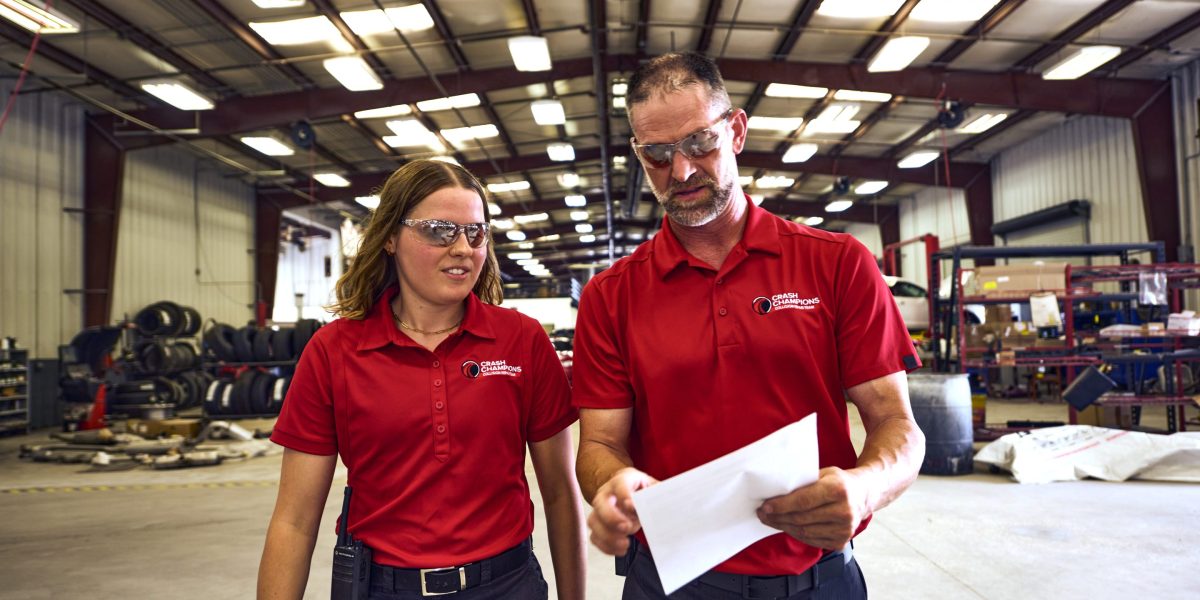
Ebert took a job with the repairman after high school, therefore coming “literally, by accident” into the industry. Now he oversees a company that’s seen 130x revenue growth since 2019 and employs more than 10,000 people. 

And like Ebert, 83% of his workforce doesn’t have a college degree

“I’ve done really, really well in life not having gone to college,” he said. “And I’m not anti-college. I think there’s definitely things that college is great for. But I also know that it’s not an opportunity for everyone.”

Ebert’s company is ahead of the curve when it comes to employing people without a four-year degree. College has historically been viewed as a one-way ticket to a lucrative career, but younger generations are starting to catch on it’s not the only path to success. Many Gen Zers are taking trade jobs and aren’t burdened by student loan debt. Plus, some make more than six figures doing so. 

At Crash Champions, technicians make more than $100,000 a year, Ebert said. In the first quarter of 2025, the U.S. Census Bureau reported the median weekly earnings of the nation’s 120.9 million full-time wage and salary workers was $1,194, which equates to roughly $62,000 annually. That means Crash Champion workers make about 1.6 times that of the average U.S. worker.

“We view college as a bonus, not a requirement,” Ebert said. Of course, there are certain positions that require a specific degree, he added, like how their controller and chief legal officer needed degrees. 

Despite not requiring college degrees for most of its jobs, Crash Champions focuses on continued learning. It created a leadership development program focused on topics like culture and retention, financial and operational leadership, strategic leadership, communication and recognition, continuous learning, as well as delegation mastery and team employment. Thousands of employees have participated in these programs. 

Courtesy Crash Champions

“We can recruit the best technicians. We can train the best technicians, [but] if they’re working for bad managers, they’ll leave and go elsewhere,” Ebert said.

Crash Champions also offers an apprenticeship program where they can “start technicians from scratch,” he said. They’re placed with a team member whom they work with for a couple of years then are off on their own.

Crash Champions’ growth story

Ebert credits his employees with many of the company’s accomplishments.

“A key to my success has been surrounding myself with better people, smarter people than me, people that have done things that I haven’t done,” he said. 

Still, Ebert was the mastermind behind the company. After high school, he moved up to the suburbs of Chicago and stayed with his grandparents for a couple of years and got a job at a body shop. At the time, he still wanted to start his own business, but “being a young kid who didn’t know anybody,” he knew that’d be a challenge, and said starting his own body shop would be “a little over [his] head.”

With an entrepreneurial spirit, though, Ebert researched different businesses, and eventually opened his own Subway franchise by cash-advancing $100,000 on credit cards. Although that first location didn’t make any money, he decided to open a second “thinking that was going to be the path to making money.” 

But he was wrong. That one didn’t make money either. So with that, he went back to his car-repair roots, and approached a local car repairman, and they opened a bodyshop together in 1999, when Ebert was 26. His business partner, who was 20 years older than him, retired in 2014 and sold the business to Ebert in 2014. 

That became the start of Crash Champions, which was first named Lennox after a town in Illinois. Ebert changed the name of his business to Crash Champions, which originates from the idea that the bodyshop is a hero in a customer’s time of need after an accident. 

“I wanted to make the shops nice, tear down some of those stereotypes, make it a place that people would want to come, a place that people would want to work,” he explained.

Courtesy Crash Champions

After taking over the business, Ebert knew he wanted to expand, and he acquired a struggling bodyshop—which quickly snowballed into buying the business’ third and fourth locations, all within about a year. 

At the time, Ebert was still using Small Business Administration financing, and “basically grew it as far as” he could in the Chicago area. He wanted to acquire more shops, but couldn’t with SBA financing, so he worked with an investment banker who suggested private equity as an alternative to debt. Ebert was initially hesitant to do that, but recognized industry trends like tech advancements in vehicle repair would require more capital. The COVID-19 pandemic forced a shift in strategy, but Ebert also saw a need for his business model on a national scale. 

Crash Champions’ major growth came in 2021. Service King Collision, another large auto body repair company, had grown too quickly and made poor business decisions, leading them to financial trouble. Debt was coming due in 2022 and it wasn’t going to be able to pay. The company’s bondholders, mainly Clearlake Capital, would likely take it over, so Ebert proactively contacted Clearlake to merge Service King’s business with Crash Champions to expand his business. 

Those turned into 330 of Crash Champions’ current 650 locations, and the company saw its revenue skyrocket from $327.1 million in revenue in 2021 to $2.1 billion in 2022. For this year, it’s projecting around $3 billion and plans to “ramp [up] growth next year,” Ebert said. 

“I don’t want to stop until we’re number one. We’re the third largest in the country today,” Ebert said, referencing Caliber Collision and Gerber Collision & Glass. “There’s a ton of growth ahead for the company. We slowed a little bit here in the last year or two, because we grew so fast, and we wanted to get more sophisticated and more ready to be even bigger.”


Source link

Continue Reading

Business

The workforce is becoming AI-native. Leadership has to evolve

Published

on


One of the most insightful conversations I have had recently about artificial intelligence was not with policymakers or peers. It was with a group of Nokia early-careers talents in their early 20s. What stood out was their impatience. They wanted to move faster in using AI to strengthen their innovation capabilities. 

That makes perfect sense. This generation began university when ChatGPT launched in 2022. They now account for roughly half of all ChatGPT usage, applying it to everything from research to better decision-making in knowledge-intensive work. 

Some people worry that AI-driven hiring slowdowns are disproportionately impacting younger workers. Yet the greater opportunity lies in a new generation of AI-native professionals entering the workforce equipped for how technology is transforming roles, teams, and leadership.

Better human connectivity 

One of the first tangible benefits of generative AI is that it allows individual contributors to take on tasks once handled by managers. Research by Harvard Business School found that access to Copilot increased employee productivity by 5% in core tasks. As productivity rises and hierarchies flatten, early-career employees using AI are empowered to focus on outcomes, learn faster, and contribute at a higher level.

Yet personal productivity is not the real measure of progress. What matters most is how well teams perform together. Individual AI gains only create business impact when they align with team goals and that requires greater transparency, alignment, and accountability.

At Nokia, we ensure that everyone has clear, measurable goals that support their teams’ objectives. Leaders need to be open about their goals to their managers and to their reports. And everyone means everyone. Me included. That way goals are not only about recognition and reward. They become an ongoing dialogue between leaders and their teams. It’s how we’re building a continuous learning culture that thrives on feedback and agility, both essential in the AI era. 

Humans empowered with AI, not humans versus AI

AI’s true power lies in augmenting human skills. Every role has a core purpose – whether in strategy, creativity, or technical problem-solving – and AI helps people focus on that. 

During the COVID-19 pandemic, more than 60 chatbots were deployed in 30 countries to handle routine public health queries, freeing up healthcare workers to focus on critical patient care. Most health services never looked back. 

The same pattern applies inside companies. Some of the routine tasks given to new hires are drudge work and not a learning experience. AI gives us a chance to rethink the onboarding, training, and career development process.

Take an early-career engineer. Onboarding can be a slow process of documentation and waiting for reviews. AI can act as an always-on coach that gives quick guidance and helps people ramp up. Mentors then spend less time on the basics and more time helping engineers solve real problems. Engineers can also have smart agents testing their designs, ideas, and simulating potential outcomes. In this way, AI strengthens, rather than substitutes, the human connection between junior engineers and their mentors and helps unlock potential faster.

Encourage experimentation and entrepreneurship 

During two decades of the Internet Supercycle (1998-2018), start-ups created trillions of dollars in economic value and roughly half of all new jobs in OECD countries

As AI lowers the barriers to launching and scaling ventures, established companies must find new ways to encourage experimentation, nurture innovation through rapid iterations, and give employees the chance to commercialize and scale their ideas.

There is a generational shift that increases the urgency: more than 60% of Gen Z Europeans hope to start their own businesses within five years, according to one survey. To secure this talent, large organizations must provide the attributes that make entrepreneurship attractive. Empowering people with agility, autonomy, and faster decision-making creates an edge in attracting and keeping top talent.

At Nokia, our Technology and AI Organization is designed to strengthen innovation capabilities, encourage entrepreneurial thinking, and give teams the support to turn ideas into real outcomes.

More coaching, less managing 

Sporting analogies are often overused in business as the two worlds don’t perfectly align, yet the evolution of leadership in elite football offers useful lessons. Traditionally, managers oversaw everything on and off the pitch. Today, head coaches focus on building the right team and culture to win. 

Luis Enrique, the manager of Paris-St. Germain football club, last season’s UEFA Champion’s League winner, exemplifies this shift. He transformed a team of stars into a star team, while also evolving his coaching style, elevating both individual and collective potential.

Of course, CEOs must switch between both roles (as I said, the worlds don’t perfectly align) – setting vision and strategy while also cultivating the right team and culture to succeed. AI can help leaders do both with more focus. It gives us quicker insight into what is working, what is not, and where teams need support.

I have been testing these tools with my own leadership team. We are using generative AI to help us evaluate our decisions and to understand how we work together. It has revealed patterns we might have missed, and it has helped us get to the real issues faster. It does not replace judgment or experience. It supports them.

Yet the core of leadership does not change. AI cannot build trust. It cannot set expectations. It cannot create a culture that learns, improves, and takes responsibility. That still comes from people. And in a world shaped by AI, the leaders who succeed will be the ones who coach, who listen, and who help teams move faster with confidence.

Nokia’s technology connects intelligence around the world. Inside the company, connecting intelligence is about how people work together. It means giving teams the tools, support and culture they need to grow and perform with confidence. Connecting intelligence is how teams win.

The opinions expressed in Fortune.com commentary pieces are solely the views of their authors and do not necessarily reflect the opinions and beliefs of Fortune.


Source link

Continue Reading

Business

Procurement execs often don’t understand the value of good design, experts say

Published

on


Behind every intricately designed hotel or restaurant is a symbiotic collaboration between designer and maker.

But in reality, firms want to build more with less—and even though visions are created by designers, they don’t always get to see them to fruition. Instead, intermediaries may be placed in charge of procurements and overseeing the financial costs of executing designs.

“The process is not often as linear as we [designers] would like it to be, and at times we even get slightly cut out, and something comes out on the other side that wasn’t really what we were expecting,” said Tina Norden, a partner and principal at design firm Conran and Partners, at the Fortune Brainstorm Design forum in Macau on Dec. 2.

“To have a better quality product, communication is very much needed,” added Daisuke Hironaka, the CEO of Stellar Works, a furniture company based in Shanghai. 

Yet those tasked with procurement are often “money people” who may not value good design—instead forsaking it to cut costs. More education on the business value of quality design is needed, Norden argued.

When one builds something, she said, there are both capital investment and a lifecycle cost. “If you’re spending a bit more money on good quality furniture, flooring, whatever it might be, arguably, it should last a lot longer, and so it’s much better value.”

Investing in well-designed products is also better for the environment, Norden added, as they don’t have to be replaced as quickly.

Attempts to cut costs may also backfire in the long run, said Hironaka, as business owners may have to foot higher maintenance bills if products are of poor design and make.

AI in interior and furniture design

Though designers have largely been slow adopters of AI, some luminaries like Daisuke are attempting to integrate it into their team’s workflow.

AI can help accelerate the process of designing bespoke furniture, Daisuke explained, especially for large-scale projects like hotels. 

A team may take a month to 45 days to create drawings for 200 pieces of custom-made furniture, the designer said, but AI can speed up this process. “We designed a lot in the past, and if AI can use these archives, study [them] and help to do the engineering, that makes it more helpful for designers.” 

Yet designers can rest easy as AI won’t ever be able to replace the human touch they bring, Norden said. 

“There is something about the human touch, and about understanding how we like to use our spaces, how we enjoy space, how we perceive spaces, that will always be there—but AI should be something that can assist us [in] getting to that point quicker.”

She added that creatives can instead view AI as a tool for tasks that are time-consuming but “don’t need ultimate creativity,” like researching and three-dimensionalizing designs.

“As designers, we like to procrastinate and think about things for a very long time to get them just right, [but] we can get some help in doing things faster.”


Source link

Continue Reading

Business

Binance has been proudly nomadic for years. A new announcement suggests it’s chosen an HQ

Published

on


For years, Binance has dodged questions about where it plans to establish a corporate headquarters. On Monday, the world’s largest crypto exchange made an announcement that indicates it has chosen a location: Abu Dhabi, the capital of the United Arab Emirates.

In its announcement, Binance reported that it has secured three global financial licenses within Abu Dhabi Global Market, a special economic zone inside the Emirati city. The licenses regulate three different prongs of the exchange’s business: its exchange, clearinghouse, and broker dealer services. The three regulated entities are named Nest Exchange Limited, Nest Clearing and Custody Limited, and Nest Trading Limited, respectively.

Richard Teng, the co-CEO of Binance, declined to say whether Abu Dhabi is now Binance’s global headquarters. “But for all intents and purposes, if you look at the regulatory sphere, I think the global regulators are more concerned of where we are regulated on a global basis,” he said, adding that Abu Dhabi Global Market is where his crypto exchange’s “global platform” will be governed.

A company spokesperson declined to add more to Teng’s comments, but did not deny Fortune’s assertion that Binance appears to have chosen Abu Dhabai as its headquarters.

Corporate governance

The Abu Dhabi announcement suggests that Binance, which has for years taken pride in branding itself as a company with no fixed location, is bowing to the practical considerations that go with being a major financial firm—and the corporate governance obligations that entails.

When Changpeng Zhao, the cofounder and former CEO of Binance, launched the company in 2017, he initially established the exchange in Hong Kong. But, weeks after he registered Binance in the city, China banned cryptocurrency trading, and Zhao moved his nascent trading platform. Binance has since been itinerant. “Wherever I sit is going to be the Binance office,” Zhao said in 2020.

The location of a company’s headquarters impacts its tax obligations and what regulations it needs to follow. In 2023, after Binance reached a landmark $4.3 billion settlement with the U.S. Department of Justice, Zhao stepped down as CEO and pleaded guilty to failing to implement an effective anti-money laundering program.

Teng took over and promised to implement the corporate structures—like a board of directors—that are the norm for companies of Binance’s size. Teng, who now shares the CEO role with the newly appointed Yi He, oversaw the appointment of Binance’s first board in April 2024. And he’s repeatedly telegraphed that his crypto exchange is focused on regulatory compliance.

Binance already has a strong footprint in the Emirates. It has a crypto license in Dubai, received a $2 billion investment from an Emirati venture fund in March, and, that same month, said it employed 1,000 employees in the country. 


Source link

Continue Reading

Trending

Copyright © Miami Select.