Connect with us

Business

‘There are a lot of people concerned he’s not the same old Chuck Grassley’: Where has the oversight chief gone under Trump 2.0?

Published

on


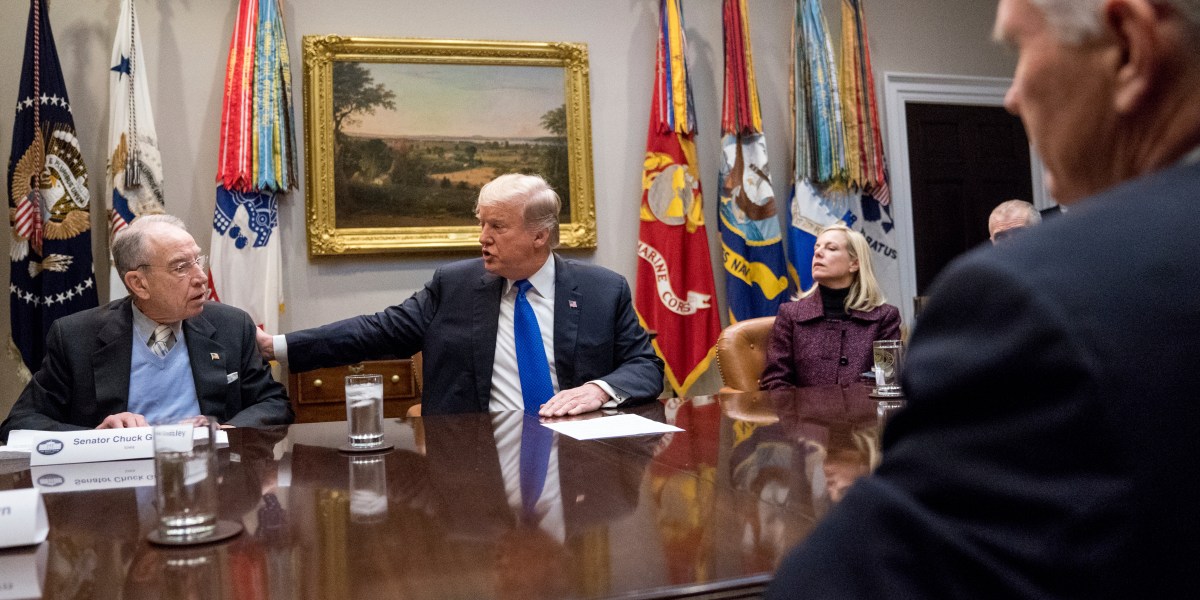
As President Donald Trump’s top law enforcement officials were firing and forcing out waves of Justice Department veterans, Sen. Chuck Grassley denounced a “political infection” that had poisoned FBI leadership.

The Iowa Republican was not criticizing FBI Director Kash Patel or Attorney General Pam Bondi. In a July statement, he directed his ire at the FBI’s “extreme lack of effort” in investigating Democrat Hillary Clinton’s use of a private email server as secretary of state a decade ago.

Trump loyalists have roiled the Justice Department, shattering norms and leading to a mass exodus of veteran officials, but the 92-year-old chairman of the Senate Judiciary Committee has remained focused on the past.

Critics say Grassley’s reluctance to challenge the Trump administration has even extended to a defining issue: His support for whistleblowers making claims of fraud, waste and abuse.

In an interview, Grassley insisted he has not abandoned his oversight role. He said he has felt compelled to investigate issues under earlier presidents to avoid a repeat of what he described as politically motivated prosecutions carried out against Trump and his allies.

“Political weaponization is being brought to the surface and being made more transparent because this administration is the most cooperative of any administration — Republican or Democrat,” Grassley said.

Grassley has acknowledged that Congress has ceded a great deal of power to the current administration, a concession he says makes his own oversight more crucial.

“It’s going to enhance the necessity for it,” he said.

Grassley is known for his focus on oversight

Grassley, upon entering Congress in 1975, quickly developed a reputation for exposing corruption and waste. He once drove to the Pentagon in his orange Chevy Chevette to demand answers from officials about their purchase of $450 hammers and $7,600 coffee pots.

He was among the chief proponents in Congress of laws to shield employees who revealed such waste and sponsored the landmark 1989 Whistleblower Protection Act. He also has played a key role in empowering inspectors general, internal watchdogs tasked with rooting out misconduct.

“He has been the conscience of the Senate on whistleblower protection rights for decades,” said Tom Devine, legal director for the Government Accountability Project. In the current Congress, he has co-sponsored legislation boosting protections for whistleblowers in the FBI and CIA.

“No one is close to having his impact,” Devine said. “That hardly means that we always agree with his judgment calls about policy.”

Criticized for not taking on Trump administration

Trump and Grassley are not always in alignment. This past week, for example, they tussled over the pace of confirmation of administration nominees.

Even so, Democrats and good government advocates say Grassley has been conspicuously silent as the administration has investigated Trump’s perceived enemies, fired agents who worked on politically sensitive cases and upended the Justice Department’s longstanding post-Watergate independence.

Some whistleblowers have been loath to trust him with revelations that might harm the administration, according to interviews with more than a dozen current and former U.S. officials, or their attorneys, several of whom spoke on condition of anonymity because they feared retaliation.

“There are a lot of people concerned he’s not the same old Chuck Grassley,” said Eric Woolson, author of a 1995 biography of Grassley who once served as a Grassley campaign spokesman.

Grassley rejected that criticism, saying whistleblowers call him regardless of who is in the White House. His office’s online portal has received more than 5,300 complaints in 2025, about the same level as past years, staffers reported.

“His entire career, he’s the guy people will trust,” said Jason Foster, a former chief investigative counsel to Grassley who founded Empower Oversight, a group that has advocated on behalf of FBI agents disciplined under the Biden administration.

Staunch Trump ally

Many of Grassley’s recent actions, however, suggest he has evolved from being a fiercely independent moderate eager to sniff out fraud to being a stalwart Trump ally, according to Democrats and whistleblower advocates.

Some were particularly alarmed at Grassley’s dismissal of witnesses who raised concerns about the June nomination of Emil Bove, a high-ranking Justice Department official and former Trump lawyer, to a lifetime federal appeals court seat.

Among several officials who came forward was Justice Department lawyer Erez Reuveni, who said he was fired for refusing to go along with Bove’s plans to defy court orders and withhold information from judges to advance the administration’s aggressive deportation goals.

Grassley said his staff tried to investigate some of the claims but that lawyers for one whistleblower would not give his staff all the materials they requested in time. Instead of delaying the hearing to dig further, Grassley circled the wagons behind Trump’s nominee.

The “vicious rhetoric, unfair accusations and abuse directed at Mr. Bove,” Grassley said in a speech, have “crossed the line.”

Stacey Young, a former Justice Department lawyer who founded Justice Connection, a network of department alumni mobilized to uphold the department’s traditionally apolitical workforce, said she was disappointed Grassley has not used his influence to condemn firings at the department.

“How is the congressional majority not screaming bloody murder? We are watching the near decimation of DOJ in real-time, and Congress is sitting by doing nothing,” she said. “Does Sen. Grassley think it’s OK that people get fired for doing their jobs?”

At a September oversight hearing, Grassley passed up a chance to grill Patel on a series of terminations of line agents and high-level supervisors, including five whose abrupt and still-unexplained dismissals had generated headlines weeks earlier.

When Democrats pressed Patel about his use of the bureau’s plane for personal reasons, Grassley chided Senate colleagues for their disinterest in the travel practices of previous directors.

Grassley has also been an eager conduit for an FBI leadership seeking to expose what it insists was misconduct and overreach in an investigation during the Biden administration into Trump’s efforts to overturn the 2020 election.

He has released batches of sensitive documents from that investigation, known as “Arctic Frost,” that he says have been furnished by FBI whistleblowers or that have been labeled as “Produced by FBI Director Kash Patel.” The records are not the type of documents federal law enforcement would typically make public on its own.

Advocates dismayed over Grassley response to IG firings

Whistleblower advocates said they were dismayed when Grassley failed to take a robust stance when Trump, within days of taking office, fired without cause some inspectors general.

Even some Republican-appointed inspectors general accused Trump of violating a law requiring the White House to provide 30-day notice and rationale to Congress. If any Republican were going to stand up for them, some of the fired inspectors general said, they expected it to be Grassley.

“He has been uncharacteristically silent,” said Mark Greenblatt, a Trump appointee at the Interior Department who was among those fired. ”It is unimaginable that the Grassley of a few years ago, the man who held nominees and fired off blistering threats at the smallest provocation to protect inspectors general, would be so silent in the face of these assaults.”

Grassley responded to the purge by sending Trump a letter requesting officials “immediately” spell out their case-by-case specific reasons for the dismissals.

It took the White House eight months to respond. In a two-page letter, it reasserted presidential authority to fire inspectors general at will and made no attempt to explain its rationale other than to cite “changed priorities.”

___

Associated Press writer Ryan J. Foley in Iowa City, Iowa, contributed to this report.


Source link

Continue Reading

Business

AI investment pressures, supply-chain risks, and strategy misalignment are all on the line for CFOs

Published

on


The talk is over. In 2026, it’s time to execute.

When the CFO Alliance, a finance-professional peer community, released its latest report, called Project Greenlight, in late November, the organization said that finance experts expect 2026 to be “the most pivotal year the finance function has faced in a decade.” There’s a lot at stake for CFOs and their organizations, according to the report, including supply-chain risks, pressure to make big AI investments, and the perils of stakeholder misalignment on strategy.

CFO Brew recently spoke with Nick Araco, the CEO of CFO Alliance, to get a sense of why 2026 is shaping up to be a high-stakes year. He also shared what’s top of mind for the finance leaders he’s been speaking with.

This interview has been edited for length and clarity.

What makes you think that 2026 will be such a pivotal year in finance?

2026 has to be a year where we replace debate with data and execution. I call it “informed execution.” We’ve seen such a rapid acceleration, given AI and technology advancements, converge with a year of volatility and uncertainty. Imagine you’re sitting in the seat of a CFO, where you’re at the intersection of that, and you’ve had a 2025 that’s caused you and your enterprises to hit a pause button. You had months, if not a whole year of pause. 2026 has to be a year of execution.

How did the group that worked on the Project Greenlight report identify the top execution risks, and how did it lay out a roadmap for addressing each?

What we did was convene about an hour-and-a-half’s time and openly debated until we got to a point where we agreed on the most material and critical areas of risk. You can imagine we started with a laundry list, because the CFO Alliance population of almost 10,000 or more is very diverse…At the end of the day, we identified four execution risks that most often stall plans, or stall action. [According to the report, these are geopolitical and regulatory disruption, technology and AI adoption, talent and team capabilities, and stakeholder alignment and governance.]

I want to focus on one specific risk: AI adoption. What would you say are the keys to identifying where an organization should be investing its money, but also how to track the ROI?

A year ago at this time, I would tell you that nine out of 10 of our members were saying, ‘We agree, it’s time to lean in, and it’s time to have the right discussions. Let’s bring in cross-functional leaders and cross-level leaders, and let’s make sure we are demonstrating comfort, and make sure that we’re demonstrating through our own actions, an embrace.’ Let me fast forward to where we are in 2025. These discussions need to be about enterprise value and performance. They need to be about, ‘How would this impact our business?’

I’m going to be very specific as to what the discussions need to be and are, because our members are using the following framework around AI. “What’s the specific opportunity or pain point that we are attempting to address…when it comes to AI? Why does it matter now? What’s blocking our progress that we’re even having this discussion? What’s one condition, and if we solve for this, what would be different by X date, and how would we know it helped us?” Those questions they’re using in every conversation, so they can tie it back to value.

What have been the biggest recurring topics in your conversations with CFOs from the past two or three months?

There are three key areas of focus: What type of leader do I want to be in ’26? How do I best stand up the highest performing finance function? And that includes accounting, treasury, FP&A, and capital markets or strategy functions. And then, from an enterprise standpoint, am I really at the forefront of understanding how technology and AI may disrupt our position in our industry, or our industry or business as a whole?

Standing up a high-performing finance function and team [is] more complex than ever before. I’m tired of the bashing of accounting…No one can do their job in finance without a strong accounting function. We’re done complaining about it; we’re going to do something about it. We’re going to try to make accounting sexy again by embracing the AI factor and bringing critical thinking into the accounting skill set.

This report was originally published by CFO Brew.


Source link

Continue Reading

Business

Ford takes $19.5 billion hit, scraps some EV ambitions in pivot to more hybrid and gas models

Published

on


The Dearborn, Michigan-based automaker will make a series of changes to its line of vehicles and production facilities to focus on producing affordable vehicles that better align with customer desires, it announced Monday.

The company will also scrap production of certain larger EVs—including the F-150 Lightning, which it will retool as an electric vehicle with a gas-powered generator—as well as redouble development of smaller, lower-cost cars, including a midsize pickup truck in 2027.

“This is a customer-driven shift to create a stronger, more resilient and more profitable Ford,” Ford president and CEO Jim Farley said in a press release. “The operating reality has changed, and we are redeploying capital into higher-return growth opportunities: Ford Pro, our market-leading trucks and vans, hybrids and high-margin opportunities like our new battery energy storage business.”

As EV demand trends downward, particularly following the end of the federal tax credit in September, Ford had struggled to sustain demand for its Model E line. Farley warned in September the end of the tax credit would throttle EV demand, cutting sales to 5% of total auto volume from roughly 10% to 12% at the time. Earlier this month, the automaker reported it sold 164,925 vehicles in November, a 0.9% year-over-year decline, with EV sales tumbling 61% to 4,247. With $3.6 billion in losses in the first three quarters of this year alone, Ford’s Model E division has lost more than $13 billion in less than three years.

In addition to regulatory challenges, Ford attributed the need to produce smaller, more affordable EVs as well as gas and hybrid vehicles, to battery prices remaining stubbornly high and an affordability crisis shaking consumer brand loyalty. The company said on Monday it would launch five new “affordable” vehicles by the end of the decade, four of which would be assembled domestically. The automaker intends to have 50% of its global vehicle volumes be hybrids, extended-range EVs, and full EVs, by 2030, up from 17% this year.

As a result of the changes to its production focus, Ford will also repurpose some of its facilities, including revamping its Tennessee Electric Vehicle Center into the Tennessee Truck Plant, which will no longer produce EVs, but rather manufacture the new Built Ford Tough truck models beginning in 2029. Its Ohio plant will similarly assemble new gas and hybrid cars in 2029.

Ford said it will employ thousands of workers in the next few years to staff its American plants. After concluding production for the 2025 F-150 Lightning model, Ford will redeploy one-third of that workforce to production on a gas and hybrid model of the F-150.

Ford will book $19.5 billion in charges, most of which will occur in 2026, as a result of the pivot, including an $8.5 billion asset write-down for its Model E division. The automaker raised its EBIT guidance for 2025 to about $7 billion, up from $6 billion, and it reaffirmed its adjusted free cash flow range of between $2 billion and $3 billion.

Ford has struggled to get returns from its ever-growing investment in its EV models, even as it continues to toy with strategy changes. Monday’s announcement follows Ford’s decision in August to invest $2 billion in retooling a Kentucky factory in order to manufacture EVs, as well as rejig its production process to a “universal EV platform” to lower the cost of its models.

Ford said it expects its Model E to be profitable by 2029; in early 2023, it predicted profitability by 2026.

At the time of the Kentucky factory announcement, analysts were hesitant to laud the company, warning that if Ford did not make a compelling product, its billions of dollars poured into factory changes and fresh vehicle production would be for nought, particularly as EV demand stays hot and cold.

“If the vehicles don’t appeal due to being EVs, then billions will be wasted,” Morningstar equity strategist David Whiston told Fortunein August. “That’s why you need a great product, great range, and lower battery cost and vehicle manufacturing techniques.”

He added, “The challenge is, do you have a great product or not? [It’s] hard to get excited about a vehicle you can’t see yet.”


Source link

Continue Reading

Business

Trump vows to fight ‘fraud’ in SNAP benefits for 42 million Americans

Published

on


President Donald Trump ’s administration is talking tough about SNAP, saying the government’s biggest food aid program is riddled with fraud that must be stopped.

His appointees are looking at Supplemental Nutrition Assistance Program from an enforcement perspective, seeing fraud as a major and expensive problem, perpetrated by organized criminal organizations, individual recipients and retailers willing to break the laws for profit.

“We know there are instances of fraud committed by our friends and neighbors, but also transnational crime rings,” Jennifer Tiller, a senior advisor to U.S. Agriculture Secretary Brooke Rollins, said in an interview.

Some experts agree that SNAP fraud is a major problem. But there is little publicly available data showing the extent of it, and others who study the program are skeptical about the scale.

“It you’re spending $100 billion on anything, you’re going to have some leakage,” said Christopher Bosso, a professor of public policy and politics at Northeastern University who published a book on SNAP.

The administration leans into fraud allegations

Of the $100 billion spent on SNAP a year, about $94 billion goes to benefits and the rest to administrative costs.

About 42 million people — or 1 in 8 Americans — receive SNAP benefits averaging about $190 per person per month. The number of recipients is in the same ballpark as the number of people in poverty — 36 million by the traditional measure and 43 million under a more nuanced one also used by the federal government.

Under federal law, most households must report their income and basic information every four to six months and be fully recertified for SNAP at least every 12 months.

The Trump administration has demanded that states turn over data on individual SNAP recipients including Social Security numbers, dates of birth and immigration status as part of its effort to root out fraud.

States with Republican governors, plus North Carolina, have complied. Most led by Democrats are pushing back in court, arguing that providing the data would violate recipients’ privacy.

The USDA says that from the records that have been shared, it found 186,000 deceased people — about 1% of participants in those states — receiving benefits and about 500,000 people — about 2.7% — receiving benefits in more than one jurisdiction.

The USDA has not made public detailed reports on the data and has not broken down the estimates by type of alleged fraud. The department also hasn’t answered questions about what portion of any improperly awarded benefits was actually spent and how much sat unclaimed on EBT cards after recipients moved or died.

The department estimated in a letter to the states that have refused to turn over data that the nationwide total combining fraud and undetected errors could be $9 billion a year or more. Democratic-led states responded in a letter last week that states already have systems to catch wrongdoing and that USDA isn’t explaining how it’s crunching the numbers.

Program participants can be perpetrators or victims of fraud

There are a lot of forms of wrongdoing.

SNAP benefits are put on EBT cards that recipients swipe in stores like debit cards. Organized crime groups put skimmers on EBT readers to get information used to make copies of the benefit cards and steal the allotments of recipients — or to use stolen identity information to apply for benefits for fictitious people. A Romanian man who was in the U.S. illegally pleaded guilty last year to skimming cards in California. Authorities say he took more than 36,000 numbers over three years.

A USDA employee pleaded guilty this year to accepting bribes in exchange for providing registration numbers for EBT card readers placed illegally in several New York delis. Authorities said more than $30 million passed through those terminals.

And three people were charged this year in Franklin County, Ohio, accused of using stolen benefits to order big quantities of energy drinks and candy — apparently to resell it.

Mark Haskins, who worked on USDA investigations from 2013 until leaving the department in August as branch chief of a special investigations unit, said there have been cases of retailers running similar operations. Several states are barring using SNAP for some junk food products with policies that kick in as soon as Jan. 1.

Haskins also says some legitimate recipients buy non-grocery items with SNAP benefits by persuading a store employee to ring up the wrong item — generally one that costs more than what’s being bought — or to sell benefit cards. He said he thinks those forms of fraud are more costly than the ones run by organized criminal groups.

Haskins and Haywood Talcove, CEO of LexisNexis Risk Solutions Government, which helps create fraud prevention strategies, both believe fraud costs significantly more than the USDA’s $9 billion estimate.

“The system is corrupt. It doesn’t need a fix here and there, it needs a complete overhaul,” said Haskins, who would like to see fewer retailers in the network and participants having to reapply, even if that makes it harder for qualified people to access benefits.

Advocates and researchers see a different system

The USDA last published a report on SNAP fraud in 2021. It covered what happened in from 2015 through 2017 and found that about 1.6% of benefits were stolen from recipients’ accounts.

The government replaced benefits that were stolen between Oct. 1, 2022 and Dec. 20, 2024. The value of replaced benefits over that time was $323 million — or about 24 cents for every $100 in SNAP benefits, though that’s believed to be an undercount.

It’s reports like those that lead advocates and academics who research SNAP to see fraud, while troublesome, as less than the massive problem the USDA makes it out to be.

Dartmouth College economist Patricia Anderson, who studies food insecurity, said in an email that the maximum benefits for a family of four are about $1,000 a month. “It really takes organized crime that is either stealing from the EBT cards or creating a lot of fake recipients out of whole cloth before the gain for the fraudster really starts to be worth it,” she said.

Jamal Brown, a 41-year-old food stamp participant who lives in Camden, New Jersey, said he’s witnessed people selling benefits to bodegas to get cash. And he’s had his benefits stolen by a skimmer.

He also said he had to deal with benefits being cut off after being told he missed an interview to recertify his need when a county welfare worker didn’t call him as planned.

“It’s always something that goes wrong,” Brown said, “unfortunately.”


Source link

Continue Reading

Trending

Copyright © Miami Select.