Connect with us

Business

‘There are a lot of people concerned he’s not the same old Chuck Grassley’: Where has the oversight chief gone under Trump 2.0?

Published

on


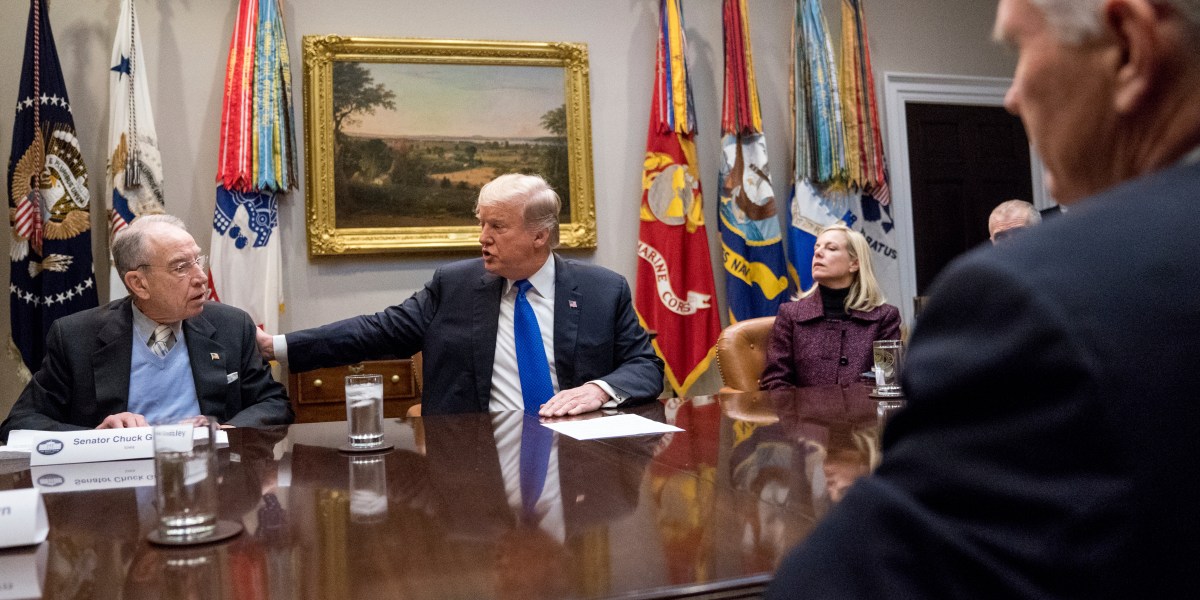
As President Donald Trump’s top law enforcement officials were firing and forcing out waves of Justice Department veterans, Sen. Chuck Grassley denounced a “political infection” that had poisoned FBI leadership.

The Iowa Republican was not criticizing FBI Director Kash Patel or Attorney General Pam Bondi. In a July statement, he directed his ire at the FBI’s “extreme lack of effort” in investigating Democrat Hillary Clinton’s use of a private email server as secretary of state a decade ago.

Trump loyalists have roiled the Justice Department, shattering norms and leading to a mass exodus of veteran officials, but the 92-year-old chairman of the Senate Judiciary Committee has remained focused on the past.

Critics say Grassley’s reluctance to challenge the Trump administration has even extended to a defining issue: His support for whistleblowers making claims of fraud, waste and abuse.

In an interview, Grassley insisted he has not abandoned his oversight role. He said he has felt compelled to investigate issues under earlier presidents to avoid a repeat of what he described as politically motivated prosecutions carried out against Trump and his allies.

“Political weaponization is being brought to the surface and being made more transparent because this administration is the most cooperative of any administration — Republican or Democrat,” Grassley said.

Grassley has acknowledged that Congress has ceded a great deal of power to the current administration, a concession he says makes his own oversight more crucial.

“It’s going to enhance the necessity for it,” he said.

Grassley is known for his focus on oversight

Grassley, upon entering Congress in 1975, quickly developed a reputation for exposing corruption and waste. He once drove to the Pentagon in his orange Chevy Chevette to demand answers from officials about their purchase of $450 hammers and $7,600 coffee pots.

He was among the chief proponents in Congress of laws to shield employees who revealed such waste and sponsored the landmark 1989 Whistleblower Protection Act. He also has played a key role in empowering inspectors general, internal watchdogs tasked with rooting out misconduct.

“He has been the conscience of the Senate on whistleblower protection rights for decades,” said Tom Devine, legal director for the Government Accountability Project. In the current Congress, he has co-sponsored legislation boosting protections for whistleblowers in the FBI and CIA.

“No one is close to having his impact,” Devine said. “That hardly means that we always agree with his judgment calls about policy.”

Criticized for not taking on Trump administration

Trump and Grassley are not always in alignment. This past week, for example, they tussled over the pace of confirmation of administration nominees.

Even so, Democrats and good government advocates say Grassley has been conspicuously silent as the administration has investigated Trump’s perceived enemies, fired agents who worked on politically sensitive cases and upended the Justice Department’s longstanding post-Watergate independence.

Some whistleblowers have been loath to trust him with revelations that might harm the administration, according to interviews with more than a dozen current and former U.S. officials, or their attorneys, several of whom spoke on condition of anonymity because they feared retaliation.

“There are a lot of people concerned he’s not the same old Chuck Grassley,” said Eric Woolson, author of a 1995 biography of Grassley who once served as a Grassley campaign spokesman.

Grassley rejected that criticism, saying whistleblowers call him regardless of who is in the White House. His office’s online portal has received more than 5,300 complaints in 2025, about the same level as past years, staffers reported.

“His entire career, he’s the guy people will trust,” said Jason Foster, a former chief investigative counsel to Grassley who founded Empower Oversight, a group that has advocated on behalf of FBI agents disciplined under the Biden administration.

Staunch Trump ally

Many of Grassley’s recent actions, however, suggest he has evolved from being a fiercely independent moderate eager to sniff out fraud to being a stalwart Trump ally, according to Democrats and whistleblower advocates.

Some were particularly alarmed at Grassley’s dismissal of witnesses who raised concerns about the June nomination of Emil Bove, a high-ranking Justice Department official and former Trump lawyer, to a lifetime federal appeals court seat.

Among several officials who came forward was Justice Department lawyer Erez Reuveni, who said he was fired for refusing to go along with Bove’s plans to defy court orders and withhold information from judges to advance the administration’s aggressive deportation goals.

Grassley said his staff tried to investigate some of the claims but that lawyers for one whistleblower would not give his staff all the materials they requested in time. Instead of delaying the hearing to dig further, Grassley circled the wagons behind Trump’s nominee.

The “vicious rhetoric, unfair accusations and abuse directed at Mr. Bove,” Grassley said in a speech, have “crossed the line.”

Stacey Young, a former Justice Department lawyer who founded Justice Connection, a network of department alumni mobilized to uphold the department’s traditionally apolitical workforce, said she was disappointed Grassley has not used his influence to condemn firings at the department.

“How is the congressional majority not screaming bloody murder? We are watching the near decimation of DOJ in real-time, and Congress is sitting by doing nothing,” she said. “Does Sen. Grassley think it’s OK that people get fired for doing their jobs?”

At a September oversight hearing, Grassley passed up a chance to grill Patel on a series of terminations of line agents and high-level supervisors, including five whose abrupt and still-unexplained dismissals had generated headlines weeks earlier.

When Democrats pressed Patel about his use of the bureau’s plane for personal reasons, Grassley chided Senate colleagues for their disinterest in the travel practices of previous directors.

Grassley has also been an eager conduit for an FBI leadership seeking to expose what it insists was misconduct and overreach in an investigation during the Biden administration into Trump’s efforts to overturn the 2020 election.

He has released batches of sensitive documents from that investigation, known as “Arctic Frost,” that he says have been furnished by FBI whistleblowers or that have been labeled as “Produced by FBI Director Kash Patel.” The records are not the type of documents federal law enforcement would typically make public on its own.

Advocates dismayed over Grassley response to IG firings

Whistleblower advocates said they were dismayed when Grassley failed to take a robust stance when Trump, within days of taking office, fired without cause some inspectors general.

Even some Republican-appointed inspectors general accused Trump of violating a law requiring the White House to provide 30-day notice and rationale to Congress. If any Republican were going to stand up for them, some of the fired inspectors general said, they expected it to be Grassley.

“He has been uncharacteristically silent,” said Mark Greenblatt, a Trump appointee at the Interior Department who was among those fired. ”It is unimaginable that the Grassley of a few years ago, the man who held nominees and fired off blistering threats at the smallest provocation to protect inspectors general, would be so silent in the face of these assaults.”

Grassley responded to the purge by sending Trump a letter requesting officials “immediately” spell out their case-by-case specific reasons for the dismissals.

It took the White House eight months to respond. In a two-page letter, it reasserted presidential authority to fire inspectors general at will and made no attempt to explain its rationale other than to cite “changed priorities.”

___

Associated Press writer Ryan J. Foley in Iowa City, Iowa, contributed to this report.


Source link

Continue Reading

Business

AIIB’s first president defends China as ‘responsible stakeholder’ in less multilateral world

Published

on


When China wanted to set up its answer to the World Bank, it picked Jin Liqun—a veteran financier with experience at the World Bank, the Asian Development Bank, China’s ministry of finance and the China Investment Corporation, the country’s sovereign wealth fund—to design it. Since 2014, Jin has been the force behind the Asian Infrastructure Investment Bank, including a decade as its first president, starting in 2016. 

Jin’s decade-long tenure comes to an end on January 16, when he will hand over the president’s chair to Zou Jiayi, a former vice minister of finance. When Jin took over the AIIB ten years ago, the world was still mostly on a path to further globalization and economic integration, and the U.S. and China were competitors, not rivals. The world is different now: Protectionism is back, countries are ditching multilateralism, and the U.S. and China are at loggerheads. 

The AIIB has largely managed to keep its over-100 members, which includes many countries that are either close allies to the U.S.—like Germany, France and the U.K.—or have longstanding tensions with Beijing, like India and the Philippines.

But can the AIIB—which boasts China as its largest shareholder, and is closely tied to Beijing’s drive to be seen as a “responsible stakeholder”—remain neutral in a more polarized international environment? And can multilateralism survive with an “America First” administration in Washington?

After his decades working for multilateral organizations—the World Bank, the ADB, and now the AIIB—Jin remains a fan of multilateralism and is bullish on the prospects for global governance.

“I find it very hard to understand that you can go alone,” Jin tells Fortune in an interview. “If one of those countries is going to work with China, and then China would have negotiations with this country on trade, cross-border investment, and so on—how can they negotiate something without understanding the basics, without following the generally accepted rules?”

“Multilateralism is something you could never escape.”

Why did China set up the AIIB?

Beijing set up the Asian Infrastructure Investment Bank almost a decade ago, on Jan. 16, 2016. The bank grew from the aftermath of the Global Financial Crisis, when Chinese officials considered how best to use the country’s growing foreign exchange reserves. Beijing was also grumbling about its perceived lack of influence in major global economic institutions, like the International Monetary Fund and the World Bank, despite becoming one of the world’s most important economies.

With $66 billion in assets (according to its most recent financial statements), the Asian Infrastructure Investment Bank is smaller than its U.S.-led peers, the World Bank (with $411 billion in assets) and the Asian Development Bank (with $130 billion). But the AIIB was designed to be China’s first to design its own institutions for global governance and mark its name as a leader in development finance.

Negotiations to establish the bank started in earnest in 2014, as several Asian economies like India and Indonesia chose to join the new institution as members. Then, in early 2015, the U.K. made the shocking decision to join the AIIB as well; several other Western countries, like France, Germany, Australia, and Canada, followed suit.

Two major economies stood out in abstaining. The U.S., then under the Obama administration, chose not to join the AIIB, citing concerns about its ability to meet “high standards” around governance and environmental safeguards. Japan, the U.S.’s closest security ally in East Asia, also declined, ostensibly due to concerns about human rights, environmental protection, and debt.

“They chose not to join, but we don’t mind.” Jin says. “We still keep a very close working relationship with U.S. financial institutions and regulatory bodies, as well as Japanese companies.” He sees this relationship as proof of the AIIB’s neutral and apolitical nature.

Still, Beijing set up the AIIB after years of being lobbied by U.S. officials to become a “responsible stakeholder,” when then-U.S. Secretary of State Robert Zoellick defined in 2005 as countries that “recognize that the international system sustains their peaceful prosperity, so they work to sustain that system.”

Two decades later, U.S. officials see China’s presence in global governance as a threat, fearing that Beijing is now trying to twist international institutions to suit its own interests. 

Jin shrugs off these criticisms. “China is now, I think, the No. 2 contributor to the United Nations, and one of the biggest contributors to the World Bank and the Asian Development Bank” (ADB), Jin says. “Yet the per capita GDP for China is still quite lower than a number of countries. That, in my view, is an indication of its assumption of responsibility.”

And now, with several countries withdrawing from global governance, Jin thinks those lecturing China on being responsible are being hypocritical. “When anybody tells someone else ‘you should be a responsible member’, you should ask yourself whether I am, myself, a responsible man. You can’t say, ‘you’ve got to be a good guy.’ Do you think you are a good guy yourself?” he says, chuckling.

Why does China care about infrastructure?

From its inception, Beijing tried to differentiate the AIIB from the World Bank and the ADB through its focus on infrastructure. Jin credits infrastructure investment for laying part of the groundwork for China’s later economic boom.

“In 1980, China didn’t have any expressways, no electrified railways, no modern airports, nothing in terms of so-called modern infrastructure,” Jin says. “Yet by 1995, China’s economy started to take off. From 1995, other sectors—manufacturing, processing—mushroomed because of basic infrastructure.”

Still, Jin doesn’t see the AIIB as a competitor to the World Bank and the ADB, saying he’s “deeply attached” to both banks due to his time serving in both. “Those two institutions have been tremendous for Asian countries and many others around the world. But time moves forward, and we need something new to deal with new challenges, do projects more cost-effectively, and be more responsive.”

Jin is particularly eager to defend one particular institutional choice: the AIIB’s decision to have a non-resident board, with directors who don’t reside in the bank’s headquarters of Beijing. (Commentators, at the time of the bank’s inception, were concerned that a non-resident board would reduce transparency, and limit the ability of board directors to stay informed.)

“In order for management to be held accountable, in order for the board to have the real authoritative power to supervise and guide the management, the board should be hands-off. If the board makes decisions on policies and approves specific projects, the management will have no responsibility,” he says.

Jin says it was a lesson learned from the private sector. “The real owners, the board members, understand they should not interfere with the routine management of the institution, because only in so doing can they hold management responsible.”

“If the CEO is doing a good job, they can go on. If they are not doing a good job, kick them out.”

What does Jin Liqun plan to do next?

Jin Liqun was born in 1949, just a few months before the official establishment of the People’s Republic of China. He was sent to the countryside during the Cultural Revolution, and spent a decade first as a farmer, and eventually a teacher. He returned to higher education in 1978, getting a master’s in English Literature from Beijing Foreign Studies University.

From there, he made his way through an array of Chinese and international financial institutions: the World Bank, the Asian Development Bank, China’s Ministry of Finance, the China International Capital Corporation, and, eventually, the China Investment Corporation, the country’s sovereign wealth fund.

In 2014, Jin was put in charge of the body set up to create the AIIB. Then, in 2016, he was elected the AIIB’s first-ever president.

“Geopolitical tensions are just like the wind or the waves on the ocean. They’ll push you a little bit here and there,” Jin says. “But we have to navigate this rough and tumble in a way where we wouldn’t deviate from our neutrality and apolitical nature.” 

He admits “the sea was never calm” in his decade in office. U.S. President Donald Trump’s election in 2016 intensified U.S.-China competition, with Washington now seeing China’s involvement in global governance as a threat to U.S. power. 

Other countries have also rethought their membership in the AIIB: Canada suspended its membership in 2023 after a former Canadian AIIB director raised allegations of Chinese Communist Party influence among leadership. (The AIIB called the accusations “baseless and disappointing”). China is also the AIIB’s largest shareholder, holding around 26% of voting shares; by comparison, the U.S. holds about 16% of the World Bank’s voting shares.

Still, several countries that have tense relations with China, like India and the Philippines, have maintained their ties with the AIIB. “We managed to overcome a lot of difficulty which arose from disputes between some of our members, and we managed to overcome some difficulty arising from conflicts around the world,” he said.

“Staff of different nationalities did not become enemies because their governments were having problems with each other. We never had this kind of problem.”


Source link

Continue Reading

Business

JetBlue flight near Venezuela avoids midair collision with U.S. Air Force tanker

Published

on


A JetBlue flight from the small Caribbean nation of Curaçao halted its ascent to avoid colliding with a U.S. Air Force refueling tanker on Friday, and the pilot blamed the military plane for crossing his path.

“We almost had a midair collision up here,” the JetBlue pilot said, according to a recording of his conversation with air traffic control. “They passed directly in our flight path. … They don’t have their transponder turned on, it’s outrageous.”

The incident involved JetBlue Flight 1112 from Curaçao, which is just off the coast of Venezuela, en route to New York City’s JFK airport. It comes as the U.S. military has stepped up its drug interdiction activities in the Caribbean and is also seeking to increase pressure on Venezuela’s government.

“We just had traffic pass directly in front of us within 5 miles of us — maybe 2 or 3 miles — but it was an air-to air-refueler from the United States Air Force and he was at our altitude,” the pilot said. “We had to stop our climb.” The pilot said the Air Force plane then headed into Venezuelan air space.

Derek Dombrowski, a spokesman for JetBlue, said Sunday: “We have reported this incident to federal authorities and will participate in any investigation.” He added, “Our crewmembers are trained on proper procedures for various flight situations, and we appreciate our crew for promptly reporting this situation to our leadership team.”

The Pentagon referred The Associated Press to the Air Force for comment. The Air Force didn’t immediately respond to a request for comment.

The Federal Aviation Administration last month issued a warning to U.S. aircraft urging them to “exercise caution” when in Venezuelan airspace, “due to the worsening security situation and heightened military activity in or around Venezuela.”

According to the air traffic recording, the controller responded to the pilot, “It has been outrageous with the unidentified aircraft within our air.”

Join us at the Fortune Workplace Innovation Summit May 19–20, 2026, in Atlanta. The next era of workplace innovation is here—and the old playbook is being rewritten. At this exclusive, high-energy event, the world’s most innovative leaders will convene to explore how AI, humanity, and strategy converge to redefine, again, the future of work. Register now.


Source link

Continue Reading

Business

Trump admits he can’t tell if the GOP will keep the House despite massive investment pledges

Published

on


President Donald Trump admitted that he’s not sure if his economic policies will pay off for Republicans at the ballot box in 2026.

In an interview with the Wall Street Journal that was published late Saturday, he pointed to massive investment pledges that he’s secured since returning to the White House.

But when asked if Republicans will lose control of the House in next year’s midterm elections, Trump replied, “I can’t tell you. I don’t know when all of this money is going to kick in,” adding that forecasts say the second quarter.

Trump has previously touted as much as $21 trillion of investments pouring into the U.S., though recent commitments don’t come close to adding up to such levels.

Still, under trade deals Trump has negotiated, the European Union has vowed $600 billion in investment, Japan $550 billion, and South Korea $350 billion. Separately, Saudi Arabia has promised $1 trillion. Companies have also announced plans to invest hundreds of billions of dollars, though some of that includes money planned during the Biden administration.

While the timing of all the money is uncertain, not to mention how much will actually be spent, companies have expressed the need to diversify supply chains with more domestic production. Apple has said its $600 billion pledge to build U.S. factories will create a “domino effect” that ignites manufacturing across the country.

At the same time, Wall Street expects Trump’s tax cuts from his One Big Beautiful Bill Act to deliver a significant jolt of fiscal stimulus to the economy next year, potentially reaccelerating GDP growth.

That would come as voters made clear in last month’s off-year elections that affordability is their top priority. Inflation has cooled from its 2022 high, but prices are up sharply from pre-pandemic levels, and consumers are revolting over higher insurance, electricity and grocery bills. Even most Trump voters say the cost of living is bad.

Trump has dismissed the affordability issue as a Democratic “hoax” and insists prices are down. He told the Journal that he will lower prices.

“I think by the time we have to talk about the election, which is in another few months, I think our prices are in good shape,” Trump said.

“I’ve created the greatest economy in history. But it may take people a while to figure all these things out,” he added. “All this money that’s pouring into our country is building things right now—car plants, AI, lots of stuff. I cannot tell you how that’s going to equate to the voter, all I can do is do my job.”

Trump has floated some ideas to appease voters on affordability, including a 50-year mortgage to lower monthly payments and $2,000 “dividend” checks. He also continues to pressure the Federal Reserve to lower rates, even though it could worsen inflation, and rolled back tariffs on some food imports.

In his interview with the Journal, Trump didn’t say if he would cut tariffs on other goods. He also warned that if the Supreme Court strikes down his global tariffs, his alternatives are not as “nimble, not as quick.”

 “I can do other things, but it’s not as fast. It’s not as good for national security,” Trump added. 


Source link

Continue Reading

Trending

Copyright © Miami Select.