
Fashion
Thélios doubles production area with new site dedicated to metal
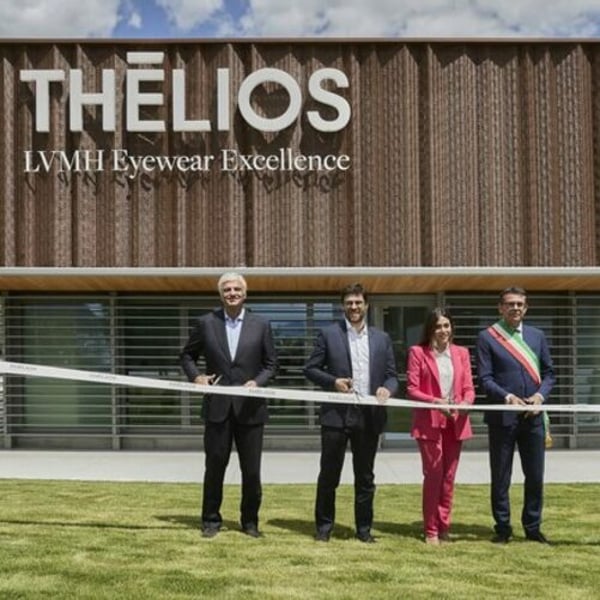
Thélios inaugurates its new factory with great fanfare. A 20,000-square-meter site adjacent to its headquarters in Longarone, Veneto. Bought from Safilo in October 2023 for 10 million euros, the facility, dedicated to metal eyewear from design to component manufacture and assembly, has been completely restructured. It joins the first factory of Thélios, LVMH‘s eyewear entity, just across the street, bringing the company’s total productive area to 40,000 square meters.
On the freshly planted lawn, Thélios CEO Alessandro Zanardo, LVMH Italy president Toni Belloni and local authorities cut the ribbon, not without a certain pride, at the entrance to the site in this steep Dolomite valley, home to Italy’s industrial eyewear district. The facade features the same elements as the first factory, dedicated to acetate eyewear, with the same “Thélios LVMH Eyewear Excellence” logo.
In eleven months, the rather sad and partly disused site has been transformed into a luminous workplace with, on the office side—the part that required the greatest investment as it was built ex novo with the garden—a succession of glassed-in rooms and planted courtyards serving as light wells, as well as common spaces such as the “agora,” a sort of open theater with tiered seating, located in the entrance hall, to encourage exchanges.
On the factory side, the premises are laid out in a gigantic open-space plateau stretching almost 200 meters in length, where workers concentrate on their tasks, each in front of his or her individual workbench or working on some of the latest-generation machines. A total of 352 people work here, out of a total workforce of 1,800 (including 1,300 in the Veneto region). All stages of production are carried out on site, from metal processing to mould development, engraving on metal frames, assembly of the various components, polishing, and quality control.

The plant, which today produces 6,000 pairs of spectacles a day out of a total output of 18,000 units a day, is fluidly structured around different departments. Some, like the welding and polishing units, didn’t exist before. They were developed from scratch and integrated into the site, which originally specialized in galvanizing (the process of applying a protective coating) and finishing. Today, the plant can offer 14 different metallic color tones. A large part of the production process is carried out by hand, while state-of-the-art machinery is used for certain tasks. The site also boasts a dedicated line for staff training.
“When you walk in here, it doesn’t look like a building from the 1980s. The renovation of the building has been a real success,” enthused Zanardo, who described it as “a long-term, sustainable project,” emphasizing the company’s vocation to be “a center of excellence in the eyewear industry.”
“It’s not just a question of relaunching a factory, but of elevating it to top production standards. And to think that, at the outset, the employees were a little wary. Today, they all want to come to the new site,” he said. “We started out as a start-up seven years ago and have gradually expanded, integrating the entire design and production process in-house, and for acetate technology, and now for metal.”
“It’s incredible to see the industrial growth of the project in seven years. Whereas the first two Thélios production modules were developed from scratch, here the structure existed, but it has been requalified, upgraded, and modernized. Through this acquisition, Thélios was also fortunate to find 250 people with a wealth of experience in a technique—metal—with which it was unfamiliar,” explained Belloni.

The company, which came under the full control of LVMH at the end of 2021, was initially set up as a joint venture with Italian eyewear manufacturer Marcolin.
In 2022, it acquired Metallart, a manufacturer specializing in metal, which, under its aegis, grew from 15 to 50 employees in a short space of time. At the time, Thélios was planning to build a brand-new plant devoted entirely to metal, on a plot of land located some fifteen kilometers from its headquarters. It was then that the opportunity arose to take over the Safilo site, threatened with closure.
A long year of negotiations between the two groups, the local authorities, and the unions followed before the takeover was finally completed, with the integration of the 250 employees of the Safilo plant.
“Having our two sites so close together is an undeniable advantage. It will also enable us to better adapt to market demand for different types of eyewear,” added Zanardo.
“In the last two or three years, we’ve seen a new craze for metal eyewear. This technique allows for some particularly detailed finishes for the luxury segment, which is a plus for us operating in this segment. What’s more, metal frames play an important role in prescription eyewear, thanks to their light weight,” he added.
Among the latest bestsellers from LVMH brands are three metal models: Celine‘s Triomphe Metal rimmed glasses, Dior‘s DiorCannage sunglasses, and the renewed popularity of Fendi‘s First Crystal model.
This article is an automatic translation.
Click here to read the original article.
Copyright © 2025 FashionNetwork.com All rights reserved.