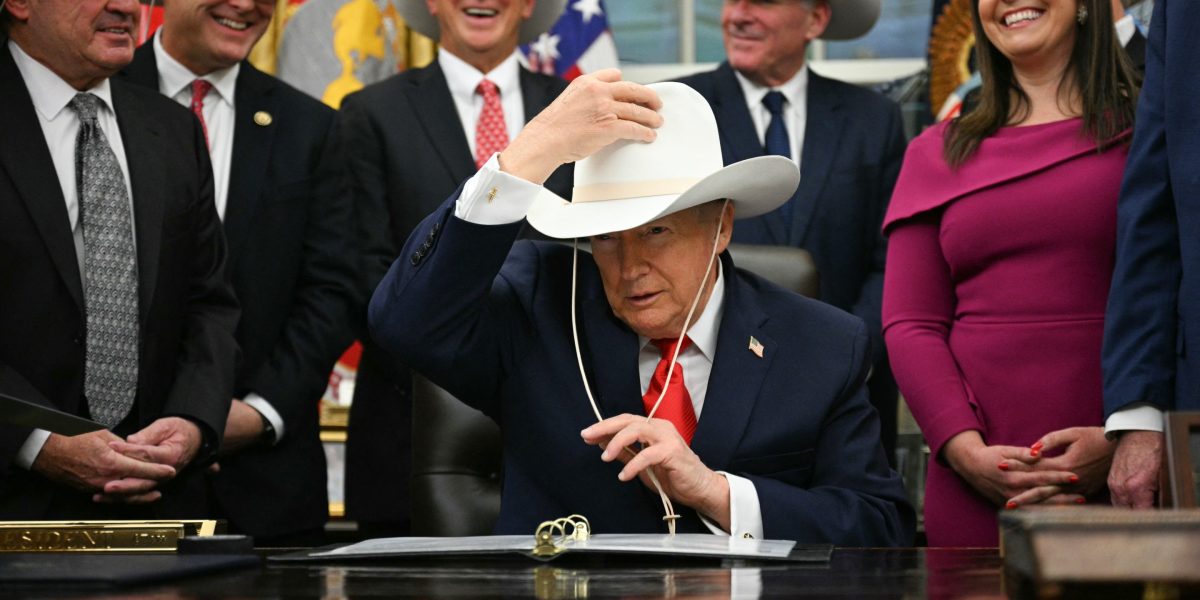
President Donald Trump convened what he called the single-largest gathering of American farmers at the White House on Friday, bringing together more than 800 cowboy-hat-wearing men and women. They filled the South Lawn alongside a shiny golden tractor as the president touted his support for the agricultural industry. “I just gave you $12 billion. I don’t know if you know that or not,” Trump boasted, referring to farm relief provided through the USDA’s Farmer Bridge Assistance Program. Apparently that wasn’t enough as he then told the crowd he asked Congress to approve additional relief in the next funding bill.
But much of the president’s support is actually falling into the hands of the wealthy, and a recent post from the libertarian think tank the Cato Institute demonstrates that disparity. The data seems to challenge the notion of a struggling farmer: the national average income of a U.S. farm household in 2024 was $159,334. That’s roughly 32% above the national mean household income, and nearly double the national median of $83,730.
And that’s not even taking into account the majority of subsidies, which data shows are going to the top 10% of farms. The post cites a 2023 report from the Government Accountability Office (GAO), which revealed that over 1,300 farmers with an adjusted gross income of more than $900,000 have received subsidies from the federal crop insurance program.
The federal crop insurance program was established in 1938 under President Franklin Delano Roosevelt to help the agricultural sector reciver from the Great Depression and the Dust Bowl. Since its inception, the program has evolved into a key support pillar to provide producers with financial protection against losses from natural disasters and economic downturns, such as droughts, freezes, damaging winds, and price fluctuations. While it began as a recovery measure, the program now covers more than 120 unique commodities, representing the vast majority of the value of U.S. crop production.
“The subsidies are not an emergency safety net for poor farm families but rather permanent welfare for high-earning businesses,” Chris Edwards, an editor at the Cato Institute, wrote in the blog post. “The government often calls crop insurance ‘market based’ but that cannot be true because the program costs taxpayers billions of dollars a year.” Edwards added that because there are no income limits on crop insurance, the top 10% of farmers capture 56% of all subsidies in the program.
A safety net—or welfare for the wealthy?
Even some billionaire farmers receive subsidies. A 2015 GAO report, for example, cited that four individuals—who earned their wealth through a variety of sources in addition to farming, such as mining, real estate, sports, and information technology—with a net worth of $1.5 billion or higher participated in the federal crop insurance program and received premium subsidies. The USDA withholds the names of certain farm subsidy recipients, so it’s not exactly clear which wealthy farmers received the subsidies.
A golden tractor during President Trump’s farmers event on the South Lawn.
Graeme Sloan/Bloomberg via Getty Images
Tariffs and the rising cost of inputs are placing much of America’s breadbasket into an increasingly precarious financial position. The Iran war is driving up energy costs and fertilizer prices. On top of that, some farms are facing pressure from the AI industry as firms look to convert farmland into data centers. Trump claimed Thursday U.S. farmers have been mistreated by some countries, and said he was taking action to support an industry battered by rising fuel and fertilizer prices caused by the Iran war.
In total, taxpayers are expected to pay $14.7 billion in 2026 for the federal crop insurance program, still just a fraction of the $7 trillion the U.S. spent in 2025, but a sizable sum, comparable to the size of federal agencies like the Environmental Protection Agency. Out of that $14.7 billion, about $9.6 billion goes to farmers, the other $5.1 billion to insurance companies. Spending on the program is only expected to rise, according to the Congressional Budget Office.
That growth has drawn critics, like Edwards, who argues the program benefits insurers as much as it does farmers. “The crop insurance program is like the government giving you $900 a year for your $1,500 car insurance premium, all while paying billions of dollars to GEICO, State Farm, and other insurance firms to boost their profits,” Edwards wrote.