Connect with us

Business

The U.S. has over 900 billionaires and their wealth soared by 18% to $6.9 trillion this year: UBS

Published

on


The United States remains the clear leader in global wealth creation, with its billionaire population expanding and their combined fortunes soaring over the past year, according to UBS Global Wealth Management’s Billionaire Ambitions Report for 2025. It reveals that U.S. billionaires’ wealth increased by almost a fifth (18% year on year) to a staggering $6.9 trillion in 2025.

This massive surge helped lift the global billionaire population to 2,919 individuals, holding a total record wealth of $15.8 trillion. The U.S. now hosts 924 billionaires, representing nearly a third (31.7%) of the global billionaire population. The growth in the Americas region, which was led by the U.S., saw overall billionaire wealth climb 15.5% to $7.5 trillion.

The dramatic increase in U.S. wealth was largely driven by an exceptional year for innovation and rising financial asset prices, the Swiss bank concluded. The United States welcomed 109 fresh entrants to the billionaire ranks, vastly outnumbering the 18 who dropped below the threshold or passed away. The growth was heavily buoyed by self-made success, as 87 new U.S. residents became self-made billionaires, contributing $171.9 billion to the Americas’ total new wealth.

The technology sector played a crucial role in this growth, UBS added, with tech billionaires globally seeing their assets increase by 23.8% to $3 trillion. This surge in tech wealth is closely linked to the appreciating values of companies driving the artificial intelligence revolution, such as Nvidia, Oracle, and Meta.

Six U.S. tech billionaires alone saw their wealth increase by a combined $171 billion compared with the previous year. This wave of entrepreneurship means that 2025 recorded the second-highest number of self-made individuals becoming billionaires in the history of the report, behind the remarkable year for markets that was 2021, demonstrating widespread business creation across diverse sectors.

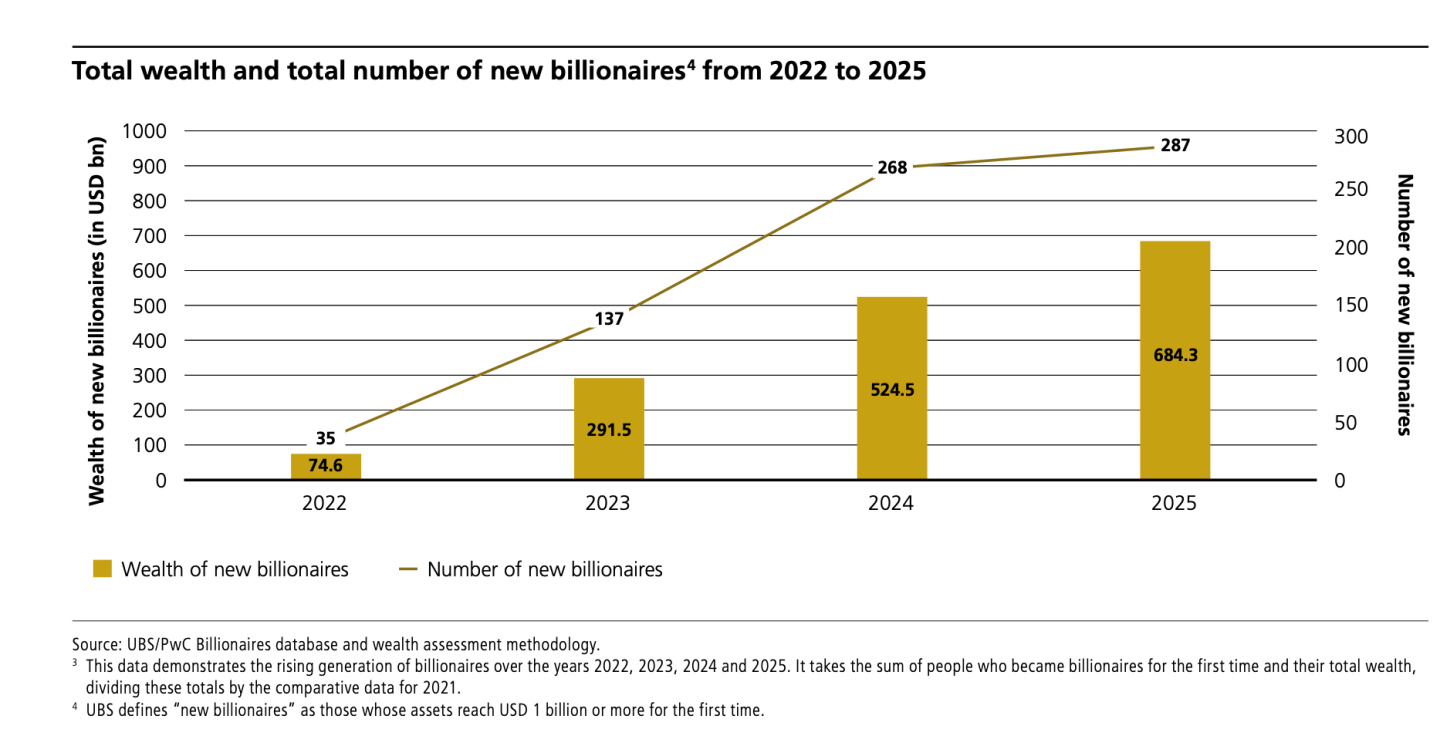
That year, 360 self-made billionaires accounted for $782 billion, an “exceptional rise [that] resulted from asset price appreciation in a period of ample financial liquidity following the COVID-19 pandemic.” The result in 2025 was more down to “widespread business creation,” UBS added. The report found the number of new billionaires minted annually increased roughly eightfold from 35 in 2022 to 287 in 2025, while their assets have grown by roughly ninefold, from $74.6 billion to $684.3 billion.
The coming transfer of wealth

While U.S. entrepreneurs are busy creating new wealth, the long-anticipated “great wealth transfer” is accelerating. Globally, at least $5.9 trillion is expected to be inherited by billionaire children over the next 15 years. Of that amount, at least $2.8 trillion will pass to U.S. heirs over this period. This calculation is likely conservative as it does not factor in future appreciation of asset values.

The report highlights that families are becoming increasingly international as the wealth transfer intensifies, yet the inheritance itself is set to be concentrated in a small number of markets, with the U.S. leading the way.

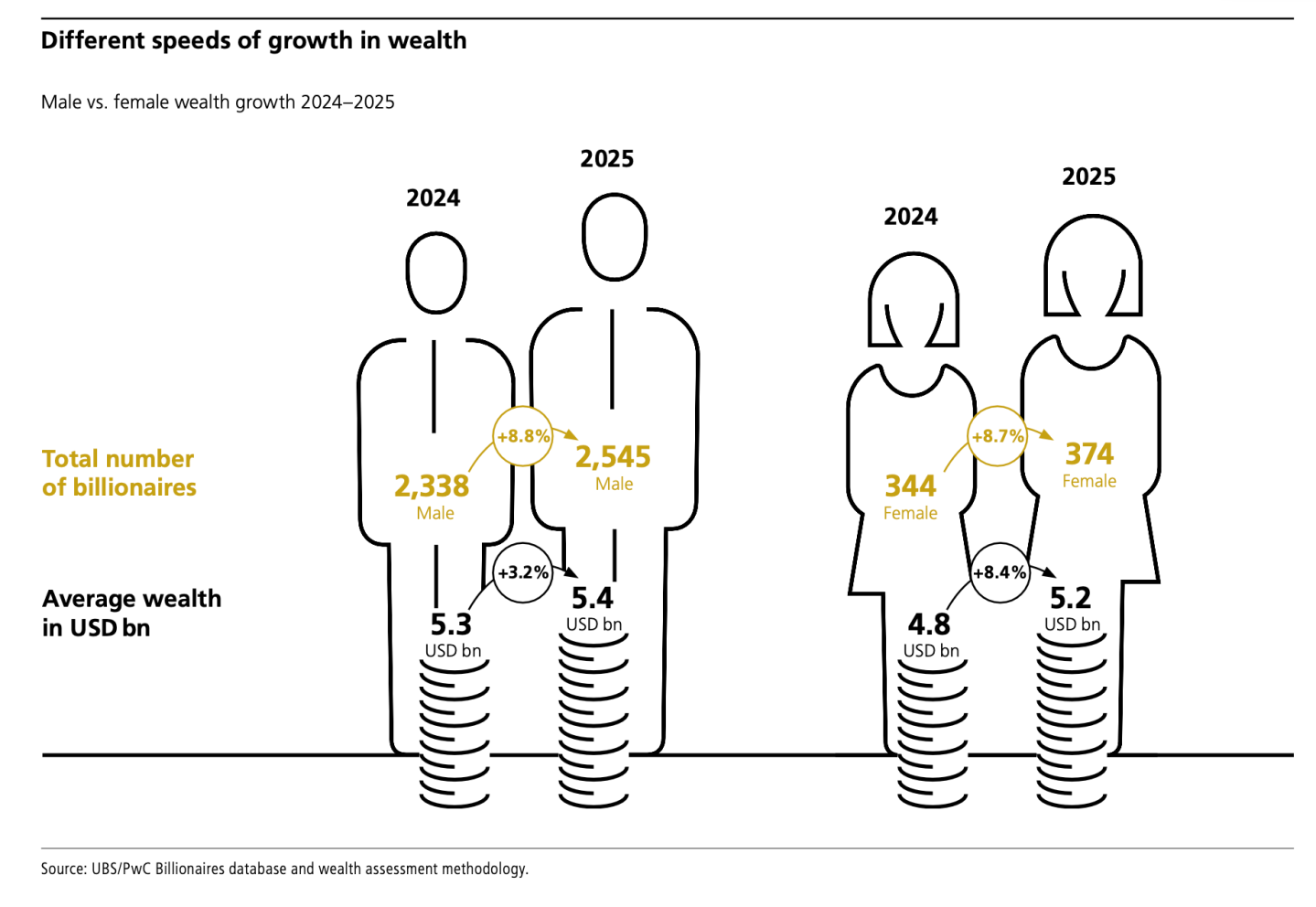
Female billionaires made notable progress in 2025, according to the report. While there are only 374 female billionaires globally, compared with 2,545 male, their average wealth grew by 8.4% to $5.2 billion in 2025, more than twice the 3.2% average growth rate for men. This is part of a trend, with the average wealth of female billionaires rising at a faster rate for each of the four years since 2022. In part, this is driven by inheritance, with more women becoming billionaires through inheritance than any other way in 2025. Of the 43 women who became billionaires in the year, UBS found that 27 inherited while 16 were self-made.
Despite the vast sums set for inheritance, surveyed billionaires expressed a strong desire for their children to achieve success independently. More than eight in 10 (82%) of those surveyed hope their children will develop the necessary skills and values to succeed without relying solely on the inherited fortune. Over half (55%) also want their heirs to use their wealth to make a positive impact on the world.

Furthermore, billionaires are highly mobile, with 36% of those surveyed having relocated at least once, and a further 9% considering a move. The top three reasons for relocation are linked to better quality of life (36%), geopolitical concerns (36%), and organizing tax affairs more efficiently (35%). This high level of mobility could potentially alter the geographic picture of where wealth is ultimately transferred.

The report was generated in part through an online survey of 87 billionaire clients as well as in-depth interviews which took place over several weeks in September and October.


Source link

Continue Reading

Business

CoreWeave CEO: Despite see-sawing stock, IPO was ‘incredibly successful’ amid challenges of tariff timing

Published

on


CoreWeave has been rocked by dizzying stock swings—with its stock currently trading 52% below its post-IPO high—and a frequent target of market commentators, but CEO Michael Intrator says the company’s move to the public markets has been “incredibly successful. And he takes the public’s mixed reaction in stride, given the novelty of CoreWeave’s “neocloud” business which competes with established cloud providers like Amazon AWS and Google Cloud.

“When you introduce new models, introduce a new way of doing business, disrupt what has been a static environment, it’s going to take some people some time,” Intrator said Tuesday at Fortune’s Brainstorm AI conference in San Francisco. But, he added, more people are beginning to understand the CoreWeave’s business model.

“We came out into one of the most challenging environments,” Intrator said of CoreWeave’s March IPO, which occurred very close to President Trump’s “Liberation Day” tariffs in April. “In spite of the incredible headwinds, we’re able to launch a successful IPO.”

CoreWeave, which priced its IPO at $40 per share, has experienced frequent severe up-and-down price swings in the eight months since its public market debut. At its closing price of $90.66 on Tuesday, the stock remains well above its IPO price.

As Fortune reported last month, CoreWeave’s rapid rise has been fueled by an aggressive, debt-heavy strategy to stand up data centers at unprecedented speed for AI customers. And for now, the bet is still paying off. In its third-quarter results released in November, the company said its revenue backlog nearly doubled in a single quarter—to $55.6 billion from $30 billion—reflecting long-term commitments from marquee clients including Meta, OpenAI, and French AI startup Poolside. Both earnings and revenue came in ahead of Wall Street expectations.

But the numbers were not all celebratory. CoreWeave disclosed a further increase in the debt it has taken on to finance its expansion, and it revised its full-year revenue outlook downward—suggesting that, even with historic demand in the pipeline.

With media headlines calling CoreWeave a “ticking time bomb,” with critics calling out insider stock sales, circular financing accusations and an overreliance on Nvidia, Intrator was asked whether he felt CoreWeave was misunderstood.

“Look, we built a company that is challenging one of the most stable businesses that exist—that cloud business, these three massive players,” he said, referring to AWS, Microsoft Azure and Google Cloud.  I feel like it’s incumbent on CoreWeave to introduce a new business model on how the cloud is going to be built and run. And that’s what we’re doing.” 

He repeatedly framed CoreWeave not as a GPU reseller or traditional data-center operator but as a company purpose-built from scratch to deliver high-performance, parallelized computing for AI workloads. That focus, he said, means designing proprietary software that orchestrates GPUs, building and colocating its own infrastructure, and moving “up the stack” through acquisitions such as Weights & Biases and OpenPipe.

Intrator also defended the company’s debt strategy, saying CoreWeave is effectively inventing a new financing model for AI infrastructure. He pointed to the company’s ability to repurpose power sources, rapidly deploy capacity, and finance large-scale clusters as proof it is solving problems incumbents never had to face.

“When I look back at history of the company, it took us a year with with a company investor like Fidelity, before they were like, ‘Oh, I get it,’” he said. “So look, we’ve been public for eight months. I couldn’t be prouder of what the company has accomplished.” 


Source link

Continue Reading

Business

UK launches $965 million plan to get unemployed Gen Z into AI, hospitality, and engineering

Published

on


Some Gen Zers have been desperately trying to break into the job market, sending out thousands of applications, standing on Wall Street with a sign begging for a job, and waitressing at industry conferences to stealthily hand out their résumés. There’s also a growing camp of disillusioned young adults who have completely checked out of education, employment, and training: NEETs. Now, one country is trying to tackle the youth unemployment crisis with a nearly $1 billion plan.

Earlier this week, the U.K. government announced a $965 million investment to create more apprenticeships and place 50,000 young people into roles.

In partnership with regional leaders, the three-year initiative will equip young hopefuls with the skills training needed for local job opportunities. A $186 million chunk of the eye-watering funding will be used for a pilot in which mayors will connect the Gen Zers, especially NEETs, with nearby employers. And to ease the financial burden on some companies, the plan will also cover the full cost of apprenticeships for talent under 25 years old at small and medium-size businesses.

U.K. Gen Zers will have access to more apprenticeship roles in high-demand industries like hospitality and retail. But the government is still paying close attention to the critical skills young professionals need in the age of AI; new short courses in engineering, digital skills, and AI will also start rolling out starting April 2026. This apprenticeship push by the U.K. is all part of Prime Minister Keir Starmer’s master plan to get two-thirds of young people active in higher-level learning and apprenticeships, after a sharp drop in 2017.

“For too long, success has been measured by how many young people go to university. That narrow view has held back opportunity and created barriers we need to break,” Starmer said. “It’s time to change the way apprenticeships are viewed and to put them on an equal footing with university.”

Gen Zers are struggling with unemployment in the U.K. and abroad

The U.K.’s ambitious billion-dollar strategy is a welcome one, as youth unemployment rates have surged all around the world.

During the first half of last year, more than 16%, or almost 460,000 of 18- to 24-year-old U.K. men, were NEETs—the highest rate in over a decade. On a global scale, about a fifth of people between ages 15 and 24 in 2023 were NEET-status. And for those actively on the job-hunt, options are scarce. In 2023 and 2024, more than 1.2 million applications were submitted for just under 17,000 open graduate roles in the U.K., according to the Institute of Student Employers (ISE). 

It marked the highest number of applications per job ever recorded since the ISE started collecting data in 1991.

But across the pond, the situation doesn’t look any better: In 2022, there were roughly 4.3 million jobless Gen Z NEETs in the United States. And as of September this year, 9.4% of men and 9% of women ages 20 to 24 were jobless—more than two times higher than the general 4.4% unemployment rate, according to a FRED analysis of U.S. Bureau of Labor Statistics data. 

What’s more, U.S. officials caution the problem could get even worse. U.S. Sen. Mark Warner (D-Va.) warned that joblessness among recent college graduates could skyrocket to as high as 25% in the next two to three years, thanks to AI. 

Similar to the U.K. government, Warner proposed a job retraining program—and the issue goes beyond party lines. In partnership with Josh Hawley (R-Mo.), they introduced a bill that would require businesses and federal agencies to report any AI-related job disruption to the Department of Labor, with results to be published to the public. 


Source link

Continue Reading

Business

Physical AI will automate ‘large sections’ of factory work in the next decade, Arm CEO says

Published

on


AI-powered humanoid robots could take over large sections of factory work within the next five to ten years, transforming the manufacturing industry, predicts Arm CEO Rene Haas.

One of the key forces pushing humanoid robots into factories is their advantage over the robotic arms and other automation machinery in use today, Haas said. Traditional factory robots are purpose-built machines designed for a single task, with both hardware and software optimized for that specific function. General purpose humanoid robots by contrast, combined with increasingly sophisticated “physical AI” that helps navigate the real world, will be able to take on different jobs on-the-fly with quick modifications to their instructions.

“I think in the next five years, you’re going to see large sections of factory work replaced by robots—and part of the reason for that is that these physical AI robots can be reprogrammed into different tasks,” Haas said at Fortune’s Brainstorm AI conference in San Francisco on Monday.

“One of the issues you’d had with factory robots in the past is that if it was a pick and place machine for a factory, they’re just optimized for one task—the software was for one task, the hardware is for one task. Now, if you design a general-purpose humanoid that the software is all AI and it learns by doing, it’s going to completely replace a large set of factory workers,” he said.

What happens to those workers and the broader job market as AI and robots proliferate in businesses is a growing concern among many policymakers and industry-observers, with ideas ranging from worker re-skilling to universal basic income among the options under debate.

Haas did not specifically address the jobs issue, but suggested that widespread physical AI adoption could reshape global manufacturing dynamics, potentially helping to level the global competitive playing field by automating a large amount of factory work. “Physical AI will be a great enabler,” he said. 

Haas also pointed to Waymo’s autonomous vehicles as an early indicator of physical AI’s potential. 

He said the next generation of autonomous systems may require even less hardware. While current self-driving cars are fitted with radar and cameras surveying their surroundings, future iterations using more advanced AI models could operate with fewer sensors—relying on artificial intelligence rather than exhaustive data collection to make decisions.

The semiconductor supply chain has ‘many single points of failure’

Arm, which does not manufacture or sell its own chips, designs and licenses the architecture used in processors made by companies including Qualcomm and Apple. Chips based on Arm’s designs are used in everything from smartphones and refrigerators to cars and servers, and most people use between 50 to 100 Arm chips on their person or in their homes, Haas said.

That widespread use and market share is a testament to the energy efficiency and performance that have made Arm’s chip design so popular. But it also raises risks to the semiconductor supply chain.

Asked about this vulnerability, Haas acknowledged the extreme market concentration within the industry, and noted that several large companies each control vital parts of the semiconductor supply chain.

“The semiconductor supply chain has many single points of failure…there’s TSMC, which is in a very obviously interesting part of the world geopolitically. There is also a very sophisticated device that has to go into these fabs that comes from one company on the planet…called the ASML.”

In the last few years, the COVID-19 pandemic exposed some of these supply chain fragilities when chip shortages left consumers unable to get key fobs for new cars for weeks. That crisis, Haas said, was “just a function of the semiconductor supply chain that has many single points of failure.”

Haas said the entire industry is “learning to live with” the concentration risk. 

Read more from Fortune Brainstorm AI:

Cursor developed an internal AI help desk that handles 80% of its employees’ support tickets, says the $29 billion startup’s CEO

OpenAI COO Brad Lightcap says ‘code red’ will force the company to focus, as the ChatGPT maker ramps up enterprise push

Amazon robotaxi service Zoox to start charging for rides in 2026, with ‘laser focus’ on transporting people, not deliveries, says cofounder


Source link

Continue Reading

Trending

Copyright © Miami Select.