Connect with us

Business

The threat to kick China out of U.S. exchanges is growing, and Hong Kong stands to benefit

Published

on


Those exposed to Chinese ADRs—whether it’s a CEO of a U.S.-listed Chinese company, or an equity strategist dealing with the China market—are now all considering one question: Is the U.S. really going to kick Chinese companies off its stock exchanges?

Some of China’s largest companies trade in the U.S., including JD.com (No. 47 on the Fortune Global 500), Alibaba (No. 70) and PDD Holdings (No. 442). But these giants and many much smaller companies could have their existence as U.S.-traded companies threatened by a revived trade war against Beijing launched by U.S. President Donald Trump. 

Last week, several Republican members of Congress, including Representative John Moolenaar, chair of the House Select Committee on the Chinese Communist Party, wrote recently appointed Securities and Exchange Commission Chair Paul Atkins to “express grave concern over the continued presence of Chinese companies on U.S. stock exchanges.” 

In a letter reported by the Financial Times, the lawmakers pointed to U.S.-listed Chinese companies, large and small, from giants like Alibaba and JD.com to smaller startups like EV brand Xpeng and self-driving car provider Pony.AI.

‘Everything is on the table’

Worries over delisting have grown since late February, when Trump revived the threat of kicking Chinese companies off U.S. exchanges in his “America First Investment Plan.” In his memo, Trump ordered officials to determine whether Chinese companies were upholding U.S. auditing standards and investigate the structures these firms use to list on foreign exchanges. 

Since then, administration officials have declined to rule out taking action against U.S.-listed Chinese companies, with Treasury Secretary Scott Bessent noting in a mid-April TV interview that “everything is on the table.”

“The threat is growing in a significant way,” says Sandeep Rao, a researcher at Leverage Shares. 

The NASDAQ Golden Dragon China Index, which tracks Chinese companies listed in the U.S., is down by around 7% since “Liberation Day.” By comparison, Hong Kong’s Hang Seng Tech Index, which tracks tech companies traded in the Chinese city (including some that also trade in the U.S.) is down by 4.6% over the same period. 

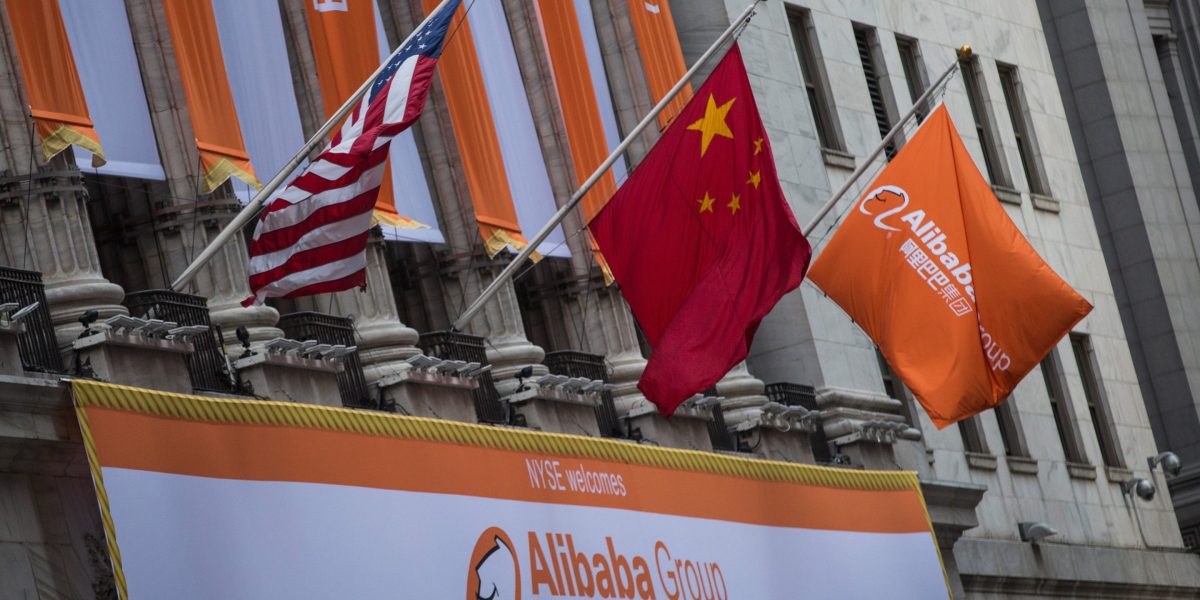
Chinese companies have long turned to the U.S.’s deep and liquid markets to raise capital. Alibaba’s IPO on the New York Stock Exchange in 2014 raised $25 billion, the world’s largest IPO at the time, and only superseded by Saudi Aramco’s 2019 listing in Riyadh. 

As of the end of March, 286 Chinese companies are listed on U.S. exchanges, with a total market value of $1.1 trillion, according to exchange data cited by the South China Morning Post

Yet U.S. investors have grumbled about poor auditing standards among Chinese companies. Technically, companies listed in the U.S. need to open their books to U.S. regulators, but Chinese officials often bar such access citing national security. The revelation in 2020 that Chinese coffee chain Luckin Coffee had inflated its sales was the last straw for Congress, which passed the Holding Foreign Companies Accountable Act that ordered Chinese companies to grant access to U.S. regulators or risk getting thrown off U.S. exchanges.

After years of negotiations, China in 2022 agreed to let U.S. regulators review auditing documents in the Chinese city of Hong Kong, lifting the delisting threat and calming investors.

Still, the damage had already been done, as U.S.-listed Chinese companies began to explore secondary listings in Hong Kong. Last year, Alibaba upgraded its Hong Kong listing to a primary listing, allowing the Chinese e-commerce company to tap mainland Chinese investors through the city’s Southbound Connect scheme.

Some investors “have been shifting over from holding the U.S. ticker to the Hong Kong ticker because of the delisting threat,” Rao says.

Hong Kong might be a winner

In mid-April, Goldman Sachs estimated that U.S. institutional investors hold about $830 billion worth of shares in Chinese companies, spread across the mainland Chinese, Hong Kong, and U.S. markets. About $250 billion of that is in Chinese ADRs.

Still, “holdings of equities by foreigners, particularly U.S. holders, have come down meaningfully versus where we were five years ago,” Cameron Chui, Asia equity strategist for JPMorgan Private Bank, said during a Wednesday briefing to reporters when asked the possibility of delistings. “The risk has definitely been meaningfully reduced.”

Rao notes that U.S. investors might still be able to keep trading in Chinese companies even if they do get delisted—it would just be in the less protected OTC market. Tencent, one of China’s largest tech companies, has its main listing in Hong Kong, but also trades in the U.S. OTC market. 

Meanwhile, Chinese companies are already murmuring about other options. In a conversation with reporters on the sidelines of the Shanghai Auto Show, Pony.ai CEO James Peng said a secondary listing in Hong Kong was possible, though affirmed the startup was focusing on releasing its next generation of vehicles.

Geely Auto is also taking its U.S.-listed EV brand Zeekr private, just one year after its New York IPO, to streamline the Chinese auto giant’s operations and improve profitability. 

In its mid-April report, Goldman Sachs highlighted 27 U.S.-listed Chinese companies that will likely be eligible for a Hong Kong listing (whether a secondary or primary listing), including PDD, retail stock trading platform Futu, and digital logistics platform Full Truck Alliance. 

But some Chinese companies are braving geopolitics to pursue a U.S. listing. Chagee, a Chinese tea chain, raised $411 million in a U.S. IPO, debuting on the Nasdaq on April 17. 

Hong Kong looks like a more attractive—or, at least, a less bad—place to trade shares. A primary listing in the city opens up the possibility of mainland Chinese investors trading the company’s shares. Southbound flows (i.e. from mainland China into Hong Kong) have surged in recent months, as mainland Chinese investors barrel into the AI boom represented by companies like Alibaba and Semiconductor International Manufacturing Corporation

“It’s quite sensible to have, at the very least, a secondary listing in Hong Kong if you’re a U.S.-listed Chinese company,” Rao says. 

The city is going through an IPO revival, as mainland Chinese companies now hope to tap global capital through an “overseas” listing. Last November, a $4 billion IPO by Midea, the world’s largest maker of home appliances, kicked things off; Mixue, an ice-cream chain with more outlets than McDonald’s, followed in March.

Hong Kong is expecting at least two more blockbuster IPOs in the coming months. CATL, the main supplier of batteries for Tesla, hopes to raise $5 billion in Hong Kong in the near future. (JPMorgan and Bank of America are assisting with the IPO, which has attracted congressional scrutiny.) Chinese automaker Chery Auto is also gearing up for a Hong Kong listing to raise $1.5 billion. 

But Hong Kong isn’t a perfect replacement for New York. “There are no positives from this. Liquidity in Hong Kong is not the same as in the U.S.,” Chui said on Wednesday.

This story was originally featured on Fortune.com


Source link

Continue Reading

Business

MacKenzie Scott tries to close the higher ed DEI gap, giving away $155 million this week alone

Published

on

MacKenzie Scott has arguably been the biggest name in philanthropy this year—and has nonstop been making major gifts to organizations focused on education, DEI, disaster recovery, and many other causes.

This week alone, several higher education institutions announced major gifts from the billionaire philanthropist and ex-wife of Amazon founder Jeff Bezos—donations totaling well over $100 million. In true Scott fashion, many of these donations are the largest single donations these schools have ever received.

The donations announced this week include: 

  • $50 million to California State University-East Bay
  • $50 million to Lehman College (part of the City University of New York system)
  • $38 million to Texas A&M University-Kingsville
  • $17 million to Seminole State College

All four institutions are public, access-oriented colleges that enroll large shares of low‑income, first‑generation, and racially diverse students and function as minority‑serving institutions or similar engines of social mobility. They fit MacKenzie Scott’s broader pattern of directing large, unrestricted gifts to colleges that serve “chronically underserved” communities rather than already wealthy, highly selective universities.

Scott, who is worth about $40 billion and has donated over $20 billion in the past five years, has doubled down this year on causes that the Trump administration has cut deeply, such as education, DEI, and disaster recovery.

“As higher education, in general, works to find its way in an uncertain environment, this gift is a major source of encouragement that we are on the right path,” Lehman College President Fernando Delgado said in a statement. 

Scott also made one of the largest donations in HBCU Howard University’s 158-year history with an $80 million gift earlier this fall, and a $60 million donation to the Center for Disaster Philanthropy after Trump administration’s cuts to the Federal Emergency Management Agency (FEMA)—an organization Americans rely on for help during and after hurricanes, wildfires, tornadoes, and floods.

“All sectors of society—public, private, and social—share responsibility for helping communities thrive after a disaster,” CDP president and CEO Patricia McIlreavy previously told Fortune. “Philanthropy plays a critical role in providing communities with resources to rebuild stronger, but it cannot—and should not—replace government and its essential responsibilities.”

Trust-based philanthropy

Scott accumulated the vast majority of her wealth from her 2019 divorce from Bezos, but is dedicated to giving away most of her fortune. She’s considered a unique philanthropist in today’s environment because her gifts are typically unrestricted, meaning the organizations can use the funding however they choose. 

“She practices trust-based philanthropy,” Anne Marie Dougherty, CEO of the Bob Woodruff Foundation previously told Fortune. Scott has donated $15 million to the veteran-focused nonprofit organization in 2022, and made a subsequent $20 million donation this fall.

Scott is also considered one of the most generous philanthropists, and credits acts of kindness for inspiring her to give back.

“It was the local dentist who offered me free dental work when he saw me securing a broken tooth with denture glue in college,” Scott wrote of her inspiration for philanthropy in an Oct. 15 essay published to her Yield Giving site. “It was the college roommate who found me crying, and acted on her urge to loan me a thousand dollars to keep me from having to drop out in my sophomore year.”


Source link

Continue Reading

Business

Netflix’s bombshell deal to buy Warner Bros. brings Batman and Harry Potter to the streamer, infuriates theater owners and the Ellisons

Published

on


Netflix’s agreement to buy Warner Bros. in a $72 billion deal marks a seismic shift in Hollywood, handing the streaming giant control of iconic franchises such as Batman and Harry Potter and triggering an immediate backlash from theater owners and the jilted Ellison family behind Paramount. The bombshell transaction, struck after a bidding war that ensued after David Ellison’sunsolicited bids several months ago, positions Netflix ever more at the center of the Southern California entertainment business that the Northern California company disrupted so famously decades ago.

The deal will see Netflix acquire Warner Bros. Discovery’s film and TV studios and its streaming operations, including HBO Max, in a deal with an equity value of roughly $72 billion, or about $27.75 per share in cash and stock, valuing Warner Bros. at $82.7 billion. The agreement followed a heated auction in which Netflix’s bid edged out offers from Paramount Skydance and Comcast, both of which had pushed to keep the storied Warner assets in more traditional hands.

Two days before Netflix won the bidding, Paramount hinted at its fury with a strongly worded letter to WBD CEO David Zaslav, arguing the process was “tainted” and Warner Bros. was favoring a single bidder: Netflix. Paramount called it a “myopic process with a predetermined outcome that favors a single bidder,” Bloomberg reported, although Netflix’s bid is understood to be the highest of the three.

Another angry group is theater owners, who have famously warred with Netflix for years over the big red streamer’s reluctance, even refusal to follow traditional theatrical-release practices. Netflix Co-CEO Ted Sarandos has adamantly defended Netflix’s streaming-forward distribution, saying it’s what consumers really want. At the Time 100 event in April of this year, Sarandos called theatrical release “an outmoded idea for most people” and said Netflix was “saving Hollywood” by giving people what they want: streaming at home.

Cinema United, the trade association which represents over 30,000 movie screens in the U.S. and 26,000 internationally, immediately announced its opposition to Netflix acquiring a legacy Hollywood studio. The organization’s chief, Michael O’Leary, said it “poses an unprecedented threat to the global exhibition business” as Netflix’s states business model simply does not support theatrical exhibition. He urged regulators to look closely at the acquisition.

Deadline reported that other producers are warning of “the death of Hollywood” as a result of this deal. Several days earlier, Bank of America Research’s analysts had surveyed the landscape and concluded that as a defensive move, Netflix would be “killing three birds with one stone,” as its ownership of Warner Bros’ would be a daunting blow to Paramount and Comcast, while taking the Warner legacy studio out of the running. The bank calculated that a combined Netflix and Warner Bros. would comprise roughly 21% of total streaming time—still shy of YouTube’s 28% hold on the market, but far greater than Paramount’s 5% and Comcast’s 4%.

What’s known and what’s still at play

As part of the deal, Netflix will retain the studio that controls the superheroes of DC, the Wizarding World of Harry Potter, and HBO’s prestige brands. Other details on what will happen to the standalone streaming service HBO Max were scant, with the companies saying only that Netflix will “maintain” Warner Bros. current operations. The companies expect the transaction to close after regulatory review, with Netflix projecting billions in annual cost savings by the third year after completion.

​The deal will not include all of Warner Bros. Discovery, according to the press release announcing the acquisition, which said the previously announced plans to separate WBD’s cable operations will be completed before the Netflix deal, in the third quarter of 2026. The newly separated publicly traded company holding the Global Networks division will be called Discovery Global, and will include CNN, TNT Sports in the U.S., as well as Discovery, free-to-air channels across Europe, plus digital products such as Discovery+ and Bleacher Report.  

On a conference call with reporters Friday morning, Sarandos said Netflix is “highly confident in the regulatory process,” calling the deal pro-consumer, pro-innovation, pro-worker, pro-creator and pro-growth. He said Netflix planned to work closely with regulators and was running “full speed” ahead toward getting all regulatory approvals. He added that Netflix executives were “tired” after “an incredibly rigorous and competitive process.” Alluding to Netflix’s traditional resistance to big M&A, Sarandos added that “we don’t do many of these, but we were deep in this one.”

Influential entertainment journalist Matt Belloni of Puck previewed the likely deal on Bill Simmons’ podcast on Spotify’s Ringer network (which recently struck a deal to bring some video podcasts to Netflix), and they speculated about potential problems inside Netflix that brought the deal to a head. In conversation about how defensive the move is, Belloni said Netflix is “doing this for a reason” and may have reached a “stress point” because it hasn’t been getting traction with its own moviemaking efforts after 10 years of trying. (Netflix has also been agonizingly close to an elusive Best Picture Oscar, with close calls on Roma and Emilia Perez, the latter of which was derailed in a bizarre social-media controversy.) Belloni also acknowledged the criticism that Netflix has struggled to create its own franchises, also after years of trying.

Sarandos highlighted Netflix’s homegrown franchises while announcing the deal, arguing that Netflix’s ” culture-defining titles like Stranger Things, KPop Demon Hunters and Squid Game” will now combine with Warner’s deep library including classics Casablanca and Citizen Kane, even Friends.

The biggest losers in the bidding war may be David Ellison and his father, Oracle co‑founder (and long-time Republican donor)Larry Ellison, whose Paramount‑Skydance empire had been widely seen as a front‑runner to acquire Warner Bros. Discovery. David Ellison, has since reportedly been pleading his case around Washington, meeting Trump administration officials as allies float antitrust and national‑interest concerns about giving Netflix control of such a critical studio.

While Netflix has tried to calm regulators by arguing that a combined Netflix–HBO Max bundle would increase competition with Disney and others, the Ellisons and their supporters are signaling they will continue to press for tougher scrutiny or even intervention. Large M&A has made a big comeback in 2025 as the Trump administration has been notably friendlier to big deals than the deep freeze of the Biden administration, making this deal an acid test for just how true that is when a company with deep ties to the White House gets jilted.​

[Disclosure: The author worked internally at Netflix from June 2024 through July 2025.]


Source link

Continue Reading

Business

Elon Musk and Bill Gates are wrong about AI imminently replacing all jobs. ‘That’s not what we’re seeing,’ LinkedIn exec slams

Published

on

The future of work as we know it is hanging by a thread—at least, that’s what many tech leaders consistently say. Elon Musk predicts AI will replace all jobs in less than 20 years. Bill Gates says even those who train to use AI tools may not be safe from its claws. And then there’s Klarna’s CEO, Sebastian Siemiatkowski, who is even warning workers that “tech bros” are sugarcoating just how badly it’s about to impact jobs.

But according to one LinkedIn exec, that’s simply not what the data is showing. 

With hundreds of millions of workers hunting for jobs and employers posting open roles in real time, LinkedIn acts as one of the clearest barometers of what’s actually happening on the ground—and its managing director for EMEA, Sue Duke, is not buying the AI apocalypse narrative.

“That’s not what we’re seeing,” Duke revealed at the Fortune CEO Forum in The Shard in London. When asked about an AI-induced hiring slowdown she insisted that the opposite is actually true. 

“What we’re seeing is that organizations who are adopting and integrating this technology, they’re actually going out and hiring more people to really take advantage of this technology,” Duke explained. 

“They’re going out and looking for more business development people, more technologically savvy people, and more sales people as they realize the business opportunities, the innovation possibilities, and ultimately the growth possibilities of this technology.”

For the millions of job seeking Gen Zers—who keep being told that entry-level jobs are about the get swallowed by AI and that a youth unemployment crisis is well underway—the news will be a welcome surprise.

LinkedIn exec breaks down exactly what employers are looking for from new hires in 2026

For those looking to make the most of the job market’s shift, Duke says there are two key areas to upskill in.

The first, no surprise one, is AI skills. Whether that’s literacy, tooling, prompt-writing, or more technical capabilities, “we continue to see those AI skills being red, red hot in the labor market,” she said. 

With companies racing to integrate automation into products and workflows, that demand isn’t cooling anytime soon—no matter what industry you’re looking to work in. “We see a huge demand for those skills across the board, economy-wide, across all sectors, and tons of companies looking for those,” Duke added.

As AI takes over many administrative tasks, it’s putting the spotlight on job functions that bots can’t do. “Those unique human skills,” Duke said, is the second area of focus for employers. “They remain rock solid, constant at the heart of hiring desires and demands out there. They’re not going away either.”

She called out communication, team building, and problem solving, as some of those human skills that will stand the test of time: “They’re the ones to invest in.”

And ultimately, the skill employers are zeroing in on most isn’t technical at all—it’s adaptability. Bosses know the tools will change faster than job titles. What they want is someone who can change with them.

“The most important thing for job seekers to think about is the mindset that you’re also bringing to the table,” Duke concluded. 

“What employers are really looking for is that growth mindset and understanding that this technology is moving very, very quickly, and we need adaptability. Adaptability is right at the top of those most in-demand skills, so making sure you’re bringing that mindset, bringing that agility with you, that’s going to be hugely important.”


Source link

Continue Reading

Trending

Copyright © Miami Select.