Connect with us

Business

The technie who allegedly showed Sam Altman and Jony Ive a drawing of an AI device just got sued by his former employer

Published

on


A secretive competition to pioneer a new way of communicating with artificial intelligence chatbots is getting a messy public airing as OpenAI fights a trademark dispute over its stealth hardware collaboration with legendary iPhone designer Jony Ive.

In the latest twist, tech startup iyO Inc., which already sued Ive and OpenAI CEO Sam Altman for trademark infringement, is now suing one of its own former employees for allegedly leaking a confidential drawing of iyO’s unreleased product.

At the heart of this bitter legal wrangling is a big idea: we shouldn’t need to stare at computer or phone screens or talk to a box like Amazon’s Alexa to interact with our future AI assistants in a natural way. And whoever comes up with this new AI interface could profit immensely from it.

OpenAI started to outline its own vision in May by buying io Products, a product and engineering company co-founded by Ive, in a deal valued at nearly $6.5 billion. Soon after, iyO sued for trademark infringement for the similar sounding name and because of the two firms’ past interactions.

U.S. District Judge Trina Thompson ruled last month that iyO has a strong enough case to proceed to a hearing this fall. Until then, she ordered Altman, Ive and OpenAI to refrain from using the io brand, forcing them to take down the web page and all mentions of the venture.

A second lawsuit from iyO filed this week in San Francisco Superior Court accuses a former iyO executive, Dan Sargent, of breach of contract and misappropriation of trade secrets over his meetings with another io co-founder, Tang Yew Tan, a close Ive ally who led design of the Apple Watch.

Sargent left iyO in December and now works for Apple. He and Apple didn’t immediately respond to a request for comment.

“This is not an action we take lightly,” said iyO CEO Jason Rugolo in a statement Thursday. “Our primary goal here is not to target a former employee, whom we considered a friend, but to hold accountable those whom we believe preyed on him from a position of power.”

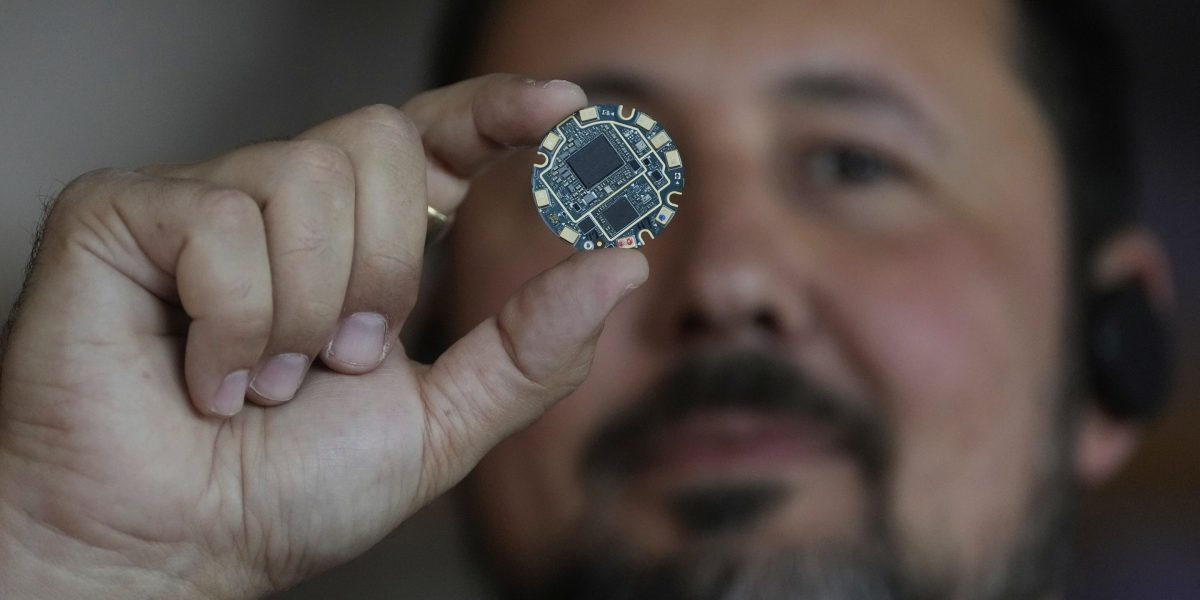
Rugolo told The Associated Press last month that he thought he was on the right path in 2022 when he pitched his ideas and showed off his prototypes to firms tied to Altman and Ive. Rugolo later publicly expanded on his earbud-like “audio computer” product in a TED Talk last year.

What he didn’t know was that soon after, Ive and Altman would begin quietly collaborating on their own AI hardware initiative and give it a similar name.

“I’m happy to compete on product, but calling it the same name, that part is just amazing to me. And it was shocking,” Rugolo said in an interview.

The new venture was revealed publicly in a May video announcement, and to Rugolo about two months earlier after he had emailed Altman with an investment pitch.

“thanks but im working on something competitive so will (respectfully) pass!” Altman wrote to Rugolo in March, adding in parentheses that it was called io.

Altman has dismissed iyO’s lawsuit on social media as a “silly, disappointing and wrong” move from a “quite persistent” Rugolo. Other executives in court documents have characterized the product Rugolo was pitching them as a failed one that didn’t work properly in a demo.

Altman said in a written declaration that he and Ive chose the “io” name two years ago in reference to the concept of “input/output” that describes how a computer receives and transmits information. Neither io nor iyO was first to play with the phrasing — Google’s big annual technology showcase is called I/O — but Altman said he and Ive acquired the io.com domain name in August 2023.

The idea was “to create products that go beyond traditional products and interfaces,” Altman said. “We want to create new ways for people to input their requests and new ways for them to receive helpful outputs, powered by AI.”

A number of startups have already tried, and mostly failed, to build gadgetry for AI interactions. The startup Humane developed a wearable pin that you could talk to, but it was poorly reviewed and the startup discontinued sales after HP acquired its assets earlier this year.

Altman has suggested that io’s version could be different. He said in a now-removed video that he’s already trying a prototype at home that Ive gave him, calling it “the coolest piece of technology that the world will have ever seen.”

What Altman and Ive still haven’t said is what exactly it is. The court case, however, has forced their team to disclose what it’s not.

“Its design is not yet finalized, but it is not an in-ear device, nor a wearable device,” said Tan in a court declaration that sought to distance the venture from iyO’s product.

It was that same declaration that led iyO to sue Sargent this week. Tan revealed in the filing that he had talked to a “now former” iyO engineer who was looking for a job because of his frustration with “iyO’s slow pace, unscalable product plans, and continued acceptance of preorders without a sellable product.”

Those conversations with the unnamed employee led Tan to conclude “that iyO was basically offering ‘vaporware’ — advertising for a product that does not actually exist or function as advertised, and my instinct was to avoid meeting with iyO myself and to discourage others from doing so.”

IyO said its investigators recently reached out to Sargent and confirmed he was the one who met with Tan.

Rugolo told the AP he feels duped after he first pitched his idea to Altman in 2022 through the Apollo Projects, a venture capital firm started by Altman and his brothers. Rugolo said demonstrated his products and the firm politely declined, with the explanation that they don’t do consumer hardware investments.

That same year, Rugolo also pitched the same idea to Ive through LoveFrom, the San Francisco design firm started by Ive after he left Apple. Ive’s firm also declined.

“I feel kind of stupid now,” Rugolo added. “Because we talked for so long. I met with them so many times and demo’d all their people — at least seven people there. Met with them in person a bunch of times, talking about all our ideas.”


Source link

Continue Reading

Business

Why the timing was right for Salesforce’s $8 billion acquisition of Informatica — and for the opportunities ahead

Published

on


The must-haves for building a market-leading business include vision, talent, culture, product innovation and customer focus. But what’s the secret to success with a merger or acquisition? 

I was asked about this in the wake of Salesforce’s recently completed $8 billion acquisition of Informatica. In part, I believe that people are paying attention because deal-making is up in 2025. M&A volume reached $2.2 trillion in the first half of the year, a 27% increase compared to a year ago, according to JP Morgan. Notably, 72% of that volume involved deals greater than $1 billion. 

There will be thousands of mergers and acquisitions in the United States this year across industries and involving companies of all sizes. It’s not unusual for startups to position themselves to be snapped up. But Informatica, founded in 1993, didn’t fit that mold. We have been building, delivering, supporting and partnering for many years. Much of the value we bring to Salesforce and its customers is our long-earned experience and expertise in enterprise data management. 

Although, in other respects, a “legacy” software company like ours — founded well before cloud computing was mainstream — and early-stage startups aren’t so different. We all must move fast and differentiate. And established vendors and growth-oriented startups have a few things in common when it comes to M&A, as well. 

First and foremost is a need to ensure that the strategies of the two companies involved are in alignment. That seems obvious, but it’s easier said than done. Are their tech stacks based on open protocols and standards? Are they cloud-native by design? And, now more than ever, are they both AI-powered and AI-enabling? All of these came together in the case of Salesforce and Informatica, including our shared belief in agentic AI as the next major breakthrough in business technology.

Don’t take your foot off the gas

In the days after the acquisition was completed, I was asked during a media interview if good luck was a factor in bringing together these two tech industry stalwarts. Replace good luck with good timing, and the answer is a resounding, “Yes!”

As more businesses pursue the productivity and other benefits of agentic AI, they require high-quality data to be successful. These are two areas where Salesforce and Informatica excel, respectively. And the agentic AI opportunity — estimated to grow to $155 billion by 2030 — is here and now. So the timing of the acquisition was perfect. 

Tremendous effort goes into keeping an organization on track, leading up to an acquisition and then seeing it through to a smooth and successful completion. In the few months between the announcement of Salesforce’s intent to acquire Informatica and the close, we announced new partnerships and customer engagements and a fall product release that included autonomous AI agents, MCP servers and more. 

In other words, there’s no easing into the new future. We must maintain the pace of business because the competitive environment and our customers require it. That’s true whether you’re a small, venture-funded organization or, like us, an established firm with thousands of employees and customers. Going forward we plan to keep doing what we do best: help organizations connect, manage and unify their AI data. 

Out with the old, in with the new

It’s wrong to think of an acquisition as an end game. It’s a new chapter. 

Business leaders and employees in many organizations have demonstrated time and again that they are quite good at adapting to an ever-changing competitive landscape. A few years ago, we undertook a company-wide shift from on-premises software to cloud-first. There was short-term disruption but long-term advantage. It’s important to develop an organizational mindset that thrives on change and transformation, so when the time comes, you’re ready for these big steps. 

So, even as we take pride in all that we accomplished to get to this point, we now begin to take on a fresh identity as part of a larger whole. It’s an opportunity to engage new colleagues and flourish professionally. And importantly, customers will be the beneficiaries of these new collaborations and synergies. On the day Informatica was welcomed into the Salesforce family and ecosystem, I shared my feeling that “the best is yet to come.” That’s my North Star and one I recommend to every business leader forging ahead into an M&A evolution — because the truest measure of success ultimately will be what we accomplish next.

The opinions expressed in Fortune.com commentary pieces are solely the views of their authors and do not necessarily reflect the opinions and beliefs of Fortune.


Source link

Continue Reading

Business

The ‘Great Housing Reset’ is coming: Income growth will outpace home-price growth in 2026

Published

on


Homebuyers may experience a reprieve in 2026 as price normalization and an increase in home sales over the next year will take some pressure off the market—but don’t expect homebuying to be affordable in the short run for Gen Z and young families.

The “Great Housing Reset” will start next year, with income growth outpacing home-price growth for a prolonged period for the first time since the Great Recession era, according to a Redfin report released this week. 

The residential real estate brokerage sees mortgage rates in the low-6% range, down from down from the 2025 average of 6.6%; a median home sales price increase of just 1%, down from 2% this year; and monthly housing payments growth that will lag behind wage growth, which will remain steady at 4%.

These trends toward increased affordability will likely bring back some house hunters to the market, but many Gen Zers and young families will opt for nontraditional living situations, according to the report. 

More adult children will be living with their parents, as households continue to shift further away from a nuclear family structure, Redfin predicted.

“Picture a garage that’s converted into a second primary suite for adult children moving back in with their parents,” the report’s authors wrote. “Redfin agents in places like Los Angeles and Nashville say more homeowners are planning to tailor their homes to share with extended family.”

Gen Z and millennial homeownership rates plateaued last year, with no improvement expected. Just over one-quarter of Gen Zers owned their home in 2024, while the rate for millennial owners was 54.9% in the same year.

Meanwhile, about 6% of Americans who struggled to afford housing as of mid-2025 moved back in with their parents, while another 6% moved in with roommates. Both trends are expected to increase in 2026, according to the report.

Obstacles to home affordability 

Despite factors that could increase affordability for prospective homebuyers, C. Scott Schwefel, a real estate attorney at Shipman, Shaiken & Schwefel, LLC, told Fortune that income growth and home-price growth are just a few keys to sustainable homeownership. 

An improved income-to-price ratio is welcome, but unless tax bills stabilize, many households may not experience a net relief, Schwefel said.

“Prospective buyers need to recognize that affordability is not just price versus income…it’s price, mortgage rate and the annual bill for living in a place—and that bill includes property taxes,” he added.

In November, voters—especially young ones—showed lowering housing costs is their priority, the report said. But they also face high sale prices and mortgage rates, inflated insurance premiums, and potential utility costs hikes due to a data center construction boom that’s driving up energy bills. The report’s authors expect there to be a bipartisan push to help remedy the housing affordability crisis.

Still, an affordable housing market for first-time home buyers and young families still may be far away.

“The U.S. housing market should be considered moving from frozen to thawing,” Sergio Altomare, CEO of Hearthfire Holdings, a real estate private equity and development company, told Fortune

“Prices aren’t surging, but they’re no longer falling,” he added. “We are beginning to unlock some activity that’s been trapped for a couple of years.”


Source link

Continue Reading

Business

Nvidia’s CEO says AI adoption will be gradual, but we still may all end up making robot clothing

Published

on


Nvidia CEO Jensen Huang doesn’t foresee a sudden spike of AI-related layoffs, but that doesn’t mean the technology won’t drastically change the job market—or even create new roles like robot tailors.

The jobs that will be the most resistant to AI’s creeping effect will be those that consist of more than just routine tasks, Huang said during an interview with podcast host Joe Rogan this week. 

“If your job is just to chop vegetables, Cuisinart’s gonna replace you,” Huang said.

On the other hand, some jobs, such as radiologists, may be safe because their role isn’t just about taking scans, but rather interpreting those images to diagnose people.

“The image studying is simply a task in service of diagnosing the disease,” he said.

Huang allowed that some jobs will indeed go away, although he stopped short of using the drastic language from others like Geoffrey Hinton a.k.a. “the Godfather of AI” and Anthropic CEO Dario Amodei, both of whom have previously predicted massive unemployment thanks to the improvement of AI tools.

Yet, the potential, AI-dominated job market Huang imagines may also add some new jobs, he theorized. This includes the possibility that there will be a newfound demand for technicians to help build and maintain future AI assistants, Huang said, but also other industries that are harder to imagine.

“You’re gonna have robot apparel, so a whole industry of—isn’t that right? Because I want my robot to look different than your robot,” Huang said. “So you’re gonna have a whole apparel industry for robots.”

The idea of AI-powered robots dominating jobs once held by humans may sound like science fiction, and yet some of the world’s most important tech companies are already trying to make it a reality. 

Tesla CEO Elon Musk has made the company’s Optimus robot a central tenet of its future business strategy. Just last month, Musk predicted money will no longer exist in the future and work will be optional within the next 10 to 20 years thanks to a fully fledged robotic workforce. 

AI is also advancing so rapidly that it already has the potential to replace millions of jobs. AI can adequately complete work equating to about 12% of U.S. jobs, according to a Massachusetts Institute of Technology (MIT) report from last month. This represents about 151 million workers representing more than $1 trillion in pay, which is on the hook thanks to potential AI disruption, according to the study.

Even Huang’s potentially new job of AI robot clothesmaker may not last. When asked by Rogan whether robots could eventually make apparel for other robots, Huang replied: “Eventually. And then there’ll be something else.”


Source link

Continue Reading

Trending

Copyright © Miami Select.