Connect with us

Business

The Supreme Court’s conservatives don’t seem to be buying Trump’s trillion-dollar tariff play

Published

on


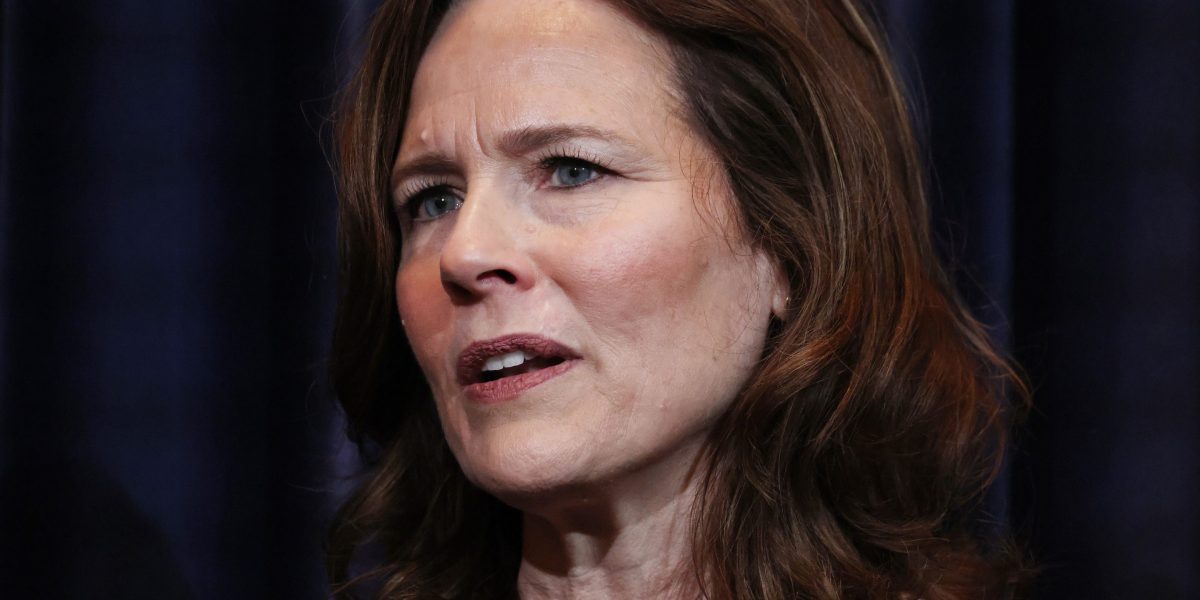
Conservative members of the Supreme Court on Wednesday appeared skeptical of President Donald Trump’s sweeping unilateral tariffs midway through arguments in a case that’s a pivotal test of executive power for a tool central to his broader agenda.

While the questions at times seemed to challenge the rationale for the tariffs, the arguments are still ongoing, and further questioning could shed additional light on their positions. A decision in the case could take weeks or months.

The Republican administration is trying to defend the tariffs central to Trump’s economic agenda after lower courts ruled the emergency law he invoked doesn’t give him near-limitless power to set and change duties on imports.

The Constitution says Congress has the power to levy tariffs. But the Trump administration argues that in emergency situations the president can regulate importation — and that includes tariffs.

Justice Amy Coney Barrett grilled the government on that point. “Has there ever been another instance in which a statute has used that language to confer the power?” she asked.

Justices Neil Gorsuch also questioned the government on whether Trump’s position would hand congressional powers to the president.

Trump has called the case one of the most important in the country’s history and said a ruling against him would be catastrophic for the economy.

The challengers argue the 1977 emergency powers law Trump used doesn’t even mention tariffs, and no president before has used it to impose them. A collection of small businesses say the uncertainty is driving them to the brink of bankruptcy.

The case centers on two sets of tariffs. The first came in February on imports from Canada, China and Mexico after Trump declared a national emergency over drug trafficking. The second involves the sweeping “reciprocal” tariffs on most countries that Trump announced in April.

Multiple lawsuits have been filed over the tariffs, and the court will hear suits filed by Democratic-leaning states and small businesses focused on everything from plumbing supplies to women’s cycling apparel.

Lower courts have struck down the bulk of Trump’s tariffs as an illegal use of emergency power, but the nation’s highest court may see it differently.

Trump helped shape the conservative majority court, naming three of the nine justices in his first term. The justices have so far been reluctant to check his extraordinary flex of executive power, handing him a series of wins on the court’s emergency docket.

Still, those have been short-term orders — little of Trump’s wide-ranging conservative agenda has been fully argued before the nation’s highest court. That means the outcome could set the tone for wider legal pushback against his policies.

The justices have been skeptical of executive power claims before, such as when then-President Joe Biden tried to forgive $400 billion in student loans under a different law dealing with national emergencies. The Supreme Court found the law didn’t clearly give him the power to enact a program with such a big economic impact, a legal principle known as the major questions doctrine.

The challengers say Trump’s tariffs should get the same treatment, since they’ll have a much greater economic effect, raising some $3 trillion over the next decade. The government, on the other hand, says the tariffs are different because they’re a major part of his approach to foreign affairs, an area where the courts should not be second-guessing the president.

The challengers are also trying to channel the conservative justices’ skepticism about whether the Constitution allows other parts of the government to use powers reserved for Congress, a concept known as the nondelegation doctrine. Trump’s interpretation of the law could mean anyone who can “regulate” can also impose taxes, they say.

The Justice Department counters that legal principle is for governmental agencies, not for the president.

If he eventually loses at the high court, Trump could impose tariffs under other laws, but those have more limitations on the speed and severity with which he could act. The aftermath of a ruling against him also could be complicated, if the government must issue refunds for the tariffs that had collected $195 billion in revenue as of September.

The Trump administration did win over four appeals court judges who found the 1977 International Emergency Economic Powers Act, or IEEPA, gives the president authority to regulate importation during emergencies without explicit limitations. In recent decades, Congress has ceded some tariff authority to the president, and Trump has made the most of the power vacuum.

___

Follow the AP’s coverage of the U.S. Supreme Court at https://apnews.com/hub/us-supreme-court.


Source link

Continue Reading

Business

Mark Zuckerberg says the ‘most important thing’ he built at Harvard was a prank website

Published

on


For Mark Zuckerberg, the most significant creation from his two years at Harvard University wasn’t the precursor to a global social network, but a prank website that nearly got him expelled.

The Meta CEO said in a 2017 commencement address at his alma mater that the controversial site, Facemash, was “the most important thing I built in my time here” for one simple reason: it led him to his wife, Priscilla Chan.

“Without Facemash I wouldn’t have met Priscilla, and she’s the most important person in my life,” Zuckerberg said during the speech.

In 2003, Zuckerberg, then a sophomore, created Facemash by hacking into Harvard’s online student directories and using the photos to create a site where users could rank students’ attractiveness. The site went viral, but it was quickly shut down by the university. Zuckerberg was called before Harvard’s Administrative Board, facing accusations of breaching security, violating copyrights, and infringing on individual privacy.

“Everyone thought I was going to get kicked out,” Zuckerberg recalled in his speech. “My parents came to help me pack. My friends threw me a going-away party.”

It was at this party, thrown by friends who believed his expulsion was imminent, where he met Chan, another Harvard undergraduate. “We met in line for the bathroom in the Pfoho Belltower, and in what must be one of the all time romantic lines, I said: ‘I’m going to get kicked out in three days, so we need to go on a date quickly,’” Zuckerberg said.

Chan, who described her now-husband to The New Yorker as “this nerdy guy who was just a little bit out there,” went on the date with him. Zuckerberg did not get expelled from Harvard after all, but he did famously drop out the following year to focus on building Facebook.

While the 2010 film The Social Network portrayed Facemash as a critical stepping stone to the creation of Facebook, Zuckerberg himself has downplayed its technical or conceptual importance.

“And, you know, that movie made it seem like Facemash was so important to creating Facebook. It wasn’t,” he said during his commencement speech. But he did confirm that the series of events it set in motion—the administrative hearing, the “going-away” party, the line for the bathroom—ultimately connected him with the mother of his three children.

Chan, for her part, went on to graduate from Harvard in 2007, taught science, and then attended medical school at the University of California, San Francisco, becoming a pediatrician.

She and Zuckerberg got married in 2012, and in 2015, they co-founded the Chan Zuckerberg Initiative, a philanthropic organization focused on leveraging technology to address major world challenges in health, education, and science. Chan serves as co-CEO of the initiative, which has pledged to give away 99% of the couple’s shares in Meta Platforms to fund its work.

You can watch the entirety of Zuckerberg’s Harvard commencement speech below:

For this story, Fortune journalists used generative AI as a research tool. An editor verified the accuracy of the information before publishing. 


Source link

Continue Reading

Business

Senate Dems’ plan to fix Obamacare premiums adds nearly $300 billion to deficit, CRFB says

Published

on


The Committee for a Responsible Federal Budget (CRFB) is a nonpartisan watchdog that regularly estimates how much the U.S. Congress is adding to the $38 trillion national debt.

With enhanced Affordable Care Act (ACA) subsidies due to expire within days, some Senate Democrats are scrambling to protect millions of Americans from getting the unpleasant holiday gift of spiking health insurance premiums. The CRFB says there’s just one problem with the plan: It’s not funded.

“With the national debt as large as the economy and interest payments costing $1 trillion annually, it is absurd to suggest adding hundreds of billions more to the debt,” CRFB President Maya MacGuineas wrote in a statement on Friday afternoon.

The proposal, backed by members of the Senate Democratic caucus, would fully extend the enhanced ACA subsidies for three years, from 2026 through 2028, with no additional income limits on who can qualify. Those subsidies, originally boosted during the pandemic and later renewed, were designed to lower premiums and prevent coverage losses for middle‑ and lower‑income households purchasing insurance on the ACA exchanges.

CRFB estimated that even this three‑year extension alone would add roughly $300 billion to federal deficits over the next decade, largely because the federal government would continue to shoulder a larger share of premium costs while enrollment and subsidy amounts remain elevated. If Congress ultimately moves to make the enhanced subsidies permanent—as many advocates have urged—the total cost could swell to nearly $550 billion in additional borrowing over the next decade.

Reversing recent guardrails

MacGuineas called the Senate bill “far worse than even a debt-financed extension” as it would roll back several “program integrity” measures that were enacted as part of a 2025 reconciliation law and were intended to tighten oversight of ACA subsidies. On top of that, it would be funded by borrowing even more. “This is a bad idea made worse,” MacGuineas added.

The watchdog group’s central critique is that the new Senate plan does not attempt to offset its costs through spending cuts or new revenue and, in their view, goes beyond a simple extension by expanding the underlying subsidy structure.

The legislation would permanently repeal restrictions that eliminated subsidies for certain groups enrolling during special enrollment periods and would scrap rules requiring full repayment of excess advance subsidies and stricter verification of eligibility and tax reconciliation. The bill would also nullify portions of a 2025 federal regulation that loosened limits on the actuarial value of exchange plans and altered how subsidies are calculated, effectively reshaping how generous plans can be and how federal support is determined. CRFB warned these reversals would increase costs further while weakening safeguards designed to reduce misuse and error in the subsidy system.

MacGuineas said that any subsidy extension should be paired with broader reforms to curb health spending and reduce overall borrowing. In her view, lawmakers are missing a chance to redesign ACA support in a way that lowers premiums while also improving the long‑term budget outlook.

The debate over ACA subsidies recently contributed to a government funding standoff, and CRFB argued that the new Senate bill reflects a political compromise that prioritizes short‑term relief over long‑term fiscal responsibility.

“After a pointless government shutdown over this issue, it is beyond disappointing that this is the preferred solution to such an important issue,” MacGuineas wrote.

The off-year elections cast the government shutdown and cost-of-living arguments in a different light. Democrats made stunning gains and almost flipped a deep-red district in Tennessee as politicians from the far left and center coalesced around “affordability.”

Senate Minority Leader Chuck Schumer is reportedly smelling blood in the water and doubling down on the theme heading into the pivotal midterm elections of 2026. President Donald Trump is scheduled to visit Pennsylvania soon to discuss pocketbook anxieties. But he is repeating predecessor Joe Biden’s habit of dismissing inflation, despite widespread evidence to the contrary.

“We fixed inflation, and we fixed almost everything,” Trump said in a Tuesday cabinet meeting, in which he also dismissed affordability as a “hoax” pushed by Democrats.​

Lawmakers on both sides of the aisle now face a politically fraught choice: allow premiums to jump sharply—including in swing states like Pennsylvania where ACA enrollees face double‑digit increases—or pass an expensive subsidy extension that would, as CRFB calculates, explode the deficit without addressing underlying health care costs.


Source link

Continue Reading

Business

Netflix–Warner Bros. deal sets up $72 billion antitrust test

Published

on


Netflix Inc. has won the heated takeover battle for Warner Bros. Discovery Inc. Now it must convince global antitrust regulators that the deal won’t give it an illegal advantage in the streaming market. 

The $72 billion tie-up joins the world’s dominant paid streaming service with one of Hollywood’s most iconic movie studios. It would reshape the market for online video content by combining the No. 1 streaming player with the No. 4 service HBO Max and its blockbuster hits such as Game Of ThronesFriends, and the DC Universe comics characters franchise.  

That could raise red flags for global antitrust regulators over concerns that Netflix would have too much control over the streaming market. The company faces a lengthy Justice Department review and a possible US lawsuit seeking to block the deal if it doesn’t adopt some remedies to get it cleared, analysts said.

“Netflix will have an uphill climb unless it agrees to divest HBO Max as well as additional behavioral commitments — particularly on licensing content,” said Bloomberg Intelligence analyst Jennifer Rie. “The streaming overlap is significant,” she added, saying the argument that “the market should be viewed more broadly is a tough one to win.”

By choosing Netflix, Warner Bros. has jilted another bidder, Paramount Skydance Corp., a move that risks touching off a political battle in Washington. Paramount is backed by the world’s second-richest man, Larry Ellison, and his son, David Ellison, and the company has touted their longstanding close ties to President Donald Trump. Their acquisition of Paramount, which closed in August, has won public praise from Trump. 

Comcast Corp. also made a bid for Warner Bros., looking to merge it with its NBCUniversal division.

The Justice Department’s antitrust division, which would review the transaction in the US, could argue that the deal is illegal on its face because the combined market share would put Netflix well over a 30% threshold.

The White House, the Justice Department and Comcast didn’t immediately respond to requests for comment. 

US lawmakers from both parties, including Republican Representative Darrell Issa and Democratic Senator Elizabeth Warren have already faulted the transaction — which would create a global streaming giant with 450 million users — as harmful to consumers.

“This deal looks like an anti-monopoly nightmare,” Warren said after the Netflix announcement. Utah Senator Mike Lee, a Republican, said in a social media post earlier this week that a Warner Bros.-Netflix tie-up would raise more serious competition questions “than any transaction I’ve seen in about a decade.”

European Union regulators are also likely to subject the Netflix proposal to an intensive review amid pressure from legislators. In the UK, the deal has already drawn scrutiny before the announcement, with House of Lords member Baroness Luciana Berger pressing the government on how the transaction would impact competition and consumer prices.

The combined company could raise prices and broadly impact “culture, film, cinemas and theater releases,”said Andreas Schwab, a leading member of the European Parliament on competition issues, after the announcement.

Paramount has sought to frame the Netflix deal as a non-starter. “The simple truth is that a deal with Netflix as the buyer likely will never close, due to antitrust and regulatory challenges in the United States and in most jurisdictions abroad,” Paramount’s antitrust lawyers wrote to their counterparts at Warner Bros. on Dec. 1.

Appealing directly to Trump could help Netflix avoid intense antitrust scrutiny, New Street Research’s Blair Levin wrote in a note on Friday. Levin said it’s possible that Trump could come to see the benefit of switching from a pro-Paramount position to a pro-Netflix position. “And if he does so, we believe the DOJ will follow suit,” Levin wrote.

Netflix co-Chief Executive Officer Ted Sarandos had dinner with Trump at the president’s Mar-a-Lago resort in Florida last December, a move other CEOs made after the election in order to win over the administration. In a call with investors Friday morning, Sarandos said that he’s “highly confident in the regulatory process,” contending the deal favors consumers, workers and innovation. 

“Our plans here are to work really closely with all the appropriate governments and regulators, but really confident that we’re going to get all the necessary approvals that we need,” he said.

Netflix will likely argue to regulators that other video services such as Google’s YouTube and ByteDance Ltd.’s TikTok should be included in any analysis of the market, which would dramatically shrink the company’s perceived dominance.

The US Federal Communications Commission, which regulates the transfer of broadcast-TV licenses, isn’t expected to play a role in the deal, as neither hold such licenses. Warner Bros. plans to spin off its cable TV division, which includes channels such as CNN, TBS and TNT, before the sale.

Even if antitrust reviews just focus on streaming, Netflix believes it will ultimately prevail, pointing to Amazon.com Inc.’s Prime and Walt Disney Co. as other major competitors, according to people familiar with the company’s thinking. 

Netflix is expected to argue that more than 75% of HBO Max subscribers already subscribe to Netflix, making them complementary offerings rather than competitors, said the people, who asked not to be named discussing confidential deliberations. The company is expected to make the case that reducing its content costs through owning Warner Bros., eliminating redundant back-end technology and bundling Netflix with Max will yield lower prices.


Source link

Continue Reading

Trending

Copyright © Miami Select.