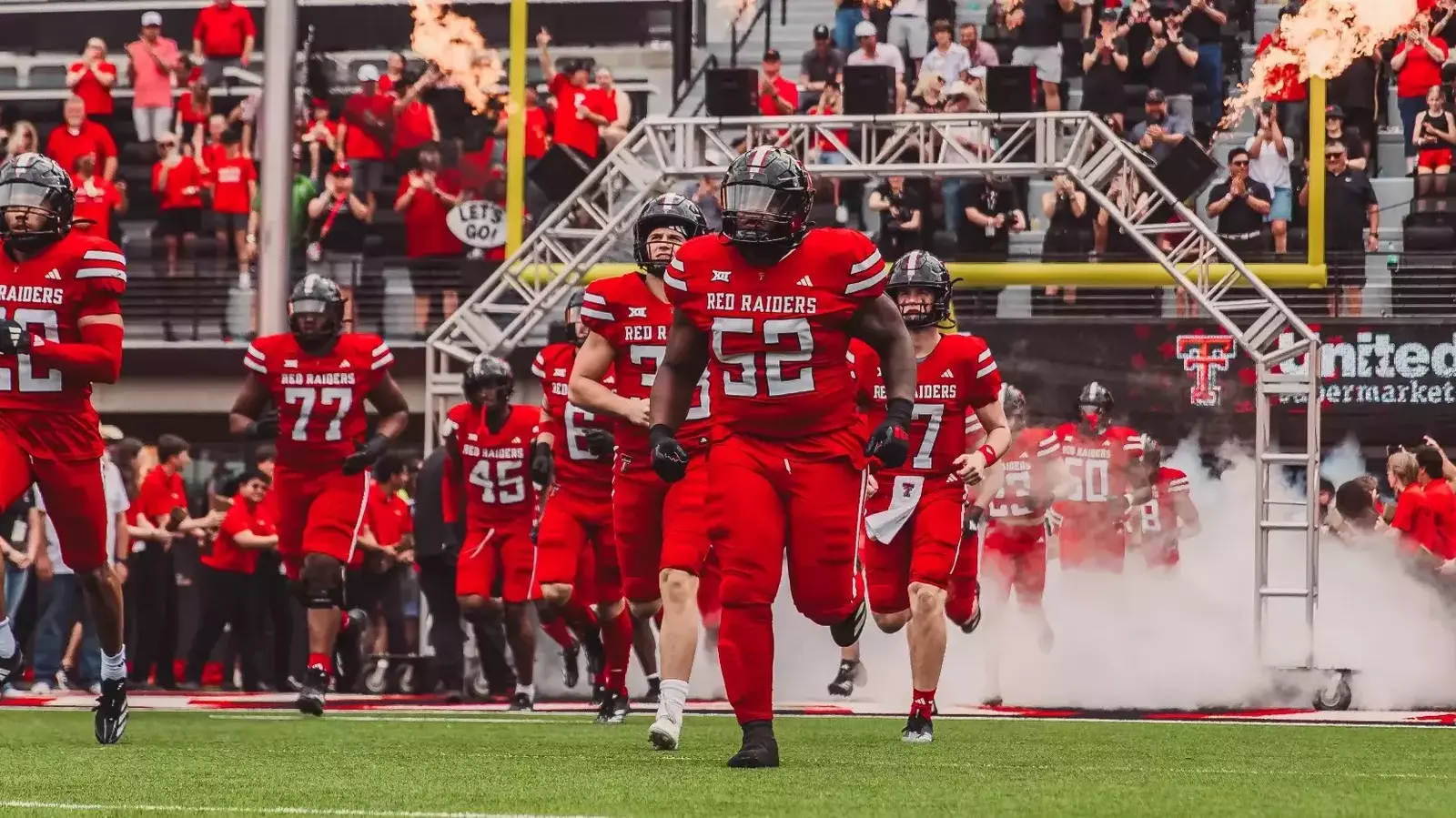
Texas Tech enters the 2025 season with high expectations. Armed with an explosive offense and a much-needed upgrade on defense
BY: KENNY VARNER
Texas Tech enters the 2025 season with high expectations. Armed with an explosive offense and a much-needed upgrade on defense, the Red Raiders are poised to challenge for a spot in the Big 12 title game. While Texas Tech has flashed potential in recent years, the program has yet to deliver that long-awaited breakout season. With five returning starters on offense and seven on defense, this could finally be the year.
The offense is loaded and deep, putting the onus on the defense to elevate the team from a solid seven-win campaign to a legitimate Big 12 contender. While the schedule presents its share of challenges, this is not a conference where going undefeated is a requirement to reach the title game.
Last season, Texas Tech racked up a staggering 6,015 yards of total offense and averaged 37.6 points per game—ranking fourth nationally. Quarterback Behren Morton returns as one of the Big 12’s top signal-callers after throwing for 3,335 yards with a 63.3% completion rate and a 27-to-8 touchdown-to-interception ratio.
As always, the Red Raiders boast talent at the receiver position. Returning are the team’s second and third leading receivers, Caleb Douglas (60 catches for 877 yards and 6 touchdowns) and Coy Eakin (49 catches for 652 yards and a team-high 7 touchdowns). The group is deep once again, with an 800+ yard receiver from Miami University transferring in—he averaged 20 yards per catch and brings big-play potential. Terrance Carter, who had 48 receptions at Louisiana, also joins the fold.
Replacing running back Tahj Brooks and his 1,505 yards and 17 touchdowns won’t be easy, so the Red Raiders will likely go with a running-back-by-committee approach early on. J’Koby Williams and Cameron Dickey return after limited action, while USC transfer Quinten Joyner is expected to make an immediate impact.
Up front, center Sheridan Wilson and guard Davion Carter return from a solid offensive line. The transfer portal brought additional help, with tackle Howard Sampson (North Carolina) expected to become a star. Hunter Zambrano (Illinois State) and Will Jados are also strong additions to a line that looks to remain a strength.
The defense, however, remains the biggest obstacle between Texas Tech and a championship-caliber season. Last year, the unit surrendered 35 points and 460 yards per game—numbers that must improve. Despite returning seven starters, the Red Raiders aggressively hit the portal after finishing 99th in sacks and a dismal 132nd in pass defense.
E’Maurion Banks is the lone returning starter on the defensive line, prompting an influx of transfers. David Bell (Stanford) and Romello Height (UTEP) should bolster the edge rush. AJ Holmes (Houston), Skyler Gill (Northern Illinois), and Lee Hunter (UCF) bring added talent to a line that should be improved over last year’s unit.
At linebacker, Jacob Rodriguez and Ben Roberts return after combining for 210 tackles, anchoring the heart of the defense. In the secondary, Mississippi State transfer Brice Pollock should make an immediate impact at corner, while North Dakota State’s Cole Wisniewski adds depth and skill at safety. AJ MacCarth and Chapman Lewis return but could face competition to retain their starting jobs. There are still questions about the defense, but the staff hopes to have uncovered some gems in the transfer market.
Texas Tech has a Big 12-caliber offense that could carry them into the conference title game. But if recent history is any indication, the defense may again be the Achilles heel, leading to high-scoring shootouts. There is hope, though, as the influx of talented transfers offers the potential for real improvement. If the defense can simply move into the middle tier of the Big 12, this team could have a special season.
A soft non-conference schedule gives Texas Tech a good shot at a 3-0 start, which would help build momentum. Tough road games at Utah, Arizona State, and Kansas State loom large, but even a two-loss Big 12 team can earn a title game berth. While it’s difficult to predict whether the Red Raiders will finally step up and have that breakthrough year, they should be an entertaining team to watch once again. Expect a season in the 7-8 win range—with the potential for more if the defense finally holds up its end.
The Rockford Peaches players were part of a women’s baseball league during and after World War II.
Four teams will debut in August 2026.
There will be a women’s sports league that will make its debut in August 2026. The Women’s Pro Baseball League has four teams and will play an abbreviated schedule in one central location at a stadium in Springfield, Illinois. The games will be seven innings and players will use aluminum bats. New York, Boston, San Francisco and Los Angeles have been awarded franchises but will not play any games in those cities in 2026. This is not the first time that entrepreneurs have attempted to build a women’s baseball league.
Following the United States declaration of war against Japan, Germany and Italy in December 1941, hundreds of Major League Baseball players ended up fighting in the war. President Franklin Roosevelt told Major League Baseball Commissioner Kenesaw Mountain Landis the game should go on and it did. The Chicago Cubs franchise owner Phil Wrigley wasn’t sure how long MLB could continue without good players and decided to form a women’s baseball league as a way to keep the industry going. Wrigley founded the All-American Girls Professional Baseball League with teams in the Midwest and players coming from amateur teams throughout the Midwest. The league began play in 1943 and the “Belles of the Ball Game” delivered high quality talent. There were some rules that would roll people’s eyes today. On the field, the women put on lipstick and played in short skirts. Off the field, “the girls” endured mandatory charm-school classes and were forbidden to wear trousers or drink alcohol. Wrigley’s women’s baseball league folded in 1954. Many Minor League Baseball teams and the women’s league died because baseball could not compete with the new medium television. The movie “League Of Their Own” is based on the league.
The Tampa Bay Rays made a strategic move this offseason by adding veteran left‑hander Steven Matz, a journeyman pitcher whose experience and versatility immediately strengthen a young and evolving pitching staff. For a franchise that relies heavily on developing arms and maximizing untapped potential, bringing in a seasoned presence like Matz offers more than innings — it provides mentorship, stability, and a professional blueprint for the Rays’ next wave of pitchers. His ability to work as both a starter and reliever gives Tampa Bay a flexible, reliable option as they shape their 2026 rotation and bullpen strategy.
Matz’s Track Record as a Durable, Stabilizing Force
Across his 11‑year career, Matz has built a reputation as a dependable, team‑first pitcher capable of handling multiple roles. He has logged 246 career appearances, including 172 starts, and owns a 4.19 ERA over that span. In 2025, he delivered one of his most efficient seasons, posting a 3.05 ERA across 53 appearances while splitting time between the St. Louis Cardinals and Boston Red Sox. His ability to adapt — shifting from starter to multi‑inning reliever to high‑leverage arm — has made him a valuable asset everywhere he has pitched.
Even more impressive, Matz walked only 3.6% of batters faced in 2025, one of the lowest rates among pitchers with at least 50 innings. That level of command and consistency is exactly what the Rays have historically targeted in veteran acquisitions. Whether stabilizing a rotation spot or anchoring the bullpen, Matz has repeatedly shown he can deliver quality innings without drama, excuses, or inconsistency.
How Matz Fits Into the Rays’ 2026 Plans
Looking ahead to 2026, Matz gives the Rays a trusted arm who can immediately contribute while elevating the pitchers around him. Tampa Bay’s staff is rich with talent but young, and Matz’s presence offers a steadying influence — someone who has navigated the highs and lows of a long MLB career and can help guide emerging starters through the grind of a full season.
On the field, Matz’s versatility allows manager Kevin Cash to deploy him wherever the team needs him most. He could compete for a rotation spot, serve as a multi‑inning bridge, or become a matchup‑driven left‑handed weapon late in games. Off the field, his professionalism and experience will be invaluable to a Rays team looking to rebound and reassert itself in the AL East.
By securing Steven Matz, the Rays didn’t just add innings — they added leadership, flexibility, and a proven veteran who can help shape the identity of the 2026 pitching staff.
Golf fans are getting a rare December treat as the Optum Golf Channel Games make their primetime debut tonight on Golf Channel and USA Network, beginning with a pre‑game show at 7 p.m. ET. This first‑of‑its‑kind, made‑for‑television event brings together the sport’s two biggest stars—Rory McIlroy and Scottie Scheffler—as captains of four‑man teams competing under the lights at Trump National Golf Club Jupiter in Jupiter, Florida. Designed specifically for TV, the Games blend speed, pressure, and entertainment, offering a fresh twist on golf’s traditional offseason exhibitions. With a mix of power challenges, precision contests, and team‑based strategy, the event aims to deliver a fast‑paced, viewer‑friendly primetime show unlike anything else in the sport.
The competition format features five unique skills challenges, each crafted to test different aspects of the players’ games while keeping the action moving quickly for viewers. The Timed Drive Competition pits players in head‑to‑head duels with only two minutes to combine power and accuracy into a scoring grid. The Timed Short Game Competition raises the pressure even further, requiring players to chip and putt from multiple locations before navigating a putting gauntlet—all in just three minutes.
One of the night’s most anticipated segments is the 14‑Club Challenge, where two‑man teams share a single bag and must use each club only once in a closest‑to‑the‑pin showdown. The twist: each team must also designate a player to hit a left‑handed 15th shot. The Team Relay adds a race‑against‑the‑clock element, with four players alternating shots across four holes. Finally, the Captains’ Challenge brings McIlroy and Scheffler together in a one‑on‑one showdown featuring irons, wedges, bunker shots, and pressure putts from 10 and 30 feet.
A Star‑Studded Broadcast Team and Production Crew
Tonight’s broadcast features a deep roster of on‑air talent. Keith Mitchell joins longtime Golf Channel voice Steve Sands for booth commentary. On the course, Smylie Kaufman, Brad Faxon, and Johnson Wagner will provide real‑time insight and player interviews. Wagner will also join Anna Jackson for pre‑ and post‑game studio coverage, while rising golf media personality Kai Trump contributes tutorials and participates in the trophy ceremony.
Behind the scenes, Emmy‑winning producers Mark Loomis and Chris Maguire, along with director Jeff Jastrow, lead the production team, working in partnership with PGA TOUR Studios, EverWonder Studio, and producer Bryan Zuriff to bring this innovative event to life.