Connect with us

Business

The progress that girls were making in STEM classes has gone into reverse since the pandemic

Published

on


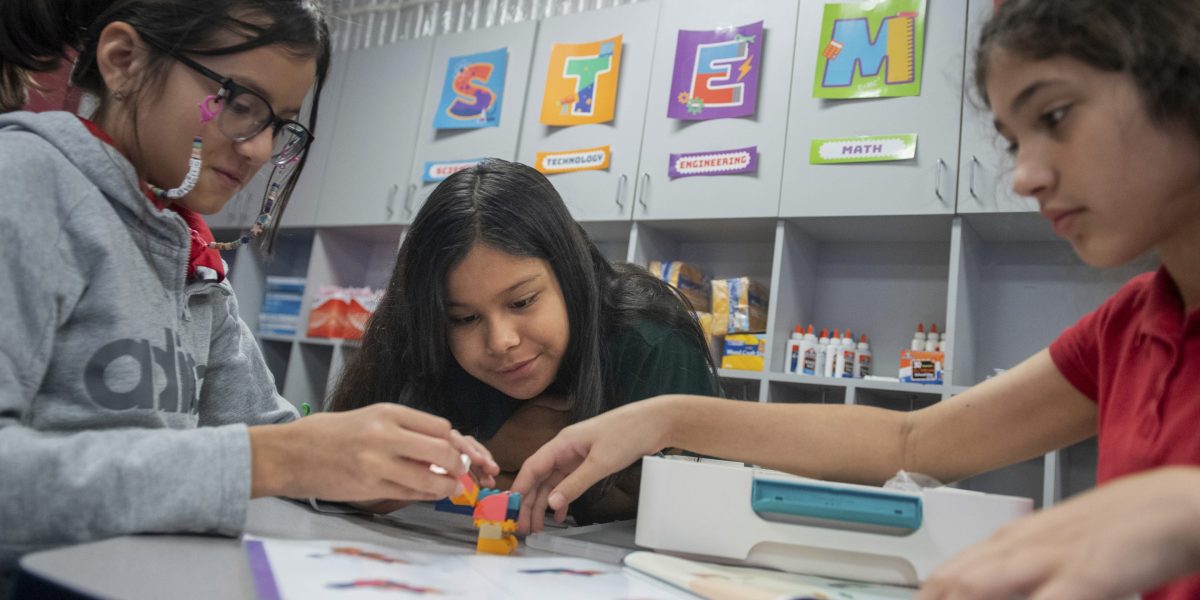
Crowded around a workshop table, four girls at de Zavala Middle School puzzled over a Lego machine they had built. As they flashed a purple card in front of a light sensor, nothing happened.

The teacher at the Dallas-area school had emphasized that in the building process, there is no such thing as mistakes. Only iterations. So the girls dug back into the box of blocks and pulled out an orange card. They held it over the sensor and the machine kicked into motion.

“Oh! Oh, it reacts differently to different colors,” said sixth grader Sofia Cruz.

In de Zavala’s first year as a choice school focused on science, technology, engineering and math, the school recruited a sixth grade class that’s half girls. School leaders are hoping the girls will stick with STEM fields. In de Zavala’s higher grades — whose students joined before it was a STEM school — some elective STEM classes have just one girl enrolled.

Efforts to close the gap between boys and girls in STEM classes are picking up after losing steam nationwide during the chaos of the COVID-19 pandemic. Schools have extensive work ahead to make up for the ground girls lost, in both interest and performance.

In the years leading up to the pandemic, the gender gap nearly closed. But within a few years, girls lost all the ground they had gained in math test scores over the previous decade, according to an Associated Press analysis. While boys’ scores also suffered during COVID, they have recovered faster than girls, widening the gender gap.

As learning went online, special programs to engage girls lapsed — and schools were slow to restart them. Zoom school also emphasized rote learning, a technique based on repetition that some experts believe may favor boys, instead of teaching students to solve problems in different ways, which may benefit girls.

Old practices and biases likely reemerged during the pandemic, said Michelle Stie, a vice president at the National Math and Science Initiative.

“Let’s just call it what it is,” Stie said. “When society is disrupted, you fall back into bad patterns.”

The pandemic upended progress toward closing the gender gap

In most school districts in the 2008-2009 school year, boys had higher average math scores on standardized tests than girls, according to AP’s analysis, which looked at scores across 15 years in over 5,000 school districts. It was based on average test scores for third through eighth graders in 33 states, compiled by the Educational Opportunity Project at Stanford University.

A decade later, girls had not only caught up, they were ahead: Slightly more than half of districts had higher math averages for girls.

Within a few years of the pandemic, the parity disappeared. In 2023-2024, boys on average outscored girls in math in nearly nine out of 10 districts.

A separate study by NWEA, an education research company, found gaps between boys and girls in science and math on national assessments went from being practically non-existent in 2019 to favoring boys around 2022.

Studies have indicated girls reported higher levels of anxiety and depression during the pandemic, plus more caretaking burdens than boys, but the dip in academic performance did not appear outside STEM. Girls outperformed boys in reading in nearly every district nationwide before the pandemic and continued to do so afterward.

“It wasn’t something like COVID happened and girls just fell apart,” said Megan Kuhfeld, one of the authors of the NWEA study.

Initiatives to boost girls’ confidence in STEM lost traction

In the years leading up to the pandemic, teaching practices shifted to deemphasize speed, competition and rote memorization. Through new curriculum standards, schools moved toward research-backed methods that emphasized how to think flexibly to solve problems and how to tackle numeric problems conceptually.

Educators also promoted participation in STEM subjects and programs that boosted girls’ confidence, including extracurriculars that emphasized hands-on learning and connected abstract concepts to real-life applications.

When STEM courses had large male enrollment, Superintendent Kenny Rodrequez noticed girls losing interest as boys dominated classroom discussions at his schools in Grandview C-4 District outside Kansas City. Girls were significantly more engaged after the district moved some of its introductory hands-on STEM curriculum to the lower grade levels and balanced classes by gender, he said.

When schools closed for the pandemic, the district had to focus on making remote learning work. When in-person classes resumed, some of the teachers had left, and new ones had to be trained in the curriculum, Rodrequez said.

“Whenever there’s crisis, we go back to what we knew,” Rodrequez said.

Bias against girls in STEM persists

Despite shifts in societal perceptions, a bias against girls persists in science and math subjects, according to teachers, administrators and advocates. It becomes a message girls can internalize about their own abilities, they say, even at a very young age.

In his third grade classroom in Washington, D.C., teacher Raphael Bonhomme starts the year with an exercise where students break down what makes up their identity. Rarely do the girls describe themselves as good at math. Already, some say they are “not a math person.”

“I’m like, you’re 8 years old,” he said. “What are you talking about, ‘I’m not a math person?’”

Girls also may have been more sensitive to changes in instructional methods spurred by the pandemic, said Janine Remillard, a math education professor at the University of Pennsylvania. Research has found girls tend to prefer learning things that are connected to real-life examples, while boys generally do better in a competitive environment.

“What teachers told me during COVID is the first thing to go were all of these sense-making processes,” she said.

A school district renews its commitment

At de Zavala Middle School in Irving, the STEM program is part of a push that aims to build curiosity, resilience and problem-solving across subjects.

Coming out of the pandemic, Irving schools had to make a renewed investment in training for teachers, said Erin O’Connor, a STEM and innovation specialist there.

The district last year also piloted a new science curriculum from Lego Education. The lesson involving the machine at de Zavala, for example, had students learn about kinetic energy. Fifth graders learned about genetics by building dinosaurs and their offspring with Lego blocks, identifying shared traits.

“It is just rebuilding the culture of, we want to build critical thinkers and problem solvers,” O’Connor said.

Teacher Tenisha Willis recently led second graders at Irving’s Townley Elementary School through building a machine that would push blocks into a container. She knelt next to three girls who were struggling.

They tried to add a plank to the wheeled body of the machine, but the blocks didn’t move enough. One girl grew frustrated, but Willis was patient. She asked what else they could try, whether they could flip some parts around. The girls ran the machine again. This time, it worked.

“Sometimes we can’t give up,” Willis said. “Sometimes we already have a solution. We just have to adjust it a little bit.”

___

Lurye reported from Philadelphia. Todd Feathers contributed reporting from New York.

___

The Associated Press’ education coverage receives financial support from multiple private foundations. AP is solely responsible for all content. Find AP’s standards for working with philanthropies, a list of supporters and funded coverage areas at AP.org.


Source link

Continue Reading

Business

WPP’s CTO says AI is reshaping advertising. But creative judgment needs to remain in human hands

Published

on


In the world of marketing, artificial intelligence tends to get the most attention when it is featured prominently in splashy creative advertising campaigns from big brands like Coca-Cola and Nike.

But at WPP—whose client roster includes Google, L’Oréal, LVMH, and Mastercard—Chief Technology Officer Stephan Pretorius says the advertising giant’s big “mic drop” moment has been the soaring adoption of WPP Open, an AI-enabled operating system that’s used by marketers to plan, create, and run campaigns. More than 85,000 of the agency’s 108,000 employees are using WPP Open on a monthly basis today, up sharply from 30,000 in February 2024.

“Getting that balance right and making sure that humans are in control of the output and that they evaluate and apply taste and judgment, but also that the thought process is expanded and augmented—so you don’t become like a passive passenger in the process—is really critical,” says Pretorius. 

Pretorius says WPP has embraced three levels of AI training to get the workforce ready for these AI tools. At the entry level, WPP runs a creative technology apprenticeship program, which it recently expanded under the company’s five-year, $400 million partnership with Google. The program aims to train 1,000 creative technology apprentices over the next three years, helping college graduates learn about AI and other technologies before they join one of WPP’s agencies. 

WPP also offers AI learning programs for more senior staff, including courses that teach the basics of generative AI and the appropriate use of AI in media planning and creative ideation. At the senior level, executives are expected to take “AI and business diploma” courses.

“You’ve got to do it continuously and you have to do it very purposely,” says Pretorius of the AI upskilling programs that he says need to be conducted on an ongoing basis. “I think it’s a tall order to expect people to know how to work with AI. Everyone’s still figuring it out.”

Ad agencies like WPP have increasingly embraced generative AI capabilities to support creative ideation, research, and to develop of content for their clients, with the hopes that the technology will both speed up production and ultimately lower costs. Three out of four ad industry executives say that their companies are using these tools in 2025, up from from 61% the prior year, according to a survey conducted by research firm Forrester.

But, like most other industries, these AI investments are for now a net cost for agencies. The cost of business—which Forrester defines as generative AI capabilities funded by a creative agency without passing those costs on to clients—grew 83% in 2025. Only 7% were able to sell generative AI capabilities as a separate service outside what these agencies have traditionally offered.

WPP has been making the pitch that its AI tools can generate meaningful savings. WPP Open, which uses technology from multiple providers including OpenAI’s GPT and DALL-E, Google’s Gemini family, and Anthropic’s Claude, gives teams of four 14 hours “back,” meaning time saved on the work being done by creatives. That would translate to roughly 90 days of saved “capacity” every year. WPP is also hoping to make WPP Open more alluring to external customers through the October launch of WPP Open Pro, a version of the platform that allows brands to plan, create, and publish their own creative campaigns independently. 

The company’s workforce has also created more than 75,000 AI agents by the end of 2025. Pretorius says he’s encouraged experimentation on that front, rather than a top-down mandate dictating which agents should be used across the various business units. That’s allowed teams to build AI agents that even Pretorius says he couldn’t have predicted.

“I think one does have to take a kind of expansive view of this,” says Pretorius. “Empower as many people in the business with general-purpose tools that you teach them how to use. And then, let the collective intelligence flourish.”

The pressure to get AI right comes as major agencies have been shedding jobs. Omnicom cut 4,000 jobs in December, while WPP’s Ogilvy shed 5% of its workforce in June. When WPP reported third-quarter revenue softness and revised its full-year organic growth target to a more bearish outlook, forecasting a decline of 5.5% to 6%, CEO Cindy Rose, called the performance “unacceptable.” The agency has said it would implement a restructuring to make the WPP more streamlined. Investments in technology are expected to be central to help return the business to growth.

Pretorius is an optimist when it comes to the changes AI will bring to advertising. These tools can help marketers generate more content, with greater personalization for different consumer groups, and do so at the same level of investment that was made without AI, he claims. 

“If you shy away from it, pretend it’s not existing, and pretend you can work the way you used to work…you will lose the business,” says Pretorius. “And other people will eat your lunch.”

John Kell

Send thoughts or suggestions to CIO Intelligence here.

NEWS PACKETS

AI takes center stage at the World Economic Forum. Top executives from the largest AI companies were in Davos this week, opining on how the technology should evolve and what that will mean for economic growth. Microsoft CEO Satya Nadella shared his belief that energy will be critical to determining which countries succeed in the AI race, while Meta’s new president and chairman, Dina Powell McCormick, urged the industry to align on “core values” that would make the technology both safe and productive. Mohamed Kandi, global chairman of consulting giant PwC, told Fortune that the CEO job has changed more in the last year than anything he’s witnessed for the past quarter-century. These leaders are still  facing big challenges wrapping their heads around AI, with most—56% of the 4,454 CEOs surveyed by PwC—saying they are getting “nothing out of it.”

OpenAI’s 2026 priority: “practical adoption.” OpenAI Chief Financial Officer Sarah Friar shared that the AI startup’s annualized revenue exceeded $20 billion in 2025, more than triple the prior year’s level, and said computing capacity also soared as weekly and daily active users reached all-time highs. Friar also said that the company’s priority will be to close the gap “between what AI now makes possible and how people, companies, and countries are using it day to day.” She didn’t expand much on what that would mean practically, but there are some recent reports that point to OpenAI’s direction, at least in terms of how it hopes to generate more money to help it turn a profit. OpenAI is aiming to debut its first hardware device later in 2026, has struck a deal with ServiceNow to integrate OpenAI’s AI models into the latter company’s business software, and is testing how ads can show up within ChatGPT. 

Geopolitics intertwine with chipmaking between the U.S. and Asia. Last week, Taiwan agreed to invest at least $250 billion in production capacity in the U.S. and a government guarantee of $250 billion in credit for the companies that make those investments, according to a new trade deal struck between the nations. In exchange, the U.S. has agreed to limit its “reciprocal” tariffs on Taiwan to 15%, down from 20%. The announcement reflects the Trump administration’s efforts to bring chipmaking back on U.S. soil. Meanwhile, in China, the U.S. imposed a 25% tariff on imports of some advanced semiconductors, including the H200 AI processors made by Nvidia, before they are shipped to China. 

Anthropic poised to raise another $25 billion or more. AI startup Anthropic is reportedly in talks with investors for fresh funding that would value the company at $350 billion, more than double its valuation from just four months ago, the Financial Times reports, saying the venture capital firm Sequoia Capital may invest in the company for the first time. This news comes days after Anthropic launched Claude Cowork, which is an AI agent that can manipulate, read, and analyze files on a user’s computer, and also create new files.

ADOPTION CURVE

CEOs are again steering AI implementation. In the immediate wake of the debut of ChatGPT in late 2022, the pressure to set a clear strategy on AI sat on the desk of the CEO. But soon after, it became clear that the top technologists—CTOs, chief information officers, chief digital officers, etc.—were empowered to drive AI adoption for employees across enterprises. They’ve been busy organizing their data to take full advantage of large language models, setting up security protocols, training employees, building partnerships with AI hyperscalers, and launching new AI tools.

But beyond the lower-stakes productivity tools, humans keep getting in the way of further progress, and that may explain why the AI playbook is back with the CEO. Seventy-two percent of CEOs say they are now the main decision-maker on AI, twice the share from a year ago, according to a survey of 2,360 executives conducted by consulting firm BCG.

“I think CEOs are realizing they need to step in and help drive the organization change,” says Vlad Lukic, the global leader of BCG’s tech and digital advantage practice, in an interview with Fortune.

They’re also feeling the pressure: half of them believe they have to get their AI strategy right if they want to keep their jobs, the survey showed. But CEOs are also more optimistic about AI’s potential for a return on investment in 2026 than last year (82% agree with this sentiment). They are also spending more. Corporate AI efforts will account for about 1.7% of revenue in 2026, more than twice the increase last year. All 10 industries BCG tracked are projected to spend more on AI this year.


Courtesy of BCG

JOBS RADAR

Hiring:

Xponential Fitness is seeking a CIO, based in Irvine, California. Posted salary range: $350K-$450K/year.

MIT Lincoln Laboratory is seeking a CIO, based in Lexington, Massachusetts. Posted salary range: $360K-$410K/year.

Hunterdon Health is seeking a CIO, based in Flemington, New Jersey. Posted salary range: $360K-$410K/year.

Scholar Rock is seeking a CIO/VP of IT, based in Cambridge, Massachusetts. Posted salary range: $300K-$400K/year.

Hired:

Coca-Cola has appointed Sedef Salingan Sahin to serve in the newly created role of chief digital officer. Sahin joined the beverage giant in 2003 and most recently held the role of president of the Eurasia and Middle East operating unit. Sahin will oversee the digital strategy efforts that were previously overseen by President and Chief Financial Officer John Murphy.

Adobe has appointed Lucius DiPhillips as CIO, joining the design software company after most recently serving as CIO at Airbnb. Prior to his eight-year career at the home-rental platform, DiPhillips held senior leadership roles at eBay, PayPal, Bank of America, and GE.

Skillsoft announced the appointment of Bernard Barbour as chief technology and product officer, joining the educational technology firm after most recently serving as CTO at agricultural technology company Indigo Agriculture. Before Indigo, he spent more than a decade at customized goods producer Cimpress, where he led a global platform team of more than 700.

ACI Worldwide has appointed JP Krishnamoorthy as chief innovation and technology officer, joining the payments software company after most recently serving as EVP of engineering, AI, cloud operations, and cybersecurity at software firm Coupa Software. He also previously held technology leadership roles at Oracle.

DigitalOcean announced Vinay Kumar as chief product and technology officer, joining the cloud infrastructure provider from Oracle, where he most recently served as SVP of cloud engineering. Kumar spent 11 years at Oracle and also previously served as a manager at Amazon Web Services.

IonQ announced the appointment of Katie Arrington as CIO and has expanded the scope of work for Leslie Kershaw, who will now serve as chief information security officer and report to Arrington. Prior to joining the quantum computing company, Arrington served as CIO for the War Department. She is also a former member of the South Carolina House of Representatives.

Komodo Health has appointed Amit Sangani as CTO to lead the medical data analytics company’s technology, engineering, and AI platform strategy. Sangani joins Komodo after 11 years at Meta, where he most recently worked with the tech giant’s Superintelligence Labs on large-scale AI systems. Prior to Meta, Sangani co-founded and served as CTO of messaging software provider MightyText.

Yesway named Robert Hampton as CTO, where he will lead the IT strategy and all aspects of enterprise technology for the Texas-based convenience store operator. Hampton joins Yesway from convenience and fuel retailer Jacksons Companies, where he served as CIO. He also held previously held technology leadership roles at infrastructure firm AECOM.

RLDatix appointed Richard Jarvis as CTO, where he will oversee platform architecture, engineering, cloud, cybersecurity, and data for the healthcare software provider. He previously served as CTO for electronic patient record systems for EMIS Health. He also held senior leadership roles at HP Enterprise , BAE Systems, and Detica.


Source link

Continue Reading

Business

Nathan’s Famous goes from 5-cent hot dog stand in Coney Island to $450 million acquisition by Smithfield Foods over 100 years later

Published

on


Nathan’s Famous, which opened as a 5-cent hot dog stand in Coney Island more than a century ago, has been sold to packaged meat giant Smithfield Foods in a $450 million all-cash deal, the companies announced Wednesday.

Smithfield, which has held rights to produce and sell Nathan’s products in the U.S., Canada and at Sam’s Clubs in Mexico since 2014, will acquire all of Nathan’s outstanding shares for $102 each. The transaction is expected to close in the first half of 2026.

Smithfield said it expects to achieve annual savings of about $9 million within two years of closing the deal.

“As a long-time partner, Smithfield has demonstrated an outstanding commitment to investing in and growing our brand while maintaining the utmost quality and customer service standards,” said Nathan’s CEO Eric Gatoff.

Nathan’s board of directors, which own or control nearly 30% of the outstanding shares of Nathan’s Famous common stock, approved the buyout and agreed to recommend to its shareholders to vote in favor of the deal.

Smithfield, which also owns the Gwaltney bacon and Armour frozen meat brands, rang up more than $1 billion in operating profit in 2024 on sales of $14.1 billion. It’s on track to eclipse both those figures when it reports its fourth-quarter results.

Smithfield shares were unchanged in midday trading Wednesday at $23.39.

In fiscal 2025, Nathan’s reported profit of $24 million on revenue approaching $150 million.

Join us at the Fortune Workplace Innovation Summit May 19–20, 2026, in Atlanta. The next era of workplace innovation is here—and the old playbook is being rewritten. At this exclusive, high-energy event, the world’s most innovative leaders will convene to explore how AI, humanity, and strategy converge to redefine, again, the future of work. Register now.


Source link

Continue Reading

Business

Trump tones down escalating Greenland rhetoric in Davos

Published

on


President Donald Trump, in his own inimitable way, struck a bellicose and yet conciliatory tone with European leaders in Davos, Switzerland, on Wednesday, somewhat tempering rising trans-Atlantic tensions and stock market jitters over concerns the U.S. is considering a takeover of Greenland. 

The nearly 90-minute speech, in which Trump lectured and hectored the tech executives and government officials in the audience, many from Europe, before clarifying that he didn’t want to use force and ultimately wanted peace, could be summed up by Trump ribbing French President Emmanuel Macron, seemingly unaware of his eye injury. “I watched him yesterday with his beautiful sunglasses. I said, ‘What the hell happened?’” Trump later added, “I actually like him. I do.” 

And while the president ruled out using military force to acquire the Danish territory of Greenland, he did not back down from antagonistic rhetoric while repeating his contested claim of having stopped eight wars around the world. (Trump’s desire for a Nobel Peace Prize, one measure of his competitiveness with predecessor Barack Obama, has hung on this eight-war figure, which some countries such as India and Pakistan reject.)

Trump used his highly anticipated address at the World Economic Forum as a platform to reaffirm his critique of European nations and of the U.S.’s status as a global superpower, but clarified that he prefers a peaceful resolution to the question over Greenland’s ownership that has threatened to kneecap the 76-year-old NATO alliance.

“I don’t have to use force. I don’t want to use force. I won’t use force,” he said.

Trump’s statement on having resolved multiple conflicts first emerged in a leaked text message the president sent to Norwegian prime minister Jonas Gahr Støre over the weekend in which he said, ominously, that he was no longer obliged to “think purely of Peace.” In that message, Trump linked his Greenland bombast to the Nobel committee deciding not to award him a Peace Prize last October, despite having “stopped 8 wars PLUS.” The committee that awards Nobel Prizes is based in Norway, although the Norwegian government does not have a say in allocating the prizes. 

Sigh of relief in the mountains

The statement assuaged the concerns of some European leaders about a possible military confrontation with the U.S. and seemed to reassure markets jittery about the onset of a new trade war, or the end of the western alliance. 

Markets responded positively after their big Tuesday sell-off. As of late morning, both the S&P 500 and the Dow Jones Industrial Average had risen over 1%, while the Nasdaq Composite index had advanced 1.3%. The 10-year Treasury yield turned lower, and the U.S. dollar stabilized after big losses Tuesday.

But Trump’s comments were an olive branch in text only, not in tone. Speaking for over an hour, the president reiterated his desire for Greenland, stating “that’s our territory” with regards to the island, while claiming he had “stopped eight wars.” (India has repeatedly rejected Trump’s claim that he stopped a war between the countries, while Pakistan has welcomed his involvement, nominating him for a Nobel.)

And while Trump toned down aggressive rhetoric of an impending military takeover of Greenland, he made clear to foreign leaders that it was a choice, even a favor: “We probably won’t get anything unless I decide to use excessive strength and force, where we would be, frankly, unstoppable, but I won’t do that,” he said.

Trump’s claim has been disputed. While the president did not specify which wars he was referring to, the U.S. has been involved in six ceasefires, although tensions have occasionally flared between Israel and Hamas and India and Pakistan. He may also be referring to agreements brokered during his first term.

Trump’s ruling out of military force on Wednesday soothed some European officials. Rasmus Jarlov, who chairs the defense committee in Denmark’s parliament, told The New York Times he “wasn’t too upset” with the president’s comments.

Lars Lokke Rasmussen, Denmark’s foreign minister, was encouraged as well: “It is positive that it is being said that military force will not be used,” he told local reporters Wednesday. “But that will not make this case go away,” he added.

While Trump reiterated his desire for a peaceful resolution during his speech, he challenged European leaders to remain opposed to him.

“You can say yes and we will be very appreciative, or you can say no and we will remember,” he said.


Source link

Continue Reading

Trending

Copyright © Miami Select.